
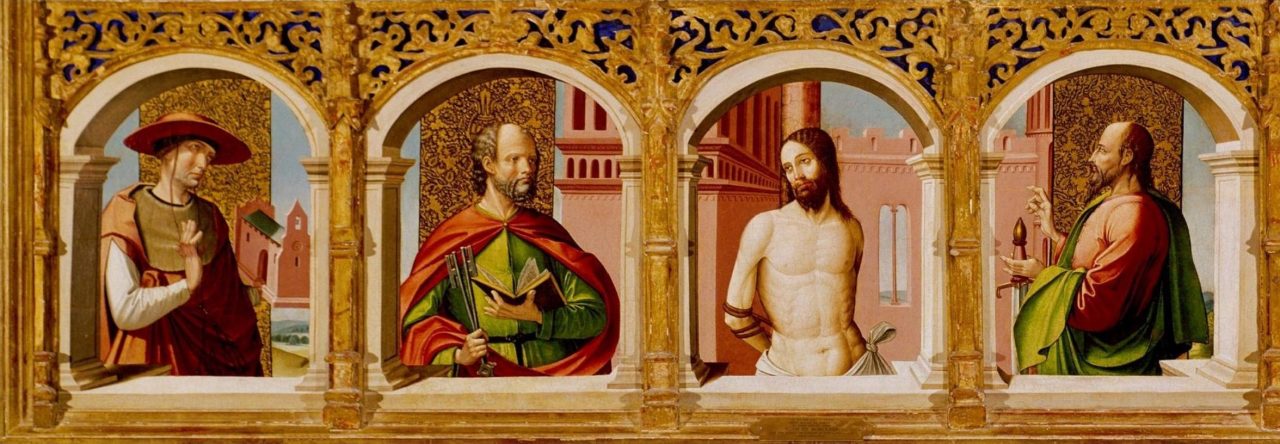
 Jean-Baptiste (Joanny) Bricaud (1881-1934) was Patriarch of the Universal Gnostic Church in France. He was a Prelate-Commander of the Order of the Crown of Thorns and, together with his wife Eugénie, was of vital importance in the preservation of its archives and spiritual tradition in the last years of Prince-Abbot Joseph III.
Bricaud had entered the minor seminary in preparation for the Roman Catholic priesthood, but instead took up secular employment in a bank and continued an extensive exploration of Gnostic and kabbalistic traditions that had begun while he was a seminarian. He had contact with French esotericists Elia Alta and Charles Henri Détré (Teder) (1855-1918) and became involved with the Eliate Church of Carmel and the “Work of Mercy” which had been founded in 1839 by Eugéne Vintras (1807–1875), as well as the Johannite Church of Primitive Christians, founded in 1803 by the Templar revivalist Bernard-Raymond Fabré-Palaprat (1777–1838). He became a member of the Martinist Order and in that capacity met Gerard Encausse (Papus) (1865-1916) who was head of that order, in 1899.
The Gnostic Church in France had been established by Jules-Benoît Stanislas Doinel du Val-Michel (1842–1903), a librarian, Grand Orient Freemason and spiritualist. In 1888, while archivist at the Library of Orléans, Doinel discovered a charter dated 1022 by Canon Stephan of Orléans, who was a Gnostic forerunner of the Cathars and was burned at the stake in that same year as a heretic. This inspired Doinel to make a detailed study of Cathar and Gnostic teachings, and convinced him that it was Gnosticism that was the essential religious basis for Freemasonry.
Following a mystic consecration by the avatar of Jesus Christ in a vision, Doinel announced that the year 1890 was to begin the “Era of the Gnosis Restored” and became Patriarch of the Gnostic Church. The new church was to have both male and female bishops, the latter to be known as sophias, and they would take a mystic name prefaced by the Greek letter Tau (which represents the Tau Cross) or the Egyptian Ankh. Among the first bishops consecrated by Doinel, who became known as Tau Valentin, was Papus. Membership of the church was restricted to those who, in the view of its hierarchy, were “of high intelligence, refinement and open mind”.
The Gnostic liturgy was strongly Roman Catholic in influence (perhaps prefiguring a similar influence in the later Liberal Catholic Church), with a Gnostic Mass as the central ceremony, and two other main rites from the Cathar tradition, the Consolamentum and the Appareillamentum.
In 1895, Doinel resigned as Patriarch and converted to Roman Catholicism. He now launched a series of bitter attacks on his former church, which naturally endeared him to the Roman hierarchy. However, he repented of this behaviour, and was readmitted to the Gnostic Church as a bishop in 1899 by his successor as Patriarch, Léonce-Eugène Fabre des Essarts (Tau Synesius) (1848-1917).
It was Tau Synesius who consecrated the twenty-one year old Joanny Bricaud as a bishop of the Gnostic Church in 1901. Papus, who wanted to see a more directly Martinist and Roman Catholic-modelled body than the more general esotericism of Tau Synesius, encouraged Bricaud to found his own church as a schism of the Gnostic Church, which he did in 1907, adopting the name Gnostic Catholic Church and the title of Tau Jean II. In February 1908, the Episcopal Synod of the Gnostic Catholic Church elected Bricaud as its Patriarch, which event marked the point at which Bricaud’s jurisdiction, subsequently known as the Eglise Gnostique Universelle, became acknowledged as the successor jurisdiction to the Gnostic Church of Doinel, the Carmelite Church of Vintras and the Johannite Church. Papus conditionally consecrated Bricaud in 1911, from which date the Eglise Gnostique Universelle was considered to be the official church of Martinism. Eventually, in 1926, the remnant of Tau Synesius’ church also chose to unite with Bricaud’s Eglise Gnostique Universelle.
In 1908, an exchange of orders between Papus and Theodor Reuss (Merlin Peregrinus) (1855–1923), founder and head of the Ordo Templi Orientis, led to a commission to Papus in respect of authority within the Rites of Memphis and Mizraïm, and to Reuss in respect of establishing the Eglise Gnostique Universelle in Germany (which he did through subsuming it within the OTO).
Bishop Paulo Miraglia Gulotti had been consecrated by Prince-Abbot Joseph III in 1900 for work in Italy. On 4 December 1904, Gulotti consecrated another French esotericist, Jules Houssaye (Abbé Julio) (1844-1912). Houssaye consecrated Louis-Marie-François Giraud (1876-1951) as Mar Louis on 21 June 1911. After Bricaud had become Patriarch of the Eglise Gnostique Universelle, he had contact with Giraud, a bishop of the Eglise Catholique Gallicane, who ordained him deacon and priest on 25 July 1912 and consecrated him on 21 July 1913, thus bringing the Eglise Gnostique Universelle within the Vilatte succession and the historic Apostolic Succession proper, via the lineage of the Syrian Orthodox Church.
On 20 May 1914, Bricaud received a further conditional priestly ordination and episcopal consecration from Albert Laurain de Lignieres, who was the French co-adjutor to British Old Catholic bishop Arnold Harris Mathew and also a bishop of the Eglise Catholique Gallicane. Laurain de Lignières had been consecrated in 1909 by Henry Marsh-Edwards (1866-1931), one of the British bishops consecrated by Prince-Abbot Joseph III. Pursuant to this, Bricaud was appointed Bishop of Lyons in the Eglise Catholique Gallicane.
On 10 September 1919, Bricaud received a warrant via Theodor Reuss to establish the French Sovereign Sanctuary of the Orders of Memphis and Misraïm. On 30 September, he established a Supreme Grand Council of the Confederated Rites, which consolidated the Masonic and associated esoteric bodies that were under his aegis.
Bricaud and the Ancient British Church
According to Richard, Duc de Palatine’s work “The Right of Succession”, in which he discussed the Apostolic Successions he had received from his consecrator Mar Georgius of Glastonbury, Catholicos of the West, Bricaud appointed John Yarker the English representative of L’Eglise Gnostique Universelle, L’Ordre Martiniste, the Rite Ancien et Primitif Memphis-Mizraim, and L’Ordre de la Rose Croix. Palatine continues, “The Grand Orient of France, being based upon the Gnostic doctrines, extended John Yarker Jr. the Hand of Friendship with the proviso that all the Gnostic and Chrestian Orders were to remain separate from the common Masonic Lodges…Dr. [Herbert James] Monzani Heard [Mar Jacobus II (1866-1947), fifth British Patriarch and a bishop of the Catholicate of the West] was consecrated a Bishop of L’Eglise Gnostique Universelle, and thus through him the Chrestian/Gnostic lines of the Right of Succession passed into England. John Yarker Jr. died in 1913, but before he died he passed to Dr. Heard the whole of his authorities both secular and religious. Dr. Heard did consecrate and initiate Dr. Hugh G. de Willmott Newman [Mar Georgius of Glastonbury] into L’Eglise Gnostique Universelle and also into all the Masonic Orders Dr. Heard gained from John Yarker Jr.” These statements indicate that Yarker was towards the end of his life consecrated a bishop of the Eglise Gnostique Universelle, presumably by Bricaud, and then that Yarker in turn consecrated Heard, who consecrated Mar Georgius. Mar Georgius never publicly referred to holding any Gnostic succession (although documentation exists attesting to his Masonic and Rosicrucian authorities), but in doing so he was surely simply following the common practice in the membership of esoteric bodies in those days (and sometimes still) of maintaining silence lest his motives and involvement should be misunderstood by others. Mar Georgius was also a bishop of the Apostolic Episcopal Church, which since 1977 has been united with the Catholicate of the West and is today part of the Abbey-Principality of San Luigi, and thus this succession has passed to the present Prince-Abbot of San Luigi.
Bricaud and Prince-Abbot Joseph III (Vilatte)
In February 1922, Prince-Abbot Joseph III was in France once more, and there he began to correspond with Bricaud. They continued contact after his reconciliation with Rome in 1925, and from 1927 onwards, Bricaud and his wife-to-be Eugénie (Mother Angelique Sophia) (they would marry in December 1929) were key to Prince-Abbot Joseph III’s plans for the continuation of his work.
By 1927, Prince-Abbot Joseph III had determined that he would not remain within the Roman Catholic Church. He had gained much-needed rest and respite from his time there since 1925, as well as welcome financial support through his Papal pension and from donors in the United States. However, he was frustrated by the Roman authorities’ unwillingness to allow him to celebrate Mass in public and felt that his mission demanded a more active witness. He intended to travel to the United States where he would conduct his mission through the Order of the Crown of Thorns and through the nascent Order of Antioch, which he planned in detail. In addition, it was planned that he would resume the headship of the American Catholic Church on the intended resignation of its Primate, Archbishop Frederick E.J. Lloyd.
For many years it was thought that many of the documents and artefacts associated with Prince-Abbot Joseph III – all of which had been seen by the future Prince-Abbot Edmond I during his visits – had been either destroyed in a fire at his home, or seized and subsequently destroyed at his death by the Roman authorities. In fact, neither was the case. A great deal of thought went into the best place for the safekeeping of this substantial archive. As correspondence of the time shows, Prince-Abbot Joseph III viewed Prince-Abbot Edmond I as his closest friend (see letter from Prince-Abbot Joseph III to Prince-Abbot Edmond I of 19 July 1925: “you are my Chancellor-General and my most sincere and faithful friend for ever”.) However, Prince-Abbot Edmond I was at the time and for some years to come still a priest in the Protestant Episcopal Church. Prince-Abbot Joseph III remembered the ill-treatment he had received at the hands of that church, and understandably feared that his most prized possessions would not be safe in an Anglican vicarage. A decision was taken as a result that they should be entrusted to Archbishop Lloyd in Chicago, who was both independent ecclesiastically and possessed of considerable financial means. Correspondence between Prince-Abbot Joseph III and Lloyd was smuggled in and out by the Bricauds, without the knowledge of the Roman authorities, and this was then followed by the archives themselves. One letter refers to the skirts of Mme. Bricaud concealing more than her virtue!
The Bricauds were key to the spiritual developments of Prince-Abbot Joseph III’s last years. A complete Missal, Service Book, Ritual and Pontifical was prepared by Bricaud under the nihil obstat of (and with an extended forward by) Prince-Abbot Joseph III. This is dedicated to Mother Angelique Sophia. It was subsequently translated from French into English by a professor of the University of Chicago under the commission of Mrs Lloyd. The nature of the work is esoteric, with a concluding section explaining its meaning with reference to Pythagoreanism, the symbolism of the triangle, and the use of Hebrew characters. There are three forms of the Divine Liturgy (the Rite of Perfection): one for bishops, one for priests, and one exclusively for the use of sophias. Although it might at first appear that Prince-Abbot Joseph III through his nihil obstat had given his support to the ordination of women in this Gnostic context, his subsequent response to Bricaud on the matter showed that this was not the case. In subsequent publications, the main form of this liturgy (the “Wadle Mass”, or “Divine Liturgy of the Antiochene Malabar Rite of the Holy Catholic Church”) has been referred to as originating under the authorship of Lloyd, but comparison has shown it to have originated with the Bricaud Missal.
Bricaud and the American Chapter of the Order of the Crown of Thorns
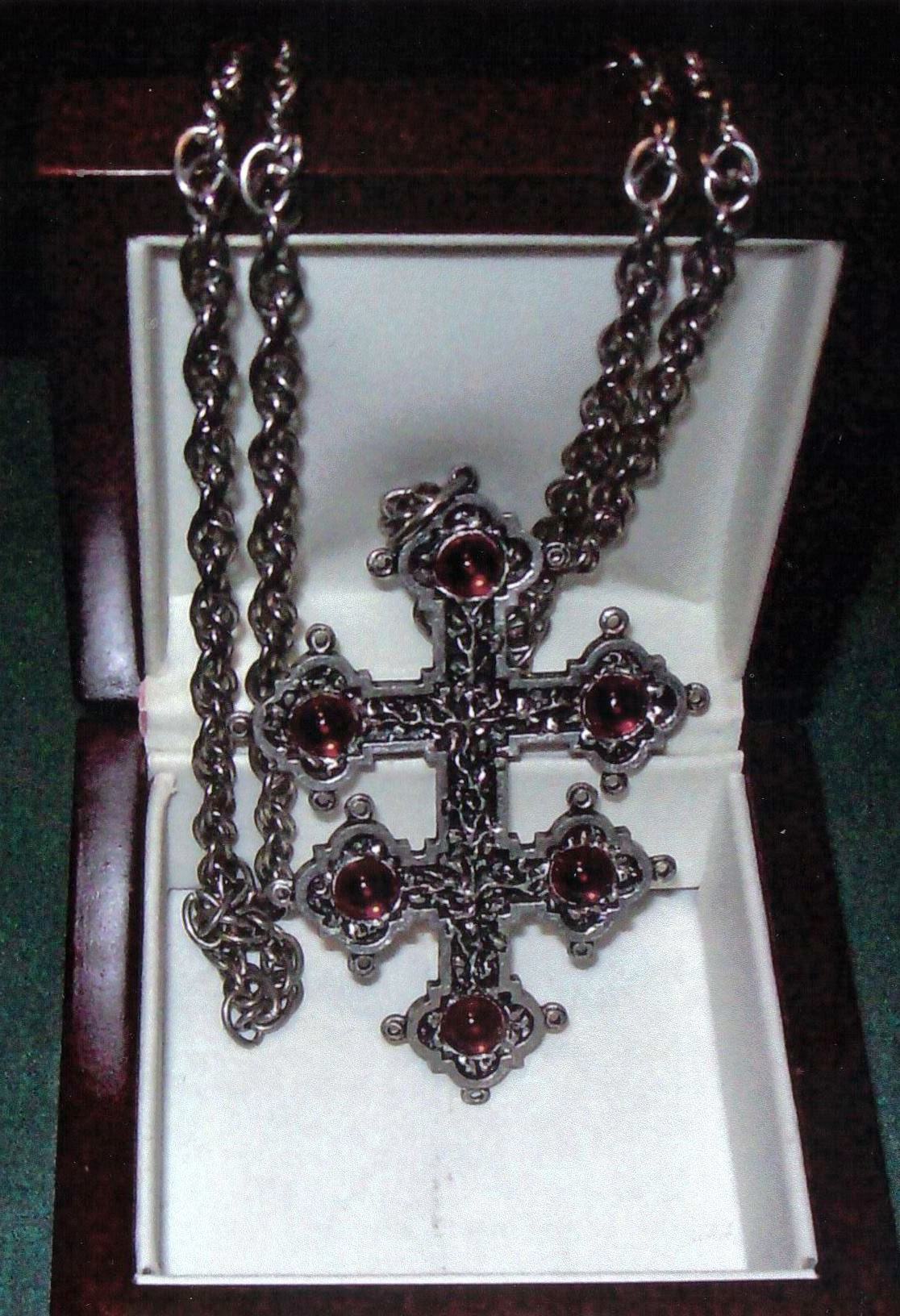
In addition, a complete plan was formulated for an American Chapter of the Order of the Crown of Thorns, under the patronage of St Louis. Central to this work was a jewelled pectoral cross given by Bricaud to Prince-Abbot Joseph III (photographed at right). At the beginning and end of each meeting of the Chapter, three gold-framed photographs were venerated: in the centre, of Prince-Abbot Joseph III wearing the Bricaud Cross, and to the sides, of Prince-Abbot Joseph III and Bricaud, and of Bricaud and Mother Angelique Sophia. The Chapter members each wore the Bricaud Cross in rotation during meetings, regardless of ecclesiastical or chivalric rank.
Unfortunately, relations between Bricaud and Prince-Abbot Edmond I did not proceed as planned. The intention had been for Prince-Abbot Edmond I to be fully involved (as befitted his office) in the American Chapter and the work taking place in Chicago. However, Prince-Abbot Edmond I regarded Bricaud as having turned Prince-Abbot Joseph III against him and having supplanted him as his closest friend and confidant for his own gain. Indeed, Prince-Abbot Edmond I went to his grave believing that Prince-Abbot Joseph III had betrayed him through reposing his trust in Bricaud.
Prince-Abbot Edmond I rejected Bricaud’s approaches during the early 1930s and as a result the American Chapter was separated from the canonical jurisdiction of the Order as a whole, eventually becoming closed to non-members of the American Catholic Church. After the deaths of Lloyd in 1933 and Bricaud in 1934, the archives moved from Chicago to Laguna Beach in California where Archbishop Lowell Paul Wadle (1900-65) succeeded Bricaud. For several years, relations between Prince-Abbot Edmond I and Wadle were publically at odds – Prince-Abbot Edmond I condemning Wadle for his esotericism and heresy, and Wadle condemning Prince-Abbot Edmond I for his social respectability and “selling out” to the Episcopalians for a paycheck. However, in private, they formed a highly productive relationship, and in 1960 formal union was entered into by the two prelates. In 1971, the American Chapter was reabsorbed into the general administration of the Abbey-Principality under Prince-Abbot Edmond II.
The succession to Bricaud
Bricaud had consecrated Victor Blanchard (1878-1953) (Paul Yésir) on 5 July 1920. However, this act did not negate the fact that much of the relationship between Bricaud and Blanchard was antagonistic. Blanchard had not accepted Bricaud as head of Martinism in France and in 1921 had established his own Martinist body, the Martinist Order and Synarchy. Unlike Bricaud’s body, this did not restrict membership to men who were Master Masons, admitting women and non-Masonic members. Blanchard also received many other esoteric authorities during his career and on 14th July 1938 proclaimed that he was the Universal Grand Master of the Rose-Croix and of all the initiatic orders of the entire world.  On 28 January 1945, Blanchard consecrated Robert Amadou (Tau Jacques) (1924-2006), who on 17 September 1988 (pictured at right) conditionally consecrated Archbishop Bertil Persson of the Apostolic Episcopal Church, consecrator of the present Prince-Abbot of San Luigi.
Bricaud in 1907, and then again in 1918 or 1919, consecrated the Haïtian Lucien François Jean-Maine (Tau Ogdoade-Orfeo I) (1869-1960), who had previously received consecration from Tau Synesius and other Gnostic bishops, and who was at that time living in France and later Spain. Tau Ogdoade-Orfeo I was also a Voudon high priest, initiated in his father’s temple. About 1910, he was given a charter by Papus for the Ordo Templi Orientis in Haiti and the French West Indies. Aspects of the O.T.O. had much in common with the Voudon heritage into which he had previously been initiated. The Spanish-Haitian development of this body would be designated Ordo Templi Orientis Antiqua after 1921.
 Tau Ogdoade-Orfeo I had also received the Rites of Memphis and Misraïm from his first consecrator Tau Orfeo VI (Paul-Pierre de Marraga) of the Spanish Albigensian Gnostic Church (From Tau Orfeo VI he had also inherited a line of episcopal succession through the French Eglise Constitutionelle that originated with Pope Benedict XIII). In consequence, Tau Ogdoade-Orfeo I was able to impart to Papus a number of the higher grades in Memphis and Misraïm and in return, Papus gave him charters for those Orders he had received from John Yarker and Theodor Reuss. Significantly, Tau Ogdoade-Orfeo I did not maintain his esoteric authorities separately from his Gnostic church authorities. Frater Joseph has written of this, “For under the combined influences of the O.T.O., Martinism, Gnosticism, and Voudoo-not to mention the Fraternitas Lucis Hermetica-the Spanish and Haitian branches of the Rite of Memphis-Misraim gave up entirely their quasi-masonic character and became completely esoteric and Gnostic orders of magic, i.e., The Gnostic and Esoteric Order of Misraim. or of Egypt and the Gnostic and Esoteric Order of Memphis, within the larger, totally occult and much more ecclesiastical “Ancient and Primitive Rite of Memphis-Misraim”. This point must be emphasized because there are other branches of the Rite of Memphis-Misraim which claim to continue a masonic character, while it is only interested in continuing the Gnostic and apostolic succession and the magical currents of initiation.” (Frater Joseph, History of La Couleuvre Noire, in Skoob Occult Review, no. 3, London: Skoob Books Publishing, Ltd., 1990).
In 1921, having returned to Haiti and married, Tau Ogdoade-Orfeo I developed his own occult initiatic system called La Couleuvre Noire (The Black Snake), since as a Black man he was excluded from much Western European esoteric activity. This work has survived to the present day, as has the succession of Memphis-Misraïm bishops from Tau Ogdoade-Orfeo I. Returning to and slightly amplifying Frater Joseph’s account, we learn that “On January 18, 1966, an American Martinist, Tau Ogoade-Orfeo IV [Michael Paul Bertiaux], born January 18, 1935, was consecrated to the episcopate for the Rite of Memphis-Misraim. The consecration took place in Chicago, with Tau Ogoade-Orfeo II [José Marraga y Adhémar (1893-1969) as principal consecrator] and Tau Ogoade-Orfeo III [Hector François Jean-Maine (1924-84)] acting as the co-consecrator. Later, Tau Ogoade-Orfeo IV received the complete magical consecrations and currents of the Ecclesia Gnostica Hermetica on August 10, 1967. The Ecclesia Gnostica Hermetica carried the magical currents of the secret work of the O.T.O. and the Choronzon Club, and thus united the Crowleyan (Germerian) and Neo-Crowleyan (Choronzon Club and G.B.G.) successions with the Gnostic and Hermetic traditions inherited from the Vilatte succession of bishops.” Bertiaux then on 16 June 1979 consecrated Archbishop Forest Barber of the Apostolic Episcopal Church, through whom this heritage has passed to the present Prince-Abbot of San Luigi.
 Bricaud died on 21 February 1934 and was succeeded as Patriarch of the Eglise Gnostique Universelle by Constant Chevillon (Tau Harmonius (1880-1944)). According to the account of Mme. Bricaud, Chevillon worked closely with Bricaud in his last years, and indeed the two men are buried in the same tomb. Bricaud certainly consecrated Chevillon, probably in the mid-1920s, but no record of the exact date of this event has survived. Chevillon was consecrated again by Giraud on 5 January 1936. At the time of his assassination by agents of the Vichy government during World War II, Chevillon had consecrated no bishops. His successor was René Chambellant (Tau Renatus (1907-93)) who was consecrated in 1945 by Edouard Gesta (Dr X), who had been consecrated by Blanchard on 28 January 1945. After World War II, the church was placed in a state of dormancy and Chambellant relocated for many years to Africa.
While there would be a continuation of elements of the work of the Eglise Gnostique Universelle through the churches led by Robert Ambelain and his successors, this would essentially be a work of revival and rebirth that continues in many Gnostic churches of today, perhaps illustrating that its inner traditions and their spiritual teachings are capable of creating their own organizational frameworks through the transmission of initiatic and episcopal successions.
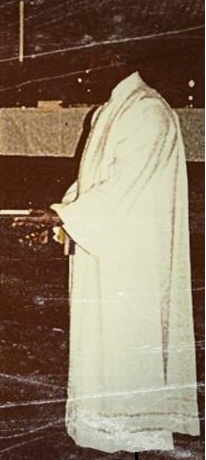
Holy Water and incense blessed by Bricaud is today part of the San Luigi archive, as are some of his vestments and items from the Vilatte archive that he helped save. He remains one of our most important forefathers and a continuing presence and inspiration.




 The Abbey-Principality of San Luigi
You must be logged in to post a comment.