The Catholicate of the West has issued a Perpetual Charter to the American World Patriarchates, a historic Orthodox federation of communions with which it has enjoyed intercommunion for several decades.
The AWP has been without an Apostolic Administrator since the death of Patriarch Yuri in 2013. However, it is not a federation that is dependent on a central administration, consisting instead of a loose grouping of independent patriarchs and their churches which call upon a common identity and heritage within the AWP.
Several clergy of the AWP have joined the Catholicate of the West recently and the issuing of a Perpetual Charter is intended to support their ministries and maintain their identity and heritage. It is open to other clergy of the AWP to join the Catholicate of the West should they wish, but it is also recognized that because of the diffuse and decentralized nature of the AWP there will be other clergy of the AWP who will be outside the Catholicate.
The Catholicate wishes to make its position clear on several issues that have been the source of controversy. Firstly, it has never been the case that the AWP has been the hereditary possession of the Ryzy family.
Secondly, there is no basis for the appointment of an Apostolic Administrator other than following his election by the AWP patriarchs worldwide in synod. The position of Apostolic Administrator will be vacant until such an eventuality.
Thirdly, Michael James Kline of Independence, Missouri, of whom we have written elsewhere, was never a member or patriarch of the AWP during the lifetime of Patriarch Yuri and has no legitimate authority over the AWP or its patriarchs, nor does he have the authority to appoint an Apostolic Administrator. Kline was consecrated by Patriarch Yuri, but as the document of consecration makes clear, this was for the One Holy Catholic and Apostolic Church and not for the AWP.
About the author:
Rudolph Andries Ulrich JUCHTER VAN BERGEN QUAST, LLM, FSS is a lawyer and Fellow of the Royal Statistical Society. He is the honorary president of the Family Association of the Barons von Quast (Familienverband der Freiherren von Quast), a Swiss Verein. Main interests: international law and finance, international relations, banking, statistics and the law, art, culture and history.
In earlier articles, I examined the fons honorum of certain historical dynasties, like the former monarchs of Georgia, Rwanda and Hawaii. This article investigates, from a legal perspective, the fons honorum of religious organizations to grant titles and awards. I will demonstrate that this fons honorum is based on religious freedom and the freedom of association. Although international law does not define religion, it does identify religion with conscience, and enumerates a number of manifestations of religion that are to be protected.
The freedom of religious manifestation
European legal perspective
Article 9 of the European Convention on Human Rights (ECHR), guarantees the freedom of thought, conscience and religion in relation to the State. From a European law perspective, there are three aspects to the aforementioned freedoms: internal, external and collective aspects.
Regarding the internal aspect, the aforementioned freedom is absolute. This freedom concerns deeply held ideas and convictions that are forged in a person’s individual conscience and therefore cannot in themselves prejudice public order. Therefore, these ideas and convictions cannot be subject to restrictions by State authorities.
With regard to the external aspect, the freedom is not absolute but relative. This freedom to manifest a person’s beliefs is limited, because it can affect or even threaten a country’s public order. While religious freedom is primarily a matter of individual conscience, it also implies, inter alia, freedom to “manifest [one’s] religion” alone and in private or in community with others, in public and within the circle of those whose faith one shares. Article 9 lists a number of forms which manifestation of one’s religion or belief may take, namely worship, teaching, practice and observance (European Court of Human Rights (ECtHR), Metropolitan Church of Bessarabia and Others v Moldova, judgment of 13 December 2001, ECHR Reports 2001-XII, § 114 et seq. and case-law cited).
Most of the rights recognised under Article 9 are individual rights that cannot be challenged. However, some of these rights may have a collective aspect. Accordingly, the ECtHR has recognised that a Church or ecclesiastical body may, as such, exercise on behalf of its members the rights guaranteed by Article 9 of the Convention (ECtHR, 12 June 2014, Martinez Fernandez v. Spain, Comm. 1104/2002, U.N. Doc. A/60/40, Vol. II, at 150 (HRC 2005).
Freedom of conscience and of religion does not protect each and every act or form of behaviour, motivated or inspired by a religion or a belief. In other words, Article 9 of the ECHR protects a person’s private sphere of conscience, but not always any public conduct inspired by that conscience. It does not allow general laws to be broken (Pichon and Sajous v. France (dec.), no. 49853/99, ECtHR 2001-X).
As religious communities traditionally and universally exist in the form of organized structures, Article 9 ECHR has to be interpreted in the light of Article 11 ECHR which safeguards associative life against unjustified state interference. Seen in this perspective, the believer’s right to freedom of religion includes the right of a religious community to function peacefully; free from arbitrary State intervention. This autonomous existence of religious communities is indispensable for pluralism in a democratic society and is thus an issue at the very heart of the protection which Article 9 affords (Hasan and Chaush v. Bulgaria [GC], no. 30985/96, § 62, ECtHR 2000-XI; Metropolitan Church of Bessarabia and Others, cited above, § 118; and Holy Synod of the Bulgarian Orthodox Church (Metropolitan Inokentiy) and Others v. Bulgaria, nrs. 412/03 and 35677/04, § 103, 22 January 2009).
There exist a vast number of cases where the ECtHR decided regarding the wearing of religious clothing and the use of symbols. Under Article 9(2) ECHR, the right to freely manifest one’s religion can only be restricted under certain cumulative conditions. These restrictions must (i) be prescribed by law; (ii) be necessary in a democratic society by fulfilling a pressing social need; (iii) have a legitimate aim (these aims are mentioned in Article 9(2) ECHR); and, (iv) the means used to achieve that aim must be proportionate and necessary. The right not to be discriminated against can, according to the ECHR, also be restricted under certain circumstances, where a similar justification test is applied. In addition, article 51(2) Charter of Fundamental Rights of the European Union (EUCFR), is a similar test that also applies to restrictions on the rights in Articles 10 and 21 EUCFR. The bans on the wearing of religious clothing or symbols are justified under Article 9(2) ECHR.
Global legal perspective
The freedom of religion or belief is also guaranteed by article 18 of the (mondial) Universal Declaration of Human Rights, article 18 of the International Covenant on Civil and Political Rights and the Declaration on the Elimination of All Forms of Intolerance and of Discrimination Based on Religion or Belief. Regarding the use of religious expressions, the United Nations issued the following statements:
Art. 6 (c): The right to freedom of thought, conscience, religion or belief includes the freedom, “To make, acquire and use to an adequate extent the necessary articles and materials related to the rites or customs of a religion or belief;”.
4 (b): The Commission on Human Rights urges States, “To exert the utmost efforts, in accordance with their national legislation and in conformity with international human rights law, to ensure that religious places, sites, shrines and religious expressions are fully respected and protected and to take additional measures in cases where they are vulnerable to desecration or destruction;”.
UN Commission on Human Rights, Resolution 2005/40 on Elimination of All Forms of Intolerance and of Discrimination Based on Religion or Belief, 19 April 2005
UN Commission on Human Rights, Resolution 2005/40 on Elimination of All Forms of Intolerance and of Discrimination Based on Religion or Belief, 19 April 2005
Para. 4: “The concept of worship extends to […] the display of symbols”.
Para. 4: “The observance and practice of religion or belief may include not only ceremonial acts but also such customs as […] the wearing of distinctive clothing or head coverings […].”
The aforementioned legal frameworks show that religious freedom and the liberty to manifest this freedom by symbols is a fundamental human right and protected by international law, that is incorporated by states in national law. In my opinion, religious freedom also includes the freedom to grant titles and awards when issued in the context of religious customs, symbols and honorifics. Therefore, the fundamental human rights of religious freedom combined with the freedom of association are the source of authority of religious groups for legally and legitimately granting such titles and awards.
Case studies
Roman Catholic Church
The so-called “Bologna Mozart” was copied 1777 in Salzburg (Austria) by a now unknown painter from a lost original for Padre Martini in Bologna (Italy), who had ordered it for his gallery of composers. Today it is displayed in the Civico Museo Bibliografico Musicale in Bologna in Italy. Leopold Mozart, W. A. Mozart’s father, wrote about this portrait: „Malerisch hat es wenig wert, aber was die Ähnlichkeit anbetrifft, so versichere ich Ihnen, daß es ihm ganz und gar ähnlich sieht.“ (Letter of Leopold Mozart to Padre Martini in Bologna from Dec 22, 1777, MBA II, pp. 204f, No. 396).
At the age of 14, the famous composer Wolfgang Amadeus Mozart (1756-1791) left Salzburg to go on tours to Italy, accompanied by his father, the musician Leopold Mozart (1719-1787). Their principal destinations were Verona, Mantua, Cremona, Milan, Parma, Bologna, Florence and finally Rome, which he reached on 10 April 1770. When Pope Clement XIV was informed of the child prodigy, he received Mozart and his father in a private audience on their return from Naples two months later, on 4 July 1770. On that occasion, the Pope conferred the Order of the Golden Spur on young Mozart (Jahn, 1856, pp. 199-205; Cardinale 1983, pp. 35-42), thus making him a Papal Knight of the Golden Spur. The following day, Mozart received his official insignia, consisting of ‘a golden cross on a red sash, sword, and spurs,’ emblematic of honorary knighthood. In 1777, Mozart had his portrait painted with the star-encircled cross of the order on his coat.
The papal patent of 4 July 1770 for the award stated:
Inasmuch as it behoves the beneficence of the Roman Pontiff and the Apostolic See that those who have shown them no small signs of faith and devotion and are graced with the merits of probity and virtue, shall be decorated with the honours and favors of the Roman Pontiff and the said See.’
Vatican secret archives 2009, p. 183
It is interesting to examine the capacity in which the pope issued the diploma. Roman Pontiff refers to the Bishop of Rome, the Pope. An apostolic see is an episcopal see (a bishop’s ecclesiastical jurisdiction) of which the foundation is attributed to one or more of the apostles of Jesus or to one of their close associates. In Roman Catholicism, the apostolic see refers to the See of Rome. Therefore, both references to the fons honorum are of a religious nature. Although the Papal States on the Italian Peninsula were under the direct sovereign rule of the pope at that time, the fons honorum for the diploma is based on religion, instead of public law. It has an internal character within the church structures.
Currently, the Pontifical Orders of Knighthood are secular orders of merit of which the membership is conferred by a direct decision of the Pontiff. The diplomas given to recipients of the most popular Pontifical Orders, the Pontifical Equestrian Order of Saint Sylvester Pope and Martyr (reorganised by Pope Pius X on his own initiative, motu proprio, “Multum ad excitandos” on 7 February 1905), and the Pontifical Equestrian Order of Saint Gregory the Great (established on 1 September 1831, by Pope Gregory XVI), are issued in the capacity of pontifex maximus. Although this designation has been used in inscriptions referring to the Popes for some centuries, it has never been included in the official list of papal titles, which is published yearly in the Annuario Pontificio. The official list of titles of the Pope given in the Annuario Pontificio mentions “Supreme Pontiff of the whole Church” (in Latin, Summus Pontifex Ecclesiae Universalis) as the fourth title, the first being “Bishop of Rome“. The title pontifex maximus appears in inscriptions on religious buildings and on coins and medals. Awards are gazetted in Acta Apostolica Sedis, the Gazette of the Holy See. Diplomas of appointment are issued by the Secretariat of State. Papal knighthoods are personal. Perpetual succession is no longer granted.
The Order of Saint Sylvester is intended to honour Roman Catholic lay people who are actively involved in the life of the church, particularly as it is exemplified in the exercise of their professional duties and mastership of the different arts. According to Pope Gregory XVI’s Papal Brief of 1 September 1831, the Order of Saint Gregory is an order of merit to be bestowed on gentlemen of proven loyalty to the Holy See who, by reason of their nobility of birth and the renown of their deeds or the degree of their munificence, are deemed worthy to be honoured by a public expression of esteem by the Holy See (see: appendix 1, underlined sentence).
The Order of Saint Sylvester, originally united with the Order of the Golden Spur, was formally constituted on 7 February 1905 by Pope Saint Pius X in his motu proprio, Multum ad excitandos. From that time, the united order became two orders, the Order of Saint Sylvester and the Order of the Golden Spur. Since the 1905 reforms of Pope Saint Pius X, the grades are, from highest to lowest, Knight Grand Cross (1st class), Knight Commander with Star (2nd class)*, Knight Commander (3rd class), and Knight (4th class). Since 1994 women have been admitted to the Order as Dames in the same grades and divisions as men. It was also Saint Pius X who gave Papal knights a place of honor in Papal processions and ecclesiastical ceremonies (source: papalknights.org)
Clearly, the orders of knighthood focus on religious merit and are issued in a religious capacity. I have not seen an explicit reference to the capacity of the pope as sovereign of the Vatican State. The latter capacity is referred to as the temporal power of the church: the rule of the Church in earthly possessions and the authority of the Pope over civil territories belonging to the Church, as in the former Papal States. This power is an addition to his dominion in spiritual matters and becomes necessary if freedom from civil power is to be assured. The church’s temporal power is presently exercised in relation to the Vatican City State since the Lateran Treaty of 1929. The term may also refer to the exercise of political influence by the bishops formerly through landed estates and currently through financial and other means. The aforementioned orders of knighthood are not issued as part of the Vatican’s temporal power; they are awards, issued for religious merit and therefore have a religious nature.
Considering the foregoing, from both a historical and a legal perspective, for centuries, Popes have exercised their religious fons honorum to grant titles and awards. These awards have an internal effect. They are part of the religious structure of the Roman Catholic faith and are logically recognised as such by the Vatican City State. Other states may choose to either allow their citizens to wear them or to forbid them. The latter could be in breach of religious freedom, as guaranteed by international law.
Abbey-Principality of San Luigi
Since 1970, the Catholic population has nearly doubled, growing from about 650 million in 1970 to about 1.3 billion in 2020. The Church has circa 415.000 priests. As the world’s oldest and largest continuously functioning international institution, it has played a prominent role in the history and development of Western civilization. It is interesting to compare this huge organization to a small religious group, like for example the Abbey-Principality of San Luigi, based in the United Kingdom.
The history of the Abbey-Principality, is described on its webpage:
The new scandal, the new nightmare, the tomb of the Pope’s Roman Catholic Moral Theology: aborted babies used for making COVID-19 Vaccines.
by Professor Luca Scotto di Tella de’ Douglas
Bioethics was born after the most terrible experiments made on prisoners during the Second World War II by the Nazis and the Japanese allied to the Nazis. Dr. Mengele and Dr. Ishii without any ethics, pity, mercy, or compassion tortured and killed a huge quantity of human beings who were used like guinea pigs. Now after some decades in the name of profit and for a few months of supposed protection – a shield from Covid 19 – we discovered the skeleton in the closet, the vaccines proposed as a great solution are based on the torture and death of innocent babies, aborted. Several vaccines are made in cells from foetuses aborted for example, decades ago. They include vaccines against rubella, hepatitis A, and chicken pox/shingles.
We don’t need to be saints in order to raise a firm ethical objection to this cruel and merciless, barbaric and inhuman trivialization and banalization of Human Life that, for profit and career is not any more considered as sacred but a mere tool for making money. The manufacture of this group of unethical vaccines using such ethically-tainted human cell lines demonstrates profound disrespect for the dignity of Human Life which for us comes from God and which deserves to be respected in depth. A true “hara kiri”, a suicide, was made by the Vatican’s Pontifical Academy for Life (that should after this be renamed FALLING) when it declared in 2005 and reaffirmed in 2017 that in the absence of alternatives, Catholics could, in “good conscience”, receive vaccines made using historical human fetal cell lines. This means that if there is a risk for health, a Roman Catholic can ask legally and with a pure conscience, to the scientist, to have a medicine (a vaccine is a medicine) without even asking how it was produced. If in that production they were partners in crime, accomplices in horrible acts such as abortions, who cares. This is something profound, serious and shameful that has nothing of Christianity about it; it is simply abominable even for a non-Christian and for an Atheist Man of Good Will.
The current Pope and the Vatican approve of Catholics receiving vaccines manufactured using human fetal cells by abortion “only” in the absence of alternatives but this is also equivalent to justifying the dirty trafficking of organs sold, for example by countries where the death penalty is in force and the organs of executed criminals are sold. The important thing is to get what you need, ethics are of no use, obviously, morality is something heavy and impractical, better to be cynical, selfish and not ask too many questions.
Let us ask ourselves this, would Jesus, the Christ, ever approve, in order to create a medicine, to have innocent babies killed in small pieces in the womb of Mothers? To order this butchery of fetuses and consciences?
The Apostolic Episcopal Church strongly condemns the purchase and use of aborted human foetal corpses for so-called “scientific” uses. The AEC firmly calls on drug companies to work to create ethical medicines and vaccines that reject certain shameful uses of Human Life.
The Abbey-Principality has recently been sent a copy of an important letter of Mgr. Joseph-René Vilatte (1854-1929) (who would become Prince-Abbot Joseph III of San Luigi in 1899). The letter is dated 29 December 1893 and is addressed to Prince Guy de Lusignan (1831-1906), a Patron of the Order of the Crown of Thorns.
At the time of writing, Vilatte had been Grand Master of the Order of the Crown of Thorns for just six months, having succeeded the Rev. Gaston Fercken. The Order was the first Western-style order of chivalry to be established under the Orthodox Church rather than Rome, when in 1891 the Syrian Orthodox Patriarch Ignatius Peter IV approved the refoundation under Fercken of the former medieval Order of the Crown of Thorns. In 1899, it would unite with the separate branch of the Order that had been founded in 1883 by the first Prince-Abbot of San Luigi. Vilatte was consecrated Metropolitan for the Old Catholics of America by the Syrian Orthodox Church in 1892.
The letter makes it clear that problems had arisen in the Order under Fercken. According to Vilatte, Fercken had appointed as members of the Order several Parisian journalists. Mutual jealousies ensued and the Order found itself the victim of controversy and outright falsehood in the Parisian press. These developments had clearly occasioned Prince Guy’s concern and prompted him to write to Vilatte, who was at that time at his American missions in Wisconsin.
In writing, Vilatte directs a few barbs towards Rome which in his view had departed from Catholic faith and tradition in the First Vatican Council (1870) of still-recent memory. He speaks of the Order “refusing the infallible Pope’s blessing”, referring to the doctrine of Papal infallibility which had been central to the decrees of the First Vatican Council and which he did not accept. He then makes it clear that the Order of the Crown of Thorns is a Catholic order without being either Roman or Papist, since it had turned to Orthodox authority in the place of a fallen Rome.
A full transcript of the text of the letter follows:
Monseigneur,
Je suis profondement chagriné de voir les mensonges qui sont publiés dans les journeaux de Paris, au sujet de notre Saint Ordre.
Mais je puis vous assurer que depuis que j’ai l’honneur d’être le grand Maître de l’Ordre de la Couronne d’Epines, pas un seul français a été reçu dans l’ordre par moi. Les personnes qui ont demandés leur admission depuis 6 mois ont étés refuses elles étaient tous de Paris.
Si quelques personnes sont indiqués de notre Ordre la faute retourne sur mon predecesseur le Rev. Fercken. Qui malheureusement a reçu des journalistes qui sont jaloux les uns des autres. De là les mensonges etc etc.
Pour le future je puis vous assurer que l’ordre marchera dans le progrets et pour la défense de Jesus crucifié.
La France est un pays romain, soumise au Pape de Rome, il suffit pour notre ordre de la couronne d’Epines de refuser la benediction du Pape infaillible pour que les journaux français soient en harmonie avec le Pape de Rome pour maudire et mépriser les Ordres religieux qui sont Catholiques sans être romains ou papiste.
Dans l’espérance que vous comprendre la situation de notre St. Ordre. J’ai l’honneur de vous informer que pas un seul français a merité l’honneur depuis 6 mois d’être reçu par moi dans l’Ordre, et que personne a Paris pas selon que dans les autres pays n’a le droit ou l’autorité de conferer les brevets.
Dans l’espérance Monseigneur, que Dieu et la très St Mère vous combleront de benedictions pour cette nouvelle année.
J’ai l’honneur de vous saluir
+J R Vilatte
Archevêque
Duvall
Kewaunee Co.
Wisconsin
This is translated into English as follows:
December 29, 1893 United States
To His Royal Highness
Mgr. Guy de Lusignan,
Paris – Neuilly
France
Monseigneur,
I am deeply saddened to see the lies that are published in the newspapers of Paris, about our Holy Order.
But I can assure you that since I have the honour of being the Grand Master of the Order of the Crown of Thorns, not a single Frenchman has been received in the order by me. The people who applied for admission in the past 6 months were refused; they were all from Paris.
If some people are indicated to be in our Order the fault goes to my predecessor the Rev. Fercken. Who unfortunately received some journalists who are jealous of each other. From them come the lies etc etc.
For the future I can assure you that the order will work for the benefit and for the defense of Jesus crucified.
France is a Roman country, subject to the Pope of Rome, it suffices for our order of the Crown of Thorns to refuse the infallible Pope’s blessing, for the French newspapers to be in harmony with the Pope of Rome to curse and despise Religious Orders which are Catholic without being Roman or Papist.
In the hope that you will understand the situation of our Holy Order. I have the honour to inform you that for 6 months not a single Frenchman has deserved the honour of being received by me in the Order, and that no one in Paris, nor in other countries, has the right or authority to grant its brevets.
In the hope, Monseigneur, that God and the Blessed Mother may fill you with blessings for this new year.
The Grand Priory of Brazil of the Ordo Supremus Militaris Templi Hierosolymitani (Sovereign Military Order of the Temple of Jerusalem) has recently launched its new website at https://www.osmthbrasil.org The website contains many informative texts and video presentations on subjects of interest.
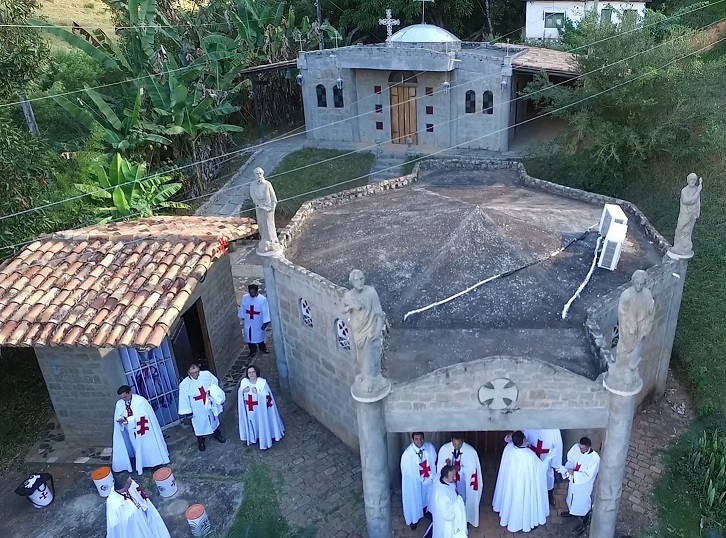
In Brazil, the Grand Priory of the OSMTH has built a Templar Complex dedicated to the Spiritual Cavalry of St John the Baptist, located in Santa Maria, Carangola, Minas Gerais. It is built of stone following the medieval model and consists of three parts: (1) the Temple ofSaint John the Baptist, built in the shape of an octagon, like the Temple of Solomon in Jerusalem, where the Order was born. This is where private meetings take place; (2) the Candle Room of Arms of Grandmaster Dom Fernando Campello Pinto Pereira de Souza Fontes, where the postulants are received for the first time, before their initiation; and (3) the Chapel of Santa Maria Madalena, built in the shape of a cross (like the Church of the Holy Sepulchre and the Gothic Cathedrals built in Europe by the Order), which is where the Public Ceremonies are held.Everyone is welcome at the complex, regardless of their religious beliefs.
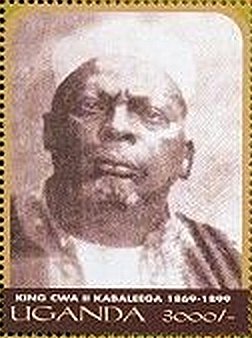
The Abbey-Principality of San Luigi commends its members and visitors to support the Kabalega Foundation, a charitable and commemorative institution which has been established in the Kingdom of Bunyoro-Kitara in memory of His late Majesty Omukama Chwa II Kabalega. H.M. Omukama Chwa II Kabalega, then the absolute ruler of the Bunyoro-Kitara Kingdom, was responsible for the re-establishment of the Abbey of San Luigi in 1885 and bestowed upon Prince-Abbot Joseph II the title of Mukungu of the Ancient Abbey-Principality of San Luigi (Fizzan), which is held by his successor today.
The Foundation’s activities include civic advocacy and engagement, cultural research and development, environmental protection, and health, water, sanitation and hygiene.
There is also much historical information at the Foundation’s website. The Fact File about H.M. Omukama Chwa II Kabalega recounts the history of the King’s generosity towards the Abbey-Principality, saying,
In 1885 Kabaleega signed a diplomatic agreement with the Abbey Principality of San Luigi (Fezzan), in which he formally recognised the Prince-Abbot and granted the monks territory in Bunyoro. On March 15, 1885, Kabaleega conferred upon the Prince-Abbot the title of “Mukungu (Prince Governor) of the Chieftainship of the Abbey-Principality of San Luigi (Fizzan)” (incorrectly transcribed “Makougos” in a number of later documents). This marked the beginning of the diplomatic relationship between Bunyoro and the Principality, which has continued to-date.
The monks, who had travelled from Fezzan (Libya) through Sudan, remained in Bunyoro until 1888 when an epidemic of tropical fever left Prince-Abbot José II the only survivor; he therefore closed the Abbey in Bunyoro and returned to Europe.
The Principality of San Luigi is a traditional Catholic sovereign principality. It was founded on St Louis’ Day, August 25, 1883, at Ghadames in the Touareg-Azgar country (Tripolitania-Fezzan, now part of modern Libya) by members of the Benedictine Order, with the Rev. Fr Dom Henrice Pacomez elected the first Prince-Abbot and recognised as such by the French government and the Roman Catholic Church. The dignity of Prince-Abbot is of the same character as the Papal titles of prince-abbot and prince-bishop which historically carried with them territorial sovereignty.



 The Abbey-Principality of San Luigi
You must be logged in to post a comment.