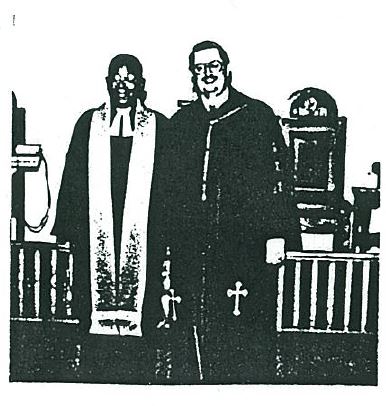
From the archives: A photograph of Archbishop William Bernard Crow

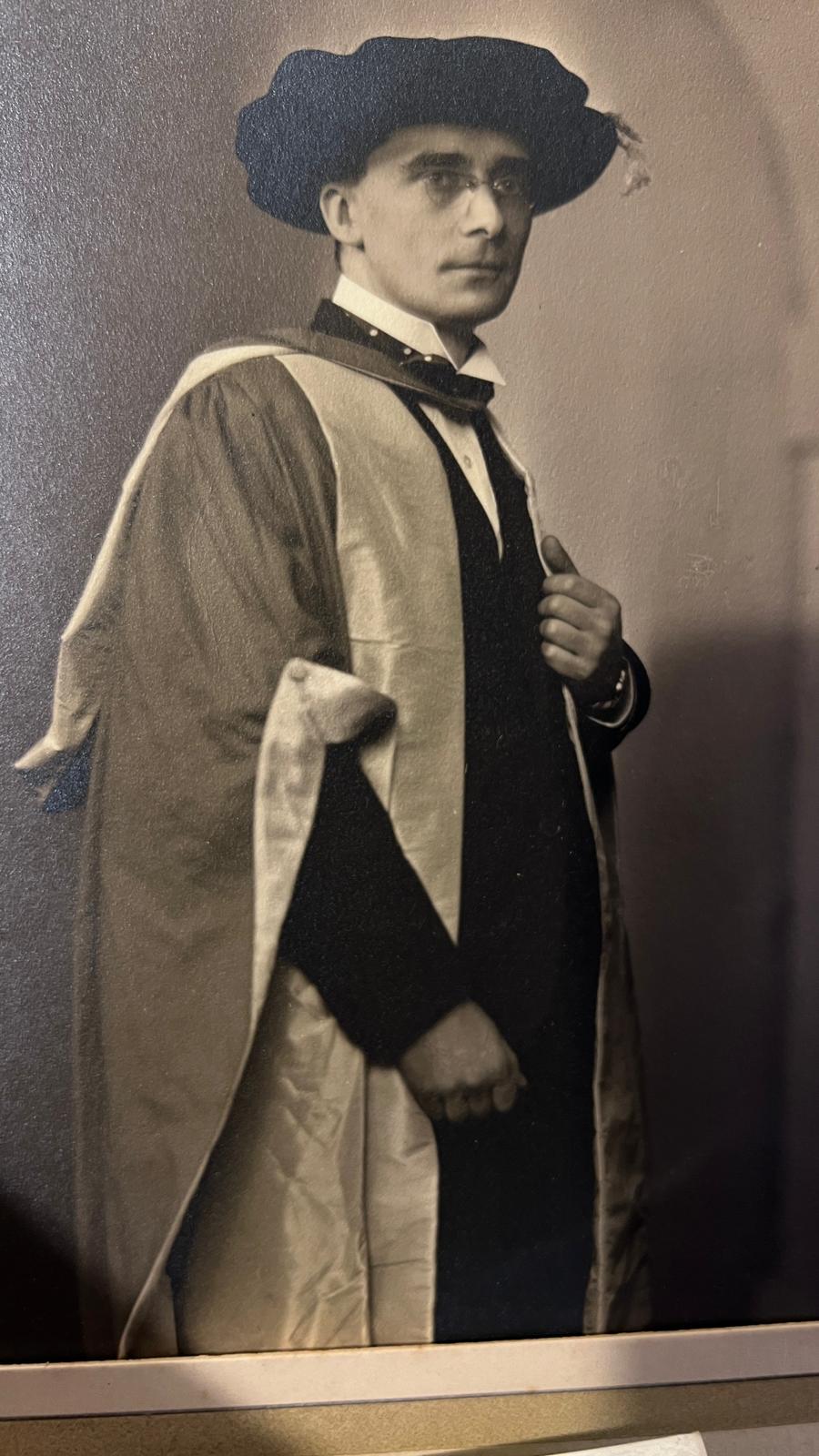
This photograph of the future Archbishop William Bernard Crow (Mar Bernard, subsequently Mar Basilius Abdullah III) (1895-1976) has recently been shared with us by his family. Dr Crow is shown here in the full dress robes of a Doctor of Science of the University of London.

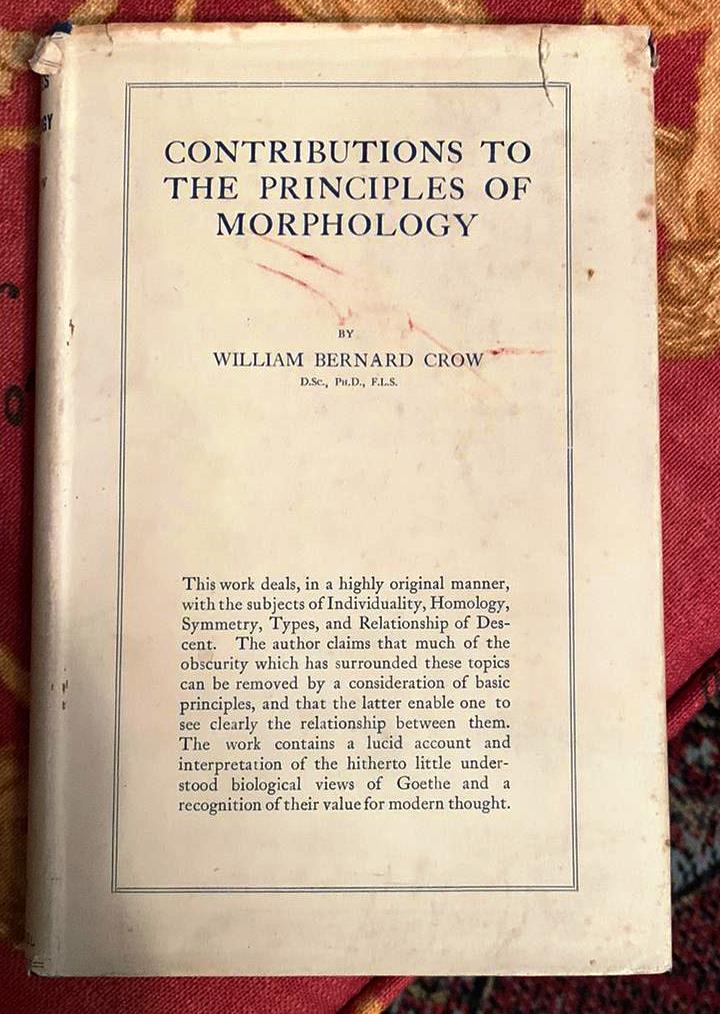
Dr Crow held the degrees of Associate of Arts (University of Oxford), Master of Science (University of Wales), Bachelor of Science, Master of Science, Doctor of Philosophy and Doctor of Science (University of London). This last degree was a rare academic distinction awarded in 1928 for a thesis entitled “Contributions to the Principles of Morphology” At that time, the higher doctorate of Doctor of Science from a British university was so prized that a university professor who had been awarded the degree would be called Doctor rather than Professor. Dr Crow was aged 33 in 1928 and so would have been one of the youngest persons ever to be awarded this degree.

At the University of London, the Doctor of Science degree by examination was withdrawn on 30 September 2001 and is no longer awarded.

Dr Crow’s published D.Sc. thesis (1929) – a signed copy preserved in our archives.

The academic robes for the Doctor of Science degree worn by Dr Crow in the photograph were of scarlet cloth, faced and the sleeves and hood lined with faculty silk, which for Science was gold.

Dr Crow was Grand Master of the Apostolate of the Holy Wisdom (which includes the Ancient Catholic Orthodox Church). This has since 2015 been united with the Abbey-Principality of San Luigi, which continues its work.

Clergy of the Ancient Catholic Church: Mar Lukos of Lagos, Accra and Trinidad

Mar Lukos (Davison Quartey Arthur) was a bishop of the Ancient Catholic Church, appointed in 1951.

Davison Quartey Arthur was born in Ethiopia, but travelled to the United States as a young man, where he worked with Bishop St-John-the-Divine Hickerson (sometimes rendered Hickersayon, or referred to as St-John-the-Vine) of the Malankara-Syriac Vilatte succession in an evangelical mission called the Church of the Living God. In 1942, the two prelates established the Coptic Orthodox Church Apostolic Incorporated in Harlem, New York, and Hickerson consecrated Arthur as Mar Lukos, Bishop of Lagos, Accra and Trinidad.

This church adopted the Coptic rites and traditions familiar from Mar Lukos’s youth, and found a following among Black African-Americans who, influenced by the teachings of Marcus Garvey, were looking to connect with their roots and heritage in Africa. Hickerson corresponded with the Coptic Orthodox Patriarchate, hoping for a formal church relationship to be established, but this was not forthcoming.

John A. Hickerson’s faith journey had taken him from Pentecostalism into the Baltimore African-American movement under the travelling preacher Samuel Morris. Here he met the cleric known as Father Divine. Both Morris and Father Divine asserted that they were divine manifestations of God. In 1912, Hickerson broke with Morris and Father Divine, holding that divinity was in fact present in all mankind (1 John 4:15) and that the two of them did not hold a monopoly on the same.

Hickerson was also an early believer in the ideas of Ethiopianism, which holds that the true Jews are Africans and that Jesus Himself was an African. In 1938 he was consecrated in the succession of the African Orthodox Church, one of the first major Black church movements established by George Alexander McGuire and Mar Timotheos (Joseph-René Vilatte, fifth Prince-Abbot of San Luigi).

In 1950, Mar Lukos relocated from the USA to London, UK, where he was resident in Chelsea. He came to know Mar Joannes I of the Ancient Catholic Church (Harold Percival Nicholson) at the Cathedral Church of the Good Shepherd, then at Lower Sloane Street, Chelsea, and through him Mar Georgius of Glastonbury.

Mar Lukos presented papers relating to his clerical status which, after initial scepticism on the part of Mar Georgius, were scrutinized closely and accepted as fully authentic on account of their Coptic seals. While Mar Georgius accepted that there was a Coptic Orthodox origin to Mar Lukos’s consecration, it is notable that his account in Successio Apostolica (1959) does not trace that succession beyond Hickerson, and the same work refers to his church as an American mission of the Coptic Orthodox Church. This was certainly true in respect of its religious practice and heritage, even if it was not in communion with the Coptic Orthodox Patriarchate. Indeed, in the United States, a tradition of independent Coptic Orthodoxy has continued in New York to this day.

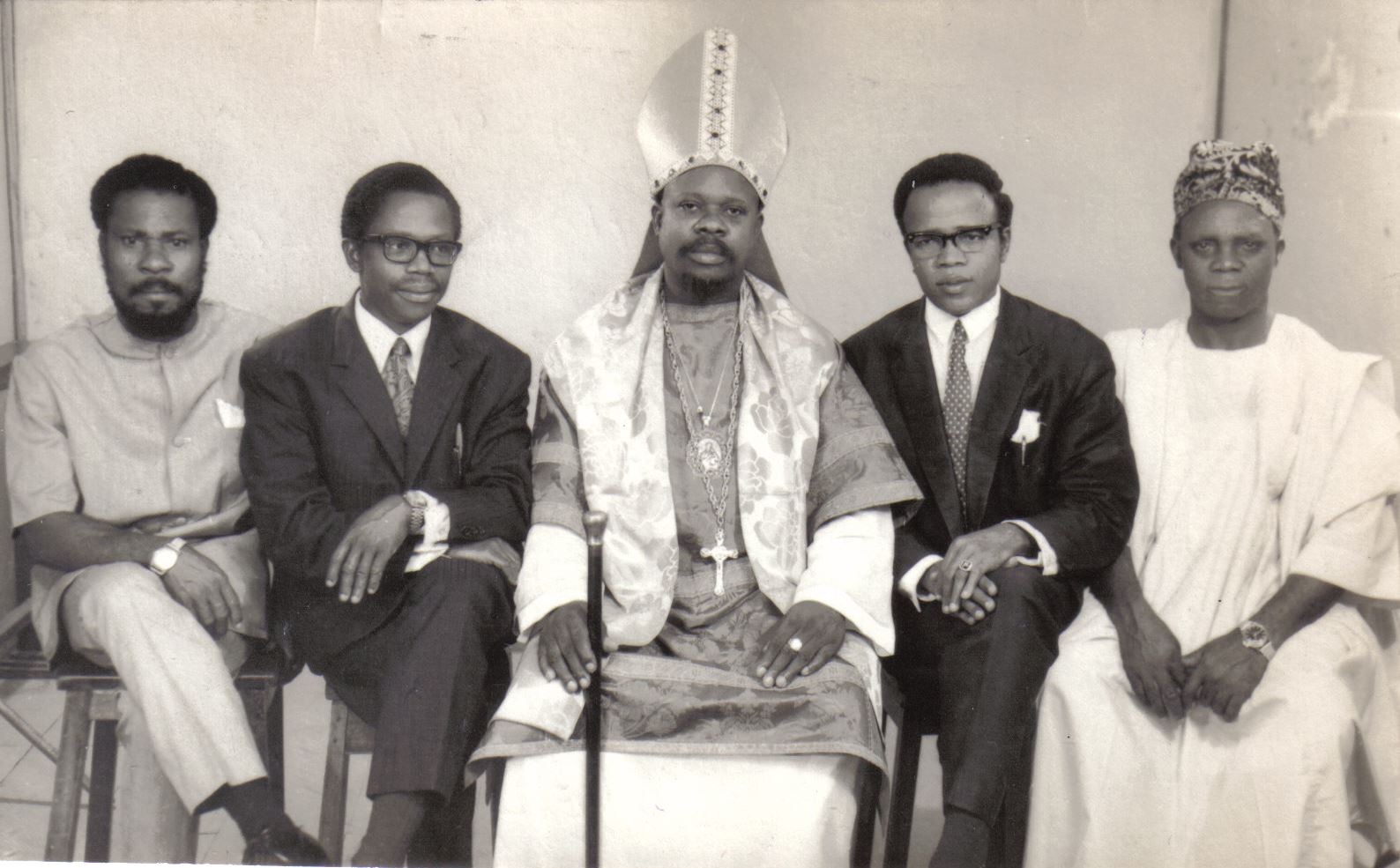
On 19 February 1951, Mar Lukos participated in an episcopal consecration for the Catholicate of the West and the Ancient Catholic Church in the Cathedral Church of the Good Shepherd, Chelsea, London, where he received subconditional consecration for ecumenical reasons from Mar Georgius of Glastonbury assisted by Mar Joannes I (Nicholson). At the same ceremony, Mar Lukos consecrated the two prelates sub conditione. A photograph from the ceremony is reproduced above, in which an English translation of the Coptic Orthodox rite was used. The consecration was reported in the local press.

Mar Lukos was subsequently appointed Archbishop of the West Indies in the Ancient Catholic Church. In 1957, he was further appointed to the Sacred Synod of the Eglise Catholique Apostolique Primitive d’Antioche Orthodoxe et de Tradition Syro-Byzantine under Prince-Patriarch Mar Joannes Maria (Assendelft-Altland).

Although none of the churches to which he belonged was in communion with the Coptic Orthodox Patriarchate, in 1952 Mar Lukos travelled to Ethiopia and was received by Emperor Haile Selassie at the Imperial Palace in Addis Ababa.

Remaining in London, Mar Lukos during the 1950s conducted a correspondence with various members and hierarchs of the Church of England, who were generally hostile to him, and his request to them to use a redundant church for worship was refused. The Church of England would not consecrate a Black bishop until 1985.
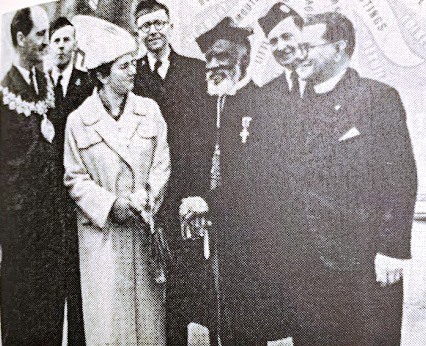
Nonetheless, Mar Lukos continued to make a contribution to the London community, and the photograph above, which appeared in the Kentish Mercury in April 1957, shows him with the Mayor and Mayoress of Deptford at a Boys’ Brigade inspection. Of his life after the 1950s, nothing is known.
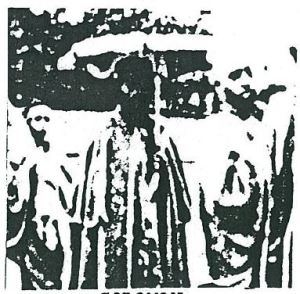
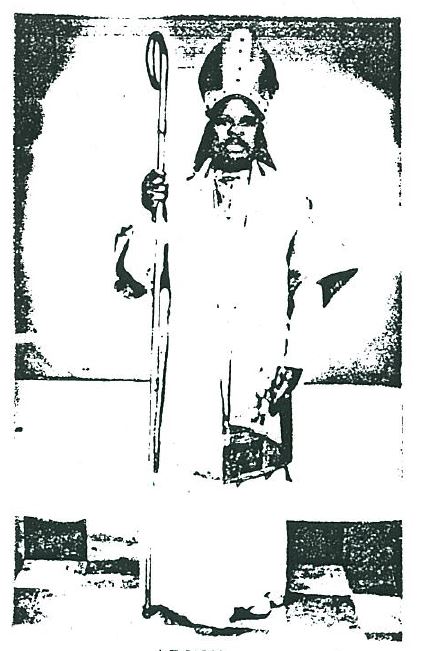
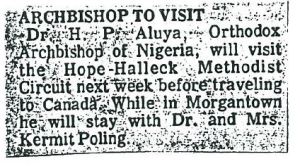
During the late 1950s Mar Lukos consecrated Mar Solomon (T. Makeba) (pictured left) as Bishop of Niger and Chad. Mar Solomon had been a priest of the Coptic Orthodox Patriarchate. He left or was deposed from the Patriarchate and joined a group called Christ Gospel Apostolic Church of Nigeria. He met Mar Lukos in the 1950s when Mar Lukos visited Africa. In 1966, he consecrated Albert Aluya, known as Holy Prophet Aluya.
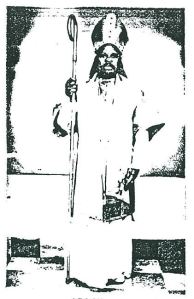
Albert Aluya was a member of the Royal House of Irrua of the Benin Kingdom of West Africa, and was the grandson of Queen Abuade I. Having been called to ordination in his youth, he served multiple ministries in various churches, including as Primate of Nigeria in the Christ Orthodox Catholic Exarchate. He was often featured in Nigerian newspapers on account of his prophetic pronouncements, and also took a role in ending the Nigerian Civil War, where he was close to the government that was eventually victorious. With a change of government, however, he fell out of favour and was imprisoned, dying while incarcerated.
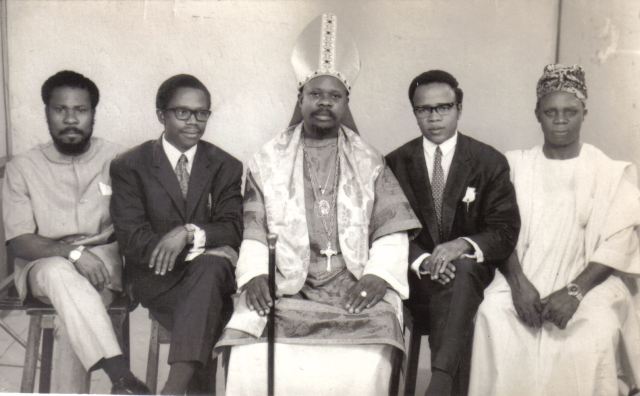
Archbishop Aluya in 1971 consecrated Archbishop Prince Kermit Poling de Polanie-Patrikios, who was a Royal Patron of the Abbey-Principality of San Luigi and adoptive father of the present Prince-Abbot.
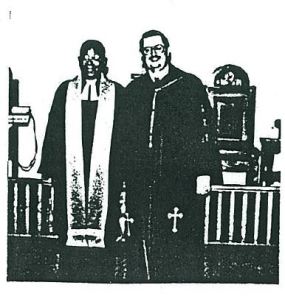
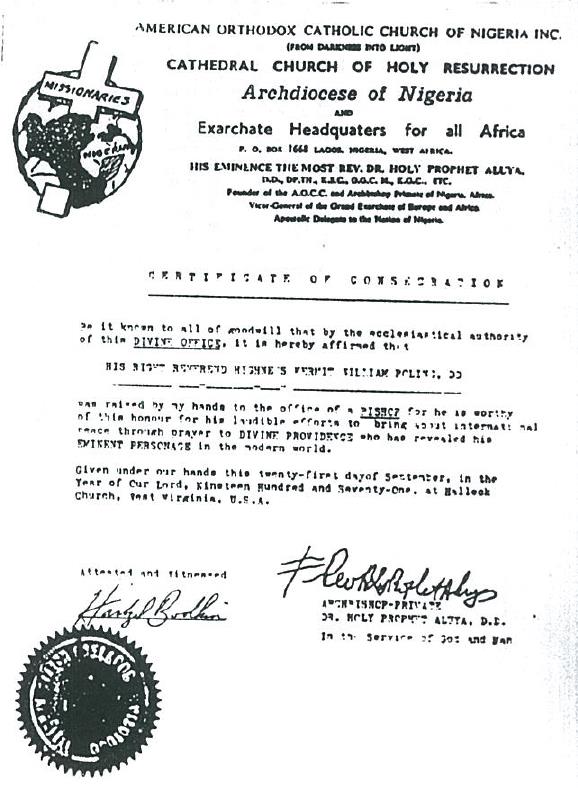
The Apostolic Succession that was held by Mar Lukos is a branch of the Malankara-Syriac succession from Mar Timotheos I (Vilatte) descending through the African Orthodox Church. This branch is preserved today in the Abbey-Principality of San Luigi, and indeed Archbishop Phillip Lewis, one of the consecrators of the present Prince-Abbot and a prelate in the contemporary independent Coptic Orthodox movement, stands in the same succession.

Mar Lukos’ first name is also sometimes mistakenly recorded as Denison, but Mar Georgius’s published references to him make it clear that it was in fact Davison.

Death of Pope Benedict XVI

The Abbey-Principality of San Luigi wishes to express its condolences on the announcement of the death of Pope Benedict XVI.

Ecce sacerdos magnus, qui in diébus suis plácuit Deo: Ideo jure jurando fecit illum Dóminus crescere in plebem suam. Benedictiónem ómnium géntium dedit illi, et testaméntum suum confirmávit super caput eius. Ideo jure jurando fecit illum Dóminus crescere in plebem suam. Gloria patri et filio et spiritui sancto.

Lectures of Archbishop John van Ryswyck

Archbishop John van Ryswyck (1898-1963), whose biography can be read here, was a senior member of, and British representative of, the San Luigi Orders between the 1940s and 1960. He was consecrated bishop in 1949 by Mar Georgius of Glastonbury, first Catholicos of the West.

His Lectures were delivered between 1942 and 1947 and reflect his personal perspectives on a variety of issues that pertain to the more esoteric aspects of the Christian Faith and its history. They were originally collected and placed online by members of his family, and are now reproduced for educational purposes so that they may again be accessible to scholars.

The opinions expressed in these Lectures are those of the author, and do not necessarily represent the views of this jurisdiction.

Index of John Van Ryswyk’s Lectures 1942-47

1-4. Introductory: definitions of religion, science and philosophy.
5. The inner pattern of all religions; the “Heaven-Father”
6-10. Decoding the Genesis story from its Sanskrit origin.
11. J.v.R’s ”Three-in-One Cell Theory” (see 79, 87)
12. The mind analysed in its three parts, or functions.
13. ”Lo-Gos”, the word, from Sanskrit, ”Lo” = ”Sound” ”Gos” = ”Divine” (see 51)
14. God in manifestation: His body, Mind and soul. (see 56)
15. The Invisible: the Comos is finite.
16. Thought-forms; the battle between good and evil.
17. An expanding all-round view, in learning, is superior to a step-by-step method of teaching; The power of thought. Christ the Philosopher.
18. Actuality; the Spirit includes all vibration.
19. The one-ness of all life. (see 52)
20. The law of correspondence; man in the image of God. The Balancing Breath. (see 55)
21. Evolution by re-embodiment, the key to the in-equality of man. All things are living.
22. Evolution continued. The path to perfection at the human stage.
23. Evolution throughout creation. The Ascension of Christ was by de-materialisation.
24. Recapitulation. Morley Martin’s experiment, demonstrating the indestructibility of matter.
25-35. Twelve lectures on the Tao-Teh-King in relation to Christianity.
36. Christianity and Eastern philosophy. The consciousness Exercise.
37. Christianity and Islam.
38. Christianity and Gnosticism. Pt. 1
39. Christianity and Gnosticism. Pt. 2
40. Christianity and Buddhism.
41. The Incarnation of Christ (see 57)
42. Christ and the evolutionary process.
43. The mystical aspect of Sound. (see 63)
44. The entrance of Soul into man. Soul-mates.
45. Karma, the Law of Redemption. (see 47)
46. The Soul and Mind in Time.
47. Responsibility. The Akashic Records.
48. The Spirtual centre within. Christ is within.
49. Further warning against outside control.
50. Stages of Man’s search. The four corner-stones, the four ‘L’s’. (see 53)
51-57. The 12 precepts of John van Ryswyk.
58. The two Wills.
59. The Cosmos is the material (finite) universe, not Reality
60-61. The difference between Mind and Soul. (see 53)
62-63. Awareness. Sound is colour.
64. Thought – how it comes into being
65. More about sound. Lucifer (see 43)
66. The continuity of the picture. The Jig-saw.
67. Everything in life has something to tell us of the spiritual.
68. Finding one’s own centre.
69. True measurement. The ”Sacred Inch.” Go’s Aura.
70. The finite is part of the Infinite: everything is threefold.
(71. Not Available)
72. Sound, contd. The conversion of mind into soul.
(73. Not Available)
74. The Positive and Negative in all Religions. Woman – the ”Power behind the Throne”.
75. Practise contact with all life.
76. The Transformers. Don’t expect a spiritual cup of tea!
77. The path of Evolution is circular.
78. Power is within.
79. The Three-in-One Cell and pre-natal influence.
80. We cannot picture God-the-Father.
81. More about the Three-in-One Cell. God, the germ within the egg. Thought is colour.
82. On ”Precept 7.” (No.53). ”Learn to differentiate between Mind and Soul….”.
83. The Inequality of Man (see 55)
84. Mind control.
85. Hades, a state of consciousness. (see 54)
86. St. Augustine.
87. The Quest. Thoughts from various philosophers.
88. The child is not merely an infant. The importance of the mother’s attitude during pregnancy.
89. The theories of Plato and of other ancient philosophers. (see 51, part 2) Christ-ianity and Christian-ism
90. More about the theories of philosophers.
91. How to develop awareness.
92-95. The Palaeosophic treatment of disease. (see also 20)
96. Introduction to the study of Christian philosophers.
97-105. The philosophy of Jacob Boehme.
106-112. The philosophy of Descartes.
113-116. The philosophy of Roger Bacon
117. The most wonderful journey of the soul.
118. The power of thought.

The complete Lectures listed above may be downloaded in pdf format at this link:

>>The Lectures of Archbishop John van Ryswyck, 1942-47

Obituary – The Very Revd. Michael Reed OCR

The Abbey-Principality of San Luigi has been informed of the death of the Very Revd. Michael Reed, OCR, at the age of 76. He was Vicar for Ohio in the Apostolic Episcopal Church and Order of Corporate Reunion and had charge of the St Peter the Aleut Apostolic Episcopal Mission in North Olmsted.

Michael Bauer Reed was born in 1946 in Wooster, Ohio. He earned bachelor and master’s degrees in sacred music and music education and in secular life taught music at a school in North Olmsted. He continued to teach music throughout his retirement and sent a number of video recordings of his performances at the Hammond organ as gifts to the Prince-Abbot.

He was ordained priest in 1983 in the Orthodox-Catholic Church of America under Bishops George Hyde and Alfred Lankenau, and subsequently entered the Apostolic Episcopal Church under former Primate Archbishop Francis Spataro. He wrote in 2014 of his church affiliation, “I will probably be right here till the veil opens, and I take the next step!” He served the Apostolic Episcopal Church and the Order of Corporate Reunion faithfully and was a valued member of our clergy.

He is survived by his widow, children and grandchildren. Memory Eternal!

Death of Queen Elizabeth II

The Abbey-Principality of San Luigi extends its sincere condolences on the death of Queen Elizabeth II to the Royal Family and the peoples of the United Kingdom and the Commonwealth of Nations.

Two of the Prince-Abbots of San Luigi, Edmond I and the present Prince-Abbot, Edmond III, have been British by birth, and the San Luigi Orders have been continuously established in the United Kingdom since the 1930s.

We pray for those who join us in mourning the Queen at this time and wish her successor King Charles III God’s grace and strength as he prepares to shoulder the responsibilities of the throne.

A Response to Matthew T. Scarince

The Abbey-Principality of San Luigi notes the comments made by one Matthew T. Scarince on his Twitter account recently that refer to our organization in insulting terms and that reproduce photographs from this website of the late Prince Kermit de Polanie-Patrikios and Prince Hugo-José Tomassini Paternò without our permission.

Matthew T. Scarince (pictured left), who has a second Twitter account under the alias “Matteo Scaringi” describes himself as Catholic Restorationist, Legitimist, Habsburgtreuer Ciarsèano. Maria Laach Liturgical Movement. Author at thewarforchristendom.com”. 

It would appear that he is a young man in his early twenties and a resident of the United States of America.

It is clear from Scarince’s postings that he supports the modernist direction of the present Papacy, the Maria Laach liturgical movement having prefigured the Mass of Paul VI. If we wish to understand this movement better, perhaps we should recall the words of the Abbot of the Maria Laach monastery, Dom Ildefons Herwegen,

“What the liturgical movement is in the religious field is fascism in the political field. – The German person stands and acts under authority, under leadership … Those who do not follow are a pest for the community. … Let us say an unreserved yes to the new structure of the total state, which is thought to be entirely analogous to the structure of the church. The Church is in politics in the world like Germany today.”
Ildefons Herwegen at the third special sociological conference of the Catholic Association of Academics in Germany, Maria Laach July 1933 (Thomas Ruster: The lost usefulness of religion, Catholicism and modernity in the Weimar Republic (2nd edition 1997) Ferdinand Schöningh, Paderborn 1994, ISBN 3-506-77381-X, p. 105).

Our organization, by contrast, while respecting the person and office of the Pope, stands without apology for Catholic Tradition unimpaired and uncompromised, even though this prevents us at the present time from being in full communion with the Holy See. It is not uncommon to find those with a limited understanding of the theology behind Catholic traditionalism falling back on the argument that anything in union with the Pope is legitimate and anything else is not. This is not an argument that bears scrutiny, and it has been answered eloquently and comprehensively by the theologians of the Society of St Pius X and other traditionalist Catholic groups over the past decades.

Elsewhere Scarince has copious words of praise for Count Richard von Coudenhove-Kalergi, who was largely responsible for creating the European Union from which Britain has thankfully now extricated herself. Coudenhove-Kalergi also wished to destroy the European peoples, writing that “The man of the future will be of mixed race. Today’s races and classes will gradually disappear owing to the vanishing of space, time, and prejudice…the Eurasian-Negroid race of the future, similar in its appearance to the Ancient Egyptians, will replace the diversity of peoples with a diversity of individuals.” We reject such ideas entirely, holding that the God-given diversity of mankind has given rise to distinctive races, cultures and nations that should at all costs be preserved, and holding that the promotion of mutual respect for the traditions and established ways of life of the different peoples of the world is the path towards lasting peace and understanding between them.

Elsewhere Scarince appears to be involved with the world of fantasy and fictional monarchy. We could add further observations concerning his published writings, but much of the material reviewed was frankly too dull and poorly written to hold our attention.

Scarince’s curious attention to the restoration of the Habsburg dynasty is again marred by his lack of knowledge. He is clearly unaware that the British representative of the Empress Zita of Austria for many decades (and who received both the Golden Fleece and numerous titles of nobility from the de jure Emperor Otto under her Regency during the 1920s) was a prominent and senior member of our organization. The late Mar Georgius of Glastonbury worked tirelessly to restore the rightful Austrian and Hungarian monarchy. His efforts, it would seem, are now worthy only of being traduced by pompous and opinionated young Americans.

Scarince, like many of his ilk, is all too ready to criticize actual experts in one-line Twitter posts without having any serious factual arguments to put forward. This is the mark of the internet troll rather than the scholar. Of the lawyer and expert on nobility Bob Juchter van Bergen Quast, who is not associated with our organization but has written about it and many others in the past, Scarince opines that he has “some of the worst takes on nobility and house-law I’ve ever seen”. Unlike Scarince, Quast provides sources for his statements and supports his arguments and conclusions in a thorough and scholarly manner. We do not always agree with every point that Quast makes, but we certainly consider that he is among the most significant writers on nobility today. For Scarince, however, Quast is beyond the pale because he criticises the almighty Wikipedia, “Dude [sic] cites himself in an article on his own blog about how Wikipedia is totally wrong. Amazing:” It has clearly not occurred to Scarince that Wikipedia, which is not written by experts and is party to all manner of bullying and influencing tactics by powerful partisan forces, is susceptible to considerable bias and inaccuracy on subjects that are controversial.

It is obvious from Scarince’s comments that he is woefully ignorant concerning the question of Byzantine nobility, as is further proven by his ignoble and base attack on the late Prince Hugo-José Tomassini Paternò. This seems more to be based on the late Prince’s political support for Mussolini (for whom he fought heroically during the Second World War) than on any objective judgement. How curious that this political alignment should be criticised, given Scarince’s endorsement of the Maria Laach liturgical movement as discussed above.

As an indicator of his lack of scholarship, Scarince states entirely incorrectly that the Prince claimed “to be the head of the Sovereign Military Order of Malta”. The correct position is that the Prince in 1975 became Grand Protector of one of the numerous branches of the Order of St John that descend from a common foundation in the original medieval Johannine Order. He certainly did not claim authority over the Order of Malta with which he had no official relationship. It would doubtless harm Scarince’s case to mention that the Prince received the Lateran Cross from the Pope and acted in an official capacity as heraldic advisor to the Venezuelan government. The Prince was certainly no phoney; he was a remarkable and principled individual whose life honoured both his dynastic forebears and the traditions and causes for which he stood. His successor today is also a distinguished member of our organization.

Sadly there are many in our society today who claim to stand for monarchy and legitimism but are in reality little more than modern liberals in disguise, keen to throw mud at those who stand for genuine principle and have sacrificed much to do so.  They will remain safely within the boundaries of the mainstream, even when that mainstream betrays everything that it had inherited. Real monarchy, which is to say monarchy not tethered by a constitution but exercised in absolute form in accordance with sacred tradition, terrifies them. It is no surprise, then, that in order to convince themselves of the rectitude of their position they turn to attacking others. In doing so they can gain the attention that they so crave and the support of those who enjoy the resulting spectacle, while ignoring the shaky foundations of their own beliefs.

We by contrast adhere to Tradition, in religious, cultural and political matters, and will not hesitate to defend our principles and organization against modernist keyboard warriors.