The International College of Arms of the Noblesse was founded in 1925 at the International Convention of the Noblesse de Race in the United States of America, by virtue of powers previously confirmed to the noblesse by Francis II, King of France and extended to French-speaking Canada. King Francis II recognized the right of the noblesse to govern themselves in all matters heraldic, which was then confirmed and extended by Ordinances of the Kings of France dated 1725 and 1744 respectively, as recognized and maintained by Articles XXXVII and XLV of the Capitulation of Montreal 1760, and guaranteed by the Quebéc-Canada Act 1774 and by Articles II and XXVI of the Treaty of Paris 1763.
At the International Convention in 1925 the College was placed under the control of Count H. Victor Cherep-Spiridovich, formerly aide-de-camp to Tsar Nicholas II of Russia. From him, it passed to the British Orthodox Archbishop Mar Frederic Harrington, and on Archbishop Harrington’s death in 1942 he was succeeded as Supreme Herald-Marshall by Mar Jacobus II, British Patriarch. In 1945, Mar Jacobus II appointed as his successor Mar Georgius, Catholicos of the West.
The College was incorporated under Act XXI of 1860 in India on 20 February 1950 (registration 5/1950) as a constituent corporation of the Catholicate of the West. In 1953, Mar Georgius separated his work from the Catholicate, abandoning the Indian incorporation, and founded a new organization. However, the Catholicate continued in existence independently from Mar Georgius and on 6 August 1977 was formally united with the headship of the Apostolic Episcopal Church in an act registered with the Secretary of State of California, USA. In February 2015, the present Prince-Abbot of San Luigi also became Presiding Bishop of the Apostolic Episcopal Church and Catholicos of the West, whereby the College became part of a common administration with the Abbey-Principality of San Luigi under the Prince-Abbot as Supreme Herald-Marshall.
The International College of Arms of the Noblesse, Limited, is incorporated in England and Wales with number 13020067. Contact details are contained on the contact page.
John The Duke of Avram, born John Charlton Rudge, is an Australian citizen and the leader of a micronation called the Grand Duchy of Avram. He has represented and issued documents in the name of the International College of Arms of the Noblesse without any legitimate authority and in contravention of the rights of the rightful owners of the College.
Representations were made by us in 2015 to John The Duke of Avram asking by what right and authority he used the name of the College. The response was “We took over the organisation in good faith by Letters Patent in 1987 and have been issuing Letters Patent from that date”. This was interpreted by our office as meaning that any such authority had been entirely self-assumed. Despite being made aware of the rightful representation of the College within the Abbey-Principality of San Luigi, no adjustment or retraction has been forthcoming from the Grand Duchy of Avram.
Consequently, this notice is published to make the public aware that the use of the name of the College by the Grand Duchy of Avram is without legitimacy and in contravention of the rights of the genuine College, and that any heraldic grants that may have been made by the Grand Duchy of Avram using the name of the College will not be recognized within the genuine College.
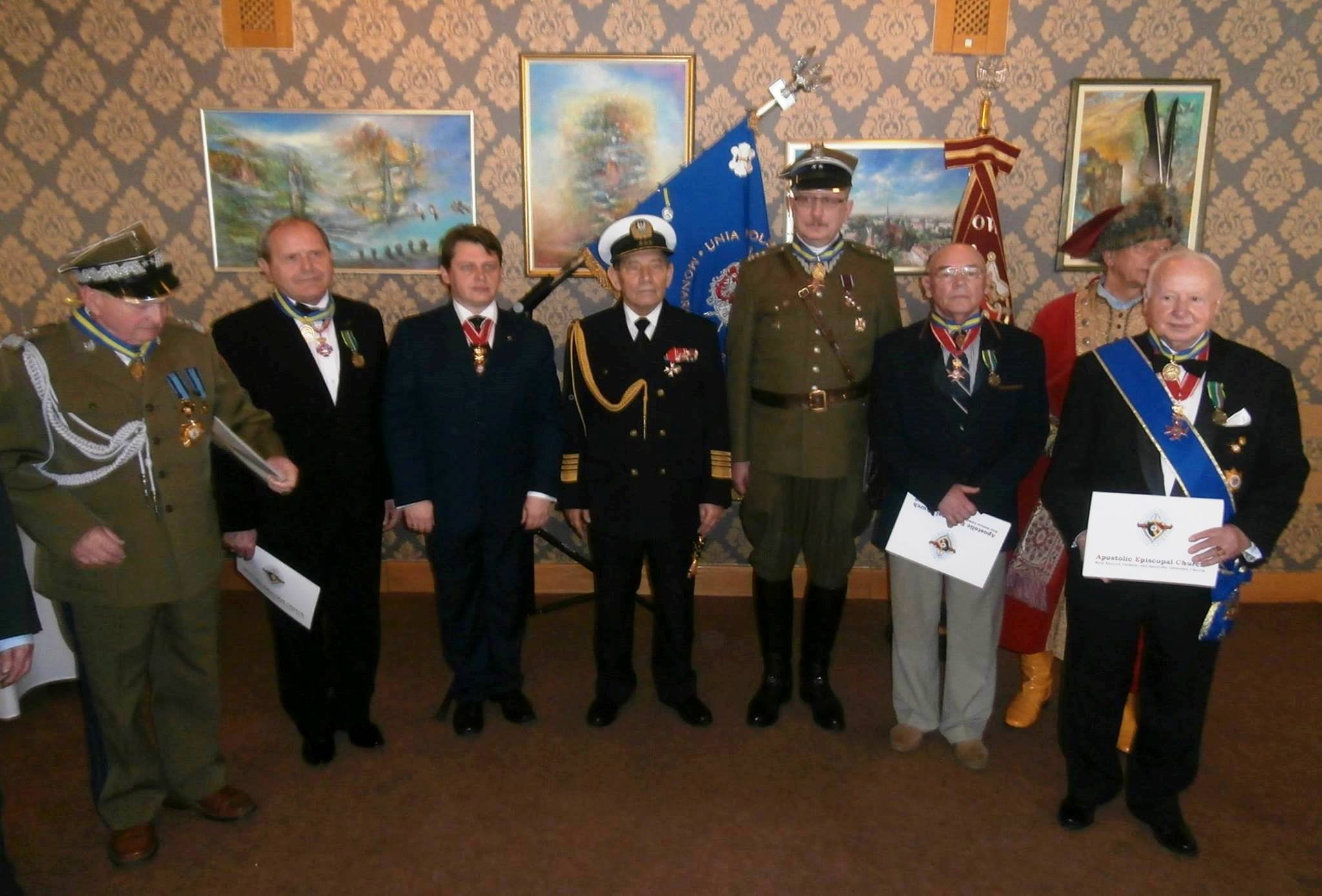
On 24 April a ceremony took place in Poland at which the Juliusz Sokolnicki Memorial Medals were presented by H.E. Dr Norbert Wójtowicz, Grand Prior for Continental Europe of the San Luigi Orders. The Medals, which are awarded in silver and in gold, were instituted by the Apostolic Episcopal Church to commemorate the late Count Juliusz Nowina-Sokolnicki, who was a bishop of the Apostolic Episcopal Church. They are charity medals and for each medal, a donation will be made to support activity centres for children from poor families in Wrocław, Poland.
Dr Wójtowicz presents the Gold Medal to Ryszard Złociński
Recipients of the Sokolnicki Medals in Gold: Stanisław August Chmura, Maciej Myczka and Ryszard Złociński.
(Not shown) Recipients of the Sokolnicki Medals in Silver: Jerzy Mieczysław Korwin Małaczyński, Wacław Nowak, Jolanta Cieśla Zagórska, Jan Stanisław Posiew.
List of Recipients of the Juliusz Sokolnicki Memorial Charity Medal:
– Count Prof. Jose Antonio de Almarza Martin Vogue
– Mr Alfredo Lopez Ares
– Mr Wiesław Barnat
– Mr Czesław Berkowski
– Mr Władysław Borcz
– Mr Stanisław August Chmura
– Ms Jolanta Cieśla-Zagórska
– Mr Robert Clifford Hoani Cribb
– H.S.H. Edmond III, 8th Prince Abbot of San Luigi
The sudden death of the Revd. Richard Pumphrey as a result of injuries sustained in a car accident has deprived the Apostolic Episcopal Church of one of her most effective priests.
Charles Richard Pumphrey was born in 1947 in Evansville, Indiana. Strongly traditionalist in his beliefs, his advocacy of traditional Anglicanism was of a piece with a worldview that he saw as defending a threatened Western civilization. He graduated with an Associate of Arts degree with a major in Bible from Freed Hardeman College in 1967 and a Bachelor of Arts degree in Education and History from David Lipscomb College, Tennessee, in 1969, also studying for a year at Memphis Theological Seminary. In 2003 he received the degree of Master of Theology in Pastoral Counseling from Campbellsville University, Kentucky.
Faced with the modernist changes in the Anglican Communion that became particularly visible towards the end of the twentieth-century, he initially joined the Orthodox Anglican Church. This church was founded as the Episcopal Orthodox Christian Archdiocese of America by Episcopalians in 1963, and was not originally a “continuing Anglican” body, but in 1999 a decision was taken that it would orientate itself to a greater extent with the Continuum, with its name changing to the Orthodox Anglican Church in 2005. He was ordained deacon in 2001 and priest in 2002 by that church’s presiding bishop, the Most Revd. Scott McLaughlin. In 2002, he received the degree of Master of Arts in Biblical Studies from St Andrew’s Theological College and Seminary of the Orthodox Anglican Church, and then served that seminary as a professor between 2002 and 2008. He also undertook pastoral charges as associate priest of Holy Apostles, a Bolivian ministry in Elizabethtown, Kentucky (2004-06), and student chaplain to Ephraim McDowell Memorial Hospital in Danville, Kentucky (2003). He also served as chaplain to his local fire department for several years.
In secular life, he worked in the field of insurance, and was latterly Senior Field Representative for the Pennsylvania Lumbermens Mutual Insurance Company.
In April 2008, faced with declining opportunities for ministry in the OAC, he was received into the Anglican Catholic Church, one of the Continuing Anglican churches that derived from the 1977 Congress of St Louis, and was inducted as celebrant at All Saints, Soddy-Daisy, Tennessee. He was advanced to Rector of that church in May 2010.
Later that year, he became interested in the opportunities for ministry in the Ecclesia Apostolica Divinorum Mysteriorum, a new communion of the Apostolic Episcopal Church that had been formed with a specific mission towards the inner and contemplative traditions. He was received by incardination into EADM from the ACC in December 2010 and subsequently licensed as a priest in the Apostolic Episcopal Church in February 2015. He was further admitted to membership in the First Class of the Order of Antioch and to membership of the Order of Corporate Reunion.
He was married five times, lastly in 2012 to Tricia, who survives him. Their marriage was close and resulted in a loving home life. One interest they shared was the raising of chickens. By his first marriage he had two daughters, Jennifer and Rebecca, and with his fourth wife he adopted Stephanie. He was also a foster parent and between 2002-07 he served as Chairman of the Washington and Marion County, Kentucky, Foster Care Review Board and as a member of the Interested Party Review Board.
Richard Pumphrey was passionate about making a difference to the world around him. He was politically engaged in what he believed was a struggle for the survival of Western civilization and the Christian values that were at its heart. He advocated for the American Freedom Party and, via social media, was a frequent commentator on political and social issues. In all of this, he avoided any suggestion of bigotry or hatred and grounded his commentary in sound religious principle, careful research and a genuine regard for his community. He also displayed a sense of humour that made his writings accessible and invited others to share his world and the deeply-held values that illuminated it. One of the most significant roles that he took on was as a mentor to young people interested in Traditional Anglicanism.
Our thoughts and prayers at this time are with his widow Tricia and his family.
The Abbey-Principality of San Luigi has entered into a Treaty of Full Collaboration, Partnership, Accreditation and Recognition with the Venerabile Confraternita (o Compagnia) detta del Buonconsiglio di Città di Castello and the OR.VEN. – Ordine Venerabile della Venerabile Confraternita di Maria Ss.ma del Buonconsiglio della Buona Morte e Misericordia, Città di Castello, Italy (Order of the Venerable Confraternity (or Company), known as of (Our Lady of) Good Counsel of Good Death and Mercy of Città di Castello). This chivalric and Christian brotherhood can trace its origins to the last years of the first millennium (990-999 A.D.) and in its present form dates to 1230, making it probably the oldest religious brotherhood in continuous existence today. The Order is based at Città di Castello (Province of Perugia) where it has its own Magistral Church, and is governed by a Grand Prior (Grand Master). The Prince-Abbot has the honour to be a Perpetuum (Grand Cross) of the Order, its highest rank.
The J.S.M. Ward Society, a constituent society of the Apostolic Episcopal Church and a research centre of the Western Orthodox University (Commonwealth of Dominica), has provided the cover feature of the June edition of The Square, the independent quarterly magazine for Freemasons. In his article, Warren D. Pilkington gives an introduction to the nature and aims of the Society and discusses both Ward’s life and his considerable involvement in Freemasonry.
The editor of The Square is Dr Mike Kearsley, who is a Professorial Fellow of the University.
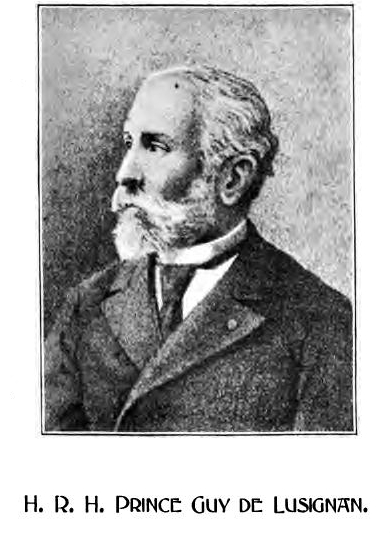
Calfa and his brothers asserted that they were descendants of the Lusignan dynasty that had once ruled Jerusalem, Cyprus and Lesser Armenia. Accordingly, following the death of his elder brother in 1887, Calfa styled himself Prince Guy de Lusignan, Prince Royal of Jerusalem, Cyprus and Armenia. His claim was the subject of much controversy both during and after his lifetime, but there is no evidence that his stance on these issues was other than sincere. A book in support of him, The Royal House of Lusignan, was published by William Edward Horton in 1896.
He was the second of the three sons of Kevork (George)-Yusuf Calfa (1802-1838 or 1859), called Nar Bey, an Armenian merchant in Constantinople, and Sophie Cantar (or Kantaroglou), daughter of an Armenian merchant banker in the Ottoman capital. His family was of Jewish descent, but he and his brothers were brought up as Roman Catholics. He studied at the Mekhitarist college in Venice and then, after 1848, in Paris. His studies revealed a particular gift for history and linguistics.
In 1854 he was appointed Prefect of Studies at the Armenian College Moorat Samuel in Paris (Rue Monsieur) and settled permanently in this city, where he later founded an Armenian National College which he directed between 1856 and 1859. He became a member of several learned societies, including the Asiatic Society, and published several works on history and linguistics, including an Armenian Calligraphy (Paris, 1853), which won awards at the Universal Exhibition of 1855, and, above all, an Armenian-French Dictionary (Paris, Hachette, 1861) dedicated to Tsar Alexander II of Russia. This latter work went through numerous imprints and was the standard reference work on its subject in its time. He founded and edited the short-lived French-Armenian journal La Colombe de Massis.
Both he and his elder brother Youssouf Leon Calfa Nar Bey were domiciled in France, but continued to maintain close ties with their country of origin. Youssouf Leon, a businessman associated with the Baron Seillière, was a supplier of equipment to the Ottoman army, while Ambrose received the Sultan Abdul-Mejid plate of the Order of Medjidie (1858). The youngest of the siblings, Djivan (John)-Khorene, remained in the Levant, where he devoted himself to religion as an archbishop in the Armenian Apostolic Church.
On August 12, 1863, Ambroise Calfa married Marie Louise Ambrose Calfa Legoupil Josephine (1833-90). The couple had two children, Emilia-Gabrielle (who married Gérard, Marquis of Naurois) and Leon-Amaury-Gaston. Before settling in a villa in Neuilly, the family lived in a mansion on the Avenue d’Eylau and had other buildings on the same street. One of their tenants was none other than Victor Hugo, who lived there for his last ten years.
From 1878, Ambrose and his brothers claimed publicly that they were members of the cadet branch of the House of Lusignan, which had provided medieval Armenia’s last sovereign. They based these claims on a letter of recognition which was addressed to them by the head of the elder branch of their family, a cousin of their father named Prince Louis Christian de Lusignan (1807-84). Prince Louis was a colonel in the Russian army and his titles of Crown Prince of Cyprus, Jerusalem and Armenia had been recognised by the Russian Empire. He was the eventual heir to Louis, the last French Marquis de Lusignan, who was the brother of his great-grandfather.
E.P. Karnovich’s Rodovye prozvaniya I tituly v Rossii (Family Names and Titles in Russia) (St Petersburg 1886) discusses Louis de Lusignan’s case. According to Karnovich, there was a colonel named Prince de Lusignan in the Russian service, allowed to be called the titular King of Cyprus and Jerusalem by Tsar Nicholas I. He claimed to be descended from Christobul de Lusignan, who had served in the Greek army under the Byzantine empire and was allegedly descended from a member of the Cypriot House of Lusignan who had moved to Egypt and on to St Petersburg in Russia. Tsar Nicholas I allowed Colonel Lusignan to be matriculated as a Russian noble. In the issue No. 180 of the Peterburgskiy Listok (Petersburg List) Newspaper July 3–15, 1884, a list of the deceased in St Petersburg between 11 June and 18 June was found. There was a record for Louis Christian de Lusignan, colonel (retired). In the same newspaper, issue No. 172 June 25-July 7, 1884, the following article was published: “The deceased who was buried thereby on Smolensk graveyard on 23 July, was titled King of Cyprus and Jerusalem and Armenia, descendant of one of the protectors of God’s Casket, colonel of the Russian service, Louis de Lusignan.” An obituary was also published for him in the New York Times, which referred to his tireless but unsuccessful attempts to restore his kingdom.
The Calfa brothers asserted that their surname was an alteration of the word khalifa (caliph) and that their patronymic Nar Bey referred in the case of Nar to “fire” or “flame” (referring to the Latin word lux, “light” in this “Lusignan”), and Bey to the recognition of their rank by the Ottomans.
At the death of his elder brother Youssouf Leon on October 12, 1887 (Prince Louis Christian having died in 1884), Ambroise-Guy claimed headship of the Royal House of Lusignan, and as such, assumed the titles of Crown Prince of Cyprus, Armenia and Jerusalem. In 1891 he revived the Order of St. Catherine of Mount Sinai. His wife Princess Marie de Lusignan established the Humanitarian and Royal Order of Melusine on August 15, 1881. A webpage for a recent revival of this latter order is maintained here. The members of the original Order included King Alfonso XII of Spain, King Luis I of Portugal, Anthony W. Gardiner, President of Liberia, Joaquin Crespo and Juan Pablo Rojas Paul, successive Presidents of Venezuela, Bernardo Soto Alfaro, President of Costa Rica, Lysius Salamon, President of Haiti, and the following Roman Catholic dignitaries: Ferdinand Cardinal Donnet, Guglielmo Cardinal Sanfelice d’Acquavilla, Patriarch Vinceno Bracco, and Lucido, Cardinal Parocchi. This list of supporters is worth bearing in mind when considering the merits of the various propagandistic writings against the Calfas and their chivalric work.
It was not long before the claim of the Calfas to headship of the Lusignan dynasty was hotly contested by others, such as a certain Jacques Roux de Lusignan and Prince Michael David, (claiming as son and heir of Louis de Lusignan of Russia), while another Lusignan, Korikosz Leon, died in poverty in Milan in 1876. In an attempt to determine the position, a trial was scheduled in 1880 before the civil tribunal of the Seine, but the tribunal declined jurisdiction over the dispute. Prince Michael published a history of his family and their descent in 1903. Without doubt, the acrimonious division between different branches and representatives of the family made it easier for their critics to dismiss their claims altogether, although examination would suggest that each of the three main branches as well as further branches in Spain and the Middle East were indeed lineal descendants of the medieval Lusignan dynasty.
John Charles Thomas (September 6, 1891 – December 13, 1960) was a popular American opera, operetta and concert baritone. He was a member of the Order of the Crown of Thorns and received the Grand Prix Humanitaire de France et des Colonies.
Hear Thomas sing “Largo al factotum” from Rossini’s Il Barbiere di Siviglia:
Birth, schooling and stage debut
John Charles Thomas was born in Meyersdale, Pennsylvania. He was the son of a Methodist minister of Welsh descent while his mother, of German immigrant stock, had been an amateur singer. After studying initially for a medical career, Thomas won a scholarship to the Peabody Institute in Baltimore in 1910. He remained there for two years, receiving vocal tuition from Adelin Fermin.
In 1912, Thomas left the Peabody and toured briefly with a musical troupe. He then went to live in New York City, where he performed with a Gilbert and Sullivan operetta company before being contracted by the Shubert brothers to perform in the show The Peasant Girl, which opened in March 1913. For the next nine years, he starred in a series of hit Broadway musicals including Her Soldier Boy, Maytime, Naughty Marietta, and Apple Blossoms (with Fred and Adele Astaire).
Operatic, recital and radio career
Thomas sang in a concert performance of Rimsky-Korsakov’s opera Sadko at New York’s Carnegie Hall in December 1924. His debut in a fully staged opera occurred in March 1925, as Amonasro in a production of Verdi’s Aida, presented by the semi-professional Washington National Opera.
Thomas was earning a great deal of money singing on Broadway but he wanted to gain more experience in opera. During the 1922-28 period, he spent part of each year in Europe, polishing his singing technique and appearing under contract at La Monnaie opera house in Brussels for the seasons of 1925-27. He would return to La Monnaie for 25 more performances in 1928, eight in 1930 and four in 1931. Even more importantly, he appeared with the famous Russian bass Feodor Chaliapin in productions of Faust at the Royal Opera House, Covent Garden, London, in July 1928.
He continued to give recitals in the United States during this period and, in 1923, acted in a silent film, Under the Red Robe, directed by Alan Crosland. He made recordings, too, for the Vocalion label (1920–24) and Brunswick Records (1924–29), before signing with RCA Victor in 1931. Thomas also became a pioneer of radio broadcasts, in both New York and Florida. From 1929-32 he was a member of the Philadelphia Grand Opera Company, and in 1930 made one appearance with the Philadelphia Civic Opera Company.
He accepted engagements with the Washington National, San Francisco, Chicago and Philadelphia opera companies, and in 1934, to satisfy a public demand, he was signed by the Metropolitan Opera in New York City. He would remain at the Met until 1943, performing opposite such stars as the soprano Rosa Ponselle.
In the tough Great Depression years of the 1930s, he established himself as one of the most sought-after singers in America, with both a classical-music following and a considerable popular audience. His concerts normally offered selections from both repertoires: classical and operatic to begin, and American art songs and humorous “character” songs to close. He also appeared regularly on commercial radio programs. These included Five-Star Theater (in 1932-33 with the Joseph Bonime Orchestra), the Vince Radio Program (1934–36), the Ford, General Motors and The Magic Key of RCA shows (1937–40) and the Coca Cola show (1940–41).
In 1938, he helped Edwin Lester launch the Los Angeles Civic Light Opera, appearing in the company’s very first production in Blossom Time. This work was derived from a Viennese operetta Das Dreimäderlhaus, with music arranged from that of Schubert and adapted for American audiences by Dorothy Donnelly and Sigmund Romberg. Thomas sang regularly in operettas with the LACLO until 1942, starring in productions of The Gypsy Baron, H.M.S. Pinafore, The Chocolate Soldier and Music in the Air.
He now divided his private time between residences in Easton, Maryland, and Palm Beach, Florida, pursuing an active life as a sportsman. Golfing, yachting, racing speedboats and deep-sea fishing counted among his favourite pastimes.
The Second World War made concert touring inconvenient, and very high taxes made it non-remunerative. Thomas was duly engaged to star on the Westinghouse Radio Program in 1943-46, accompanied by the Victor Young Orchestra. He probably reached his widest audience during this period, although his practice of performing songs exclusively in English has perhaps left him less well-remembered by today’s musical “purists” than he should be. Nevertheless many songs tailored for him to sing have gone on to become standards, such as the version of “The Lord’s Prayer” by Albert Hay Malotte and the arrangement of “Home on the Range” by David W. Guion.
In 1947-48, Thomas undertook a long and demanding tour of Australia and New Zealand, where he played to crowded theatres. He retired bit by bit from the concert stage after 1950, and settled in Apple Valley, California in 1955 with his wife Dorothy. He died there in December 1960 from cancer. Owing to his high-spending lifestyle, the fortune that he had earned through singing was largely dissipated at the time of his death.
Recordings
John Charles Thomas left a large pool of audio recordings, many of which sold extremely well in their day and have been transferred in recent times to compact disc. Only a handful of these recordings, however, are devoted to opera arias. His operatic voice is probably best appreciated in commercial offerings such as “Nemico della patria” from Andrea Chénier, and “C’en est fait… Salomé demande” from Hérodiade. However, live broadcast recordings of “Per me giunto” from Don Carlos, “Vien Leonora” from La favorite and “Il balen” from Il trovatore display his brilliant top notes and bel canto capabilities.
He sang hymns, art songs, ballads, cowboy tunes, introspective German lieder, and shanties.
Voice
Thomas belonged to a remarkable sequence of exceptionally gifted American operatic baritones whose neatly overlapping careers stretched in an unbroken line from the 1920s through to the 1960s. They included Richard Bonelli, Lawrence Tibbett, Arthur Endrèze (who was based in Paris), Leonard Warren and Robert Merrill.
His was an essentially lyric voice, which, while not “light”, was more notable for its free top register than for its lower range. It was particularly suited to the French operatic repertoire, in which he was seldom heard in the United States apart from his Athanael in Massenet’s Thais. It had remarkable flexibility, which was enhanced by Thomas’s energy and expressiveness, particularly in his repertoire of popular material. In operatic work, however, this skill could be shown to good effect in trills and runs. Notable examples of his technical expertise are displayed his versions of “Il balen” from Il trovatore, and the “Drinking Song” from Hamlet.
In common with a lot of singers of his inter-war generation, Thomas’s voice was highly distinctive. In part, this may have been due to his early career on Broadway. He knew how to “sell” a song—to build a stirring aria to a climax that would bring audiences to their feet. While the voice was always unmistakably his, it changed noticeably in character over time. His early recordings display a darker tonal hue, and the voice is stiffer, as though he were imitating the stentorian Italian baritone of a previous generation, Titta Ruffo. By 1931, and certainly by 1934, he had found the more fluid, natural vocal style for which he is best remembered. From the late 1940s into the ’50s, his vibrato began to widen, though it never became an unpardonable flaw in his singing technique, and the voice grew somewhat thicker and heavier in tone.
Honours and legacy
He was a National Patron of Delta Omicron, an international professional music fraternity.
He was awarded a star on the Hollywood Walk of Fame on February 8th, 1960.
His rendering of the chorus of “Open Road, Open Sky” from “The Gypsy Baron” was chosen as soundtrack to the Audi TV advertising campaign in 2011.
Louis Prota Giurleo Miraglia Gulotti (1857-1916) was the first Primate of the Chiesa Episcopale Nazionale Italiana. He was Prelate-Commander of the Order of the Crown of Thorns for Italy.
He was ordained priest in the Roman Catholic Church in Italy in 1879, taking the name Paulo, and joined the Society of Jesus. On 2 May 1895 he founded the Chiesa Cattolica Italiana Indipendente, and as a result was excommunicated by Rome on 15 April 1896. He founded the journal Le Jerome Savonarole. Prince-Abbot Joseph III consecrated him in Paris as Bishop of Piacenza and head of the Chiesa Episcopale Nazionale Italiana on 6 May 1900. Hearing of this event, Pope Leo XIII excommunicated Prince-Abbot Joseph III and confirmed the earlier excommunication of Gulotti on 13 June.
On 15 September 1900, Gulotti established the Seminario Teologico di Formazione Presbiterale, Milan. Between 1900 and 1904 he was a refugee on Corsica, and there joined an independent Old Catholic mission. In May 1908 he settled in New York where he was Prince-Abbot Joseph III’s suffragan, and with him subscribed to the Declaration of Ecclesiastical Principles issued on 6 January 1910. He ministered extensively to Italian-American communities and established missions in New York, Ohio, New Jersey and West Virginia. In addition, he visited England, and consecrated William Patterson Whitebrook, a barrister, at Headley, Hampshire, on 27 December 1908.
During 1916, Mgr. Gulotti was partially paralyzed and came to live with Prince-Abbot Joseph III at the rectory of Our Lady in Chicago. On June 25 he died of heart disease. His jurisdiction was subsequently incorporated into the North American Old Roman Catholic Church, which has several successor bodies that survive today.

 The International College of Arms of the Noblesse was founded in 1925 at the International Convention of the Noblesse de Race in the United States of America, by virtue of powers previously confirmed to the noblesse by Francis II, King of France and extended to French-speaking Canada. King Francis II recognized the right of the noblesse to govern themselves in all matters heraldic, which was then confirmed and extended by Ordinances of the Kings of France dated 1725 and 1744 respectively, as recognized and maintained by Articles XXXVII and XLV of the Capitulation of Montreal 1760, and guaranteed by the Quebéc-Canada Act 1774 and by Articles II and XXVI of the Treaty of Paris 1763.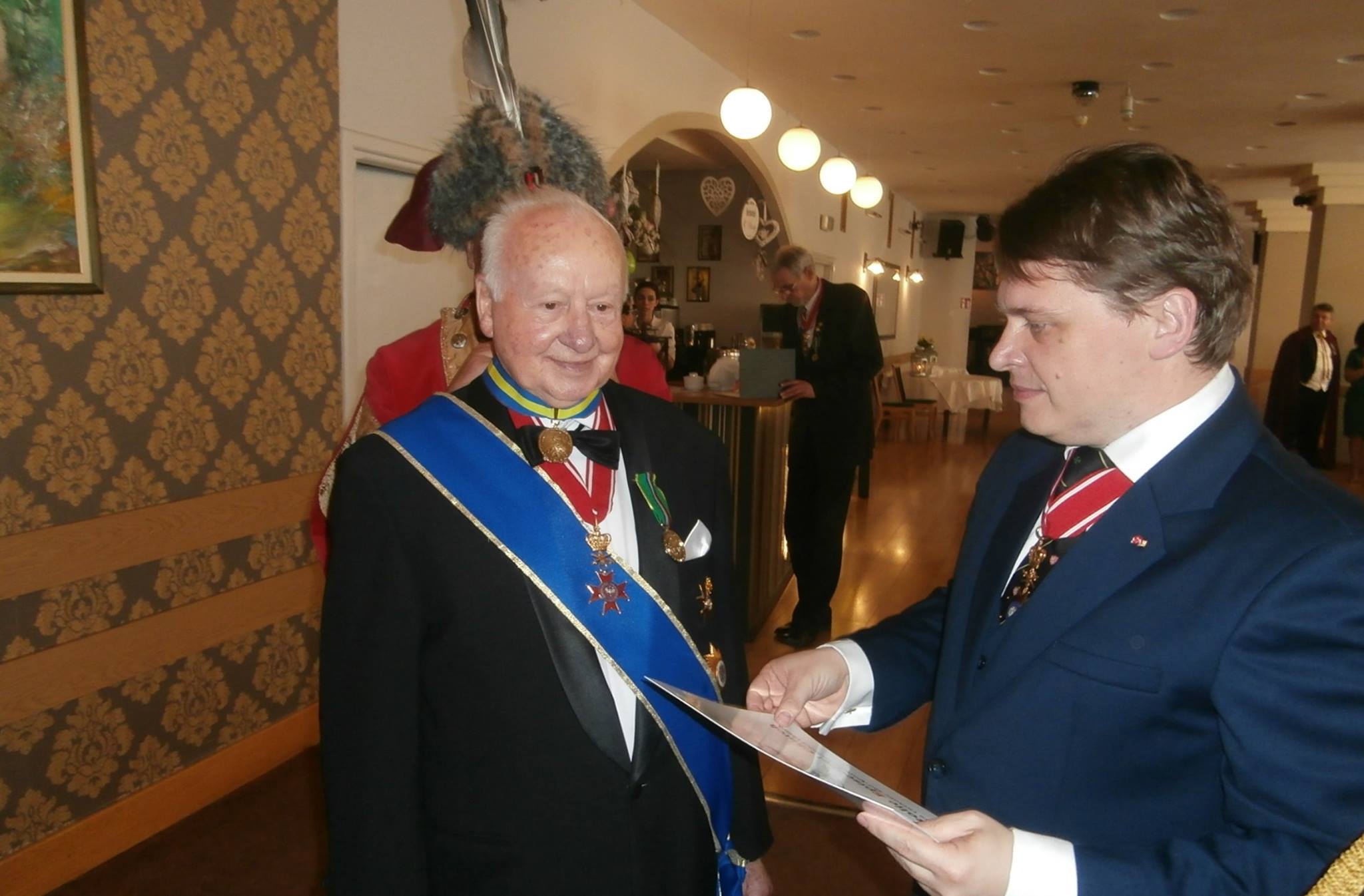

 The Abbey-Principality of San Luigi has entered into a Treaty of Full Collaboration, Partnership, Accreditation and Recognition with the Venerabile Confraternita (o Compagnia) detta del Buonconsiglio di Città di Castello and the OR.VEN. – Ordine Venerabile della Venerabile Confraternita di Maria Ss.ma del Buonconsiglio della Buona Morte e
  Misericordia, Città di Castello, Italy (Order of the Venerable Confraternity (or Company), known as of (Our Lady of) Good Counsel of Good Death and Mercy of Città di Castello). This chivalric and Christian brotherhood can trace its origins to the last years of the first millennium (990-999 A.D.) and in its present form dates to 1230, making it probably the oldest religious brotherhood in continuous existence today. The Order is based at Città di Castello (Province of Perugia) where it has its own Magistral Church, and is governed by a Grand Prior (Grand Master). The Prince-Abbot has the honour to be a Perpetuum (Grand Cross) of the Order, its highest rank.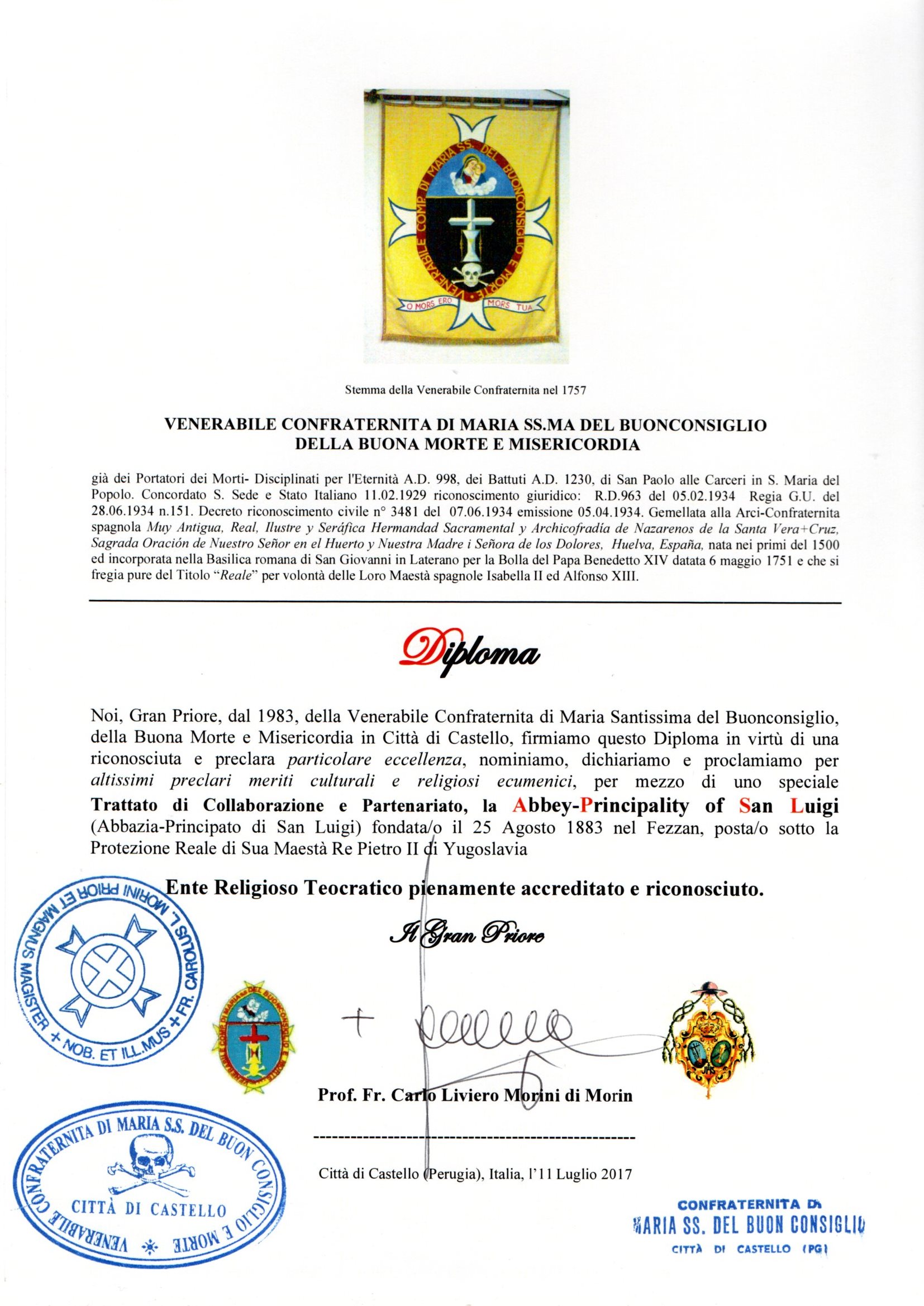






You must be logged in to post a comment.