The Kingdom of Araucania and Patagonia was established by French lawyer Orélie-Antoine de Tounens (regnal name Antoine I) in 1860 as the result of his election as king by a group of local tribal leaders in the Mapuche region, now part of Chile. He established his capital at Perquenco, minted coins with the name Nouvelle France, devised a national flag and founded chivalric orders, all with the aim of ensuring that the Mapuche nation could assert its independence and separate identity in the face of active hostility from its neighbours.
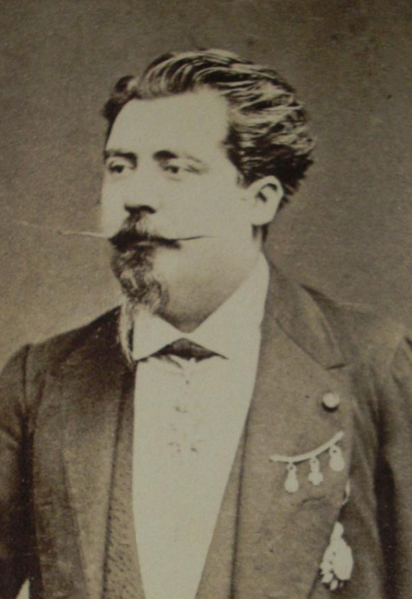
The Mapuche at that time were engaged in armed struggle against Chile and Argentina, which sought to conquer their lands. This resistance proved unsuccessful and within a year of his accession Chile had invaded and occupied the country and imprisoned King Orélie-Antoine I. Eventually released, he spent the remainder of his life in exile in France seeking to regain his kingdom. Before his death in 1878, he appointed a successor as king-in-exile, Gustave Achille Laviarde (1841-1902), who succeeded him as Aquiles I. His subsidiary titles were Prince of Aucas, Duke of Kialeou and Count of Alsena. During his reign in exile, he made strenuous efforts to have the Kingdom and the rights of its people recognised by the French government, but without success.
Laviarde was of noble descent and was born in Rheims. He travelled widely as a young man and spent time in the service of the Bey of Tunis. Returning to Rheims, he was active in the support of the imperialist candidate for mayor, Edouard Werle, and pursued professional interests as a merchant. He allied himself with the Bonapartist cause and was an official invitee at the funeral of Emperor Napoléon III. He was a member and Patron of the Order of the Crown of Thorns.
Dying on March 6 1902 without issue, his heir in the Kingdom was Antoine Hippolyte Cros (Antoine II). The Kingdom continues to exist today and maintains an official website.
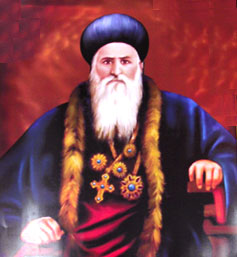
Pulikkottil Joseph Mar Dionysious II (1833-1909) was the Malankara Metropolitan of the Malankara Syrian Orthodox Church. He was a Patron of the Order of the Crown of Thorns. He was the principal consecrator of Mar Julius I Alvarez.
He was born into the family of Pulikkottil (Kunnamkulam), which is an important family in the history of the Malankara church. Considered a courageous and popular spiritual leader, utterly and selflessly dedicated to the church, he guided his followers through one of the most difficult times in the history of the Malankara Church.
He was ordained deacon by Cheppad Mar Dionysius on 6 October 1846 and priest on 18 August 1853 by Metropolitan Yuyakim Mar Kurilos at Challiserry church. On 29 April 1865 at Ameed, Patriarch Yakoob III elevated him to the rank of Ramban. On 30 April he was consecrated as Metropolitan Joseph Mar Dionysios.
Because Patriarch Yakoob III was not a bishop of the Malankara church, Pulikkottil Joseph Ramban was given the episcopal title Pulikkottil Joseph Mar Dionysious. Moreover he was not seated on the Malankara throne (on which Mar Thoma I to Mar Thoma IX were seated at the time of their consecration) and so he did not receive the title Mar Thoma. He was the fifth bishop in the Malankara Church to receive the title Dionysius.
During the eventful forty-four years between 1865 and 1909 he occupied the Malankara Metropolitan’s position with extraordinary skill. It was during that period that the Mulanthuruthy Synod, the division of dioceses and the ‘Holy Mooran Koodasha’ took place. Through his unstinting efforts, spiritual organizations like the Sunday School and the Students’ movement, and Church institutions like the Parumala Seminary, the Kunnamkulam Sehiyon Bungalow, the Kottapuram Seminary and the M.D. Seminary developed.
The history of Catholicate and M.D. Schools states “In 1870, he started a Syriac printing press, Saint Thomas, at Cochin, for publishing Syriac prayer books. At around the same time he started a Church magazine ‘Kerala Pathaka’ in Malayalam, which was later merged with another news magazine, ‘Paschimathara’. Unfortunately this Church magazine was discontinued due to financial problems. But again in January 1892, another monthly, ‘Edavaka Patrika’ started publication from Kottayam Marthoma Press.During his tenure as Malankara Metropolitan, a large gathering of Roman Catholics from Goa, joined the Suryani Church. Fr. Alvarez, a member of this group, was later consecrated as Metropolitan Mor Yulius [Mar Julius I Alvares] by Mor Dionysius in 1889. Due to the influence of Metropolitan Mor Yulius, another group of Roman Catholics from Ceylon and America too joined the Suryani Church. Their leader Fr. Rene Vilatte [Prince-Abbot Joseph III] was ordained as Metropolitan Mor Timotheos in 1892.”
After the death of Mathews Mar Athanasius Metropolitan, Thomas Mar Athanasius took charge as Metropolitan. Then Joseph Mar Dionysious II made a claim that he and the fellow trustees were the lawful owners of the Church and demanded the possession of the Seminary and control of the assets of the Church. Mar Dionysius filed a case at Alappuzha civil court on March 4, 1879 (O.S.No.439 of 1054). In the final verdict announced on July 12, 1889, Thomas Mar Athanasius Metropolitan lost all claims to the church properties. It mentioned that the consecration, the authority of Thomas Mar Athanasius as Metropolitan and the properties of the individual parishes were not under the jurisdiction of the court. So litigations for individual churches began.
Kunnamkulam Pulikkottil Joseph Dionysious II died on 11 July 1909. His mortal remains were interred in the northern side of the chapel in Pazhaya Seminary. His Death Anniversary is on 12 July.
Bishop James Theodore Holly (1829-1911) was the first African-American to be consecrated bishop in the Protestant Episcopal Church of America. He was a Patron of the Order of the Crown of Thorns.
His parents were of African descent and were Roman Catholics. He was educated at public and private schools and by tutors in Washington, New York City, Buffalo, and Detroit. In 1851 he withdrew from the Roman Catholic Church and entered the Protestant Episcopal Church. From 1852 to 1853, he was associate editor of The Voice of the Fugitive, a weekly paper, published at Windsor, Ontario. In 1854, he was principal of a public school in Buffalo.
He studied theology, and was ordained deacon on 17 June 1855 and presbyter on 2 January 1856. He was rector of St. Luke’s Church, New Haven, Connecticut, from 1856 until 1861, when he was sent to Haiti as a missionary. He served as consul for Liberia at Port-au-Prince from 1864 until 1874, in which year he was made missionary bishop of Haiti by the Protestant Episcopal Church.
In 1878 Holly went to England as a delegate to the Lambeth Conference. He received the degree of D.D. from Howard University, Washington, D.C., in 1874, and that of LL.D. from Liberia College, Monrovia, in 1882. He contributed to the Church, the Church Eclectic, and the African Methodist Church reviews.
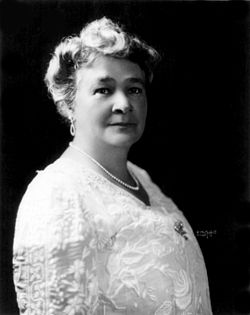
Ernestine Schumann-Heink, née Rössler (15 June 1861 – 17 November 1936), was a celebrated Austrian, later American, operatic contralto, noted for the size, beauty, tonal richness, flexibility and wide range of her voice.
She was a member of the Order of the Lion and the Black Cross and also received the Grand Prix Humanitaire de France et des Colonies. She was the first known Jewish member of the San Luigi Orders.
Listen to Schumann-Heink in Wagner’s Rienzi:
She was born as Ernestine “Tini” Rössler to a German-speaking family in the town of Libeň (German: Lieben), Bohemia, Austrian Empire, which is now part of the city of Prague, Czech Republic. Her father Hans Rössler was a shoe maker; while previously serving as an Austrian cavalry officer, he had been stationed in northern Italy (then an Austrian protectorate), where he met and married Charlotte Goldman, with whom he returned to Libeň. When Ernestine was three years old, the family moved to Verona. In 1866, at the outbreak of the Austro-Prussian War, the family moved to Prague, where she was schooled at the Ursuline Convent. At war’s end, the Roesslers moved to Podgórze, now part of Kraków. The family moved again to Graz when Tini was thirteen. Here she met Marietta von LeClair, a retired opera singer, who agreed to give her voice lessons.
Early career
In 1877, Rössler made her first professional performance, in Beethoven’s Ninth Symphony in Graz, appearing with soprano Maria Wilt, and her operatic debut at Dresden’s Royal Opera House on October 15, 1878 as Azucena in Il trovatore.
In 1882, she married Ernest Heink, secretary of the Semperoper, the Saxon State Opera Dresden; this violated the terms of their contracts, and both had their employment abruptly terminated. Heink took a job at the local customs house and was soon transferred to Hamburg. Ernestine remained in Dresden to pursue her career, and eventually rejoined her husband when she secured a position at the Hamburg Opera. She went on to have four children with Heink. One of their children, Ferdinand Schumann-Heink (1893–1958) was a prolific, though mostly unbilled, Hollywood character actor.
Ernest Heink was again thrown out of work when Saxons were banned from government positions, and departed to Saxony to find work. Ernestine, pregnant, did not follow him; they were divorced in 1893. That same year she married actor Paul Schumann, with whom she had three more children. Her second marriage lasted until Paul Schumann’s death in 1904. She made a brief foray into the Broadway theater, playing in Julian Edwards’ operetta Love’s Lottery, in which her performance was noted for the fact that she often broke off to ask the audience whether her English was good enough. She returned to opera shortly afterwards.
Her breakthrough into leading roles was provided when prima donna Marie Goetze argued with the director of the Hamburg opera. He asked Ernestine to sing the title role of Carmen, without rehearsal, which she did to great acclaim. Goetze, in a fit of pique, cancelled out of the role of Fidès in Le prophète, to be performed the following night, and was again replaced by Ernestine. Schumann-Heink replaced Goetze as Ortrud in Lohengrin the following evening, one more time without rehearsal, and was offered a ten-year contract.
International career
She performed with Gustav Mahler at the Royal Opera House, Covent Garden, London, and became well known for her performances of the works of Richard Wagner at Bayreuth, singing at the Bayreuth Festivals from 1896 to 1914.
She first sang at the Metropolitan Opera in New York City in 1898, and performed with the Met regularly thereafter for decades.
Schumann-Heink made the first of her many phonograph (gramophone) recordings in 1900. Many of them have been reissued on CD and continue to impress due to the quality of her rich voice and the excellence of her technique.
In 1905, she married William Rapp, Jr., her manager. They divorced in 1915.
In the midst of a legal battle in Germany over her late husband’s estate, she filed U.S. naturalization papers on February 10, 1905, which became final on March 3, 1908. She and her new husband lived on Grandview Avenue, North Caldwell, Essex County, New Jersey in her “Villa Fides” from April 1906 to December 1911; she then moved to 500 acres (2 km²) of farm land located just outside of San Diego, California (in an area known as Helix Hill in Grossmont), purchased by her in January 1910, where she would live for most of her life. Her residence there still stands.
In 1909, she created the role of Klytaemnestra in the debut of Richard Strauss’s Elektra, of which she said she had no high opinion, calling it ‘a fearful din’. Strauss, for his part, was not entirely taken by Schumann-Heink; according to one story, during rehearsals he told the orchestra “Louder! I can still hear Mme. Schumann-Heink!”.
In 1915, she appeared as herself in the early documentary film Mabel and Fatty Viewing the World’s Fair at San Francisco, which was directed and starred by Fatty Arbuckle.
Charitable work and community support
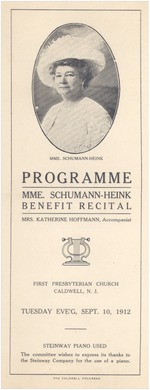
While living at North Caldwell, Schumann-Heink became interested in efforts to honor President Grover Cleveland by acquiring his birthplace and creating a museum in his honor. Friends, family and supporters of President Grover Cleveland asked her to perform at the First Presbyterian Church at Caldwell, New Jersey to raise money for the purchase of Cleveland’s Birthplace in the Presbyterian Manse. Cleveland’s father, Rev. Richard Cleveland had been the minister of the church when the future president was born in 1837. On September 10, 1912 Mme. Schumann-Heink performed a benefit concert at the First Presbyterian Church at Caldwell. The following year the Grover Cleveland Birthplace Memorial Association (GCBMA) purchased the Manse and opened it to the public and Mme. Schumann-Heink became the first lifetime member of the GCBMA.
During World War I, Schumann-Heink supported the United States and military forces. She entertained the troops and raised money to help wounded veterans. She toured the United States raising money for the war effort, although she had relatives fighting on both sides of the war – including her sons August Heink, a merchant marine who had been impressed into the German submarine service, son Walter Schumann, Henry Heink and George Washington Schumann, all in the United States Navy. August Heink died during the war. After the war she continued to support American veterans and her 1936 funeral was held with full military honors and conducted by the American Legion, Post 43, of Hollywood and the Disabled Veterans of the World War, San Diego Chapter.
Later years
In 1926, she first sang Silent Night (in both German and English) over the radio for Christmas. This became a Christmas tradition with US radio listeners through Christmas of 1935. She lost nearly all her assets in the Wall Street Crash of 1929 and was forced to sing again even though she was 69 years old.
Her last performance at the Met was in 1931 performing Erda in Der Ring des Nibelungen, aged 71. In her later years, she had a weekly radio program. In the movies of the 1930s, many a buxom opera singer/instructor/matron was modeled on her; see for instance 1937’s Stage Door.
Death
Schumann-Heink died on 17 November 1936 of leukemia in Hollywood, California.
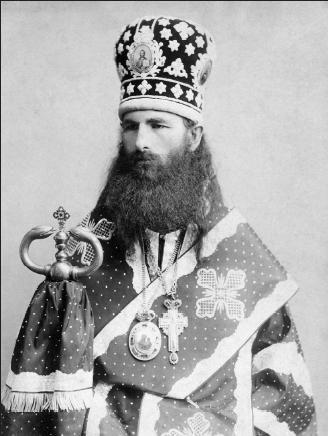
Archbishop Vladimir Sokolovsky-Avtomov (1852-1931) of the Russian Orthodox Church was of great help to Prince-Abbot Joseph III at a time when his American mission was under attack from Anglican and Roman Catholic sources. He took the mission under his omophorion and accepted it into the Russian Orthodox Diocese of North America, Aleutian Islands and Alaska, on 9 May 1891. However, the problems that had arisen in the diocese at that time meant that he was promptly reassigned to Russia, leaving that October. This development led to Prince-Abbot Joseph III’s eventual consecration the following year.
Bishop Vladimir was a Patron of the Order of the Crown of Thorns.
Vasily Grigorievich Sokolovsky-Avtonomov was born in the village of Senkovka in the Poltava Province of Russia on December 31, 1852. His father was a priest in the village. He attended the Poltava Seminary and then advanced on to the Kazan Theological Academy. His studies improved upon his gift for linguistics and music. After graduating from the academy, he was appointed assistant supervisor of the Poltava Ecclesiastical School on July 26, 1878. He was tonsured a monk and given the name Vladimir on September 29, 1878, followed by his ordination to the diaconate on the following October 1, and then to the priesthood on October 3, 1878. Fr. Vladimir led a highly ascetic life, maintaining a strict and sparse vegetarian diet.
On January 14, 1879, Fr. Vladimir was assigned as an assistant to Fr. Nicholas Kasatkin, the future St. Nicholas, Enlightener of Japan. With Fr. Vladimir’s proficiency in languages he was assigned as dean of the Russian language school in Tokyo. The language school would become part of the Tokyo Seminary which was to produce many Japanese linguists and scholars.
Upon his return to Russia, Fr. Vladimir was raised to the rank of igumen in 1884 and then appointed to the faculty of the Kholm Seminary on June 9, 1886. A year later on August 13, 1887, he was raised to archimandrite and appointed inspector of the Khom Seminary. On December 20, 1887, Fr. Vladimir was consecrated to the episcopacy in St Petersburg, Russia, with his first assignment as the ruling hierarch of the Diocese of the Aleutian Islands and Alaska. Bp. Vladimir arrived in San Francisco in March 1888 accompanied by eighteen students and five co-workers of Bp. Vladimir from the Kholm Seminary, who all were eager to help in the work of the mission. With Bp. Vladimir’s arrival the diocese once again had a ruling hierarch who was resident in North America. The previous ruling bishop, Bp. Nestor (Zakkis), was not replaced after his death at sea in 1882.
Using his gift of languages and music, Bp. Vladimir produced musical arrangements for his translations into English of the liturgical texts that the San Francisco cathedral choir sang during the church services. The liturgical services thus attracted many people, resulting in the need for a larger cathedral in San Francisco.
As the decade ended, Bp. Vladimir became cognizant of the strains that had developed among the Slavic emigrants who were members of the Unia from the Austro-Hungarian Empire. In late 1890, he met with a group from Minneapolis, Minnesota led by Fr. Alexis Toth, the future St. Alexis of Wilkes-Barre. On March 25, 1891, Fr. Alexis and his parish were received back into the Orthodox Church by Bp. Vladimir, starting the movement that was to continued for several decades. In his search for Orthodox communities to lead back to Orthodoxy Bp. Vladimir traveled widely, crossing the continent three times in his efforts.
Bp. Vladimir’s tenure as bishop of the North American diocese was cut short when he was assigned on June 8, 1891 as Bishop of Ostrogozhsk, an auxiliary of the Voronezh Diocese. It was October before he departed from North America for his new position. Later, from December 22, 1896, he was assigned ruling hierarch of the Diocese of Orenburg and the Urals, and from November 26, 1903 he was the ruling bishop of the Diocese of Yekateriniberg and Irbit. Due to illness, Bp. Vladimir was granted retirement on March 18, 1910 from active episcopal duties, but was appointed abbot of the Andronikov Monastery in Moscow.
In 1921, Patriarch Tikhon raised Bp. Vladimir to the rank of archbishop and appointed him as the ruling hierarch of Yekaterinoslav (now Dnipropetrovsk, Ukraine). But, the turmoil of the Bolshevik takeover of Russia prevented him from reaching his diocese, and he remained in Moscow. He became associated briefly in 1926 with the Gregorian schism in the Russian Church, but quickly repented and returned to the canonical church. Isolated in Soviet Russia and suffering utter poverty, Abp. Vladimir died on November 27, 1931 and was buried next to the altar of the All Saints Church in the Moscow suburbs where he had been serving.
Throughout his career, Abp. Vladimir sought to improve the quality of liturgical singing. In his writing, he concentrated on refuting Roman Catholic teachings and on missionary activities of the Russian church, with emphasis on the mission to Japan. While in America his fame is centered on his cultural refinement and musical accomplishments, Abp. Vladimir is esteemed in Moscow as an ascetic spiritual elder.
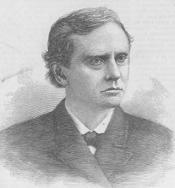
John Steele Henderson (January 6, 1846 – October 9, 1916) was a Representative for North Carolina in the United States House of Representatives.
He was a member of the Order of the Lion and the Black Cross.
Born near Salisbury, Rowan County, North Carolina in 1846, the son of Archibald and Barbara Bynum Henderson, John S. Henderson attended a private school in Melville, N.C. He entered the University of North Carolina at Chapel Hill in January 1862 and left in November 1864 to join the Confederate Army as a private in Company B, Tenth Regiment, North Carolina State Troops.He served throughout the Civil War, and graduated in Law from the University of North Carolina in 1865 without reentering.
Henderson obtained a County Court license in June 1866 and a Superior Court license in June 1867, and was appointed in June 1866 as Register of Deeds for Rowan County, North Carolina, in which capacity he served until September 1868, when he resigned. Henderson was a delegate to the State constitutional convention in 1875, became a member of the State House of Representatives in 1876, and served in the State Senate in 1878. He was elected by the General Assembly in 1881 as one of the three Commissioners to codify the statute laws of the State. In June 1884 Henderson was elected Presiding Justice of the Inferior Court of Rowan County. He was elected as a Democrat to the Forty-ninth and to the four succeeding Congresses (March 4, 1885-March 3, 1895). He was appointed Chairman of the Committee on the Post Office and Post Roads (Fifty-second and Fifty-third Congresses).
He resumed the practice of law in Salisbury, N.C., and was elected to the State Senate in 1900 and 1902. In 1900 he became a member of the Board of Aldermen.
John S. Henderson died in Salisbury, North Carolina on October 9, 1916, and was interred in Chestnut Hill Cemetery.
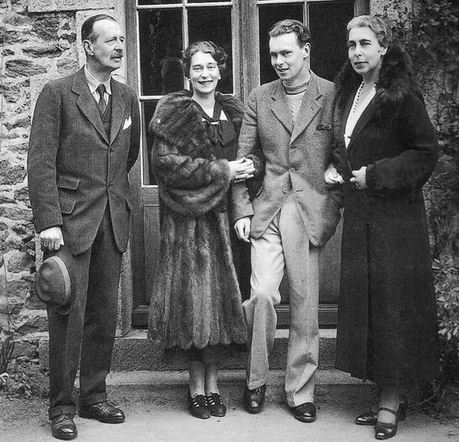
Grand Duke Cyril Vladimirovich of Russia (Russian: Кирилл Владимирович; Kirill Vladimirovich Romanov; 12 October [O.S. 30 September] 1876 – 12 October 1938) was a member of the Russian Imperial Family. After the Russian Revolution of 1917 and the deaths of Tsar Nicholas II and his brother Michael, Cyril assumed the Headship of the Imperial Family of Russia and later the title Emperor and Autocrat of all the Russias.
Grand Duke Cyril was a member of the Order of the Crown of Thorns. He was responsible for the bestowal of several honours upon Prince-Abbot Edmond I, including the Commander’s Cross with Plaque of the Imperial Russian Order of St Stanislas “for foreigners” (22 February 1922), Grand Cross of the same Order (1936), member of honour of the Association Patriotique Russe “Nicholas II”, category Section Armes Imperiale (1936), Commander with plaque, Order of St Vladimir of Kiev, with the first class ribbon of Romanov (1935) (the order was under High Protection of King Alexander of Serbia with the supreme approval of Grand Duke Cyril), Hereditary Knight with Cross of the Order of the Compassionate Heart (1936) (Russian Veterans’ Society) with, by order of Grand Duke Cyril, the Medal “pour zele et assistance” in gold, on the ribbon of the Order of St Andrew, 1st class.
Early life
Grand Duke Cyril was born in Tsarskoye Selo. His father was Grand Duke Vladimir Alexandrovich, the third son of Tsar Alexander II and Maria Alexandrovna of Hesse. His wife was Duchess Marie of Mecklenburg-Schwerin (later known as Grand Duchess Maria Pavlovna), the daughter of Friedrich Franz II of Mecklenburg-Schwerin and Princess Augusta Reuss-Köstritz. As a grandson in the male line to a Russian Tsar, he was titled Grand Duke, with the style Imperial Highness.
War service
After graduating from the Sea Cadet Corps and Nikolaev Naval Academy, on January 1, 1904, Cyril was promoted to Chief of Staff to the Russian Pacific Fleet in the Imperial Russian Navy. With the start of the Russo-Japanese War, he was assigned to serve as First Officer on the battleship Petropavlovsk, the ship was blown up by a Japanese mine at Port Arthur in April 1904. Cyril barely escaped with his life, and was invalided out of the service suffering from burns, back injuries and shell shock.
Marriage and children
Grand Duke Cyril married his first cousin, Princess Victoria Melita of Saxe-Coburg and Gotha on 8 October 1905. Victoria’s father was Alfred, Duke of Saxe-Coburg and Gotha, the second eldest son of Queen Victoria. Victoria’s mother was Grand Duchess Marie Alexandrovna of Russia, a daughter of Tsar Alexander II and Cyril’s paternal aunt.
The marriage caused a scandal in the courts of European royalty as Princess Victoria was divorced from her first husband, Grand Duke Ernst Ludwig of Hesse, also her first cousin. The Grand Duke of Hesse’s sister was Tsarina Alexandra Fyodorovna, the wife of Nicholas II. The Tsarina already disliked her former sister-in-law and first cousin, being instrumental in leading the opposition to the marriage in the Russian court. Shortly after returning to Russia, the Tsar stripped Cyril of his imperial allowance and style Imperial Highness, his honours and decorations, his position in the navy and then banished him from Russia.
However in 1908, after the death of Grand Duke Alexei Alexandrovich had put Cyril third in the line of succession to the Imperial Throne, Nicholas II restored Cyril to his rank of Captain in the Imperial Russian Navy and his position as aide de camp to the emperor. His wife came into favour, and was given the title Grand Duchess of Russia and from then on was styled as Her Imperial Highness Grand Duchess Viktoria Feodorovna. From 1909-1912, he served on the cruiser Oleg and was its captain in 1912. In 1913, he joined the Maritime Division of the Imperial Guards and was made Commander of the Naval Guards in 1915.
Grand Duke Cyril and Princess Victoria Melita had three children:
Grand Duchess Maria Kirillovna of Russia (2 February 1907 – 27 October 1951) who married Friedrich Karl, Prince of Leiningen
Grand Duchess Kira Kirillovna of Russia (9 May 1909 – 8 September 1967) who married Louis Ferdinand, Prince of Prussia
Vladimir Kirillovich, Grand Duke of Russia (30 August 1917 – 21 April 1992) who became the claimant to the title ‘Emperor of Russia’ upon the death of his father
Revolution
During the February Revolution of 1917, Cyril came with his regiment to swear allegiance to the Russian Provisional Government, wearing a red band on his uniform. This caused grave offence to some in the Imperial Family and led to some members shunning him as legitimate heir to the Throne.
After the October Revolution, Cyril and Victoria fled to Finland, then Coburg, Germany. Eventually the exiled family moved to France where they stayed for the rest of their lives.
Life in exile
On 8 August 1922 Cyril declared himself “Curator of the Russian Throne,” a title which he had devised himself. Two years later, on 31 August 1924, he went a step further and assumed the title Emperor and Autocrat of all the Russias. Though by the laws of the Russian Empire, he was the prime claimant after the execution of Tsar’s family by the Bolsheviks, his claim to the throne was met with opposition because at his birth his mother was a Lutheran and not yet a member of the Russian Orthodox Church. After claiming the throne, he became known as the “Soviet Tsar” because in the event of a restoration of the monarchy, he intended to keep some of the features of the Soviet regime.
While living in exile, Cyril was supported by some emigres who styled themselves “legitimists” (legitimisti, in Russian легитимисты), underlining the “legitimacy” of Cyril’s succession. The opponents of Cyril were known as the “un-predetermined” (nepredreshentsi, in Russian непредрешенцы); they believed that in the wake of the radical revolutionary events, the convening of a Zemsky Sobor was necessary in order to choose a new monarch for Russia. (In 1922, Nicholas II’s cousin Grand Duke Nicholas Nikolaevich was proclaimed “Emperor of all Russia” by a “Zemsky Sobor of the Amur Region”, convened by General Mikhail Diterikhs. However, Grand Duke Nicholas had no children.)
Cyril’s son Vladimir Kirillovich succeeded him as head of the Romanov dynasty, although this was contested by some members of the Romanov family. Following the fall of the Soviet Union, the remains of Cyril and his spouse were transferred from Coburg to the Grand Ducal Mausoleum of the Peter and Paul Fortress in St. Petersburg, Russia.
Moran Mor Ignatius Pathros (Peter) IV (sometimes counted as III) (1799-1894), who led the Syrian Orthodox Church for 22 years as its supreme head (1872-94), was the 116th in the line of canonical Patriarchs of Antioch in the Apostolic See of St. Peter. He is regarded as the architect of the modern Syrian Church. He is popularly known as “Peter the Humble”.
The Patriarch was responsible for the re-foundation of the Order of the Crown of Thorns in 1891, appointing Prince-Abbot Joseph III (who had been consecrated on his mandate) as its Grand Master, and became one of its Patrons.
Born in a well known Christian family of Turabdin in south east Turkey, he spent his childhood days at the Mor Hananyo Dayro (Deir al-Za`faran Monastery) which was the centre of the Syrian Church for many centuries. His priestly formation was at this monastery. He was consecrated as Mor Yulius, Bishop of Taifat Alsrien Al-Qadima in 1846 by Moran Mar Ignatius XXXII Elias II, Patriarch of The Syrian Patriarchate of Antioch and All the East between 1838 and 1847, who also appointed him “Julius, Metropolitan of the World”. Between 1850 and 1875 he was Superior-General of The Orthodox-Catholic Guild of S. Columba of Iona.
As the diocesan Metropolitan he succeeded in settling the row with the Roman Catholic Church and recovered many of the ancient Monasteries and churches which were under dispute. It was during his stay at Constantinople that his immediate predecessor Patriarch Mor Yakub II passed away. Because he had difficulty making the long journey to Mardin he informed the Synod of his inability to attend the patriarchal election. But the Synod’s unanimous decision was to elevate Mor Yulius as the next Patriarch; a decision which he politely refused to accept. However under repeated persuasion, he agreed to abide by the decision of the Holy Episcopal Synod.
That title of “Metropolitan of the World” reflected Mor Yulius’s ecumenical ambitions. He had wished for the reunion of Christendom, and accordingly sought to promote a “Reunion Movement” that would bring Orthodoxy to the West, gaining the support of his Patriarch for this mission. However, since his charge did not permit him to leave Syria, he was compelled to look for a man who would be able to fulfil such a mission on his behalf. When he met the former Presbyterian missionary and Roman Catholic priest Jules Ferrette (1828-1904) in 1865, he felt that he had found someone worthy of this trust and capable of achieving its aims. In the event, Peter the Humble would be the progenitor of not one but two Western missions, the second under Prince-Abbot Joseph III, each of which shared the common characteristic that it was not a local branch of the Syrian church, but an indigenous and autocephalous Roman Rite entity that was Orthodox in faith but Western in character and mission.
At last on 16th June 1872, on the day of Pentecost, he was enthroned as the 116th Patriarch of Antioch at the ancient St. Mark’s Dayro in Jerusalem. The Patriarch after his enthronement went to Amida (Omid / Dierbakir) and stayed there for a short period. The Dayro there was reconstructed under the advice of the Patriarch. In 1872 His Holiness ordained Rabban Abdul Sattuf as Metropolitan with the name Mor Gregorios for the Archdiocese of Jerusalem and then left for Constantinople. Through the exertion of His Holiness, the Syrian Christians received direct representation at Constantinople (recognition as an independent millet in Ottoman Turkey) and were honoured with other exclusive rights, thus fulfilling the long standing aspirations of the community.
During 1875-77 the Patriarch was in India resolving the situation that had developed regarding the Malankara Archdiocese. His work revived the Syrian Church in this area and set in place developments that would lead to its further stable growth. After this he returned to Constantinople where he established a new church in the name of the Mother of God. While residing there, Ramban Elias who later became the Patriarch of Antioch and the all the East (St. Ignatius Elias III) stayed with him for a while. Later the Patriarch left for Mor Hananyo Dayro where he consecrated Holy Myron again. The holy father spent the remaining years in this monastery.
Peter the Humble would explicitly advocate ecumenism on a scale that is astonishing for his time. He was invited to the 1892 Old Catholic Congress at Lucerne, but could not be present; nonetheless he sent a letter of support for the objects of the Congress. That same year, he wrote to the Apostolic Delegate of the Near East and told him he was willing to submit to the Holy See. He offered to give up his position as Patriarch in favour of a lesser role as Catholicos or Exarch of Syria in order to unite with other Orthodox, but the political pressure placed on him by the Turks precluded this.
The proposals of Peter the Humble were not merely ahead of their time, but, as history has proved, almost entirely without precedent or successor; a totally exceptional approach to the insular understanding of the Orthodox faith of his time and a progressive vision of the means by which that faith might be nurtured.
At 4.00 am on Monday, October 8, 1894, Moran Mor Ignatius Pathros IV passed away. He was then about 96. The mortal remains of the holy Patriarch were interred at the Mor Hananyo (St. Ananias) Dayro, which is also known as the Kurkkuma Dayro orDeir al-Za`faran Monastery. This ancient monastery is situated today in south east Turkey.

 The Kingdom of Araucania and Patagonia was established by French lawyer Orélie-Antoine de Tounens (regnal name Antoine I) in 1860 as the result of his election as king by a group of local tribal leaders in the Mapuche region, now part of Chile. He established his capital at Perquenco, minted coins with the name Nouvelle France, devised a national flag and founded chivalric orders, all with the aim of ensuring that the Mapuche nation could assert its independence and separate identity in the face of active hostility from its neighbours.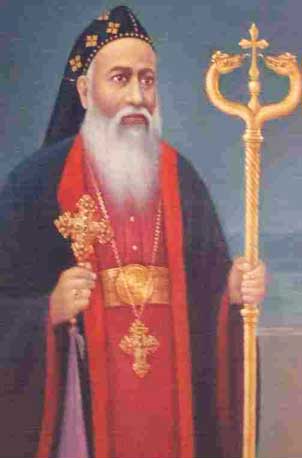



 The Abbey-Principality of San Luigi
You must be logged in to post a comment.