
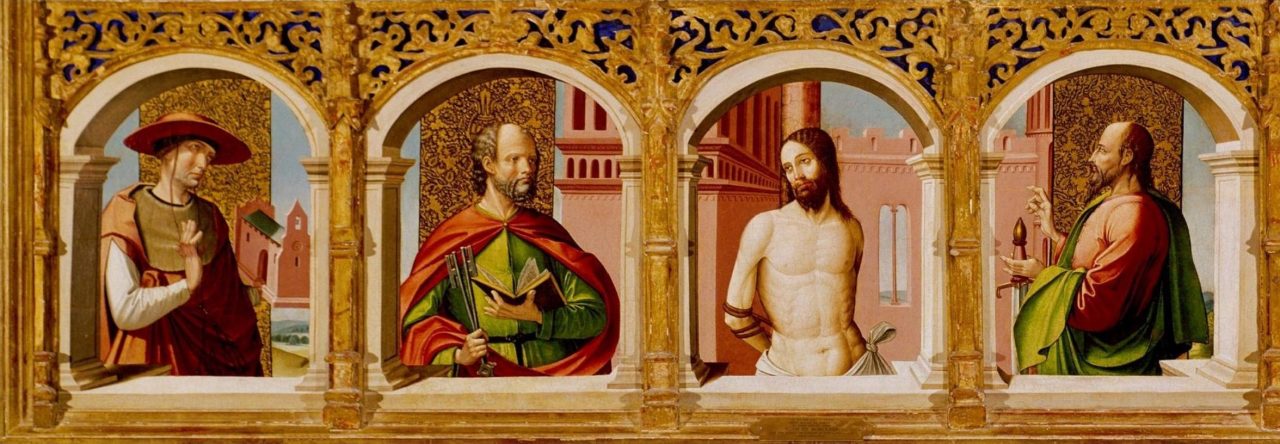
by R.A.U. Juchter van Bergen Quast – reproduced with permission from https://freiherrvonquast.wordpress.com/2020/12/20/to-what-extent-do-religious-organizations-have-a-fons-honorum-to-grant-titles-and-awards/
About the author: Rudolph Andries Ulrich JUCHTER VAN BERGEN QUAST, LLM, FSS is a lawyer and Fellow of the Royal Statistical Society. He is the honorary president of the Family Association of the Barons von Quast (Familienverband der Freiherren von Quast), a Swiss Verein. Main interests: international law and finance, international relations, banking, statistics and the law, art, culture and history.
In earlier articles, I examined the fons honorum of certain historical dynasties, like the former monarchs of Georgia, Rwanda and Hawaii. This article investigates, from a legal perspective, the fons honorum of religious organizations to grant titles and awards. I will demonstrate that this fons honorum is based on religious freedom and the freedom of association. Although international law does not define religion, it does identify religion with conscience, and enumerates a number of manifestations of religion that are to be protected.
The freedom of religious manifestation
European legal perspective
Article 9 of the European Convention on Human Rights (ECHR), guarantees the freedom of thought, conscience and religion in relation to the State. From a European law perspective, there are three aspects to the aforementioned freedoms: internal, external and collective aspects.
- Regarding the internal aspect, the aforementioned freedom is absolute. This freedom concerns deeply held ideas and convictions that are forged in a person’s individual conscience and therefore cannot in themselves prejudice public order. Therefore, these ideas and convictions cannot be subject to restrictions by State authorities.
- With regard to the external aspect, the freedom is not absolute but relative. This freedom to manifest a person’s beliefs is limited, because it can affect or even threaten a country’s public order. While religious freedom is primarily a matter of individual conscience, it also implies, inter alia, freedom to “manifest [one’s] religion” alone and in private or in community with others, in public and within the circle of those whose faith one shares. Article 9 lists a number of forms which manifestation of one’s religion or belief may take, namely worship, teaching, practice and observance (European Court of Human Rights (ECtHR), Metropolitan Church of Bessarabia and Others v Moldova, judgment of 13 December 2001, ECHR Reports 2001-XII, § 114 et seq. and case-law cited).
- Most of the rights recognised under Article 9 are individual rights that cannot be challenged. However, some of these rights may have a collective aspect. Accordingly, the ECtHR has recognised that a Church or ecclesiastical body may, as such, exercise on behalf of its members the rights guaranteed by Article 9 of the Convention (ECtHR, 12 June 2014, Martinez Fernandez v. Spain, Comm. 1104/2002, U.N. Doc. A/60/40, Vol. II, at 150 (HRC 2005).
Freedom of conscience and of religion does not protect each and every act or form of behaviour, motivated or inspired by a religion or a belief. In other words, Article 9 of the ECHR protects a person’s private sphere of conscience, but not always any public conduct inspired by that conscience. It does not allow general laws to be broken (Pichon and Sajous v. France (dec.), no. 49853/99, ECtHR 2001-X).
As religious communities traditionally and universally exist in the form of organized structures, Article 9 ECHR has to be interpreted in the light of Article 11 ECHR which safeguards associative life against unjustified state interference. Seen in this perspective, the believer’s right to freedom of religion includes the right of a religious community to function peacefully; free from arbitrary State intervention. This autonomous existence of religious communities is indispensable for pluralism in a democratic society and is thus an issue at the very heart of the protection which Article 9 affords (Hasan and Chaush v. Bulgaria [GC], no. 30985/96, § 62, ECtHR 2000-XI; Metropolitan Church of Bessarabia and Others, cited above, § 118; and Holy Synod of the Bulgarian Orthodox Church (Metropolitan Inokentiy) and Others v. Bulgaria, nrs. 412/03 and 35677/04, § 103, 22 January 2009).
There exist a vast number of cases where the ECtHR decided regarding the wearing of religious clothing and the use of symbols. Under Article 9(2) ECHR, the right to freely manifest one’s religion can only be restricted under certain cumulative conditions. These restrictions must (i) be prescribed by law; (ii) be necessary in a democratic society by fulfilling a pressing social need; (iii) have a legitimate aim (these aims are mentioned in Article 9(2) ECHR); and, (iv) the means used to achieve that aim must be proportionate and necessary. The right not to be discriminated against can, according to the ECHR, also be restricted under certain circumstances, where a similar justification test is applied. In addition, article 51(2) Charter of Fundamental Rights of the European Union (EUCFR), is a similar test that also applies to restrictions on the rights in Articles 10 and 21 EUCFR. The bans on the wearing of religious clothing or symbols are justified under Article 9(2) ECHR.
Global legal perspective
The freedom of religion or belief is also guaranteed by article 18 of the (mondial) Universal Declaration of Human Rights, article 18 of the International Covenant on Civil and Political Rights and the Declaration on the Elimination of All Forms of Intolerance and of Discrimination Based on Religion or Belief. Regarding the use of religious expressions, the United Nations issued the following statements:
Art. 6 (c): The right to freedom of thought, conscience, religion or belief includes the freedom, “To make, acquire and use to an adequate extent the necessary articles and materials related to the rites or customs of a religion or belief;”.
Declaration on the Elimination of All Forms of Intolerance and of Discrimination Based on Religion or Belief, Proclaimed by United Nations General Assembly resolution 36/55 of 25 November 1981
Declaration on the Elimination of All Forms of Intolerance and of Discrimination Based on Religion or Belief, Proclaimed by United Nations General Assembly resolution 36/55 of 25 November 1981
4 (b): The Commission on Human Rights urges States, “To exert the utmost efforts, in accordance with their national legislation and in conformity with international human rights law, to ensure that religious places, sites, shrines and religious expressions are fully respected and protected and to take additional measures in cases where they are vulnerable to desecration or destruction;”.
UN Commission on Human Rights, Resolution 2005/40 on Elimination of All Forms of Intolerance and of Discrimination Based on Religion or Belief, 19 April 2005
UN Commission on Human Rights, Resolution 2005/40 on Elimination of All Forms of Intolerance and of Discrimination Based on Religion or Belief, 19 April 2005
Para. 4: “The concept of worship extends to […] the display of symbols”. Para. 4: “The observance and practice of religion or belief may include not only ceremonial acts but also such customs as […] the wearing of distinctive clothing or head coverings […].”
Office of the United Nations High Commissioner for Human Rights, General Comment No. 22: The right to freedom of thought, conscience and religion (Art. 18): 30/07/93, CCPR/C/21/Rev.1/Add.4, General Comment No. 22. (General Comments), 1996-2001.
Office of the United Nations High Commissioner for Human Rights, General Comment No. 22: The right to freedom of thought, conscience and religion (Art. 18): 30/07/93, CCPR/C/21/Rev.1/Add.4, General Comment No. 22. (General Comments), 1996-2001.
The aforementioned legal frameworks show that religious freedom and the liberty to manifest this freedom by symbols is a fundamental human right and protected by international law, that is incorporated by states in national law. In my opinion, religious freedom also includes the freedom to grant titles and awards when issued in the context of religious customs, symbols and honorifics. Therefore, the fundamental human rights of religious freedom combined with the freedom of association are the source of authority of religious groups for legally and legitimately granting such titles and awards.
Case studies
Roman Catholic Church

At the age of 14, the famous composer Wolfgang Amadeus Mozart (1756-1791) left Salzburg to go on tours to Italy, accompanied by his father, the musician Leopold Mozart (1719-1787). Their principal destinations were Verona, Mantua, Cremona, Milan, Parma, Bologna, Florence and finally Rome, which he reached on 10 April 1770. When Pope Clement XIV was informed of the child prodigy, he received Mozart and his father in a private audience on their return from Naples two months later, on 4 July 1770. On that occasion, the Pope conferred the Order of the Golden Spur on young Mozart (Jahn, 1856, pp. 199-205; Cardinale 1983, pp. 35-42), thus making him a Papal Knight of the Golden Spur. The following day, Mozart received his official insignia, consisting of ‘a golden cross on a red sash, sword, and spurs,’ emblematic of honorary knighthood. In 1777, Mozart had his portrait painted with the star-encircled cross of the order on his coat.
The papal patent of 4 July 1770 for the award stated:
Inasmuch as it behoves the beneficence of the Roman Pontiff and the Apostolic See that those who have shown them no small signs of faith and devotion and are graced with the merits of probity and virtue, shall be decorated with the honours and favors of the Roman Pontiff and the said See.’
Vatican secret archives 2009, p. 183
It is interesting to examine the capacity in which the pope issued the diploma. Roman Pontiff refers to the Bishop of Rome, the Pope. An apostolic see is an episcopal see (a bishop’s ecclesiastical jurisdiction) of which the foundation is attributed to one or more of the apostles of Jesus or to one of their close associates. In Roman Catholicism, the apostolic see refers to the See of Rome. Therefore, both references to the fons honorum are of a religious nature. Although the Papal States on the Italian Peninsula were under the direct sovereign rule of the pope at that time, the fons honorum for the diploma is based on religion, instead of public law. It has an internal character within the church structures.
Currently, the Pontifical Orders of Knighthood are secular orders of merit of which the membership is conferred by a direct decision of the Pontiff. The diplomas given to recipients of the most popular Pontifical Orders, the Pontifical Equestrian Order of Saint Sylvester Pope and Martyr (reorganised by Pope Pius X on his own initiative, motu proprio, “Multum ad excitandos” on 7 February 1905), and the Pontifical Equestrian Order of Saint Gregory the Great (established on 1 September 1831, by Pope Gregory XVI), are issued in the capacity of pontifex maximus. Although this designation has been used in inscriptions referring to the Popes for some centuries, it has never been included in the official list of papal titles, which is published yearly in the Annuario Pontificio. The official list of titles of the Pope given in the Annuario Pontificio mentions “Supreme Pontiff of the whole Church” (in Latin, Summus Pontifex Ecclesiae Universalis) as the fourth title, the first being “Bishop of Rome“. The title pontifex maximus appears in inscriptions on religious buildings and on coins and medals. Awards are gazetted in Acta Apostolica Sedis, the Gazette of the Holy See. Diplomas of appointment are issued by the Secretariat of State. Papal knighthoods are personal. Perpetual succession is no longer granted.
The Order of Saint Sylvester is intended to honour Roman Catholic lay people who are actively involved in the life of the church, particularly as it is exemplified in the exercise of their professional duties and mastership of the different arts. According to Pope Gregory XVI’s Papal Brief of 1 September 1831, the Order of Saint Gregory is an order of merit to be bestowed on gentlemen of proven loyalty to the Holy See who, by reason of their nobility of birth and the renown of their deeds or the degree of their munificence, are deemed worthy to be honoured by a public expression of esteem by the Holy See (see: appendix 1, underlined sentence).
Clearly, the orders of knighthood focus on religious merit and are issued in a religious capacity. I have not seen an explicit reference to the capacity of the pope as sovereign of the Vatican State. The latter capacity is referred to as the temporal power of the church: the rule of the Church in earthly possessions and the authority of the Pope over civil territories belonging to the Church, as in the former Papal States. This power is an addition to his dominion in spiritual matters and becomes necessary if freedom from civil power is to be assured. The church’s temporal power is presently exercised in relation to the Vatican City State since the Lateran Treaty of 1929. The term may also refer to the exercise of political influence by the bishops formerly through landed estates and currently through financial and other means. The aforementioned orders of knighthood are not issued as part of the Vatican’s temporal power; they are awards, issued for religious merit and therefore have a religious nature.
Considering the foregoing, from both a historical and a legal perspective, for centuries, Popes have exercised their religious fons honorum to grant titles and awards. These awards have an internal effect. They are part of the religious structure of the Roman Catholic faith and are logically recognised as such by the Vatican City State. Other states may choose to either allow their citizens to wear them or to forbid them. The latter could be in breach of religious freedom, as guaranteed by international law.
Abbey-Principality of San Luigi
Since 1970, the Catholic population has nearly doubled, growing from about 650 million in 1970 to about 1.3 billion in 2020. The Church has circa 415.000 priests. As the world’s oldest and largest continuously functioning international institution, it has played a prominent role in the history and development of Western civilization. It is interesting to compare this huge organization to a small religious group, like for example the Abbey-Principality of San Luigi, based in the United Kingdom.
The history of the Abbey-Principality, is described on its webpage:
Continue reading “R.A.U. Juchter van Bergen Quast – “To what extent do religious organizations have a fons honorum to grant titles and awards?””
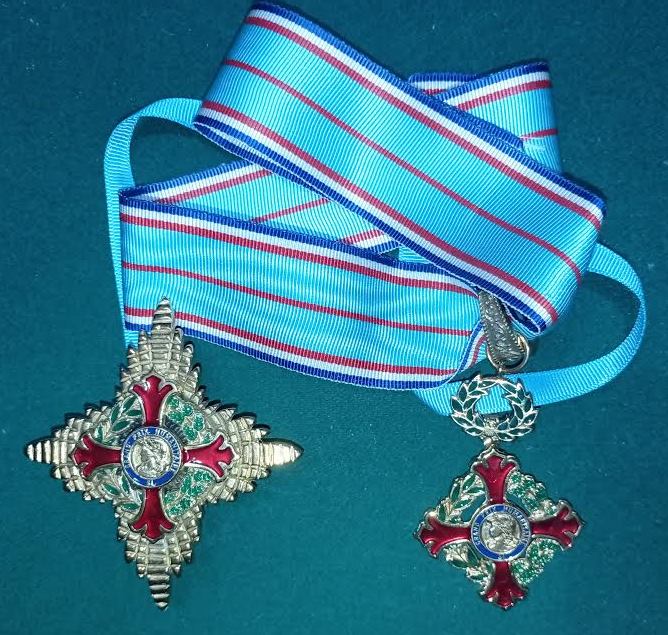

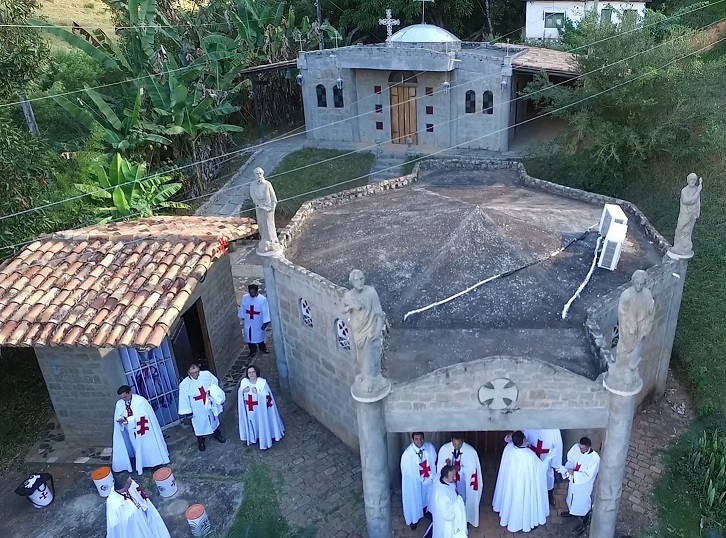

 The Abbey-Principality of San Luigi
You must be logged in to post a comment.