Official website of the Order of Corporate Reunion: https://www.orderofcorporatereunion.org
The Order is incorporated with nonprofit status in England, UK, and California, USA.
This Notice has been issued to clarify several matters with respect to succession and rights within the Order of Corporate Reunion and to address the false claims and actions of Michael James Kline, Dario Caldarelli and Ben Wiltshire. The false claims made by Rodney Rickard have already been dealt with here.
I. THE MISSOURI CORPORATION OF THE ORDER OF CORPORATE REUNION AND MICHAEL KLINE’S CLAIMS REGARDING IT
On 25 January 2010, a non-profit corporation named “The Order of Corporate Reunion” was formed in the State of Missouri, USA. Because various claims have been made concerning the authority and succession to this corporation by Michael James Kline and others associated with him, notably at https://www.orderofcorporatereunion.net/notice, we have seen fit to examine these claims and to arrive at conclusions as to whether they can be upheld. The analysis that follows is divided into sections for the convenience of the reader.
As a preliminary, we invite the reader to examine the incorporation documents of this corporation, to which we refer in detail below, and to verify the same at the website of the Missouri Secretary of State, Division of Corporations, at https://bsd.sos.mo.gov. The corporation reference number is B01036801.
>>Copy of the Missouri OCR corporation creation documents
1. The nature of the corporation
The corporation was formed pursuant to Section 352.060, Chapter 352, Revised Statutes of Missouri. This law requires that the circuit court shall satisfy itself, based on the articles of incorporation, that the corporation is formed from a benevolent association as defined in Section 352.010 “Any number of persons not less than three, who shall have associated themselves by articles of agreement in writing, as a society, company, association or organization formed for benevolent, religious, scientific, fraternal-beneficial, or educational purposes, may be consolidated and united into a corporation.” The fact that the petition for incorporation is examined by a circuit court is of no more consequence than that the court in doing so satisfies itself that the purposes and lawfulness of the said corporation is in conformity with the statutes; in other words, it is created as a nonprofit (benevolent) corporation with exactly the same effect as a nonprofit corporation in any other state.
The process of incorporation:
a. proceeds when the court is satisfied that the application is made for genuine nonprofit/public benefit purposes and is in conformity with the law.
It does not:
b. confer any special authority upon the corporation. The corporation has no more powers than any usual nonprofit corporation in Missouri.
c. require judicial investigation into the historical or jurisdictional claims of the proposed corporation. The court has no powers under law to investigate historical claims, and there is no evidence that it did so in the documents of incorporation.
It has been asserted that the Missouri corporation is the only worldwide entity that has the right to the name and history of the Order of Corporate Reunion. This is completely false.
The Missouri corporation could never have “become the Order” because as of 2010, the Order was an unincorporated worldwide membership organization, all of whose members and officers had not been appointed under the Missouri corporation, nor were asked to consent to the incorporation, nor who became voting or non-voting members or officers of the resulting corporation. As will be seen, the Missouri corporation had a voting membership of one.
Both as of 2010 and since that time multiple corporations have been formed in the USA and elsewhere in the world to represent the Order, and the Missouri OCR corporation is powerless to prevent these actions, since its powers extend only to the limits of the law of the State of Missouri. At best, then, the Missouri OCR corporation was merely a local organization of the Order. That confusion arose as to the facts of the matter is entirely due to the assertions of Michael Kline.
The claims made that the court process had recognized the corporation as the sole representative of the Order is false, even though an assertion to that effect was made by the incorporators in Article V of the pro forma decree for incorporation. Interestingly, that assertion is specifically made “under English common law” and not under the laws of the State of Missouri or indeed the United States of America. The Missouri court had no powers under law to investigate the truth of historical claims regarding England or English law; merely to establish whether the proposed corporation met the requirements of the nonprofit statute and was in keeping with the laws of Missouri and of the United States of America. See Section 352.060 “If the court shall be of the opinion that such articles of agreement and the purposes of the association come properly within the purview of this chapter, and are not inconsistent with the constitution or laws of the United States, or of this state, the court shall enter of record an order to that effect.”
The only matters that would give rise to investigation are stated thus in the same section, “But no such order shall be made until such petition shall have remained on file in the clerk’s office of said court for at least three days after said petition shall have been presented to the court; and whenever the judge to whom such petition shall have been presented shall entertain any doubt as to the lawfulness or public usefulness of the proposed corporation, it shall be his duty to appoint some competent attorney, as a friend of the court, whose duty it shall be to examine said petition and show cause, if any there be, on some day to be fixed by the court, why the prayer of said petition should not be granted, and said attorney shall not be confined in his examination to said petition and articles of association, but may introduce such testimony as may be available and proper in order to fully disclose the true purposes of the association.” So we can see that the only grounds for further investigation are the “lawfulness or public usefulness” of the proposed corporation – not its historical or jurisdictional claims.
2. The membership of the corporation
The membership of the corporation is defined in Article VI, where it is stated that there shall be only one member of the corporation, the Universal Primate, who as stated in the incorporation was the late Archbishop Peter Paul Brennan (1941-2016).
Note well the following under the same article, “Mention of any other “members” are considered non-voting, and therefore have no legal rights to ownership, title, nor legal management of the Order of Corporate Reunion; former members are also considered having no legal rights to ownership, title, nor legal management of the Order of Corporate Reunion. Non-voting membership is open to the public, under such reasonable rules and regulations as the Universal Primate-Bishop may provide.”
No non-voting members of the corporation were known to have been appointed by Archbishop Brennan. Nor were any changes made to the terms or appointments of officers and members of the Order of Corporate Reunion whose tenure antedated the Missouri incorporation.
3. Appointment of a successor to the Universal Primate
The petition makes provision for the appointment of a successor to the Universal Primate at Article VIII, in which it is stated that the Universal Primate shall choose “a successor by the ancient right of bequeathing (ref. advowson)” The meaning of this is unambiguous: it is that the only means by which a person may succeed as Universal Primate is if his predecessor bequeaths the role to him.
Archbishop Brennan did not appoint a successor. On 28 July 2016, four days before Archbishop Brennan died, Michael Kline circulated an email to senior OCR clergy in which he stated the facts clearly, “I had requested on 2-3 occasions that +Brennan appoint me as a co-adjutor or successor for the OCR, but he was silent on this matter…I would serve willingly as a manager of the OCR as Camerlingo [sic] until a Primate is appointed.” This email shows not only that Kline was definitively not named by Archbishop Brennan as his successor but that it was also not expected by him or anyone else that he would succeed him as Primate of the OCR, still less that he would subsequently claim that such an office was his by right.
4. The role of the “executor” and “administrator”
Article VII further nominates Bertil Persson of Sweden and Francis Spataro of New York, described as “two additional Order of Corporate Reunion leaders” as “executor” and “administrator” respectively “in the event of the untimely death of the Primate”. Persson was Universal Primate between 1998 and 2004, while Spataro was the Order’s representative for New York.
What are the powers of these roles?
- Neither Persson nor Spataro was a voting member of the corporation, and so they were subject to the restrictions in Article VI, that is to say “Mention of any other “members” are considered non-voting, and therefore have no legal rights to ownership, title, nor legal management of the Order of Corporate Reunion”.
- An executor has the power to protect the assets of a nonprofit corporation, and then to ensure their transfer to the rightful beneficiaries (if any). It is not clear that the Missouri OCR corporation had any assets since OCR members were not solicited at any time for dues or donations, and the OCR did not own any property.
- The requirements for an out-of-state executor, such as Persson, to act lawfully in performing this role are stated at Missouri Revised Statutes 473.117, section 3 as follows: “Before a nonresident of this state or a corporation organized under the laws of another state or country is issued letters testamentary or of administration he, she or it shall file in the probate division of the circuit court a designation, including the signature and address, of a resident of this state, or a corporation of this state authorized to administer trusts, as agent for the service of process on and the receipt of notice by such nonresident or foreign corporation. This designation shall be recited in the letters testamentary or of administration. Such a designation may be revoked only by a new designation of an agent for service and notice in this state, which shall be endorsed on the letters testamentary or of administration. By filing such designation, the nonresident submits personally to the jurisdiction of the court in all proceedings relating to the administration of the estate and to the performance of his fiduciary duties until discharged of those duties by the court.”
- There is no evidence that Persson was ever issued letters testamentary or of administration regarding the Missouri OCR corporation by the circuit court. Any action taken without these prerequisites would be legally invalid.
- The role of “administrator” in regard to a corporation in this context is undefined by statute and therefore it cannot be said that this role conferred any legal powers upon its holder.
5. What powers was Michael Kline given under the corporation?
The only mention of Kline occurs on the final page of the petition, in which it is stated, “+Bishop Michael Kline may execute written articles of incorporation and is acknowledged before the Universal Primate as an officer, and he is authorized to act on our behalf as a Registered Agent and Incorporator before the Honorable Circuit Courts of Missouri.”
Therefore, Kline was never a voting member of the corporation, and his powers were confined to those of an officer, to wit, the execution of written articles of incorporation, the duties of a registered agent and an incorporator.
6. How could the failure to nominate a successor be overcome?
In Kline’s own words, reproduced above, Archbishop Brennan appointed no successor.
There is no provision anywhere in the corporation for any other person to be appointed as Universal Primate.
If Persson had been granted letters testamentary or of administration (which he was not), could he have validly appointed anyone to the position of Universal Primate? No, because Article VI is explicit on this point “Mention of any other “members” are considered non-voting, and therefore have no legal rights to ownership, title, nor legal management of the Order of Corporate Reunion.”
Therefore neither Persson, nor Spataro, nor indeed Kline, had any legal right to ownership, title, nor legal management of the Order of Corporate Reunion according to the Missouri OCR corporation. Those sole rights in respect of the Missouri OCR corporation rested with Archbishop Brennan and they died with him.
7. Would the corporation have continued in existence in the absence of a Universal Primate?
Yes. However, the corporation would have had no members, and so would effectively be a dead letter, unable to act other than to continue its existence on paper.
Kline can maintain the corporation as its resident agent by paying the appropriate dues and representing himself as an officer of the corporation – but his powers are confined to the legal steps needed to keep the corporation in good standing. As he is not a member of the corporation, he cannot do anything else validly in its name.
Because the corporation now has no members, it cannot appoint any other resident agent to succeed Kline in the event of Kline’s incapacity or death. Consequently, the corporation will likely be administratively dissolved for failure to file returns and pay dues when this happens.
8. Was Kline ever appointed validly as Universal Primate?
Kline has claimed that he was appointed as Universal Primate by Persson and Spataro. However, it is clear from the above analysis that neither of them had the required authority to make such an appointment under the terms of the Missouri corporation.
The following timeline is instructive:
- On 1 August 2016 (at which time Brennan was still alive), Spataro asserted that he had appointed Kline “Provisional Primate” of the OCR during Brennan’s incapacity. Spataro cited the Missouri corporation as his authority to make this appointment. However, as has been shown, the corporation did not give Spataro any such authority.
- Brennan died that evening. In an email sent on 3 August, Kline stated “After I receive the official appointment letter from +Francis, then we plan to file this with the Secretary of State.” It will be clear firstly that no such letter would have been legally valid under the terms of the corporation, and secondly that as such, it could not have been filed with any authority. Examination of the corporation file at the website of the Missouri Secretary of State shows that there is but one sole document filed for the corporation – its creation.
It can therefore be seen that at no point was Kline appointed validly as Universal Primate, nor could any such appointment have been made by anyone except Archbishop Brennan.
No contact names are shown for the Missouri OCR corporation at the website of the Secretary of State, presumably because it now has no members. The address given is Kline’s, as resident agent.
There is nothing in the corporation file with the Secretary of State to indicate that Kline has ever been officially recognized in any capacity other than that of resident agent.
9. Conclusions
- Archbishop Brennan appointed no successor as Universal Primate.
- No other person was authorized under the terms of the Missouri OCR corporation to appoint a Universal Primate
- Therefore, Archbishop Brennan was the last Universal Primate and the last member of the Missouri OCR corporation.
- The purported appointment of Michael Kline as Universal Primate by Francis Spataro and Bertil Persson was legally invalid from the outset under the terms of the Missouri OCR corporation, which provides that any persons named in the pro forma charter other than Brennan shall “have no legal rights to ownership, title, nor legal management of the Order of Corporate Reunion.”
- The invalidity of this appointment is further shown by the fact that no letters testamentory or of administration were issued in respect of the Missouri OCR corporation to any person, and that neither Kline nor anyone else was registered by the Secretary of State as a voting member of the corporation.
Some questions for Michael Kline
- Can you produce any document showing that the Secretary of State of the State of Missouri recognizes that you are the Universal Primate for the purposes of the Missouri OCR corporation?
- Can you produce any document showing that the Secretary of State of the State of Missouri recognizes that you are a voting member of the Missouri OCR corporation?
If the answers to these questions are “no”, as we believe will be the case, Michael Kline’s claims regarding the Universal Primacy of the OCR are wholly false.
We hold that the Missouri OCR corporation is a dead letter. It exists only on paper, has no voting members and therefore cannot act other than to continue its nominal existence for as long as Kline, as its resident agent, has the capacity to do so.
The continuation of the Order of Corporate Reunion must therefore be found not in the Missouri corporation but in the unincorporated worldwide membership organization that preceded and coincided with it. The continuous history of that organization for nearly a century is found in the Apostolic Episcopal Church, whose representation of the OCR was never subsumed in the Missouri OCR corporation, and which continues to maintain that representation today.
II. HISTORICAL AND JURISDICTIONAL CONSIDERATIONS
When the OCR was founded in 1874, the head of the Order was not referred to as “Universal Primate”, as certain persons are currently claiming. Indeed, this title has no provable antecedence before the 1980s, and was used by a branch of the Order whose historical and jurisdictional claims have proved impossible to verify. Instead, the head of the OCR was referred to as the “Prelate” and “Rector Pro-Provincial of Canterbury” (doubtless in reference to his intended role as the guiding light in the unification of Rome and the Church of England). The founder of the OCR, +Dr Frederick George Lee served as the Order’s first Prelate and Rector Pro-Provincial of Canterbury. Furthermore, historically since 1946, that position has been occupied by the presiding bishops of the Apostolic Episcopal Church, the church which has the longest unbroken formal relationship with the OCR, dating from 1933. It was only in 1998 that the joint offices of head of the AEC and the OCR were separated.
The Order has faced a number of conflicting claims as to authority and lineage during its complex history. Where these claims are based on false assertions, we believe it is in the interest of the faithful that this should be made known. We invite those who assert that Arnold Harris Mathew was secretly consecrated conditionally by prelates of the Order in 1909 (and thus continued rather than revived the Order) to put forward evidence to support that assertion. We have seen none whatsoever. We likewise invite those who believe that Friedrich Heiler and the Anglican bishop George Bell were ever “Universal Primates” of the Order to produce any evidence that supports these claims. There is none, and Bell’s papers in particular are extensively preserved. Lastly, we invite anyone with proof that the outlandish claims made by the late Diederik D.J. Quatannens, who again claimed to be “Universal Primate” of the Order, concerning his alleged episcopal consecration were true to produce them. Quatannens unfortunately appears to be the source of the majority of false statements and legends concerning the Order, which seem to have been part of his stock-in-trade as an arch-conspiracy theorist convinced that the Catholic Church was being controlled by secret para-church and Masonic bodies.
In 1998, Quatannens passed what he asserted was the “Universal Primacy” of the OCR to Bertil Persson, who in turn retired in favour of the late +Peter Paul Brennan in 2004. However, Quatannens’ tendentious claims regarding the OCR’s history were completely separate from the AEC’s representation of the OCR, which continued regardless of the 1998 separation and was never formally or otherwise merged in it. It is important to note that the AEC does not claim to continue Quatannens’ pseudo-OCR; rather, it holds that the events of 1998 were an error that gave rise to understandable confusion. During the time of the late +Peter Paul Brennan there was no need to raise historical and jurisdictional issues since it was universally held that Archbishop Brennan did an excellent job in leading the OCR. Indeed, we had hoped that this status quo would hold after Archbishop Brennan’s death in 2016, at which point he named no successor. Sadly, this has not proved to be the case. The AEC initially restated its position regarding the OCR during the aftermath of Archbishop Brennan’s death, and then formally acted upon this in 2017 with the support of all AEC clergy and the Emeritus Primate, Archbishop Francis Spataro.
The Presiding Bishop of the Apostolic Episcopal Church is also Prelate and Rector Pro-Provincial of Canterbury in the OCR. There is no such position as “Universal Primate” of the OCR and no historical basis for such a position.
Currently, the Presiding Bishop of the Apostolic Episcopal Church, and the Prelate and Rector Pro-Provincial of Canterbury of the OCR is The Most Reverend Archbishop +John Kersey, OCR, OA. He was confirmed as Bishop and Rector Pro-Provincial of Canterbury by Archbishop Brennan and past AEC and OCR primate Archbishop Bertil Persson (who installed him in office) on November 23, 2008, and succeeded as Prelate of the OCR and Presiding Bishop of the AEC on February 6, 2015.
The OCR as constituted under the AEC recognizes no other organization as legitimately continuing the Order, not merely because of lack of historical continuity, but because of the lack of respect of other organizations for the OCR’s clear and authentic mission as a bridge between Rome and the Anglican Communion. We dissociate ourselves completely from those pseudo-prelates who would use the name of the OCR as a front for ordination mills and attempts at personal aggrandisement.
THE POSITION REGARDING MICHAEL KLINE
When the late Archbishop Brennan passed into eternal glory on 2 August 2016, he did not name a successor to his position of Universal Primate of the OCR.
We do not accept the various claims made by Michael Kline to the effect that he was by rights the successor of Archbishop Brennan, or that he became so automatically by virtue of his position as an officer of the OCR’s corporation in Missouri. The falsehood of any such claims is shown clearly in Kline’s own words and in the analysis above.
On 28 July 2016, four days before Archbishop Brennan died, Michael Kline circulated an email to senior OCR clergy in which he stated the facts clearly, “I had requested on 2-3 occasions that +Brennan appoint me as a co-adjutor or successor for the OCR, but he was silent on this matter…I would serve willingly as a manager of the OCR as Camerlingo [sic.] until a Primate is appointed.” This email shows not only that Kline was definitively not named by Archbishop Brennan as his successor but that it was also not expected by him or anyone else that he would succeed him as Primate of the OCR, still less that he would subsequently claim that such an office was his by right.
While corporations have at various times been formed to represent the OCR in various local jurisdictions, those local organizations of the OCR did not at any point represent the entire unincorporated worldwide OCR membership organization as constituted under Archbishop Brennan. Therefore, the Missouri corporation established by Michael Kline could not represent the entire OCR, despite his claims to the contrary put forward after the death of Archbishop Brennan. Rather than revert to historical precedent, or call a vote of the membership, Kline instead asserted that his Missouri corporation constituted the entire OCR and that he, as its owner, had been confirmed in office as Universal Primate of the OCR by its “executor” and “administrator”. This was notwithstanding the fact that prior to Archbishop Brennan’s death, not a single member of the OCR held membership in the Missouri corporation or had been appointed to office in the OCR through it. Indeed, it might well seem with hindsight that Kline had formed the Missouri corporation purely as a vehicle for his personal advancement.
It should be noted that Francis Spataro, at that time Emeritus Primate of the Apostolic Episcopal Church, and “administrator” of the Missouri OCR corporation responsible for Kline’s appointment, subsequently reversed his earlier position and in an email of February 2019 wrote “On receiving your Letter I state as Emeritus my desire to remain within the AEC’s OCR and do not want my name associated with the organization led by Archbishop Kline.” He has subsequently stated his wish to be considered retired from all religious affiliations.
THE POSITION REGARDING DARIO CALDARELLI
In June 2021, Michael Kline retired from his representation of the OCR, appointing Dario Caldarelli, of Rome, Italy, to succeed him. We hold that since Kline was never the legitimate successor of +Brennan, he does not possess anything to pass on to a successor so far as the OCR is concerned.
According to documentation in the possession of the OCR, Dario Caldarelli was ordained deacon on 13 September 2012 and priest on 13 September 2013 for the Igreja Católica Apostólica da Redençao, an independent church in Brazil, by its archbishop Dom Edivaldo dos Santos. He was consecrated bishop in this church by the same Edivaldo dos Santos, assisted by bishops Osiel Luiz dos Santos and Genival Martins de Oliveira on 15 September 2013. Research indicates that Osiel Luiz dos Santos and Genival Martins de Oliveira were both themselves consecrated by Edivaldo dos Santos. There is no mention of any co-consecrators at these consecrations.
Edivaldo dos Santos was consecrated on 18 December 2012 by José Milton Cabral dos Santos, who in turn was consecrated on 11 September 2011 by Emmanuel Milingo. There is no mention of any co-consecrators at these consecrations.
The former Archbishop Emmanuel Milingo undertook a number of episcopal consecrations which have been declared illicit by the Holy See and in consequence of which he and a number of the bishops concerned incurred latae sententiae excommunication. Archbishop Brennan was one such bishop. Such canonical penalty, however, has no bearing on the validity of the consecration concerned. The OCR considers the episcopal consecrations conducted by Archbishop Milingo prior to and following the declaration of the Holy See of his excommunication on 26 September 2006 to be valid but illicit in accordance with Roman canon law.
A different situation, however, applies to any ordination or consecration conducted by Emmanuel Milingo after 17 December 2009, on which date the the Holy See Press Office in a statement announced that Milingo had been dismissed from the clerical state. The statement explained the effect of the action as “loss of the rights and duties attached to the clerical state, except for the obligation of celibacy; prohibition of the exercise of any ministry, except as provided for by Canon 976 of the Code of Canon Law in those cases involving danger of death; loss of all offices and functions and of all delegated power, as well as prohibition of the use of clerical attire. Consequently, the participation of the faithful in any future celebrations organized by Archbishop Emmanuel Milingo is to be considered unlawful.”
It is clear that the Roman Catholic Church will not consider any consecration by Emmanuel Milingo after 17 December 2009 as valid. This observation therefore applies to the consecration of José Milton Cabral dos Santos by Milingo on 11 September 2011 and to those who derive their succession from him, including Dario Caldarelli.
The OCR, being primarily concerned with issues of validity according to Roman canon law, cannot recognize the clerical status of men who have received Holy Orders that have been the subject of a pronouncement of the Holy See as to their definitive invalidity. It therefore cannot acknowledge truthfully that it accepts Dario Caldarelli as holding the ordained state validly, purely because the Holy See has made it clear that it does not do so.
In discussions with Caldarelli, he has referred to placing the matter of the headship of the OCR before an “international court”. The OCR recognizes no “international court” and no tribunal save that of the Holy See itself.
In discussions with Caldarelli, he has claimed to have a document in which Archbishop Brennan appoints Kline as his successor. He has been repeatedly challenged to produce this document and has failed to do so. Our position is that it is either non-existent or false.
KLINE’S RESIGNATIONS AND “UNRESIGNATIONS”
We also note that within a short time of installing Caldarelli as his successor, Kline has purported to retract his retirement because of disagreements with Caldarelli.
Kline further appointed one Richard Cummings to succeed him, but having retired in his favour, Kline then “unretired” for a second time in 2023, purporting to depose Cummings and install one Jon-Lawrence Patrick Mathew Langer initially as “Camerlingo” (sic) and then as “Acting Universal Primate”.
As a result of Kline’s actions, therefore, there are no fewer than three separate competing entities that falsely claim the legacy of the Order of Corporate Reunion, headed respectively by Caldarelli, Cummings and Langer.
In the course of this fiasco, Cummings claimed to have revived the Association for the Promotion of the Unity of Christendom that had been founded by Ambrose Philipps de Lisle and Dr Frederick George Lee with others in 1857. The APUC was condemned by the Holy See 16 September 1864 by a letter signed by Constantinus Cardinal Patrizi Naro, and had discontinued its activities by the end of that decade. It is curious as to why Cummings would seek to revive a body that Rome had explicitly condemned, since this could by that fact not be a vehicle for the promotion of unity with the Holy See.
These matters do not involve the OCR proper under our leadership and we do not intend to become involved in them, noting only that they are typical of some of the worst aspects of the smaller church bodies and bring no glory to the Body of Christ.
CONCLUSION
For several years now, Kline has posted repeated personal attacks and hatred on social media directed against Archbishop Kersey, the Prelate of the OCR and Primate of the AEC. In January 2022, Kline raised two men from the lay state to the episcopate in the space of three days (surely a record for the independent sacramental movement). One of these men, Ben Wiltshire, has now made common cause with Kline and engaged in public controversy. Our response is simply, “by their fruits shall ye know them”. It is inconceivable that any bishop of a mainstream communion would be permitted to behave in such a manner, and through these actions, these men show amply their unsuitability for any form of ecclesiastical office. We have no intention of being deflected from the Order’s purposeful and successful mission by the behaviour of gadflies.
For over six months, senior members of the OCR were engaged in extensive and detailed negotiations with the generous assistance of an experienced bishop as an independent third party to bring about a position of peaceful co-existence between the OCR as represented under us and the Kline/Caldarelli group. A full agreement was prepared after these negotiations but Kline refused to sign it and it has now also been rejected by Caldarelli who has dismissed those who tried to negotiate peace from membership in his group. In the circumstances, we do not intend to pursue the matter further, but simply to state our case and allow any who are interested to form their opinions accordingly.
If OCR members and those interested have any questions concerning this Notice, please contact us at info@ocr1874.org
In Christ,
The Most Reverend +John Kersey OCR
Prelate, Bishop and Rector Pro-Provincial of Canterbury in the Order of Corporate Reunion
The Most Reverend +Robert Chung, OCR, SCR
Superior General, Bishop of Selby and Provincial of York in the Order of Corporate Reunion

 Matthew T. Scarince (pictured left), who has a second Twitter account under the alias “Matteo Scaringi” describes himself as “Catholic Restorationist, Legitimist, Habsburgtreuer Ciarsèano. Maria Laach Liturgical Movement. Author at thewarforchristendom.com”.


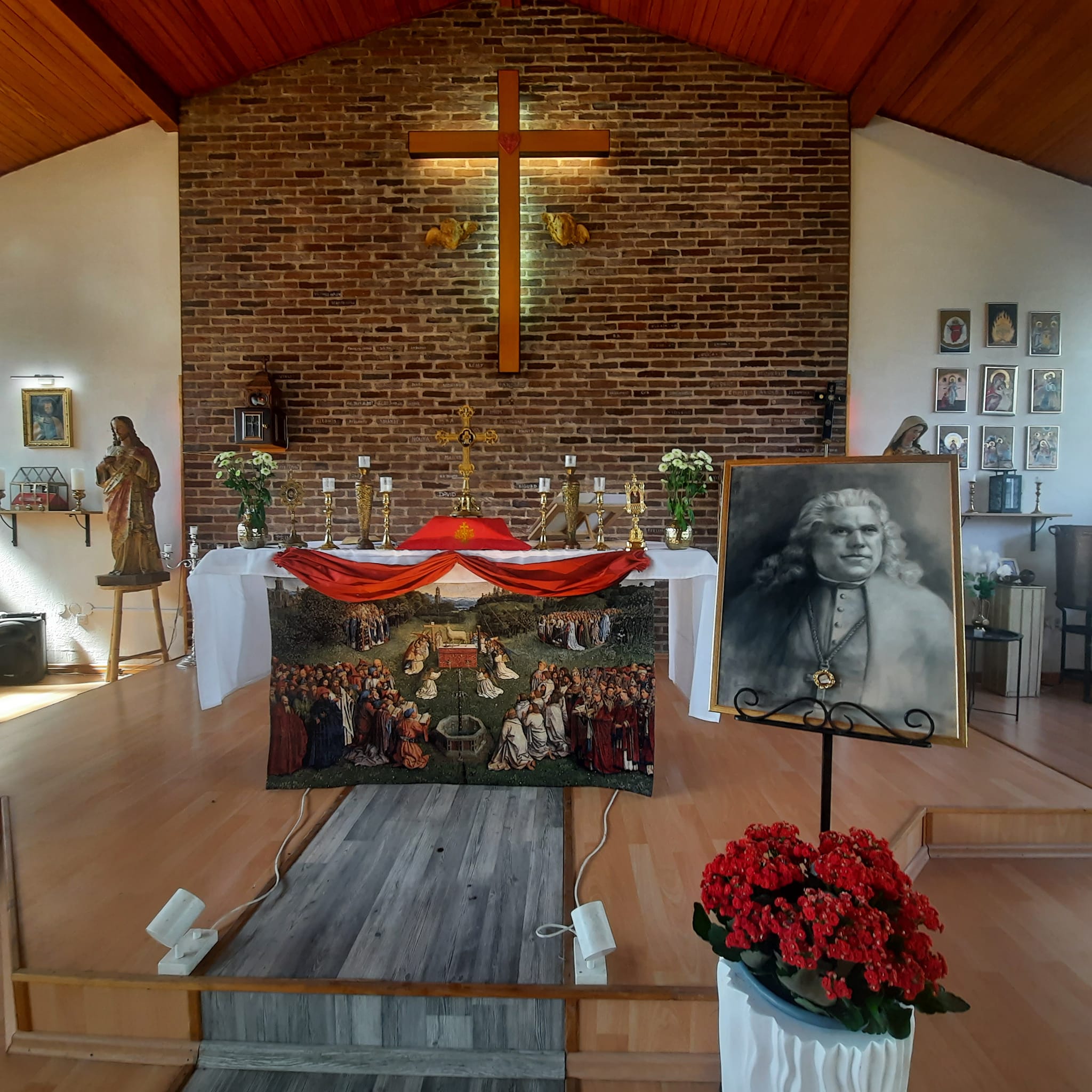

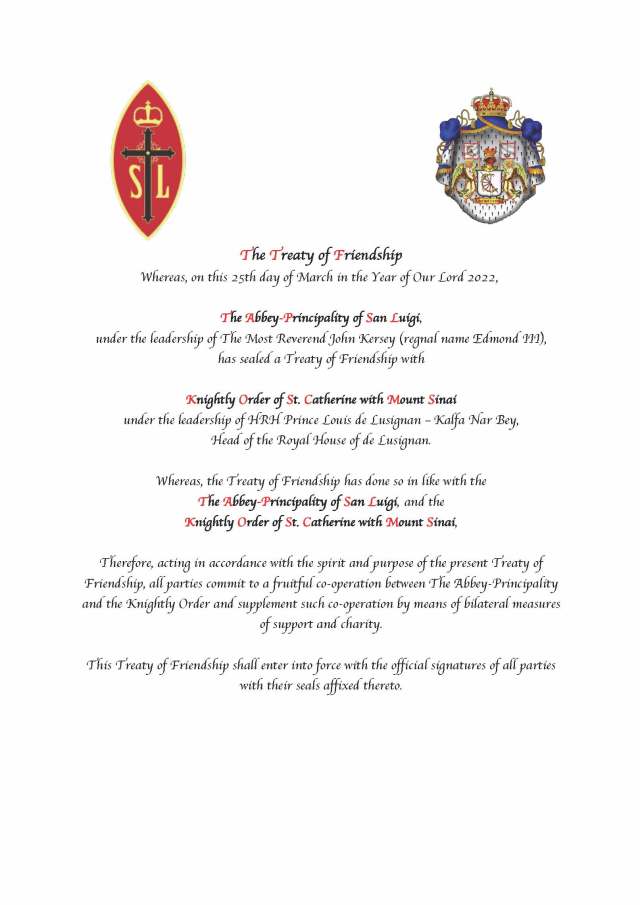
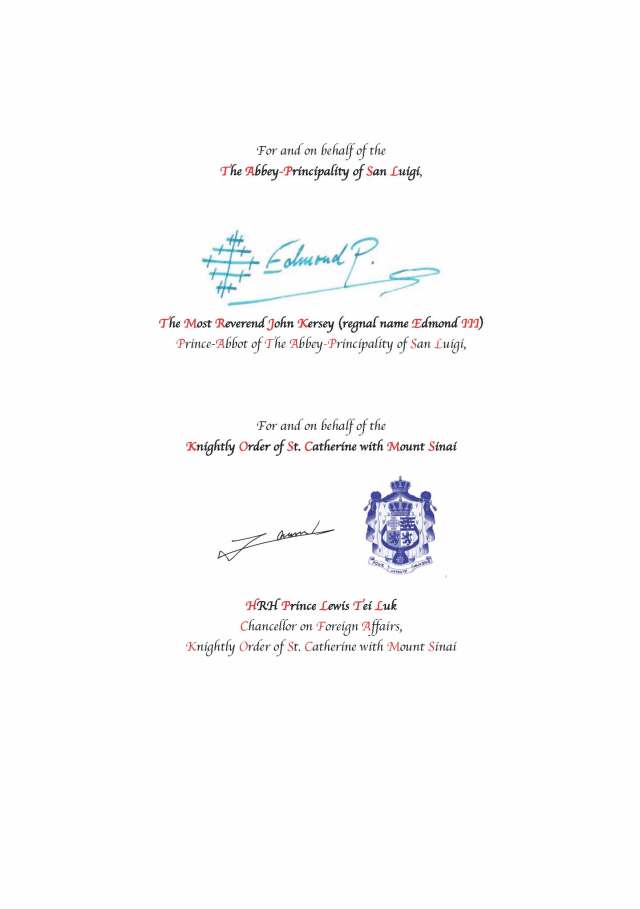


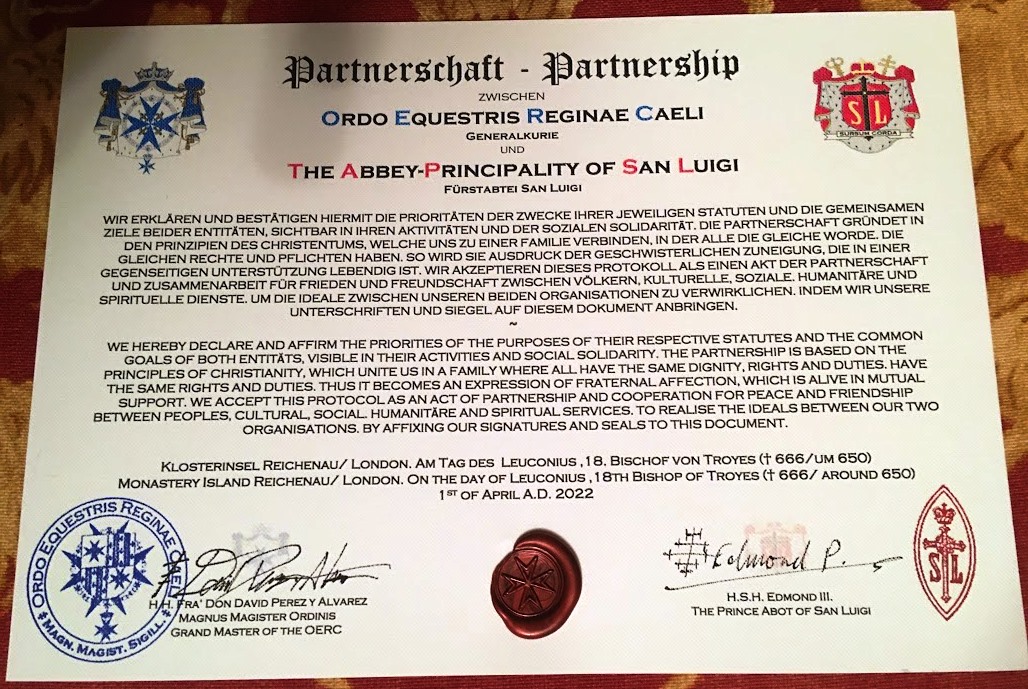
 The Abbey-Principality of San Luigi
You must be logged in to post a comment.