
The Abbey-Principality of San Luigi wishes all members, friends and visitors to its website a very happy Easter.

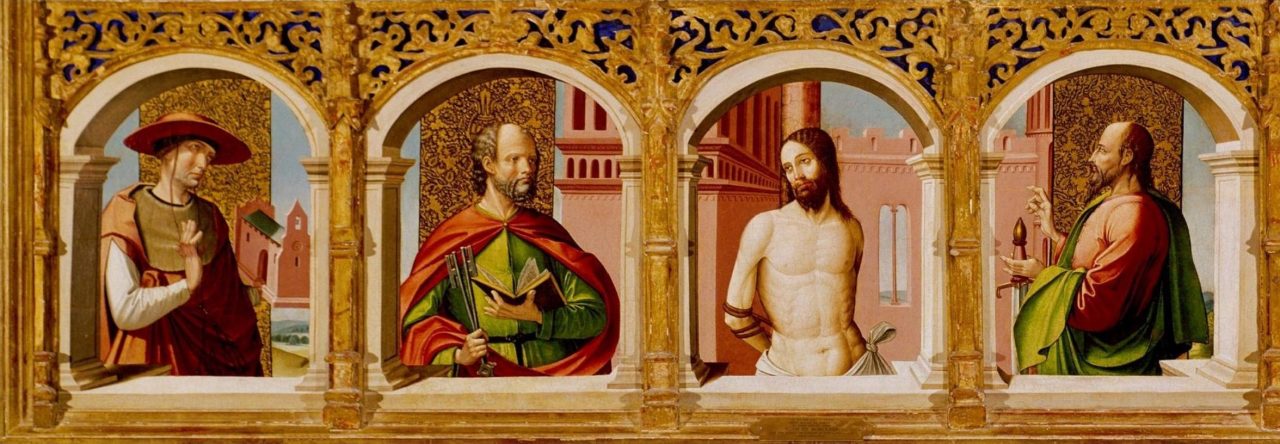
The Abbey-Principality of San Luigi wishes all members, friends and visitors to its website a very happy Easter.
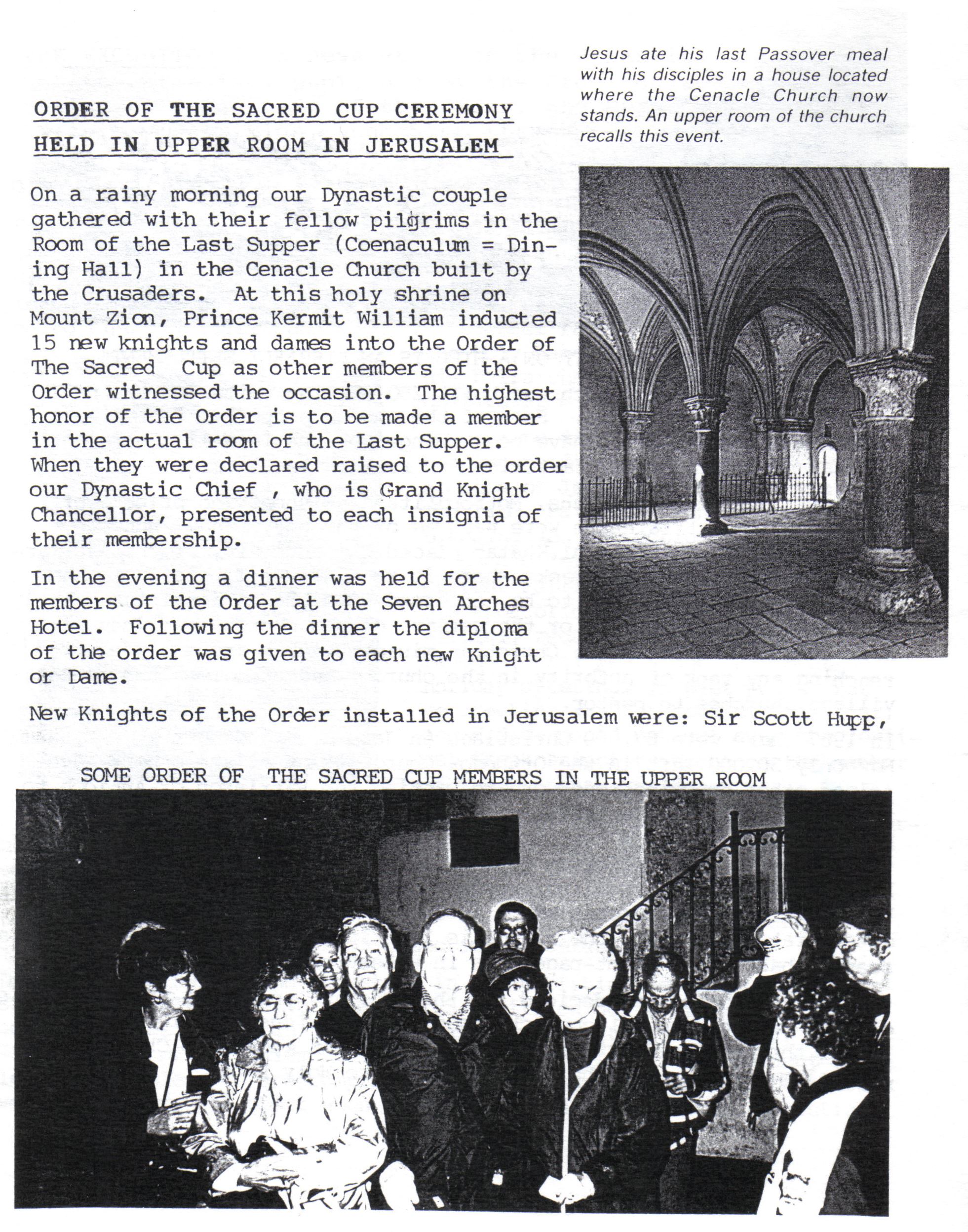
From a past edition of The Excubitor comes this account of one of a number of investitures of the Order of the Sacred Cup held in Jerusalem in the Cenacle Church, the location of the Last Supper.
The Byelorussian Patriarchate of St Andrew the First-Called Apostle was established in 1970 under the late Patriarch Peter II Zhurawetsky, in whose memory the Patriarchal seat has been held vacant since his death in 1994. From the outset the executive duties of the Patriarchal office were devolved to the Ecclesiast of All Byelorussia, the first holder of this office having been the late Prince Kermit of Miensk. Under Prince Kermit, the Patriarchate was latterly maintained as a private ekklesia of the Royal House Polanie-Patrikios.
Since the succession of Prince Edmond of Miensk to the position of Ecclesiast of All Byelorussia on the death of his adoptive father Prince Kermit in 2015, there has been an increase in the ecclesiastical activities in exile of the Patriarchate, these having been centred on missions in Brazil which have latterly expanded to other countries.
Recent developments have caused a revision of those missions that have hitherto been associated with the Patriarchate and which have operated under the working name Igreja Católica Ortodoxa Bielorussa no Brasil.
With immediate effect, the position of the Patriarchate has reverted to the former status of a private ekklesia of the Royal House Polanie-Patrikios solely. As such, its only member of clergy is now the Prince of Miensk as its Ecclesiast. All former members of the clergy, all lay ministers and all attached missions have now been released from the Patriarchate, and those clergy and missions who have wished to remain with our communion have been transferred to the Apostolic Episcopal Church and the Order of Antioch, where their ministry will continue.
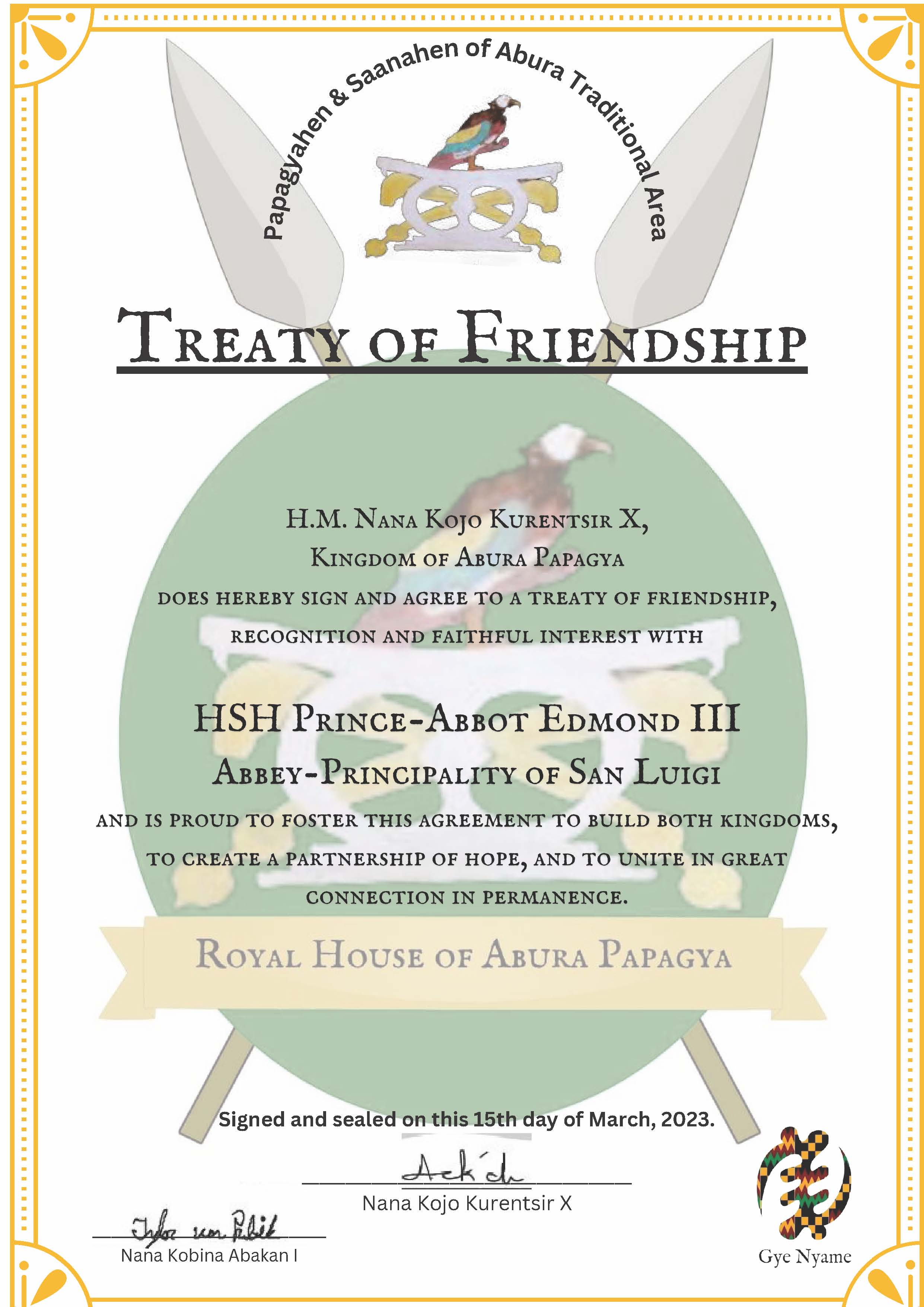
The Abbey-Principality of San Luigi has entered into a Treaty of Amity, Friendship and Goodwill with the Stooldom of Abura Papagya, Abura Traditional Area, Republic of Ghana. The Stooldom is a recognized traditional kingdom in Ghana, ruled by HRH Nana Kojo Kurentsir X, the current Papagyahen (King), who was enstooled in 2015.
The website of Papagya linked above gives further information concerning the Kingdom, its history and its current projects.
As is customary on these occasions, an exchange of honours has taken place whereby HRH Nana Kojo Kurentsir X has been awarded the Grand Collar of the Order of the Crown of Thorns, and the Prince-Abbot has been awarded the Grand Collar of the Royal Order of Kwakyen Ababio.
This photograph of the future Archbishop William Bernard Crow (Mar Bernard, subsequently Mar Basilius Abdullah III) (1895-1976) has recently been shared with us by his family. Dr Crow is shown here in the full dress robes of a Doctor of Science of the University of London.
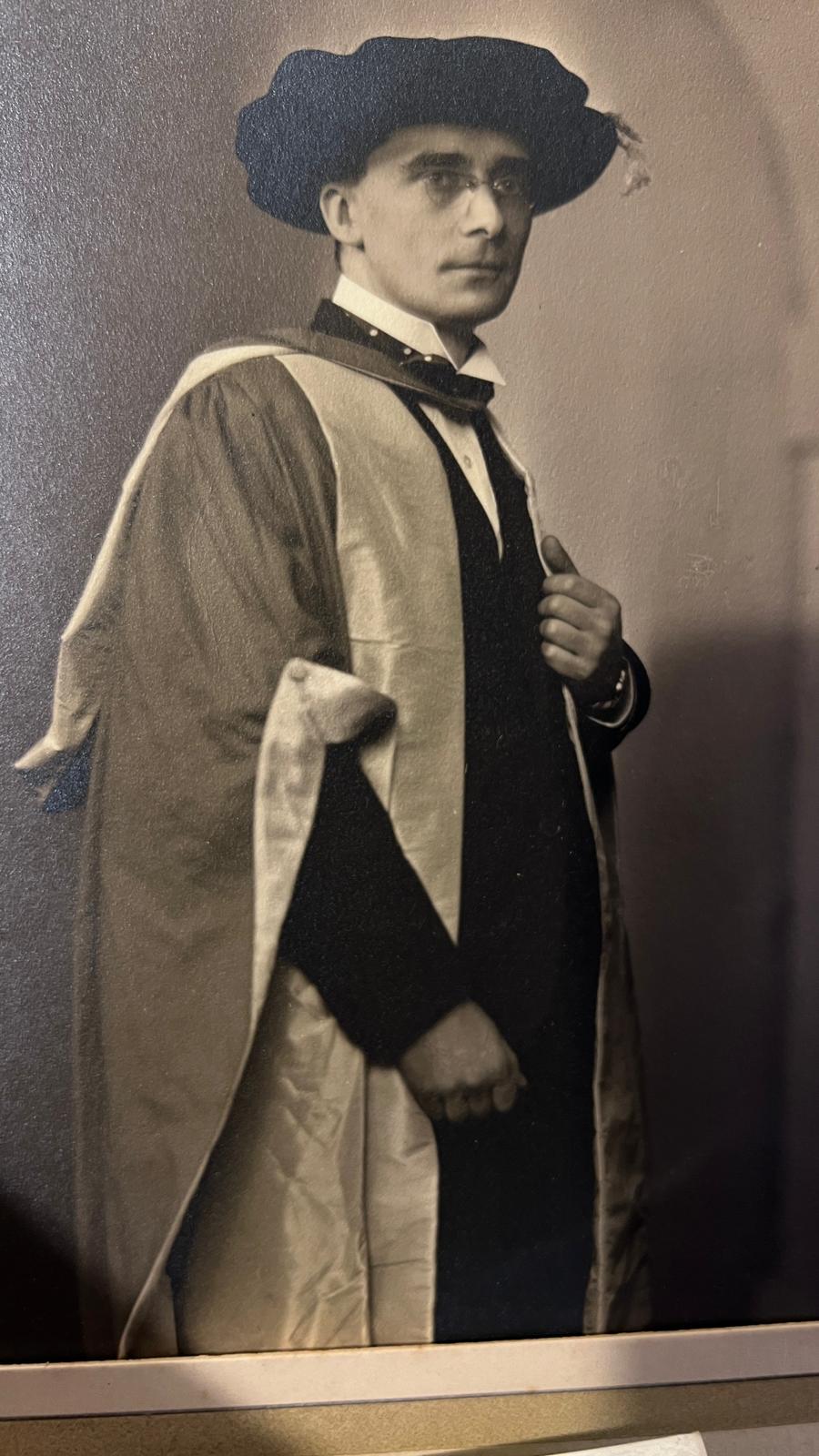
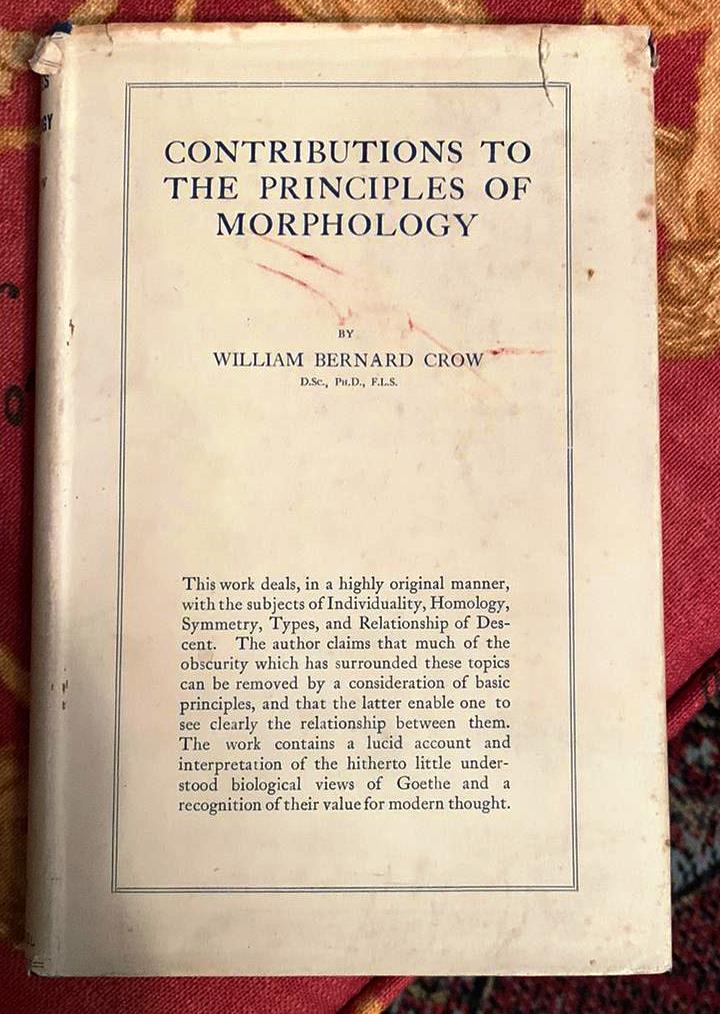
Dr Crow held the degrees of Associate of Arts (University of Oxford), Master of Science (University of Wales), Bachelor of Science, Master of Science, Doctor of Philosophy and Doctor of Science (University of London). This last degree was a rare academic distinction awarded in 1928 for a thesis entitled “Contributions to the Principles of Morphology” At that time, the higher doctorate of Doctor of Science from a British university was so prized that a university professor who had been awarded the degree would be called Doctor rather than Professor. Dr Crow was aged 33 in 1928 and so would have been one of the youngest persons ever to be awarded this degree.
At the University of London, the Doctor of Science degree by examination was withdrawn on 30 September 2001 and is no longer awarded.
The academic robes for the Doctor of Science degree worn by Dr Crow in the photograph were of scarlet cloth, faced and the sleeves and hood lined with faculty silk, which for Science was gold.
Dr Crow was Grand Master of the Apostolate of the Holy Wisdom (which includes the Ancient Catholic Orthodox Church). This has since 2015 been united with the Abbey-Principality of San Luigi, which continues its work.
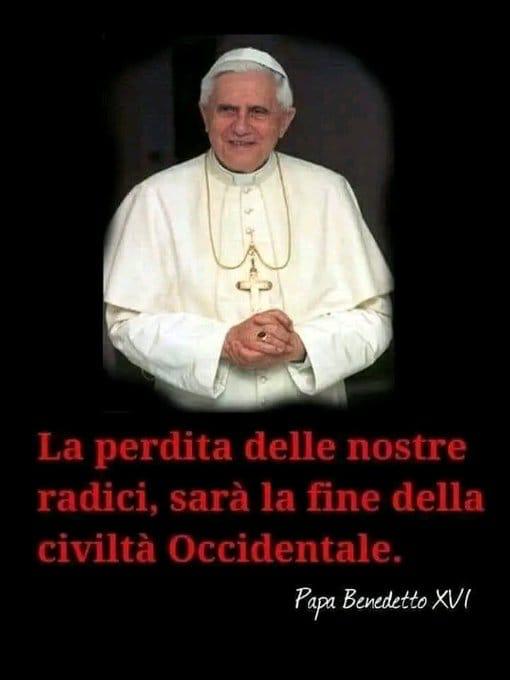
The Abbey-Principality of San Luigi wishes to express its condolences on the announcement of the death of Pope Benedict XVI.
Ecce sacerdos magnus, qui in diébus suis plácuit Deo: Ideo jure jurando fecit illum Dóminus crescere in plebem suam. Benedictiónem ómnium géntium dedit illi, et testaméntum suum confirmávit super caput eius. Ideo jure jurando fecit illum Dóminus crescere in plebem suam. Gloria patri et filio et spiritui sancto.
 Archbishop John van Ryswyck (1898-1963), whose biography can be read here, was a senior member of, and British representative of, the San Luigi Orders between the 1940s and 1960. He was consecrated bishop in 1949 by Mar Georgius of Glastonbury, first Catholicos of the West.
His Lectures were delivered between 1942 and 1947 and reflect his personal perspectives on a variety of issues that pertain to the more esoteric aspects of the Christian Faith and its history. They were originally collected and placed online by members of his family, and are now reproduced for educational purposes so that they may again be accessible to scholars.
The opinions expressed in these Lectures are those of the author, and do not necessarily represent the views of this jurisdiction.
Index of John Van Ryswyk’s Lectures 1942-47
1-4. Introductory: definitions of religion, science and philosophy.
5. The inner pattern of all religions; the “Heaven-Father”
6-10. Decoding the Genesis story from its Sanskrit origin.
11. J.v.R’s ”Three-in-One Cell Theory” (see 79, 87)
12. The mind analysed in its three parts, or functions.
13. ”Lo-Gos”, the word, from Sanskrit, ”Lo” = ”Sound” ”Gos” = ”Divine” (see 51)
14. God in manifestation: His body, Mind and soul. (see 56)
15. The Invisible: the Comos is finite.
16. Thought-forms; the battle between good and evil.
17. An expanding all-round view, in learning, is superior to a step-by-step method of teaching; The power of thought. Christ the Philosopher.
18. Actuality; the Spirit includes all vibration.
19. The one-ness of all life. (see 52)
20. The law of correspondence; man in the image of God. The Balancing Breath. (see 55)
21. Evolution by re-embodiment, the key to the in-equality of man. All things are living.
22. Evolution continued. The path to perfection at the human stage.
23. Evolution throughout creation. The Ascension of Christ was by de-materialisation.
24. Recapitulation. Morley Martin’s experiment, demonstrating the indestructibility of matter.
25-35. Twelve lectures on the Tao-Teh-King in relation to Christianity.
36. Christianity and Eastern philosophy. The consciousness Exercise.
37. Christianity and Islam.
38. Christianity and Gnosticism. Pt. 1
39. Christianity and Gnosticism. Pt. 2
40. Christianity and Buddhism.
41. The Incarnation of Christ (see 57)
42. Christ and the evolutionary process.
43. The mystical aspect of Sound. (see 63)
44. The entrance of Soul into man. Soul-mates.
45. Karma, the Law of Redemption. (see 47)
46. The Soul and Mind in Time.
47. Responsibility. The Akashic Records.
48. The Spirtual centre within. Christ is within.
49. Further warning against outside control.
50. Stages of Man’s search. The four corner-stones, the four ‘L’s’. (see 53)
51-57. The 12 precepts of John van Ryswyk.
58. The two Wills.
59. The Cosmos is the material (finite) universe, not Reality
60-61. The difference between Mind and Soul. (see 53)
62-63. Awareness. Sound is colour.
64. Thought – how it comes into being
65. More about sound. Lucifer (see 43)
66. The continuity of the picture. The Jig-saw.
67. Everything in life has something to tell us of the spiritual.
68. Finding one’s own centre.
69. True measurement. The ”Sacred Inch.” Go’s Aura.
70. The finite is part of the Infinite: everything is threefold.
(71. Not Available)
72. Sound, contd. The conversion of mind into soul.
(73. Not Available)
74. The Positive and Negative in all Religions. Woman – the ”Power behind the Throne”.
75. Practise contact with all life.
76. The Transformers. Don’t expect a spiritual cup of tea!
77. The path of Evolution is circular.
78. Power is within.
79. The Three-in-One Cell and pre-natal influence.
80. We cannot picture God-the-Father.
81. More about the Three-in-One Cell. God, the germ within the egg. Thought is colour.
82. On ”Precept 7.” (No.53). ”Learn to differentiate between Mind and Soul….”.
83. The Inequality of Man (see 55)
84. Mind control.
85. Hades, a state of consciousness. (see 54)
86. St. Augustine.
87. The Quest. Thoughts from various philosophers.
88. The child is not merely an infant. The importance of the mother’s attitude during pregnancy.
89. The theories of Plato and of other ancient philosophers. (see 51, part 2) Christ-ianity and Christian-ism
90. More about the theories of philosophers.
91. How to develop awareness.
92-95. The Palaeosophic treatment of disease. (see also 20)
96. Introduction to the study of Christian philosophers.
97-105. The philosophy of Jacob Boehme.
106-112. The philosophy of Descartes.
113-116. The philosophy of Roger Bacon
117. The most wonderful journey of the soul.
118. The power of thought.
The complete Lectures listed above may be downloaded in pdf format at this link:
 The Abbey-Principality of San Luigi
You must be logged in to post a comment.