Prince-Abbot is appointed to office in the Order of St. Lazarus

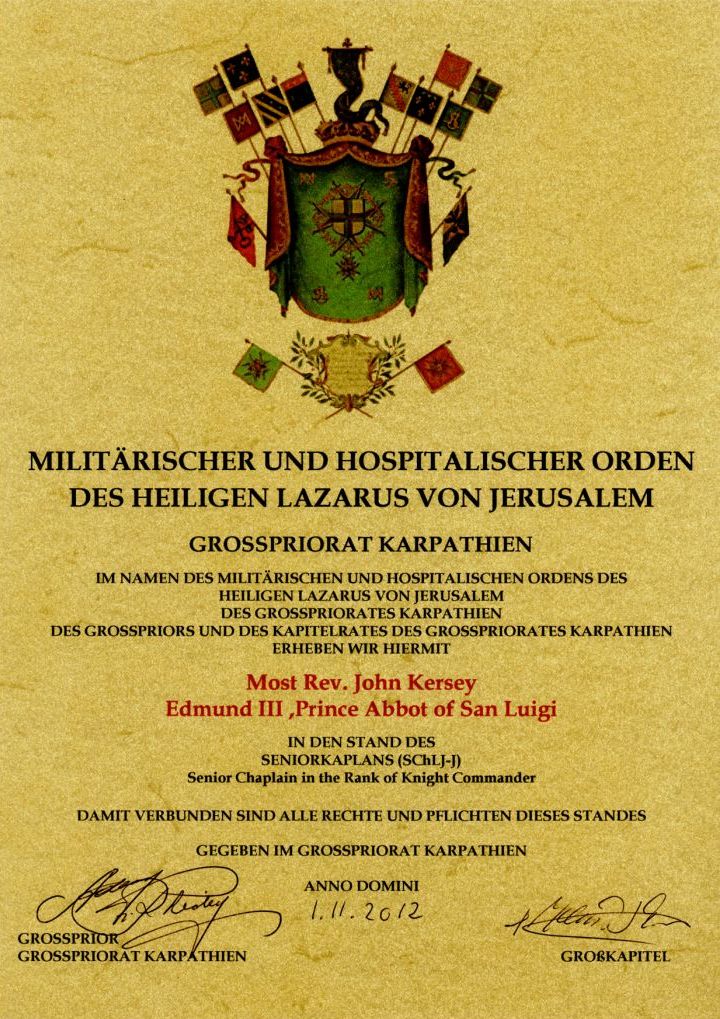
The Prince-Abbot has been appointed as a Senior Chaplain in the rank of Knight Commander of Justice in the Grand Priory of Carpathia of the Order of St Lazarus of Jerusalem. The website of the Grand Priory gives details of its history, organization and charitable activities for the relief of leprosy.

Contact between the Order of St Lazarus and the Abbey-Principality of San Luigi has a long history. A former Grand Master of the Order of St Lazarus, Comte Charles Otzenberger-Detaille, was among the members of the Order of the Crown of Thorns in the years before the Second World War.

Members of the San Luigi Orders: Archbishop Paul Schultz

Archbishop Paul Christian Gerald William Schultz (1931-95) was a member of the San Luigi Orders, being admitted by Prince-Abbot Edmond II on 3 July 1976 in a ceremony in Hollywood, and was the author of “A Brief History of the San Luigi Orders” (1977). He was a bishop of the Mexican National Catholic Church, the Old Roman Catholic Church, the Apostolic Episcopal Church and the Philippine Independent Catholic Church.

Paul Schultz was born in Decatur, Indiana, on 10 April 1931. His father, Paul Christian William Adolph Schultz (1900-75) was pastor of Zion Lutheran Church in Decatur for many years, later working with the Division of Gifts and Endowments at Valparaiso University. Schultz graduated from Glendale College, California, in 1950, and then studied for the ministry first at Concordia Theological Seminary, Springfield, Illinois, and then at Pacific Lutheran Theological Seminary.

On 30 January 1952 he was ordained priest by Grant Timothy Billet, co-founder and primate of the Old Catholic Church in North America. This action was the cause of a long-term rift between Schultz and his father, and after a short time, Schultz resumed his studies, this time at the University of Heidelberg, where he earned a diploma in basic science and public health. Returning to California, he was appointed as a professor at Los Angeles City College. At this time he came to befriend Prince-Abbot Edmond I. However, he had not altogether abandoned his plans for ministry, and alongside his teaching continued his seminary studies, eventually graduating from California Graduate School of Theology in 1974. He would continue his teaching career, his final appointment being as Professor Emeritus at the Los Angeles College of Chiropractic, Whittier (now part of Southern California University of Health Sciences), and was noted as a popular lecturer.

As of 1974, Schultz was a lay member of the First Lutheran Church in Glendale, California. His graduation from seminary that year meant that he finally felt able to fulfil his ministerial vocation. He had also healed the breach with his father and received a Lutheran ordination and consecration from him in October and December 1974, the form of such being to the office of Superintendent and Visitor for the Power of Minister. In consequence, Schultz junior established the Collegiate and German Lutheran Church of the Buffalo Synod Tradition of the Old Lutheran Church. This small group later merged with that of Jürgen Bless, who would himself receive episcopal consecration from Schultz in 1986.

The nature of Schultz’s work changed rapidly during the mid-1970s from that of pastor of a small Lutheran community to a much wider ecumenical Catholic mission. The major factor in this was the considerable development of Free Catholicism in California at that time, leading to a number of jurisdictions being based there which represented different Catholic and Orthodox heritages. Schultz was seen as a reliable and trustworthy figure, personally orthodox and of stable life, who was in a good position to build bridges between small jurisdictions whose primates were at times at odds with each other, and who could undertake missions involving contact with the larger churches with credibility.

Key to this expansion was Schultz’s role as Prelate and Rector Provincial of New York in the Order of Corporate Reunion (also known as the Order of Christian Renewal). This position came about as a result of the decision of Archbishop Wallace David de Ortega Maxey (1902-92) of Glendale, California, to come out of retirement in 1976 and resume his previous episcopal offices as worldwide Primate of the Apostolic Episcopal Church, Patriarch of Malaga in the Catholicate of the West, President of the Ancient Christian Fellowship and Prelate and Rector Provincial of New York in the Order of Corporate Reunion. During 1976-77, Archbishop Maxey transferred most of his offices to Archbishop Robert Ronald Ramm (also a member of the San Luigi Orders), and Ramm in turn consecrated Schultz Apostolically and installed him for the OCR on 17 October 1976. The OCR had been founded in 1874 as an initiative of the Roman Catholic Archbishop of Milan in order to provide the Church of England with a source of valid Holy Orders, these orders being conveyed by means of additional commissioning through conditional episcopal consecration. During the twentieth-century, its activities – which were always somewhat clandestine – expanded to encompass a wider mission of Christian reunion among the smaller churches.

Through accepting and bestowing such additional commissioning, which was not concerned with the validity of the Episcopate but instead with the ability to work ecumenically in different contexts, Schultz came to hold episcopal office in several of the Free Catholic jurisdictions simultaneously. On 18 May 1975, he had received consecration as a Catholic bishop from Prince-Abbot Edmond II of San Luigi and the then-Vice Chancellor of the San Luigi Orders for the United States, Archbishop Frederick Charles King (of the Old Roman Catholic Church of Hollywood, California, and the American Orthodox Catholic Church, whose erstwhile primate, Homer Ferdinand Roebke, had also consecrated Schultz two months before his death in 1975). Archbishop King had himself been consecrated by Prince-Abbot Edmond II on 24 November 1964. This confirmed Schultz’s role within the San Luigi Orders as a custodian of their direct Apostolic Succession from the Syrian Orthodox Church. Prince-Abbot Edmond II was to write on 20 January 1977 that Schultz’s “A Brief History of the San Luigi Orders” would soon be off the press, and that this publication had coincided with an upsurge in activity in the American Grand Priory: the forthcoming investiture on 28 January would honour “the widow of a well-known Governor; the Mayor of Los Angeles for 16 years; the editor of a ‘Who’s Who’ publication; the director of music for a major studio; the head of education for the State of Washington; a much loved local TV star who has done much for children with learning disabilities; the leading black attorney in the western part of the country who has done much for youth of all races; and one of the southland’s most famous doctors.”

Schultz’s wife, who was Spanish, brought him into closer contact with the Hispanic community in California. Inevitably, his association with San Luigi led to a connexion from 1976 onwards with Archbishop Emile Rodriguez y Fairfield of the Mexican National Catholic Church and the Old Roman Catholic Church of Great Britain under Archbishop Gerard George Shelley. Rodriguez consecrated Schultz on 20 March 1977 for the ORCCGB at a time when Archbishop Shelley was largely inactive due to advanced age and much of the ministerial burden had devolved upon Rodriguez, who would eventually succeed Shelley as Primate. Rodriguez assigned Schultz to administer the See of Caer-Glow and to pastor the MNCC’s California congregation of St Augustine of the Mystical Body of Christ. On 20 May 1978, Schultz received a further conditional consecration from another member of the San Luigi Orders, Archbishop Edgar Ramon Verostek (1909-94) of the North American Old Roman Catholic Church – Utrecht Succession, another of the Carfora-succession churches.

On 5 July 1981, Schultz suffered a serious heart attack, to be followed by two more within the ensuing three years. This caused a revision of his responsibilities, and in 1984, having been confronted with irrefutable evidence of Prince-Abbot Edmond II’s mental illness, he ended his work with him, continuing, however, his association with Archbishop Rodriguez.

At this time, he became involved with Archbishop Bertil Persson of Sweden in efforts to unite the various jurisdictions of the Apostolic Episcopal Church. This ecumenical communion, which had its origins in a 1925 commission by the Exarch of the Chaldean Catholic Church in the United States, had divided into its separate provinces in 1951 when Archbishop Maxey had retired from office as its worldwide Primate; this had led to rival claims to succeed him with the heads of each of the three provinces asserting that they were the true primate. During the 1970s, co-operation was again established between the Scandinavian Province and the Province of the East, United States, and in the 1980s negotiations with Archbishops Ramm and Maxey of the remaining Province, the Province of the West, United States (also called the Apostolic Episcopal Catholic Church) likewise bore fruit. This meant that the divided church could once more be united, and accordingly Persson was installed and consecrated as worldwide Primate of the AEC by Maxey, Ramm, Schultz, Rodriguez and other bishops on 7 November 1986 (ratified by a further instrument of 11 June 1988). Schultz was consequently appointed as AEC Provincial of the West from 7 November 1986 onwards.

Schultz had noted the historic parallels between the creation of the Mexican National Catholic Church and the Philippine Independent Catholic Church (Iglesia Filipina Independiente) (a member church of the Union of Utrecht of the Old Catholic Churches and of the Anglican Communion). He began a correspondence with the PICC and this in due course led to a historic meeting in Glendale, California, on 15 June 1988, when an intercommunion agreement was signed between the Apostolic Episcopal Church (represented by Archbishop-Primate Persson) and the Philippine Independent Catholic Church (represented by Archbishop Francisco de Jesus Pagtakhan (1916-2008), PICC Archbishop Secretary for Missions, Ecumenical Relations and Foreign Affairs). This event was achieved despite the strong opposition of some elements of the PICC and their Anglican intercommunion partners, who had protested at Pagtakhan’s earlier consecrations for the Continuing Anglican movement and split the church into opposing factions. Nevertheless, this was to be the first official concordat to be achieved between an Anglican Communion and Utrecht Union member church and a Free Catholic communion. Schultz was conditionally consecrated on the same day by Pagtakhan (this was the first occasion when he had been consecrated by three bishops simultaneously, which is a requirement for validity among the Anglicans) and on 24 July 1988 was installed as Bishop of Los Angeles for the PICC.

On 14 March 1987, Schultz received conditional consecration from our present Grand Prior of the United States for the San Luigi Orders, Archbishop Peter Paul Brennan (who in 2005 would succeed Archbishop Persson as Universal Primate of the Order of Corporate Reunion) and on the following day Schultz bestowed conditional consecration on Archbishop Brennan in return. The photograph at the top of the page was taken in 1989 when Schultz assisted Archbishop Persson in consecrating the late Karl Barwin as Metropolitan of the Evangelical Catholic Church.

Schultz died unexpectedly on 13 September 1995 leaving a widow and three children. His successor as OCR Rector Pro-Provincial of New York would be Archbishop Francis C. Spataro, who in 1998 would succeed Archbishop Persson as Primate of the AEC.

Members of the San Luigi Orders: Archbishop Geoffrey Paget King

Archbishop Geoffrey Peter Thomas Paget King (1917-91) was a Prelate-Commander of the Order of the Crown of Thorns and the Order of the Lion and the Black Cross. The office of Prelate-Commander was introduced in the 1930s, and Archbishop King was the last known appointee under Prince-Abbot Edmond I as well as the last living holder of the office. He served as Archbishop and Primate of the Old Roman Catholic Church of Great Britain between 1971 and 1982.

King was born in Haslington, Cheshire, on 25 May 1917, and was raised as an Anglican. In 1931 he received Confirmation from Bishop Luke Paget of Chester and two years later became an Anglo-Catholic. He attended Nantwich and Acton Grammar School (Matriculation Certificate, 1933; Higher School Certificate, 1935) and then Cheshire County Training College (1935-36). In March 1938, he joined the Church Army, and between 1938-40 attended the Church Army Training College.

His service with the Church Army proved a turning-point for his journey in faith. The Bishop of Chester suggested that he should seek ordination in the Church of England; but this King rejected as he was increasingly coming to recognize that the Anglo-Catholic position was unsustainable. In 1943 he made the major decision to leave the Church of England, and on 29 August of that year he was received into the Old Roman Catholic Church of Great Britain by Fr. George Aubrey St John-Seally (1898-1959).

The Old Roman Catholic Church of Great Britain, using the sub-title Pro-Uniate Rite, was at that time under Archbishop Bernard Mary Williams (1889-1952), who was second in succession from Archbishop Arnold Harris Mathew (1852-1919) who had been consecrated in 1908 as Old Catholic Regionary Bishop for Great Britain. In 1925, Williams had promulgated a new Constitution which repudiated the 1889 Declaration of Utrecht and Old Catholicism (the position on faith of Archbishop Mathew) in their entirety and brought his church into a strictly ultramontane stance. It now differed from Rome in two matters only: in permitting its priests and deacons (but not bishops) to marry, and in permitting the celebration of the liturgy in the vernacular. Although Williams and a number of those who would be involved in the ORCCGB were traditionalists, there was thus no organizational commitment to a Catholic Traditionalism and the call was instead to allow as little separation between Rome and the ORCCGB as was practicable. This conformity was to serve the ultimate purpose of establishing the ORCCGB as a proto-Uniate Rite in Great Britain, and, as will be seen, would set in place an essential tension between traditionalists and modernists within the ORCCGB that would later be crucial in its history.

In December 1946, King was confirmed in the ORCCGB and between March and May 1947 he received the minor orders, diaconate and finally the priesthood on 18 May. Ordained priest alongside him was Wilfrid Barrington-Evans (1903-71), a former Anglican lay reader with whom King would have significant later contact. At a Synod at West Drayton in October 1947, at which the recent hostile publication of Henry R.T. Brandreth (Episcopi Vagantes and the Anglican Church) was discussed, Williams approved the text of an open letter to Geoffrey Fisher, Archbishop of Canterbury, that was sent to him and to every bishop in the world-wide Anglican Communion. This letter called for an end to the open persecution of the Old Roman Catholic movement by Anglicans.

Williams vacillated for years concerning the provision for a successor in his Rite. He wrote, “I have been greatly pained and shocked by the number of Priests whom Archbishop Mathew was urged to raise to the Episcopate in order to make our Apostolic Succession secure. I have no intention of consecrating an Auxiliary Bishop until that step becomes imperative. In other words, until the Movement provides more work than one Bishop can perform. In the event of my leaving no successor through some unforeseen mischance, the Archbishop of the Old Roman Catholic Church in America, Mgr. [Carmel Henry] Carfora, whose Orders are derived from the late Archbishop Mathew through the Archbishop and Prince de Landas Berghes et de Rache, whom he succeeded, has bound himself to consecrate one who shall be elected by the Clergy in England from their own number.”

Carfora had nominated Bishop James Christian Crummey of his movement to arrange for a successor to Williams. Crummey nominated Fr. Matthew Butroyd (1888-1970), the most senior of Williams’ priests (and also Lay Secretary to the Guild of All Souls, a body that was, it would appear, entirely unaware of his status as an Old Roman Catholic clergyman), who would be consecrated at the time of need. Butroyd was therefore appointed Grand Vicar as well as a Canon. Williams at various points favoured Butroyd as successor, but then again turned to Barrington-Evans. Matters were complicated by the fact that Williams, in the open letter to the Archbishop of Canterbury of 1947 referenced above, broke communion with Carfora and excommunicated both him and those bishops deriving their orders from him.

Both King and St John Seally had been excommunicated by Williams on 31 January 1948 for breach of canonical obedience and the promotion of schism. Seally retired from active ministry at this point. King, however, placed himself under Carfora and by 1951 was leading a body he also, confusingly, called the Old Roman Catholic Church in Great Britain. In early 1952, King began talks aimed at reconciling with Williams.

Continue reading “Members of the San Luigi Orders: Archbishop Geoffrey Paget King”

Members of the San Luigi Orders: William F. Knowland

William Fife Knowland (1908-74) served as a United States Senator representing California from 1945 to 1959. He was a member of the Order of the Crown of Thorns.

Bill Knowland was the son of Joseph R. Knowland, who served as a member of the United States House of Representatives for California, and would in time succeed his father as editor and publisher of the Oakland Tribune. The family fortune derived from his grandfather, Joseph Knowland senior, who had built up a lumber business.

Knowland achieved much at a young age. He made campaign speeches for the 1920 Republican National ticket of Warren G. Harding and Calvin Coolidge at the age of twelve, married at nineteen, became a California State Assemblyman at twenty-five, entered the United States Senate at thirty-seven, and became a grandfather at forty-one. At the University of California at Berkeley he took a three-year accelerated degree program in political science (Zeta Psi), graduating in 1929.

In November 1932 he was elected to the California State Assembly, and in 1934 to the State Senate, deciding not to seek re-election in 1938. From 1940-42 he served on the executive committee of the Republican National Committee. In June 1942 he was drafted and rose to the rank of major. In 1945 he was appointed to the United States Senate on the death of Hiram Johnson. He was highly critical of the Truman administration and supportive of the struggle of Chiang Kai-Shek against Mao Tse-Tung and the Chinese Communists.

In 1953, he became Senate Majority Leader and then from 1955 Minority Leader. In 1958 he surprised many by deciding to run for Governor of California. He secured the nomination following a bruising contest, but his endorsement of Proposition 18 – which would have enacted a right-to-work act – proved his undoing, and he was soundly defeated at the polls. He never ran for elective office again, and in order to pay his campaign debts his father had to sell the Oakland Tribune radio station, KLX. He was titular head of the California Republican Party until 1967, when he was succeeded by Ronald Reagan.

After the death of his father in 1966, Knowland took over the Oakland Tribune and saw it through its centenary in February 1974. However, by that time he was heavily in debt and his second marriage had failed after only a brief time. He died later that month from a self-inflicted gunshot wound. In 1977 the Knowland family sold its interests in the Oakland Tribune.

He was twice married and had three children and two stepchildren.

Members of the San Luigi Orders: Mar Kwamin Ntsetse Bresi-Ando

Mar Kwamin Ntsetse Bresi-Ando (1884-1970) was the founder of the body that would eventually after his death become the Orthodox Church of Ghana within the Greek Orthodox Patriarchate. He was a Knight of the Order of the Crown of Thorns and member of the Order of Antioch.

Kwamin Ntsetse Bresi-Ando, who was also known by his Western name Ebenezer Johnson Anderson, was born in Ghana, then the Gold Coast, on 28 March 1884. He was raised in Apam, but little is known of his early life other than his assertion that he was of chiefly status. He trained for the ministry of the Methodist Church and was ordained for that office, serving from 1912 until 31 March 1926. On that latter date he left the Methodist Church and the Gold Coast and began his own independent Protestant church in eastern Nigeria under the name The United Free Church of Africa. In 1929, the name was changed to The Primitive African Apostolic Church. He married a Nigerian woman, Joana, and had at least three children.

On 22 September 1931, the Primitive African Apostolic Church merged with the African Universal Church and Commercial League to form the new African Universal Church, with Bresi-Ando as Supreme Pontiff. The African Universal Church and Commercial League had been founded in the United States in 1929 by Gold Coastian Laura Adorkor Koffey. Its purposes included repatriating African-Americans back to Africa in order to reverse the displacement brought about by their enslavement. This was planned to be a major part of the work of the church under Bresi-Ando.

In 1932, Bresi-Ando returned to the Gold Coast and worked with his half-brother Ernest Ando-Brew to establish the African Universal Church in Apam. A major appeal of the church was that it was all-African in its origins and hierarchy, as opposed to the colonial Christian churches, and it attracted members from the Methodist Church in particular. The ensuing years 1932-35 saw rapid growth and the opening of new parishes and schools. By 1935, the church claimed a following of some twenty million souls, which, even if somewhat exaggerated, nevertheless bore witness to a substantial body with a considerable lay following. However, the American repatriation plan proved to be a failure.

Bresi-Ando had, while back in the Gold Coast, developed an import-export business called African Churches Stores, Ltd., which was headquartered in Accra and dealt in African and European goods as well as in gold and mineral concessions. It was in furtherance of that business that he travelled to London in 1935, and whilst there lived in Hornsey. In London he came into contact with Fr. Frederic Harrington, who also lived in Hornsey, and it was probably through him that he was introduced to Harrington’s Ordinary in the Orthodox Catholic Church of England, (St.) Churchill Sibley (q.v.) This encounter with Archbishop Sibley offered Bresi-Ando the opportunity to connect his church to the historic roots of Orthodoxy; in Africa there had already been contact between Bresi-Ando and the Coptic Orthodox Church, with which he claimed intercommunion.

Accordingly, Archbishop Sibley consecrated Bresi-Ando as Mar Kwamin for the African Universal Church on 6 March 1935, and Bresi-Ando went on to establish collaboration with a number of other clergy within the Vilatte and Ferrette successions in England. From his consecration onwards, he adopted the Western Orthodoxy promoted by Archbishop Sibley and the American Catholic Church, giving his church a Roman Catholic character. Subsequently, Mar Kwamin adopted the designation Prince-Patriarch of Apam and Umuagbaghi. His consecration had been subject to an agreement that he would not perform episcopal acts within Britain, and it was his breach of this agreement in consecrating Fr. Harrington shortly afterwards that caused his separation from Archbishop Sibley.

In an interview given to the Hornsey Journal of 13 September 1935, Mar Kwamin gave a description of his church, which had by then spread to include two provinces in South America as well as its African parishes. In October 1935, Mar Kwamin conducted a visitation of his provinces in South America. Back in England, in February 1936 he was a defendant in a case at the Clerkenwell County Court where it was alleged that he had failed to pay a balance of £1 on the purchase of a piano; Mar Kwamin lost the case and what would have otherwise have been an unremarkable minor dispute was made the subject of controversy when the Registrar made a number of ill-researched remarks concerning Mar Kwamin’s ecclesiastical office. This led to an attack on Mar Kwamin in the London press, which was far from friendly to Africans at that time, and soon afterwards he returned to the Gold Coast, where he continued to manage his business interests as well as the church, which continued steady growth in numbers and had numerous church buildings to its name.

The African Universal Church was hard-hit by the outbreak of the Second World War. In 1942, Mar Kwamin responded to his Nigerian flock, who had not seen him for a decade, by again leaving the Gold Coast to work in Nigeria. However, with his absence, his communities in the Gold Coast began to divide and disperse. In response to this crisis, Mar Kwamin appointed (by mail) the Revd. Edonu as assistant bishop for the Gold Coast on 1 February 1945, and his work, while not able to restore the church to its pre-war status, at least prevented its complete disintegration.

The Ancient Christian Fellowship Review of October-December 1946, being the journal of record of that organisation together with the Apostolic Episcopal Church, published the following item,

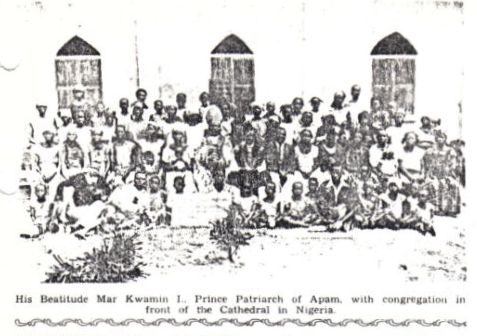
“In Nigeria, on the Gold Coast of Africa, another great work is being accomplished under the leadership of His Beatitude Mar Kwamin I, Prince-Patriarch of Apam (The Most Revd. Kwamin Ntsetse Bresi-Ando, D.D.) Mar Kwamin is a Prince in his own right as well as a great missionary. The war stopped much of the work and there is a great need for supplies of all sorts for this Mission. This missionary work is known in the United Kingdom under the title of “The Bible Mission in Nigeria”. Mar David [Archbishop Wallace David de Ortega Maxey, who held office in the ACF, the AEC and the Catholicate of the West] has been made General Superintendent for America and it is the hope and prayer of all affiliated churches that in due season we may be able to supply the greatest need of the Mission at present, ie. teachers, nurses and doctors. The above picture [reproduced at the top of this article] will give some idea of how far the work has progressed under great handicaps.”

One of those who was active in attempting to assist the work from the United Kingdom was Mar Georgius of Glastonbury (q.v.) who co-ordinated the Bible Mission which sent Bibles to Nigeria for the use of the African Universal Church. However, the hopes of restoration were to be unfulfilled. By the 1950s, only around ten parishes in the Gold Coast remained faithful to the African Universal Church, the others having dispersed, formed schisms or united with other churches; the work in Nigeria doubtless seemed at that point more likely to bear fruit.

In May 1951, the name of the church was changed to The Orthodox Catholic Church, thus emphasising its Apostolic, if not jurisdictional, continuity from Archbishop Sibley’s Orthodox Catholic Church of England. Mar Kwamin made his last visitation to the Gold Coast between December 1955 and February 1956; after this, his attention was wholly concentrated upon his work in Nigeria.

Just as war had disrupted the work in Ghana, so it would in due course disrupt that in Nigeria, and the Nigerian-Biafran civil war of 1967-70 resulted in the dispersal of Mar Kwamin’s parishes there. On 27 May 1970, by which time he was in advanced illness, he, together with his wife and three children, was repatriated to Ghana. He died at the Cape Coast Hospital on 2 October.

Although Mar Kwamin’s movement was by then a shadow of its former self, the remaining Ghanaian parishes enjoyed growth particularly among the youth during the 1970s. Eventually, they would be received into the Greek Orthodox Patriarchate of Alexandria in 1982, together with former members of Mar Kwamin’s clergy.

Some historical information about Mar Kwamin and his church can be found at the website of the Orthodox Research Institute. The Abbey-Principality rejects entirely the negative commentary provided in the course of this account concerning Prince-Abbot Joseph III and Archbishop Sibley, which is based on a series of inaccurate statements.

Prince-Abbot honoured by the COSSH Bayern

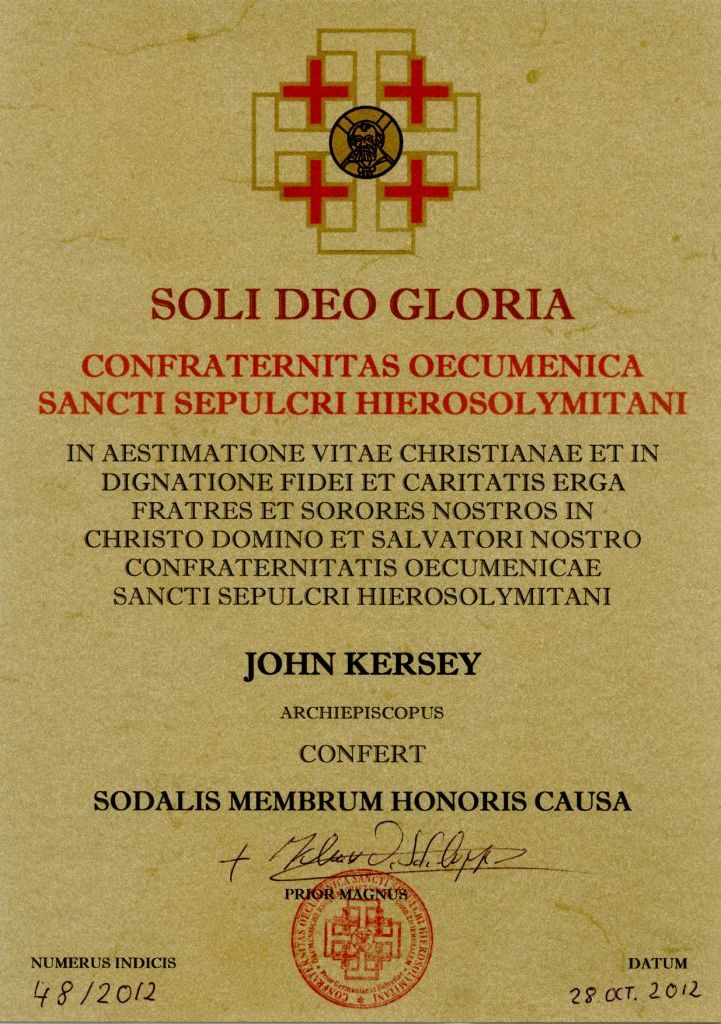
The international Confraternitas Oecumenica Sancti Sepulcri Hierosolymitani with its seat in Bavaria, Germany, has announced that it has appointed the Prince-Abbot as an Honorary Brother.

The Brotherhood was re-organised in 1987 after the model of the “Jerusalempilger von der ritterlichen Bruderschaft vom Heiligen Lande zu Haarlem” founded in 1394, and has as its Patron the Apostle St Andrew. Its ecumenical membership counts both Old and Roman Catholics as well as Anglicans, Lutherans and members of the Reformed Churches. The Grand Prior is H.E. Dom Klaus Schlapps, OPR, Duke of Saih Nasra, who serves as Prior of Continental Europe for the San Luigi Orders.

Prince-Abbot receives awards

The Prince-Abbot has been honoured with two appointments from a senior member of the San Luigi Orders, the Most Revd. Prince Kermit William Poling (Mar Titus).

The Holy and Blessed Order of the Sacred Cup is a fraternal fellowship of Christian men dedicated to the Holy Sacrifice of the Eucharist. The Order was founded on 1 August 1970 under charter of H.B. Peter Zhurawetsky (1901-94), Patriarch of Miensk and all Byelorussia in Dispersion of the Orthodox Catholic Patriarchate of America, with blessings from H.B. Benediktos, Orthodox Patriarch of Jerusalem, who became one of its first members.  In 1988, the Most. Revd. Kermit Poling became head of the Order and Grand Knight Chancellor. Archbishop Poling was consecrated by Patriarch Zhurawetsky on 1 September 1970 and received from him the title of Prince of Miensk.

The Order maintains close ties with the Shrines of the Holy Land. The Grand Knight Chancellor and other officers visit on an occasional basis The Cenacle on Mount Zion, a room in an old church built on the traditionally accepted site of the house where the Last Supper was held. Services of Investiture for the Order have been held here and insignia of the order blessed.

In December 1970, the Most Revd. Joseph Raya, Metropolitan of Akko, Haifa, Nazareth and All Galilee in the Melkite Greek Catholic Church, and a Knight of the Order, began the tradition of remembering the Knights of the Sacred Cup at the Christmas Eve Liturgy each year celebrated in “The Home of Our Lord” in Nazareth.

The Order has made periodic donations to the Cenacle and to the Church of Gabriel in Nazareth, in addition to assistance for children in need.

Members of the Order have included Patriarch Mar Ignatius Jacob III of the Syrian Orthodox Church, Ecumenical Patriarch Athenogoras, President William V.S. Tubman of Liberia, J. Edgar Hoover, President Chiang Kai-Shek of China (Taiwan), Archbishop Makarios III of the Cypriot Orthodox Church, Metropolitan Athanasius Y. Samuel of the Syrian Orthodox Church, Archbishop Thomas Julius de Czernohorsky-Fehervary of the Traditional Catholic Christian Church and Dr Oral Roberts. In the category of Honorary Members, which includes women and those not of the Christian faith, are included H.H. the Dalai Lama, Queen Diskit Wangmo of Ladakh, and H.H. Raghubir Singh, Maharaja of Rajpipla.

The consecrator of the present Prince-Abbot, Archbishop Professor Bertil Persson, and his predecessor in his offices in the Apostolic Episcopal Church and Order of Corporate Reunion, the late Archbishop Count George Boyer, together with a number of members of the San Luigi Orders, are also counted among the Knights of the Sacred Cup.

Prince Kermit, who was admitted to all three San Luigi Orders by Prince-Abbot Edmond II, is a descendant of King Edward III of England and thereby of several of the Byzantine emperors and the early Kings of Poland. He traces both his paternal and maternal lines via traditional genealogies to Leszek (Lech), the legendary founder of Gniezno. He has established the united heritage of his paternal and maternal ancestry as the Dynastic House Polanie-Patrikios. In 2006, the House established a study society to foster interests in various aspects of Byzantine history and culture, the Constantinople Orthodox Institute.

Now retired, Prince Kermit served as a Petty Officer on active duty with the United States Navy (receiving the Good Conduct Medal) and subsequently with the Identification Division of the Federal Bureau of Investigation before training for the ministry of the Evangelical United Brethren Church. In 1968, that church merged with the Methodist Church to become the United Methodist Church. Prince Kermit has pastored churches in West Virginia including the Crossroads United Methodist Charge near Parkersburg, Hope-Halleck Charge UMC near Morgantown, Trinity and Warren UMC Charge near Grafton, and First-Trinity UMC Charge at Pennsboro. He has been chaplain of Grafton City Hospital, broadcaster of the “Morning Devotions” radio programme, Instructor in Bible History for the United Methodist Lay Academy, and a lecturer on religious subjects whose talks and interviews have been broadcast in over twenty countries. He is past Assistant Secretary of the West Virginia Conference of the UMC.

He received Holy Orders in the Orthodox tradition alongside his UMC service and on 11 April 1972 was consecrated by Dr William Bernard Crow (1895-1976) (pictured), Sovereign Prince-Patriarch of Antioch in the Ancient Orthodox Catholic Church, who was the senior bishop in the Antiochean succession from Mar Julius of Iona (Ferrette) and the consecrator of Mar Georgius of Glastonbury (q.v.) Dr Crow appointed Prince Kermit as Bishop of the Apostolate of the Holy Wisdom and on 7 October 1972 as a knight in the Sacred Antiochene Order of Saints Peter and Paul. Dr Crow was also a Knight of the Sacred Cup.

Prince Kermit has been appointed an Ambassador of Good Will for West Virginia by the Secretary of State and is an Honorary Citizen of Texas, Tennessee and Georgia by appointment of the Governors of those states. In 1988, the Ohio House of Representatives awarded him a commendation for outstanding achievement in ministry and the Ohio Senate commended him for achievement as a religious leader. He has further received a Citation of Commendation and Praise from the Senate of the State of New Jersey. Among many chivalric and religious awards he has received a knighthood from King Peter II of Yugoslavia (late High Protector of the Order of the Crown of Thorns), the Cross of St Mark from Stéphanos Cardinal Sidarouss, Patriarch of Alexandria of the Coptic Catholic Church, and the Cross of St Antony of the Desert from the late Anba Marcos, Archbishop of France of the Coptic Orthodox Church. Within the Abbey-Principality of San Luigi he has received the title of Duke of Kelibia and is also a Frater Knight Grand Cross of the Valiant Order of St John the Baptist. He is a Fellow of the Augustan Society and a recipient of its Principate of Augustus Commemorative Medal.

He is married to his fifth cousin, Patricia (née Groves) and has two sons, three grandchildren and one great-grandson.