Prince-Abbot receives awards

The Prince-Abbot has received several Polish awards recently.

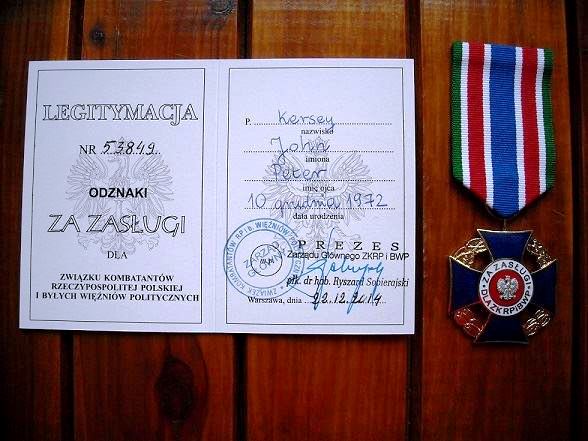
Society of Polish War Veterans Cross of MeritHe has been awarded the Cross of Merit of the Polish Society of War Veterans and Former Political Prisoners (Związek Kombatantów RP i Byłych Więźniów Politycznych). The ZKRPiBWP is an official Polish Veterans association and the largest such, with 43 regional chapters across Poland as well as 2364 clubs. Membership may be granted to any Polish citizen who was an active duty member of the Polish military (including partisan, self-defence units, and Polish Underground State) in or during the war, campaign, or conflict, as well as to all survivors of German concentration camps and pro-Soviet political imprisonment in the communist era. The constitution also requires members to have not been discharged under any conditions other than honourable.

In addition he has received two awards of the Union of the Polish Monarchists Association (Unia Polskich Ugrupowań Monarchistycznych):

UPUM Jerusalem Cross
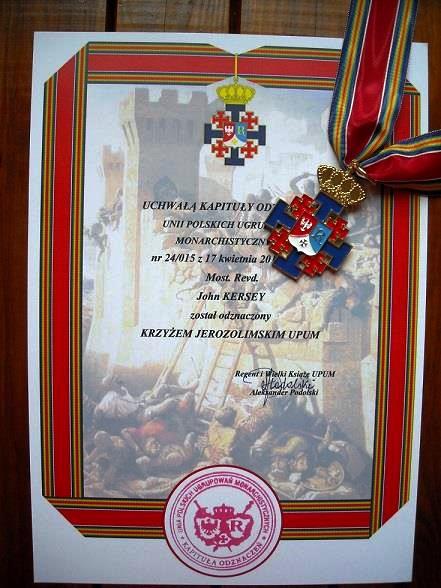
Firstly, the Jerusalem Cross of the UPUM. This award was established by resolution of the Council of Regency UPUM No. 4/08 of 5 June 2008 to honour charitable work. This is one of the highest honours of the Union of the Polish Monarchists Association. It is a distinction for UPUM members, for members of the Collegium Heraldicum Concordiae, and for other people from friendly organizations who have promoted the common good in an extraordinary way. The Jerusalem Cross of the UPUM is in one class with a neck decoration and a certificate accompanies the award.

UPUM Regent's Medal
Secondly, the Medal of the Regent of the UPUM. This medal was established by resolution of the Council of Regency UPUM No. 15/010 November 11, 2010. The medal is awarded to long-serving members of UPUM for their great loyalty to the Union and to other persons who are active in fostering awareness of monarchist ideas in society.

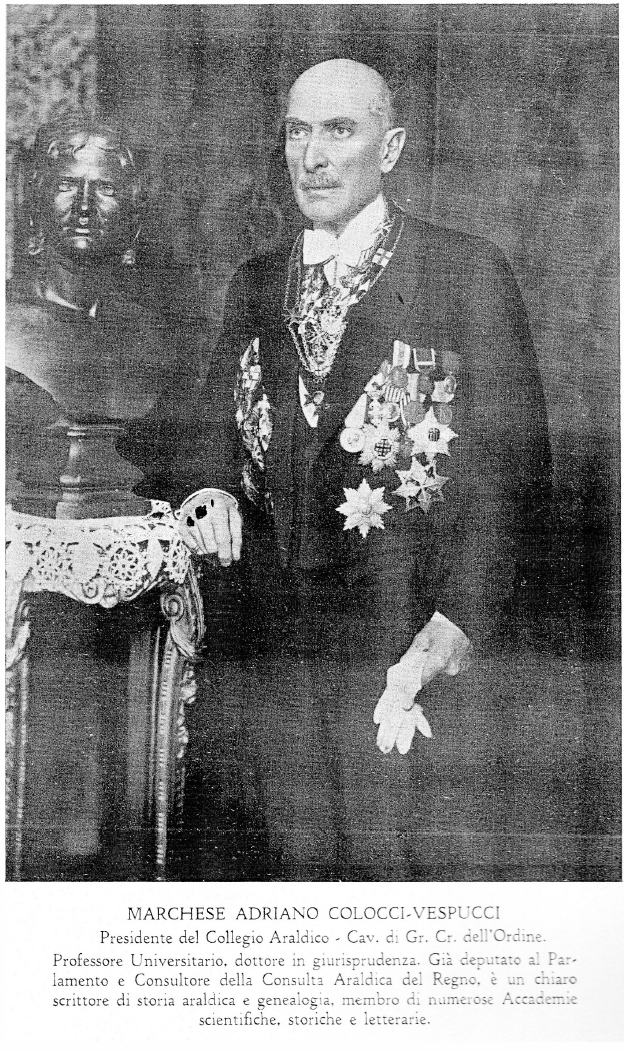
Members of the San Luigi Orders: Marquis Adriano Colucci-Vespucci

The Marchese Adriano Colucci-Vespucci, member of the Order of the Crown of Thorns and President of the Italian Collegio Araldico (Heraldic College). A Doctor of Jurisprudence and an authority on chivalric and heraldic matters, he was a member of Parliament and adviser on heraldry to to H.M. the King of Italy. Editor of “La Nobilta della Stirpe”, he included the history of the Order of the Crown of Thorns in that journal.

Marchese Adriano Colocci-Vespuccicolucci_vespucci

Prince-Abbot receives award

The Prince-Abbot has been honoured by our Royal Patron, Prince Kermit Poling de Gniezno, with the Order of Merit of Leszek II. This award was initiated by the Dynastic House Polanie-Patrikios  as a reward for merit. Leszek II (Leszko II) was Duke of the Polanes between 804 and 810 and is an ancestor of Prince Kermit, who is 37th in descent from him. Leszek II is mentioned in the Chronica Polonorum by Wincenty Kadłubek (1190-1208).

Order of Merit of Leszek IILeszek II

Old Catholic Church of Great Britain and related matters – statement of clarification

The Old Catholic Church of Great Britain has been held in personal union with the Apostolic Episcopal Church since 2015, with Dr Kersey serving as Primate of both churches. Recent material appearing on the website of ex-clergy of our jurisdiction have made it necessary to issue a statement of clarification which we trust will show the falsehood of their claims.

Dr Kersey writes: “As Primate and Archbishop of Elmham in the Old Catholic Church of Great Britain, I have noted the statements made in respect of the Benedictine Order of St Romuald, the Old Catholic Church of Great Britain and the late Archbishop Aelred Peter Coghlan Distin at http://holycrossbenedictines.weebly.com/journal—in-hoc-signo-vinces.html with interest. The article published there on these matters is familiar to me because it consists almost entirely of my own words, first published on the website of the Apostolic Episcopal Church, which have been reproduced without my permission and in violation of my copyright by Michael Skelly and by Alistair Bate, who is a former bishop of my jurisdiction. As a general rule, I am only too happy to see my words reproduced by others, with appropriate acknowledgement; however, to see my text plagiarised and used to support lies and distortions can hardly be expected to meet with my approval.

The claims made in this article in respect of Michael Skelly are bizarre and false, and have clearly been made under the impression that our documentary archive on these matters is incomplete. On the contrary, among the considerable number of documents present here are documents that directly disprove the statements made by, or on behalf of, Michael Skelly, and that were issued both by my predecessor Archbishop Distin before witnesses and in some cases by Michael Skelly himself. We also possess a number of emails sent by Archbishop Distin that confirm the matters formalized in the documents. We find no evidence whatsoever that Archbishop Distin was “confused” or anything other than fully compos mentis at the time that he issued this documentation. By contrast, Michael Skelly wrote to me on 12 March 2007, “…may I ask you to bear the following in mind concerning myself? If I sometimes don’t answer any questions you ask me, it is not because I am being rude, but rather due to my poor memory. This is a result of a near fatal road traffic accident in 1997.”

Let us begin with the position of Michael Skelly. In 2007, Skelly shared with me a copy of his Instrument of Solemn Profession in the Benedictine Congregation of St Romuald. The document is dated 21 November 2001 and witnessed by Archbishop Distin. This is accompanied by his Certificate of Episcopal Consecration by Archbishop Distin. The document is dated 21 November 2001 and it appoints Skelly as Lord Bishop of All Fortrenn in the Benedictine Congregation of St Romuald within the Titular Archbishopric of Lindsey in Anglia. These documents are reproduced below and are clear and unambiguous in their contents:

These documents prove the falsehood of the following statements: “Further to a meeting held at Drumrack near Anstruther, Fife, on 1 May 1995 between Distin and Michael Skelly, on 5 May 1995 Distin appointed Dom Michael Skelly as his perpetual coadjutor with right of succession and consequently relinquished all jurisdiction of the Church and Order. On 1 June 1996, Distin Blessed and Enthroned Dom Michael Skelly O.S.B.(C.S.R.) as Bishop-Abbot for life at Distin’s Monastic Oratory of St. Fillan located at Aipple Yaird, Newburgh, Fife. Distin then became Bishop Abbot Emeritus.”

As of the dates mentioned above in 1995-96, Skelly had yet to enter into Solemn Profession in the Order, which he did not do until November 2001. Moreover, the evidence of the certificate above is that Skelly fully accepted the authority of Archbishop Distin on behalf of the Benedictine Order of St Romuald as of November 2001, and as is evident on the certificate of consecration, that Order was within the Titular Jurisdiction of Lindsey in Anglia – that is to say, subordinate to that jurisdiction. There is not a word of any appointment as co-adjutor or abbot on the certificate of consecration or indeed on any other document.

Also in our archive is a copy of the ordination certificate of a priest from 24 November 2001, undertaken by Skelly as the ordaining bishop and witnessed by Archbishop Distin. The jurisdictional authority cited by Skelly for this action is the “Gallican Diocese of Mercia” and he describes himself as “Gallican Bishop of All Fortrenn”.

The dissolution of the Benedictine Order of St Romuald was undertaken in two stages by Archbishop Distin. In the first, on 25 November 2004, he announced that it was disbanded due to lack of support.

It appears that a “second chance” was then given, but that this produced no more encouraging a response. On 25 January 2005 Archbishop Distin dismissed all the members of the Order individually via an Ad Clerum, since they had failed to renew their commitment to the Rule of St Benedict as he had requested. “Brother Michael” is included on the list of members to be dismissed.

From these documents it can be seen that firstly that the Benedictine Order of St Romuald was indeed dissolved by Archbishop Distin, and secondly that Skelly was among those who were formally dismissed from the Order by him.

Let us now address the libelling of my immediate predecessor Archbishop Phillip Kemp. The article states, in impertinent terms, “The late Bishop Phillip Kemp claimed to have re-founded the Order in 2007 as he also claimed to be Distin’s successor, which he certainly was not.”

Having known Archbishop Kemp personally, I am in a position to vouch for his character. Whatever the issues that may have befallen us over the years, I consider him to have maintained a high standard of personal integrity as befitted not only his office as a bishop but his rank as a Captain in the British Army and an officer for a large trades union. He and I discussed the position regarding Archbishop Distin in great detail on a number of occasions, and while this relationship was complex and at times strained, it was for the greater part one of affection and positive Christian endeavour, as attested by a number of the emails in my possession. It is nothing short of disgraceful that Alistair Bate and Michael Skelly, neither of whom to my knowledge ever met Archbishop Kemp, should attempt to malign his character in this manner, and such an action reveals much about them. If they had imagined that, being dead, Archbishop Kemp would have no-one to defend him, they are sorely mistaken.

Here is Archbishop Kemp’s certificate of consecration by Archbishop Distin for the Old Catholic Church in Great Britain, dated 6 June 2004 and witnessed:

Here is Archbishop Kemp’s mandate of election as co-adjutor of the Old Catholic Church of Great Britain, issued on the same day:

And here is the instrument of retirement of Archbishop Distin in favour of Archbishop Kemp, dated 13 September 2004, from which date Archbishop Kemp succeeded Archbishop Distin as Primate of the Old Catholic Church in Great Britain:

Since that jurisdiction included the titular archbishopric of Lindsey, it follows that it also included authority over the Benedictine Order of St Romuald. It had been agreed that Archbishop Distin would continue as Abbot of the Order after his retirement in September 2004, and his decision to dissolve it was therefore taken during the Primacy of his successor. Authority over the Order was then exercised when Archbishop Kemp revived it, renaming it the Benedictine Congregation of St Romuald and appointing the Rt. Revd. Dom Simon Scruton as its Abbot under the name Aelred Peter II on 19 August 2006. The use of that name and office by Michael Skelly or any other party would appear to be entirely without legitimacy or warrant. It should be noted that as of 15 August 2006, Archbishop Distin had been excommunicated from the jurisdiction.

Subsequently, Abbot Aelred Peter II retired on 30 August 2008 in favour of the present Abbot, Dom Thomas Hugh Bodkin OSB(csr) who serves today in that office under the name Hugh I.

The Benedictine Congregation of Saint Romuald was accepted into intercommunion with the Order of Antioch on 28 September 2014 at which point its Abbot, Hugh I, became a member of that Order. By this act the Congregation returned, albeit briefly, to a position of intercommunion with its parent body, the Old Catholic Church of Great Britain. In a ceremony before witnesses on 16 February 2015, Abbot Hugh was formally incardinated into the Apostolic Episcopal Church. On 11 March 2015, at the petition of Abbot Hugh, a full canonical release was issued to him and the Congregation ceased to be in intercommunion with us once more.

This information is more than sufficient to prove the falsehood of the claims made by Alistair Bate and Michael Skelly. In the case of Michael Skelly, who is a vulnerable and elderly man labouring under a serious neurological disability, some degree of leniency may be appropriate, not least in recognition of our previous extensive correspondence which was entirely amicable throughout. In the case of Alistair Bate, who knows exactly what he is doing, the same cannot be said to apply.

It is now over four years since Alistair Bate resigned from my jurisdiction rather than be subject to an inquiry into his conduct – an inquiry which, it should be recalled, was at an initial stage and had reached no conclusions at the point of his resignation. Almost immediately afterwards, he underwent re-consecration at the hands of a prelate not associated with our communion. Rather than embrace the freedom and independence he had apparently sought, he and those associated with him have on numerous occasions published provocative and inaccurate material online directed at my jurisdiction and at me personally. Moreover, in February 2013 I was the recipient of a crude threat of violence directed towards me by Bate’s partner, Bruno Pedrini. It should not be imagined that the decision on my part to exercise restraint in not making a public response to these items or reporting them to the relevant authorities will not be revisited in the light of present and future events.”

Death of Bishop Leila Boyer

+Leila Boyer with Archbishops Phillip Lewis (Ethiopian Coptic Orthodox Church) and Paget Mack (Apostolic Episcopal Church), London, November 2008

The Apostolic Episcopal Church has been informed of the death from cancer of +Leila Boyer, Presiding Bishop of the Pre-Nicene Ekklesia and Church of the Ascension, and extends its condolences to her family and clergy.

+Leila Boyer, née Christian, was the wife of the late Archbishop-Count George Boyer, OCR (1921-2008), who served as Archbishop of Great Britain and sometime Secretary of Metropolitan Synod of the Apostolic Episcopal Church. Archbishop Boyer was the designated successor of the esotericist Richard, Duc de Palatine (1919-78), who had been installed as Presiding Bishop of the Pre-Nicene Catholic Church (later renamed the Pre-Nicene Ekklesia) and Lord Bishop-Abbot of the Order of St Raphael (in addition to numerous other ecclesiastical, chivalric and academic offices) by Mar Georgius of Glastonbury in 1953. In consecrating the Duc de Palatine, Mar Georgius acted under the authority of the British Exarchate of the Order of Antioch.

Following the death of Archbishop Boyer, Archbishop John Kersey, now Primate of the AEC and Prince-Abbot of San Luigi, was installed in the offices he had held within the AEC and the Order of Corporate Reunion, while +Leila Boyer succeeded her late husband as Presiding Bishop of the Pre-Nicene Ekklesia and as a member of the Council of Three established by the Duc de Palatine. As an esoteric jurisdiction, the Pre-Nicene Ekklesia accepted the ordination of women to the major orders, and accordingly +Leila had been consecrated bishop by her husband in 1990.

+Leila was a welcome guest at Archbishop Kersey’s installation service and at several subsequent ecumenical services in London. In her later years she completed a biography of Richard, Duc de Palatine, and edited his works for publication. She was generous in sharing a number of archival, documentary and liturgical resources concerning the Duc de Palatine with Archbishop Kersey, and helped make the Duc de Palatine’s work better known among those who had a capacity to benefit from it.

Her concern for others was notable, and although deliberately self-effacing and unconcerned with personal status, the effect of her spiritual presence was striking. After her husband’s death she was increasingly concerned with working outside formal church structures, and emphasised the unified nature of her mission across all boundaries of denomination or creed. May she rest in peace and rise in glory!