Members of the San Luigi Orders – Archbishop Joanny Bricaud (Tau Jean II), his work and his succession

Jean-Baptiste (Joanny) Bricaud (1881-1934) was Patriarch of the Universal Gnostic Church in France. He was a Prelate-Commander of the Order of the Crown of Thorns and, together with his wife Eugénie, was of vital importance in the preservation of its archives and spiritual tradition in the last years of Prince-Abbot Joseph III.

Bricaud had entered the minor seminary in preparation for the Roman Catholic priesthood, but instead took up secular employment in a bank and continued an extensive exploration of Gnostic and kabbalistic traditions that had begun while he was a seminarian. He had contact with French esotericists Elia Alta and Charles Henri Détré (Teder) (1855-1918) and became involved with the Eliate Church of Carmel and the “Work of Mercy” which had been founded in 1839 by Eugéne Vintras (1807–1875), as well as the Johannite Church of Primitive Christians, founded in 1803 by the Templar revivalist Bernard-Raymond Fabré-Palaprat (1777–1838). He became a member of the Martinist Order and in that capacity met Gerard Encausse (Papus) (1865-1916) who was head of that order, in 1899.

The Gnostic Church in France had been established by Jules-Benoît Stanislas Doinel du Val-Michel (1842–1903), a librarian, Grand Orient Freemason and spiritualist. In 1888, while archivist at the Library of Orléans, Doinel discovered a charter dated 1022 by Canon Stephan of Orléans, who was a Gnostic forerunner of the Cathars and was burned at the stake in that same year as a heretic. This inspired Doinel to make a detailed study of Cathar and Gnostic teachings, and convinced him that it was Gnosticism that was the essential religious basis for Freemasonry.

Following a mystic consecration by the avatar of Jesus Christ in a vision, Doinel announced that the year 1890 was to begin the “Era of the Gnosis Restored” and became Patriarch of the Gnostic Church. The new church was to have both male and female bishops, the latter to be known as sophias, and they would take a mystic name prefaced by the Greek letter Tau (which represents the Tau Cross) or the Egyptian Ankh. Among the first bishops consecrated by Doinel, who became known as Tau Valentin, was Papus. Membership of the church was restricted to those who, in the view of its hierarchy, were “of high intelligence, refinement and open mind”.

The Gnostic liturgy was strongly Roman Catholic in influence (perhaps prefiguring a similar influence in the later Liberal Catholic Church), with a Gnostic Mass as the central ceremony, and two other main rites from the Cathar tradition, the Consolamentum and the Appareillamentum.

In 1895, Doinel resigned as Patriarch and converted to Roman Catholicism. He now launched a series of bitter attacks on his former church, which naturally endeared him to the Roman hierarchy. However, he repented of this behaviour, and was readmitted to the Gnostic Church as a bishop in 1899 by his successor as Patriarch, Léonce-Eugène Fabre des Essarts (Tau Synesius) (1848-1917).

It was Tau Synesius who consecrated the twenty-one year old Joanny Bricaud as a bishop of the Gnostic Church in 1901. Papus, who wanted to see a more directly Martinist and Roman Catholic-modelled body than the more general esotericism of Tau Synesius, encouraged Bricaud to found his own church as a schism of the Gnostic Church, which he did in 1907, adopting the name Gnostic Catholic Church and the title of Tau Jean II. In February 1908, the Episcopal Synod of the Gnostic Catholic Church elected Bricaud as its Patriarch, which event marked the point at which Bricaud’s jurisdiction, subsequently known as the Eglise Gnostique Universelle, became acknowledged as the successor jurisdiction to the Gnostic Church of Doinel, the Carmelite Church of Vintras and the Johannite Church. Papus conditionally consecrated Bricaud in 1911, from which date the Eglise Gnostique Universelle was considered to be the official church of Martinism. Eventually, in 1926, the remnant of Tau Synesius’ church also chose to unite with Bricaud’s Eglise Gnostique Universelle.

In 1908, an exchange of orders between Papus and Theodor Reuss (Merlin Peregrinus) (1855–1923), founder and head of the Ordo Templi Orientis, led to a commission to Papus in respect of authority within the Rites of Memphis and Mizraïm, and to Reuss in respect of establishing the Eglise Gnostique Universelle in Germany (which he did through subsuming it within the OTO).

Bishop Paulo Miraglia Gulotti had been consecrated by Prince-Abbot Joseph III in 1900 for work in Italy. On 4 December 1904, Gulotti consecrated another French esotericist, Jules Houssaye (Abbé Julio) (1844-1912). Houssaye consecrated Louis-Marie-François Giraud (1876-1951) as Mar Louis on 21 June 1911. After Bricaud had become Patriarch of the Eglise Gnostique Universelle, he had contact with Giraud, a bishop of the Eglise Catholique Gallicane, who ordained him deacon and priest on 25 July 1912 and consecrated him on 21 July 1913, thus bringing the Eglise Gnostique Universelle within the Vilatte succession and the historic Apostolic Succession proper, via the lineage of the Syrian Orthodox Church.

On 20 May 1914, Bricaud received a further conditional priestly ordination and episcopal consecration from Albert Laurain de Lignieres, who was the French co-adjutor to British Old Catholic bishop Arnold Harris Mathew and also a bishop of the Eglise Catholique Gallicane. Laurain de Lignières had been consecrated in 1909 by Henry Marsh-Edwards (1866-1931), one of the British bishops consecrated by Prince-Abbot Joseph III. Pursuant to this, Bricaud was appointed Bishop of Lyons in the Eglise Catholique Gallicane.

On 10 September 1919, Bricaud received a warrant via Theodor Reuss to establish the French Sovereign Sanctuary of the Orders of Memphis and Misraïm. On 30 September, he established a Supreme Grand Council of the Confederated Rites, which consolidated the Masonic and associated esoteric bodies that were under his aegis.

Bricaud and the Ancient British Church

According to Richard, Duc de Palatine’s work “The Right of Succession”, in which he discussed the Apostolic Successions he had received from his consecrator Mar Georgius of Glastonbury, Catholicos of the West, Bricaud appointed John Yarker the English representative of L’Eglise Gnostique Universelle, L’Ordre Martiniste, the Rite Ancien et Primitif Memphis-Mizraim, and L’Ordre de la Rose Croix. Palatine continues, “The Grand Orient of France, being based upon the Gnostic doctrines, extended John Yarker Jr. the Hand of Friendship with the proviso that all the Gnostic and Chrestian Orders were to remain separate from the common Masonic Lodges…Dr. [Herbert James] Monzani Heard [Mar Jacobus II (1866-1947), fifth British Patriarch and a bishop of the Catholicate of the West] was consecrated a Bishop of L’Eglise Gnostique Universelle, and thus through him the Chrestian/Gnostic lines of the Right of Succession passed into England.  John Yarker Jr. died in 1913, but before he died he passed to Dr. Heard the whole of his authorities both secular and religious. Dr. Heard did consecrate and initiate Dr. Hugh G. de Willmott Newman [Mar Georgius of Glastonbury] into L’Eglise Gnostique Universelle and also into all the Masonic Orders Dr. Heard gained from John Yarker Jr.” These statements indicate that Yarker was towards the end of his life consecrated a bishop of the Eglise Gnostique Universelle, presumably by Bricaud, and then that Yarker in turn consecrated Heard, who consecrated Mar Georgius. Mar Georgius never publicly referred to holding any Gnostic succession (although documentation exists attesting to his Masonic and Rosicrucian authorities), but in doing so he was surely simply following the common practice in the membership of esoteric bodies in those days (and sometimes still) of maintaining silence lest his motives and involvement should be misunderstood by others. Mar Georgius was also a bishop of the Apostolic Episcopal Church, which since 1977 has been united with the Catholicate of the West and is today part of the Abbey-Principality of San Luigi, and thus this succession has passed to the present Prince-Abbot of San Luigi.

Bricaud and Prince-Abbot Joseph III (Vilatte)

In February 1922, Prince-Abbot Joseph III was in France once more, and there he began to correspond with Bricaud. They continued contact after his reconciliation with Rome in 1925, and from 1927 onwards, Bricaud and his wife-to-be Eugénie (Mother Angelique Sophia) (they would marry in December 1929) were key to Prince-Abbot Joseph III’s plans for the continuation of his work.

By 1927, Prince-Abbot Joseph III had determined that he would not remain within the Roman Catholic Church. He had gained much-needed rest and respite from his time there since 1925, as well as welcome financial support through his Papal pension and from donors in the United States. However, he was frustrated by the Roman authorities’ unwillingness to allow him to celebrate Mass in public and felt that his mission demanded a more active witness. He intended to travel to the United States where he would conduct his mission through the Order of the Crown of Thorns and through the nascent Order of Antioch, which he planned in detail. In addition, it was planned that he would resume the headship of the American Catholic Church on the intended resignation of its Primate, Archbishop Frederick E.J. Lloyd.

For many years it was thought that many of the documents and artefacts associated with Prince-Abbot Joseph III – all of which had been seen by the future Prince-Abbot Edmond I during his visits – had been either destroyed in a fire at his home, or seized and subsequently destroyed at his death by the Roman authorities. In fact, neither was the case. A great deal of thought went into the best place for the safekeeping of this substantial archive. As correspondence of the time shows, Prince-Abbot Joseph III viewed Prince-Abbot Edmond I as his closest friend (see letter from Prince-Abbot Joseph III to Prince-Abbot Edmond I of 19 July 1925: “you are my Chancellor-General and my most sincere and faithful friend for ever”.) However, Prince-Abbot Edmond I was at the time and for some years to come still a priest in the Protestant Episcopal Church. Prince-Abbot Joseph III remembered the ill-treatment he had received at the hands of that church, and understandably feared that his most prized possessions would not be safe in an Anglican vicarage. A decision was taken as a result that they should be entrusted to Archbishop Lloyd in Chicago, who was both independent ecclesiastically and possessed of considerable financial means. Correspondence between Prince-Abbot Joseph III and Lloyd was smuggled in and out by the Bricauds, without the knowledge of the Roman authorities, and this was then followed by the archives themselves. One letter refers to the skirts of Mme. Bricaud concealing more than her virtue!

The Bricauds were key to the spiritual developments of Prince-Abbot Joseph III’s last years. A complete Missal, Service Book, Ritual and Pontifical was prepared by Bricaud under the nihil obstat of (and with an extended forward by) Prince-Abbot Joseph III. This is dedicated to Mother Angelique Sophia. It was subsequently translated from French into English by a professor of the University of Chicago under the commission of Mrs Lloyd. The nature of the work is esoteric, with a concluding section explaining its meaning with reference to Pythagoreanism, the symbolism of the triangle, and the use of Hebrew characters. There are three forms of the Divine Liturgy (the Rite of Perfection): one for bishops, one for priests, and one exclusively for the use of sophias. Although it might at first appear that Prince-Abbot Joseph III through his nihil obstat had given his support to the ordination of women in this Gnostic context, his subsequent response to Bricaud on the matter showed that this was not the case. In subsequent publications, the main form of this liturgy (the “Wadle Mass”, or “Divine Liturgy of the Antiochene Malabar Rite of the Holy Catholic Church”) has been referred to as originating under the authorship of Lloyd, but comparison has shown it to have originated with the Bricaud Missal.
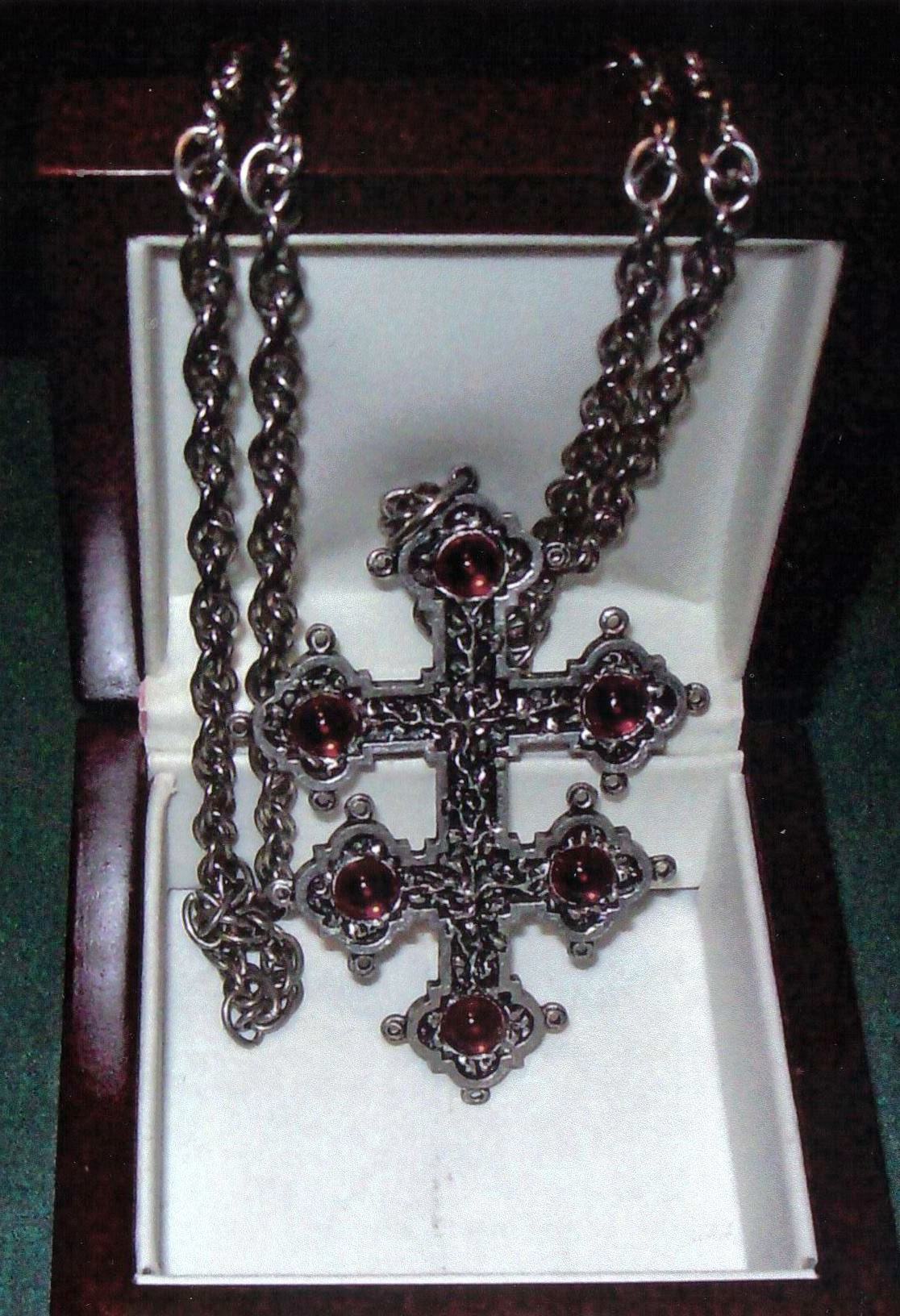
++Bricaud Cross

Bricaud and the American Chapter of the Order of the Crown of Thorns

In addition, a complete plan was formulated for an American Chapter of the Order of the Crown of Thorns, under the patronage of St Louis. Central to this work was a jewelled pectoral cross given by Bricaud to Prince-Abbot Joseph III (photographed at right). At the beginning and end of each meeting of the Chapter, three gold-framed photographs were venerated: in the centre, of Prince-Abbot Joseph III wearing the Bricaud Cross, and to the sides, of Prince-Abbot Joseph III and Bricaud, and of Bricaud and Mother Angelique Sophia. The Chapter members each wore the Bricaud Cross in rotation during meetings, regardless of ecclesiastical or chivalric rank.

Unfortunately, relations between Bricaud and Prince-Abbot Edmond I did not proceed as planned. The intention had been for Prince-Abbot Edmond I to be fully involved (as befitted his office) in the American Chapter and the work taking place in Chicago. However, Prince-Abbot Edmond I regarded Bricaud as having turned Prince-Abbot Joseph III against him and having supplanted him as his closest friend and confidant for his own gain. Indeed, Prince-Abbot Edmond I went to his grave believing that Prince-Abbot Joseph III had betrayed him through reposing his trust in Bricaud.

Prince-Abbot Edmond I rejected Bricaud’s approaches during the early 1930s and as a result the American Chapter was separated from the canonical jurisdiction of the Order as a whole, eventually becoming closed to non-members of the American Catholic Church. After the deaths of Lloyd in 1933 and Bricaud in 1934, the archives moved from Chicago to Laguna Beach in California where Archbishop Lowell Paul Wadle (1900-65) succeeded Bricaud. For several years, relations between Prince-Abbot Edmond I and Wadle were publically at odds – Prince-Abbot Edmond I condemning Wadle for his esotericism and heresy, and Wadle condemning Prince-Abbot Edmond I for his social respectability and “selling out” to the Episcopalians for a paycheck. However, in private, they formed a highly productive relationship, and in 1960 formal union was entered into by the two prelates. In 1971, the American Chapter was reabsorbed into the general administration of the Abbey-Principality under Prince-Abbot Edmond II.

The succession to Bricaud

Bricaud had consecrated Victor Blanchard (1878-1953) (Paul Yésir) on 5 July 1920. However, this act did not negate the fact that much of the relationship between Bricaud and Blanchard was antagonistic. Blanchard had not accepted Bricaud as head of Martinism in France and in 1921 had established his own Martinist body, the Martinist Order and Synarchy. Unlike Bricaud’s body, this did not restrict membership to men who were Master Masons, admitting women and non-Masonic members. Blanchard also received many other esoteric authorities during his career and on 14th July 1938 proclaimed that he was the Universal Grand Master of the Rose-Croix and of all the initiatic orders of the entire world. On 28 January 1945, Blanchard consecrated Robert Amadou (Tau Jacques) (1924-2006), who on 17 September 1988 (pictured at right) conditionally consecrated Archbishop Bertil Persson of the Apostolic Episcopal Church, consecrator of the present Prince-Abbot of San Luigi.

Bricaud in 1907, and then again in 1918 or 1919, consecrated the Haïtian Lucien François Jean-Maine (Tau Ogdoade-Orfeo I) (1869-1960), who had previously received consecration from Tau Synesius and other Gnostic bishops, and who was at that time living in France and later Spain. Tau Ogdoade-Orfeo I was also a Voudon high priest, initiated in his father’s temple. About 1910, he was given a charter by Papus for the Ordo Templi Orientis in Haiti and the French West Indies. Aspects of the O.T.O. had much in common with the Voudon heritage into which he had previously been initiated. The Spanish-Haitian development of this body would be designated Ordo Templi Orientis Antiqua after 1921.
Tau Ogdoade-Orfeo I had also received the Rites of Memphis and Misraïm from his first consecrator Tau Orfeo VI (Paul-Pierre de Marraga) of the Spanish Albigensian Gnostic Church (From Tau Orfeo VI he had also inherited a line of episcopal succession through the French Eglise Constitutionelle that originated with Pope Benedict XIII). In consequence, Tau Ogdoade-Orfeo I was able to impart to Papus a number of the higher grades in Memphis and Misraïm and in return, Papus gave him charters for those Orders he had received from John Yarker and Theodor Reuss. Significantly, Tau Ogdoade-Orfeo I did not maintain his esoteric authorities separately from his Gnostic church authorities. Frater Joseph has written of this, “For under the combined influences of the O.T.O., Martinism, Gnosticism, and Voudoo-not to mention the Fraternitas Lucis Hermetica-the Spanish and Haitian branches of the Rite of Memphis-Misraim gave up entirely their quasi-masonic character and became completely esoteric and Gnostic orders of magic, i.e., The Gnostic and Esoteric Order of Misraim. or of Egypt and the Gnostic and Esoteric Order of Memphis, within the larger, totally occult and much more ecclesiastical “Ancient and Primitive Rite of Memphis-Misraim”. This point must be emphasized because there are other branches of the Rite of Memphis-Misraim which claim to continue a masonic character, while it is only interested in continuing the Gnostic and apostolic succession and the magical currents of initiation.” (Frater Joseph, History of La Couleuvre Noire, in Skoob Occult Review, no. 3, London: Skoob Books Publishing, Ltd., 1990).

In 1921, having returned to Haiti and married, Tau Ogdoade-Orfeo I developed his own occult initiatic system called La Couleuvre Noire (The Black Snake), since as a Black man he was excluded from much Western European esoteric activity. This work has survived to the present day, as has the succession of Memphis-Misraïm bishops from Tau Ogdoade-Orfeo I. Returning to and slightly amplifying Frater Joseph’s account, we learn that “On January 18, 1966, an American Martinist, Tau Ogoade-Orfeo IV [Michael Paul Bertiaux], born January 18, 1935, was consecrated to the episcopate for the Rite of Memphis-Misraim. The consecration took place in Chicago, with Tau Ogoade-Orfeo II [José Marraga y Adhémar (1893-1969) as principal consecrator] and Tau Ogoade-Orfeo III [Hector François Jean-Maine (1924-84)] acting as the co-consecrator. Later, Tau Ogoade-Orfeo IV received the complete magical consecrations and currents of the Ecclesia Gnostica Hermetica on August 10, 1967. The Ecclesia Gnostica Hermetica carried the magical currents of the secret work of the O.T.O. and the Choronzon Club, and thus united the Crowleyan (Germerian) and Neo-Crowleyan (Choronzon Club and G.B.G.) successions with the Gnostic and Hermetic traditions inherited from the Vilatte succession of bishops.” Bertiaux then on 16 June 1979 consecrated Archbishop Forest Barber of the Apostolic Episcopal Church, through whom this heritage has passed to the present Prince-Abbot of San Luigi.

Bricaud died on 21 February 1934 and was succeeded as Patriarch of the Eglise Gnostique Universelle by Constant Chevillon (Tau Harmonius (1880-1944)). According to the account of Mme. Bricaud, Chevillon worked closely with Bricaud in his last years, and indeed the two men are buried in the same tomb. Bricaud certainly consecrated Chevillon, probably in the mid-1920s, but no record of the exact date of this event has survived. Chevillon was consecrated again by Giraud on 5 January 1936. At the time of his assassination by agents of the Vichy government during World War II, Chevillon had consecrated no bishops. His successor was René Chambellant (Tau Renatus (1907-93)) who was consecrated in 1945 by Edouard Gesta (Dr X), who had been consecrated by Blanchard on 28 January 1945. After World War II, the church was placed in a state of dormancy and Chambellant relocated for many years to Africa.

While there would be a continuation of elements of the work of the Eglise Gnostique Universelle through the churches led by Robert Ambelain and his successors, this would essentially be a work of revival and rebirth that continues in many Gnostic churches of today, perhaps illustrating that its inner traditions and their spiritual teachings are capable of creating their own organizational frameworks through the transmission of initiatic and episcopal successions.

Holy Water and incense blessed by Bricaud is today part of the San Luigi archive, as are some of his vestments and items from the Vilatte archive that he helped save. He remains one of our most important forefathers and a continuing presence and inspiration.

Notice concerning the Order of Corporate Reunion

Official website of the Order of Corporate Reunion: https://www.orderofcorporatereunion.org

The Order is incorporated with nonprofit status in England, UK, and California, USA.

This Notice has been issued to clarify several matters with respect to succession and rights within the Order of Corporate Reunion and to address the false claims and actions of Michael James Kline, Dario Caldarelli and Ben Wiltshire. The false claims made by Rodney Rickard have already been dealt with here.

I. THE MISSOURI CORPORATION OF THE ORDER OF CORPORATE REUNION AND MICHAEL KLINE’S CLAIMS REGARDING IT

On 25 January 2010, a non-profit corporation named “The Order of Corporate Reunion” was formed in the State of Missouri, USA. Because various claims have been made concerning the authority and succession to this corporation by Michael James Kline and others associated with him, notably at https://www.orderofcorporatereunion.net/notice, we have seen fit to examine these claims and to arrive at conclusions as to whether they can be upheld. The analysis that follows is divided into sections for the convenience of the reader.

As a preliminary, we invite the reader to examine the incorporation documents of this corporation, to which we refer in detail below, and to verify the same at the website of the Missouri Secretary of State, Division of Corporations, at https://bsd.sos.mo.gov. The corporation reference number is B01036801.

>>Copy of the Missouri OCR corporation creation documents

1. The nature of the corporation

The corporation was formed pursuant to Section 352.060, Chapter 352, Revised Statutes of Missouri. This law requires that the circuit court shall satisfy itself, based on the articles of incorporation, that the corporation is formed from a benevolent association as defined in Section 352.010 “Any number of persons not less than three, who shall have associated themselves by articles of agreement in writing, as a society, company, association or organization formed for benevolent, religious, scientific, fraternal-beneficial, or educational purposes, may be consolidated and united into a corporation.” The fact that the petition for incorporation is examined by a circuit court is of no more consequence than that the court in doing so satisfies itself that the purposes and lawfulness of the said corporation is in conformity with the statutes; in other words, it is created as a nonprofit (benevolent) corporation with exactly the same effect as a nonprofit corporation in any other state.

The process of incorporation:

a. proceeds when the court is satisfied that the application is made for genuine nonprofit/public benefit purposes and is in conformity with the law.

It does not:

b. confer any special authority upon the corporation. The corporation has no more powers than any usual nonprofit corporation in Missouri.
c. require judicial investigation into the historical or jurisdictional claims of the proposed corporation. The court has no powers under law to investigate historical claims, and there is no evidence that it did so in the documents of incorporation.

It has been asserted that the Missouri corporation is the only worldwide entity that has the right to the name and history of the Order of Corporate Reunion. This is completely false.

The Missouri corporation could never have “become the Order” because as of 2010, the Order was an unincorporated worldwide membership organization, all of whose members and officers had not been appointed under the Missouri corporation, nor were asked to consent to the incorporation, nor who became voting or non-voting members or officers of the resulting corporation. As will be seen, the Missouri corporation had a voting membership of one.

Both as of 2010 and since that time multiple corporations have been formed in the USA and elsewhere in the world to represent the Order, and the Missouri OCR corporation is powerless to prevent these actions, since its powers extend only to the limits of the law of the State of Missouri. At best, then, the Missouri OCR corporation was merely a local organization of the Order. That confusion arose as to the facts of the matter is entirely due to the assertions of Michael Kline.

The claims made that the court process had recognized the corporation as the sole representative of the Order is false, even though an assertion to that effect was made by the incorporators in Article V of the pro forma decree for incorporation. Interestingly, that assertion is specifically made “under English common law” and not under the laws of the State of Missouri or indeed the United States of America. The Missouri court had no powers under law to investigate the truth of historical claims regarding England or English law; merely to establish whether the proposed corporation met the requirements of the nonprofit statute and was in keeping with the laws of Missouri and of the United States of America. See Section 352.060 “If the court shall be of the opinion that such articles of agreement and the purposes of the association come properly within the purview of this chapter, and are not inconsistent with the constitution or laws of the United States, or of this state, the court shall enter of record an order to that effect.”

The only matters that would give rise to investigation are stated thus in the same section, “But no such order shall be made until such petition shall have remained on file in the clerk’s office of said court for at least three days after said petition shall have been presented to the court; and whenever the judge to whom such petition shall have been presented shall entertain any doubt as to the lawfulness or public usefulness of the proposed corporation, it shall be his duty to appoint some competent attorney, as a friend of the court, whose duty it shall be to examine said petition and show cause, if any there be, on some day to be fixed by the court, why the prayer of said petition should not be granted, and said attorney shall not be confined in his examination to said petition and articles of association, but may introduce such testimony as may be available and proper in order to fully disclose the true purposes of the association.” So we can see that the only grounds for further investigation are the “lawfulness or public usefulness” of the proposed corporation – not its historical or jurisdictional claims.

2. The membership of the corporation

The membership of the corporation is defined in Article VI, where it is stated that there shall be only one member of the corporation, the Universal Primate, who as stated in the incorporation was the late Archbishop Peter Paul Brennan (1941-2016).

Note well the following under the same article, “Mention of any other “members” are considered non-voting, and therefore have no legal rights to ownership, title, nor legal management of the Order of Corporate Reunion; former members are also considered having no legal rights to ownership, title, nor legal management of the Order of Corporate Reunion. Non-voting membership is open to the public, under such reasonable rules and regulations as the Universal Primate-Bishop may provide.”

No non-voting members of the corporation were known to have been appointed by Archbishop Brennan. Nor were any changes made to the terms or appointments of officers and members of the Order of Corporate Reunion whose tenure antedated the Missouri incorporation.

3. Appointment of a successor to the Universal Primate

The petition makes provision for the appointment of a successor to the Universal Primate at Article VIII, in which it is stated that the Universal Primate shall choose “a successor by the ancient right of bequeathing (ref. advowson)” The meaning of this is unambiguous: it is that the only means by which a person may succeed as Universal Primate is if his predecessor bequeaths the role to him.

Archbishop Brennan did not appoint a successor. On 28 July 2016, four days before Archbishop Brennan died, Michael Kline circulated an email to senior OCR clergy in which he stated the facts clearly, “I had requested on 2-3 occasions that +Brennan appoint me as a co-adjutor or successor for the OCR, but he was silent on this matter…I would serve willingly as a manager of the OCR as Camerlingo [sic] until a Primate is appointed.” This email shows not only that Kline was definitively not named by Archbishop Brennan as his successor but that it was also not expected by him or anyone else that he would succeed him as Primate of the OCR, still less that he would subsequently claim that such an office was his by right.

4. The role of the “executor” and “administrator”

Article VII further nominates Bertil Persson of Sweden and Francis Spataro of New York, described as “two additional Order of Corporate Reunion leaders” as “executor” and “administrator” respectively “in the event of the untimely death of the Primate”. Persson was Universal Primate between 1998 and 2004, while Spataro was the Order’s representative for New York.

What are the powers of these roles?

  1. Neither Persson nor Spataro was a voting member of the corporation, and so they were subject to the restrictions in Article VI, that is to say “Mention of any other “members” are considered non-voting, and therefore have no legal rights to ownership, title, nor legal management of the Order of Corporate Reunion”.
  2. An executor has the power to protect the assets of a nonprofit corporation, and then to ensure their transfer to the rightful beneficiaries (if any). It is not clear that the Missouri OCR corporation had any assets since OCR members were not solicited at any time for dues or donations, and the OCR did not own any property.
  3. The requirements for an out-of-state executor, such as Persson, to act lawfully in performing this role are stated at Missouri Revised Statutes 473.117, section 3 as follows: “Before a nonresident of this state or a corporation organized under the laws of another state or country is issued letters testamentary or of administration he, she or it shall file in the probate division of the circuit court a designation, including the signature and address, of a resident of this state, or a corporation of this state authorized to administer trusts, as agent for the service of process on and the receipt of notice by such nonresident or foreign corporation.  This designation shall be recited in the letters testamentary or of administration.  Such a designation may be revoked only by a new designation of an agent for service and notice in this state, which shall be endorsed on the letters testamentary or of administration.  By filing such designation, the nonresident submits personally to the jurisdiction of the court in all proceedings relating to the administration of the estate and to the performance of his fiduciary duties until discharged of those duties by the court.”
  4. There is no evidence that Persson was ever issued letters testamentary or of administration regarding the Missouri OCR corporation by the circuit court. Any action taken without these prerequisites would be legally invalid.
  5. The role of “administrator” in regard to a corporation in this context is undefined by statute and therefore it cannot be said that this role conferred any legal powers upon its holder.

5. What powers was Michael Kline given under the corporation?

The only mention of Kline occurs on the final page of the petition, in which it is stated, “+Bishop Michael Kline may execute written articles of incorporation and is acknowledged before the Universal Primate as an officer, and he is authorized to act on our behalf as a Registered Agent and Incorporator before the Honorable Circuit Courts of Missouri.”

Therefore, Kline was never a voting member of the corporation, and his powers were confined to those of an officer, to wit, the execution of written articles of incorporation, the duties of a registered agent and an incorporator.

6. How could the failure to nominate a successor be overcome?

In Kline’s own words, reproduced above, Archbishop Brennan appointed no successor.

There is no provision anywhere in the corporation for any other person to be appointed as Universal Primate.

If Persson had been granted letters testamentary or of administration (which he was not), could he have validly appointed anyone to the position of Universal Primate? No, because Article VI is explicit on this point “Mention of any other “members” are considered non-voting, and therefore have no legal rights to ownership, title, nor legal management of the Order of Corporate Reunion.”

Therefore neither Persson, nor Spataro, nor indeed Kline, had any legal right to ownership, title, nor legal management of the Order of Corporate Reunion according to the Missouri OCR corporation. Those sole rights in respect of the Missouri OCR corporation rested with Archbishop Brennan and they died with him.

7. Would the corporation have continued in existence in the absence of a Universal Primate?

Yes. However, the corporation would have had no members, and so would effectively be a dead letter, unable to act other than to continue its existence on paper.

Kline can maintain the corporation as its resident agent by paying the appropriate dues and representing himself as an officer of the corporation – but his powers are confined to the legal steps needed to keep the corporation in good standing. As he is not a member of the corporation, he cannot do anything else validly in its name.

Because the corporation now has no members, it cannot appoint any other resident agent to succeed Kline in the event of Kline’s incapacity or death. Consequently, the corporation will likely be administratively dissolved for failure to file returns and pay dues when this happens.

8. Was Kline ever appointed validly as Universal Primate?

Kline has claimed that he was appointed as Universal Primate by Persson and Spataro. However, it is clear from the above analysis that neither of them had the required authority to make such an appointment under the terms of the Missouri corporation.

The following timeline is instructive:

  1. On 1 August 2016 (at which time Brennan was still alive), Spataro asserted that he had appointed Kline “Provisional Primate” of the OCR during Brennan’s incapacity. Spataro cited the Missouri corporation as his authority to make this appointment. However, as has been shown, the corporation did not give Spataro any such authority.
  2. Brennan died that evening. In an email sent on 3 August, Kline stated “After I receive the official appointment letter from +Francis, then we plan to file this with the Secretary of State.” It will be clear firstly that no such letter would have been legally valid under the terms of the corporation, and secondly that as such, it could not have been filed with any authority. Examination of the corporation file at the website of the Missouri Secretary of State shows that there is but one sole document filed for the corporation – its creation.

It can therefore be seen that at no point was Kline appointed validly as Universal Primate, nor could any such appointment have been made by anyone except Archbishop Brennan.

No contact names are shown for the Missouri OCR corporation at the website of the Secretary of State, presumably because it now has no members. The address given is Kline’s, as resident agent.

There is nothing in the corporation file with the Secretary of State to indicate that Kline has ever been officially recognized in any capacity other than that of resident agent.

9. Conclusions

  1. Archbishop Brennan appointed no successor as Universal Primate.
  2. No other person was authorized under the terms of the Missouri OCR corporation to appoint a Universal Primate
  3. Therefore, Archbishop Brennan was the last Universal Primate and the last member of the Missouri OCR corporation.
  4. The purported appointment of Michael Kline as Universal Primate by Francis Spataro and Bertil Persson was legally invalid from the outset under the terms of the Missouri OCR corporation, which provides that any persons named in the pro forma charter other than Brennan shall “have no legal rights to ownership, title, nor legal management of the Order of Corporate Reunion.”
  5. The invalidity of this appointment is further shown by the fact that no letters testamentory or of administration were issued in respect of the Missouri OCR corporation to any person, and that neither Kline nor anyone else was registered by the Secretary of State as a voting member of the corporation.

Some questions for Michael Kline

  1. Can you produce any document showing that the Secretary of State of the State of Missouri recognizes that you are the Universal Primate for the purposes of the Missouri OCR corporation?
  2. Can you produce any document showing that the Secretary of State of the State of Missouri recognizes that you are a voting member of the Missouri OCR corporation?

If the answers to these questions are “no”, as we believe will be the case, Michael Kline’s claims regarding the Universal Primacy of the OCR are wholly false.

We hold that the Missouri OCR corporation is a dead letter. It exists only on paper, has no voting members and therefore cannot act other than to continue its nominal existence for as long as Kline, as its resident agent, has the capacity to do so.

The continuation of the Order of Corporate Reunion must therefore be found not in the Missouri corporation but in the unincorporated worldwide membership organization that preceded and coincided with it. The continuous history of that organization for nearly a century is found in the Apostolic Episcopal Church, whose representation of the OCR was never subsumed in the Missouri OCR corporation, and which continues to maintain that representation today.

II. HISTORICAL AND JURISDICTIONAL CONSIDERATIONS

When the OCR was founded in 1874, the head of the Order was not referred to as “Universal Primate”, as certain persons are currently claiming. Indeed, this title has no provable antecedence before the 1980s, and was used by a branch of the Order whose historical and jurisdictional claims have proved impossible to verify. Instead, the head of the OCR was referred to as the “Prelate” and “Rector Pro-Provincial of Canterbury” (doubtless in reference to his intended role as the guiding light in the unification of Rome and the Church of England). The founder of the OCR, +Dr Frederick George Lee served as the Order’s first Prelate and Rector Pro-Provincial of Canterbury. Furthermore, historically since 1946, that position has been occupied by the presiding bishops of the Apostolic Episcopal Church, the church which has the longest unbroken formal relationship with the OCR, dating from 1933. It was only in 1998 that the joint offices of head of the AEC and the OCR were separated.

The Order has faced a number of conflicting claims as to authority and lineage during its complex history. Where these claims are based on false assertions, we believe it is in the interest of the faithful that this should be made known. We invite those who assert that Arnold Harris Mathew was secretly consecrated conditionally by prelates of the Order in 1909 (and thus continued rather than revived the Order) to put forward evidence to support that assertion. We have seen none whatsoever. We likewise invite those who believe that Friedrich Heiler and the Anglican bishop George Bell were ever “Universal Primates” of the Order to produce any evidence that supports these claims. There is none, and Bell’s papers in particular are extensively preserved. Lastly, we invite anyone with proof that the outlandish claims made by the late Diederik D.J. Quatannens, who again claimed to be “Universal Primate” of the Order, concerning his alleged episcopal consecration were true to produce them. Quatannens unfortunately appears to be the source of the majority of false statements and legends concerning the Order, which seem to have been part of his stock-in-trade as an arch-conspiracy theorist convinced that the Catholic Church was being controlled by secret para-church and Masonic bodies.

In 1998, Quatannens passed what he asserted was the “Universal Primacy” of the OCR to Bertil Persson, who in turn retired in favour of the late +Peter Paul Brennan in 2004. However, Quatannens’ tendentious claims regarding the OCR’s history were completely separate from the AEC’s representation of the OCR, which continued regardless of the 1998 separation and was never formally or otherwise merged in it. It is important to note that the AEC does not claim to continue Quatannens’ pseudo-OCR; rather, it holds that the events of 1998 were an error that gave rise to understandable confusion. During the time of the late +Peter Paul Brennan there was no need to raise historical and jurisdictional issues since it was universally held that Archbishop Brennan did an excellent job in leading the OCR. Indeed, we had hoped that this status quo would hold after Archbishop Brennan’s death in 2016, at which point he named no successor. Sadly, this has not proved to be the case. The AEC initially restated its position regarding the OCR during the aftermath of Archbishop Brennan’s death, and then formally acted upon this in 2017 with the support of all AEC clergy and the Emeritus Primate, Archbishop Francis Spataro.

The Presiding Bishop of the Apostolic Episcopal Church is also Prelate and Rector Pro-Provincial of Canterbury in the OCR. There is no such position as “Universal Primate” of the OCR and no historical basis for such a position.

Currently, the Presiding Bishop of the Apostolic Episcopal Church, and the Prelate and Rector Pro-Provincial of Canterbury of the OCR is The Most Reverend Archbishop +John Kersey, OCR, OA. He was confirmed as Bishop and Rector Pro-Provincial of Canterbury by Archbishop Brennan and past AEC and OCR primate Archbishop Bertil Persson (who installed him in office) on November 23, 2008, and succeeded as Prelate of the OCR and Presiding Bishop of the AEC on February 6, 2015.

The OCR as constituted under the AEC recognizes no other organization as legitimately continuing the Order, not merely because of lack of historical continuity, but because of the lack of respect of other organizations for the OCR’s clear and authentic mission as a bridge between Rome and the Anglican Communion. We dissociate ourselves completely from those pseudo-prelates who would use the name of the OCR as a front for ordination mills and attempts at personal aggrandisement.

THE POSITION REGARDING MICHAEL KLINE

When the late Archbishop Brennan passed into eternal glory on 2 August 2016, he did not name a successor to his position of Universal Primate of the OCR.

We do not accept the various claims made by Michael Kline to the effect that he was by rights the successor of Archbishop Brennan, or that he became so automatically by virtue of his position as an officer of the OCR’s corporation in Missouri. The falsehood of any such claims is shown clearly in Kline’s own words and in the analysis above.

On 28 July 2016, four days before Archbishop Brennan died, Michael Kline circulated an email to senior OCR clergy in which he stated the facts clearly, “I had requested on 2-3 occasions that +Brennan appoint me as a co-adjutor or successor for the OCR, but he was silent on this matter…I would serve willingly as a manager of the OCR as Camerlingo [sic.] until a Primate is appointed.” This email shows not only that Kline was definitively not named by Archbishop Brennan as his successor but that it was also not expected by him or anyone else that he would succeed him as Primate of the OCR, still less that he would subsequently claim that such an office was his by right.

While corporations have at various times been formed to represent the OCR in various local jurisdictions, those local organizations of the OCR did not at any point represent the entire unincorporated worldwide OCR membership organization as constituted under Archbishop Brennan. Therefore, the Missouri corporation established by Michael Kline could not represent the entire OCR, despite his claims to the contrary put forward after the death of Archbishop Brennan. Rather than revert to historical precedent, or call a vote of the membership, Kline instead asserted that his Missouri corporation constituted the entire OCR and that he, as its owner, had been confirmed in office as Universal Primate of the OCR by its “executor” and “administrator”. This was notwithstanding the fact that prior to Archbishop Brennan’s death, not a single member of the OCR held membership in the Missouri corporation or had been appointed to office in the OCR through it. Indeed, it might well seem with hindsight that Kline had formed the Missouri corporation purely as a vehicle for his personal advancement.

It should be noted that Francis Spataro, at that time Emeritus Primate of the Apostolic Episcopal Church, and “administrator” of the Missouri OCR corporation responsible for Kline’s appointment, subsequently reversed his earlier position and in an email of February 2019 wrote “On receiving your Letter I state as Emeritus my desire to remain within the AEC’s OCR and do not want my name associated with the organization led by Archbishop Kline.” He has subsequently stated his wish to be considered retired from all religious affiliations.

THE POSITION REGARDING DARIO CALDARELLI

In June 2021, Michael Kline retired from his representation of the OCR, appointing Dario Caldarelli, of Rome, Italy, to succeed him. We hold that since Kline was never the legitimate successor of +Brennan, he does not possess anything to pass on to a successor so far as the OCR is concerned.

According to documentation in the possession of the OCR, Dario Caldarelli was ordained deacon on 13 September 2012 and priest on 13 September 2013 for the Igreja Católica Apostólica da Redençao, an independent church in Brazil, by its archbishop Dom Edivaldo dos Santos. He was consecrated bishop in this church by the same Edivaldo dos Santos, assisted by bishops Osiel Luiz dos Santos and Genival Martins de Oliveira on 15 September 2013. Research indicates that Osiel Luiz dos Santos and Genival Martins de Oliveira were both themselves consecrated by Edivaldo dos Santos. There is no mention of any co-consecrators at these consecrations.

Edivaldo dos Santos was consecrated on 18 December 2012 by José Milton Cabral dos Santos, who in turn was consecrated on 11 September 2011 by Emmanuel Milingo. There is no mention of any co-consecrators at these consecrations.

The former Archbishop Emmanuel Milingo undertook a number of episcopal consecrations which have been declared illicit by the Holy See and in consequence of which he and a number of the bishops concerned incurred latae sententiae excommunication. Archbishop Brennan was one such bishop. Such canonical penalty, however, has no bearing on the validity of the consecration concerned. The OCR considers the episcopal consecrations conducted by Archbishop Milingo prior to and following the declaration of the Holy See of his excommunication on 26 September 2006 to be valid but illicit in accordance with Roman canon law.

A different situation, however, applies to any ordination or consecration conducted by Emmanuel Milingo after 17 December 2009, on which date the the Holy See Press Office in a statement announced that Milingo had been dismissed from the clerical state. The statement explained the effect of the action as “loss of the rights and duties attached to the clerical state, except for the obligation of celibacy; prohibition of the exercise of any ministry, except as provided for by Canon 976 of the Code of Canon Law in those cases involving danger of death; loss of all offices and functions and of all delegated power, as well as prohibition of the use of clerical attire. Consequently, the participation of the faithful in any future celebrations organized by Archbishop Emmanuel Milingo is to be considered unlawful.”

It is clear that the Roman Catholic Church will not consider any consecration by Emmanuel Milingo after 17 December 2009 as valid. This observation therefore applies to the consecration of José Milton Cabral dos Santos by Milingo on 11 September 2011 and to those who derive their succession from him, including Dario Caldarelli.

The OCR, being primarily concerned with issues of validity according to Roman canon law, cannot recognize the clerical status of men who have received Holy Orders that have been the subject of a pronouncement of the Holy See as to their definitive invalidity. It therefore cannot acknowledge truthfully that it accepts Dario Caldarelli as holding the ordained state validly, purely because the Holy See has made it clear that it does not do so.

In discussions with Caldarelli, he has referred to placing the matter of the headship of the OCR before an “international court”. The OCR recognizes no “international court” and no tribunal save that of the Holy See itself.

In discussions with Caldarelli, he has claimed to have a document in which Archbishop Brennan appoints Kline as his successor. He has been repeatedly challenged to produce this document and has failed to do so. Our position is that it is either non-existent or false.

KLINE’S RESIGNATIONS AND “UNRESIGNATIONS”

We also note that within a short time of installing Caldarelli as his successor, Kline has purported to retract his retirement because of disagreements with Caldarelli.

Kline further appointed one Richard Cummings to succeed him, but having retired in his favour, Kline then “unretired” for a second time in 2023, purporting to depose Cummings and install one Jon-Lawrence Patrick Mathew Langer initially as “Camerlingo” (sic) and then as “Acting Universal Primate”.

As a result of Kline’s actions, therefore, there are no fewer than three separate competing entities that falsely claim the legacy of the Order of Corporate Reunion, headed respectively by Caldarelli, Cummings and Langer.

In the course of this fiasco, Cummings claimed to have revived the Association for the Promotion of the Unity of Christendom that had been founded by Ambrose Philipps de Lisle and Dr Frederick George Lee with others in 1857. The APUC was condemned by the Holy See 16 September 1864 by a letter signed by Constantinus Cardinal Patrizi Naro, and had discontinued its activities by the end of that decade. It is curious as to why Cummings would seek to revive a body that Rome had explicitly condemned, since this could by that fact not be a vehicle for the promotion of unity with the Holy See.

These matters do not involve the OCR proper under our leadership and we do not intend to become involved in them, noting only that they are typical of some of the worst aspects of the smaller church bodies and bring no glory to the Body of Christ.

CONCLUSION

For several years now, Kline has posted repeated personal attacks and hatred on social media directed against Archbishop Kersey, the Prelate of the OCR and Primate of the AEC. In January 2022, Kline raised two men from the lay state to the episcopate in the space of three days (surely a record for the independent sacramental movement). One of these men, Ben Wiltshire, has now made common cause with Kline and engaged in public controversy. Our response is simply, “by their fruits shall ye know them”. It is inconceivable that any bishop of a mainstream communion would be permitted to behave in such a manner, and through these actions, these men show amply their unsuitability for any form of ecclesiastical office. We have no intention of being deflected from the Order’s purposeful and successful mission by the behaviour of gadflies.

For over six months, senior members of the OCR were engaged in extensive and detailed negotiations with the generous assistance of an experienced bishop as an independent third party to bring about a position of peaceful co-existence between the OCR as represented under us and the Kline/Caldarelli group. A full agreement was prepared after these negotiations but Kline refused to sign it and it has now also been rejected by Caldarelli who has dismissed those who tried to negotiate peace from membership in his group. In the circumstances, we do not intend to pursue the matter further, but simply to state our case and allow any who are interested to form their opinions accordingly.

If OCR members and those interested have any questions concerning this Notice, please contact us at info@ocr1874.org

In Christ,

The Most Reverend +John Kersey OCR
Prelate, Bishop and Rector Pro-Provincial of Canterbury in the Order of Corporate Reunion

The Most Reverend +Robert Chung, OCR, SCR
Superior General, Bishop of Selby and Provincial of York in the Order of Corporate Reunion

Easter 2022

easter2022

“The grace of Easter is a great silence, an immense tranquility and a clean taste in your soul. It is the taste of heaven, but not the heaven of some wild exaltation. The Easter vision is not riot and drunkenness of spirit, but a discovery of order above all order—a discovery of God and of all things in Him. This is a wine without intoxication, a joy that has no poison in it. It is life without death. Tasting it for a moment, we are briefly able to see and love all things according to their truth, to possess them in their substance hidden in God, beyond all sense. For desire clings to the vesture and accident of things, but charity possesses them in the simple depths of God.” – Thomas Merton OCSO (1915-68)

On “Traditionis custodes”

The Apostolic Letter “Traditionis custodes” issued by Pope Francis recently has caused considerable concern to those who have a devotion to the Tridentine Rite. It has been necessary before responding to analyse carefully the detail of the Apostolic Letter itself, its accompanying documentation, its context, and then the responses of others to its contents. In our response, it is also necessary to set out certain priorities, so that we are seen both to uphold our brethren in full communion with the Holy See and also to state in truth the position from where we ourselves stand.

The latitude in interpretation in the language of the Apostolic Letter itself would permit an intelligent and literal interpretation that would, perhaps surprisingly, allow it to be interpreted as supportive of the status quo within the obedience of the Holy See, with the addition of some key caveats. Having examined a wide range of responses, including from the bishops of the Roman obedience, we find that some bishops are indeed minded to take this approach. Others have more regard to the modernist context that surrounds the Apostolic Letter, and have interpreted it in such a way as to lead them to prohibit the celebration of the Tridentine Rite either partially or fully within their dioceses, or to require of their traditionalist parishioners that they give explicit written assent to the provisions of the Apostolic Letter and the Second Vatican Council as a condition of continuing their chosen form of worship.

It is difficult not to have sympathy for some of the issues that the Holy Father raises. He says truthfully that the Church is divided and that the basis for at least some of this division is adherence to the Tridentine Rite and an opposition to the modernist reforms of Vatican II. Again, we are aware that it is possible to interpret the decisions of Vatican II in a traditionalist rather than a modernist light, but this is a minority viewpoint and not one that seems to be in evidence in the context of the current Apostolic Letter. Rather, it seems to us that the Holy Father is making explicit a dilemma for those of the Roman obedience. Firstly, he appears to want unanimity in both the full acceptance of Vatican II and on the modernist interpretation of Vatican II that he himself holds along with the majority of Catholics. Secondly, for those who are unable in conscience to accept this, what he is taking away is the prospect of forming a distinct traditionalist community within the Church that has the capacity for growth and ultimately for influence. The spirit of the Apostolic Letter is that the Tridentine Rite, where not extinguished altogether, is to be driven to the margins. This comes at a time when the traditionalist expressions of the Church have been those that have been growing in the most visible way, particularly among the young, and where there have inevitably been other questions that have arisen as a result of the cognitive dissonance between the expression of traditionalist worship and teaching, and the modernist emphasis of the Papacy.

As Christians, our aim should be to bring healing where there is division, and wherever possible not to be the cause of further division. It would not be possible to be involved in the work of ecumenism without having as an aspiration that such work would result in new ways of working together and of emphasising the fact that, however disparate our churchmanship, much more still unites us than divides. A starting-point for such work is a respect for those who differ from us. These differences ultimately reflect the fact that mankind is diverse, not uniform, and if we are to have the proper regard for the fact that each one of us is made in God’s image, we should avoid crude or sweeping attempts at collectivisation or centralization.

The history of the Church is not one of papocentralism nor of the Church as a centrally governed direct hierarchy. The government of the Church has historically been entrusted to its bishops, who have differed widely in their theology and polity while preserving the deposit of faith. The place of the Pope in such a structure is certainly not entirely without an obvious overarching power, but it is much more in line with the Orthodox view of the Papacy as a primacy of honour rather than one of jurisdiction. Had the present Apostolic Letter been issued some centuries ago, the view that might have been taken then would have been much more equivocal than in the modern Church. It could well have been said, and it would not have been without significant scholarly support, that if a Pope were to err in his teaching or polity, it was largely permissible to ignore any such aberration without significant spiritual or practical consequences accruing.

Our first priority in considering a response to Traditionis custodes is that of the salvation of souls. This is the supreme law of the Church. The Declaration of the Congregation of the Doctrine of the Faith Dominus Iesus (2000) states,

“Therefore, there exists a single Church of Christ, which subsists in the Catholic Church, governed by the Successor of Peter and by the Bishops in communion with him. The Churches which, while not existing in perfect communion with the Catholic Church, remain united to her by means of the closest bonds, that is, by apostolic succession and a valid Eucharist, are true particular Churches. Therefore, the Church of Christ is present and operative also in these Churches, even though they lack full communion with the Catholic Church, since they do not accept the Catholic doctrine of the Primacy, which, according to the will of God, the Bishop of Rome objectively has and exercises over the entire Church. (IV:17)

We are then given the conditions for a church to be a “true particular church”, viz. Apostolic Succession and a valid Eucharist. In practice, the second condition is only possible if the first is present.

Moreover, such separated churches are not separate in that they do not belong to the Catholic Church, “The Christian faithful are therefore not permitted to imagine that the Church of Christ is nothing more than a collection — divided, yet in some way one — of Churches and ecclesial communities; nor are they free to hold that today the Church of Christ nowhere really exists, and must be considered only as a goal which all Churches and ecclesial communities must strive to reach”. In fact, “the elements of this already-given Church exist, joined together in their fullness in the Catholic Church and, without this fullness, in the other communities”.

Therefore, these separated Churches and communities as such, though we believe they suffer from defects, have by no means been deprived of significance and importance in the mystery of salvation. For the spirit of Christ has not refrained from using them as means of salvation which derive their efficacy from the very fullness of grace and truth entrusted to the Catholic Church”.

It follows that the separated churches draw upon the same divine essence as the (Roman) Catholic Church. They are elements of a single church, not a sign of a church that consists of many disparate parts. It follows that they are as much partakers of the Holy Roman Church as is the Holy See. It is then for them to define the nature of their relationship with Rome.

Our concern in writing is not that those traditionalists under Papal obedience should now consider attending the Traditional Latin Mass in separated churches and communities, although that may in certain cases be an option for them to consider. They do not need to leave the Roman Catholic Church in order to do so; Canon 844(2) of the current Roman Catholic Code of Canon Law states, “Whenever necessity requires it or true spiritual advantage suggests it, and provided that danger of error or of indifferentism is avoided, the Christian faithful for whom it is physically or morally impossible to approach a Catholic minister are permitted to receive the sacraments of penance, Eucharist, and anointing of the sick from non-Catholic ministers in whose Churches these sacraments are valid.” 

Rather we would wish that those who find themselves in spiritual crisis due to the Apostolic Letter should have a clear understanding of their priorities. The first priority must be to ensure that the sacraments they and others receive are unambiguously valid. We do not say at all that the text of the Mass of Paul VI is not valid, but we do say that where the Mass of Paul VI is accompanied by an overtly modernist interpretation it may give rise to doubts in the mind of the faithful who are aware of the opposition of modernism and Marxist so-called “liberation theology” to the inspired and settled teaching of the Church through the ages. Likewise, assent to both Vatican Councils requires the faithful to profess beliefs about the Church that are not in accordance with the tradition of the Church but instead speak of modernism and the desire for a centralised, “managed” church that is at odds with its history before the past two centuries. Lastly, we should remember that obedience to the teachings of the Pope is not a sine qua non for the faithful, particularly if those teachings are perceived to be partisan or at variance with the unambiguously valid tradition of the Church. Tradition is not the preserve of the Pope to change or abrogate; it is the preserve and treasure of the Church, guided by the Holy Spirit. The title of the Apostolic Letter is accurate in that tradition has guardians; a guardian values and nurtures his charge rather than destroying it.

We should also approach these problems from another perspective; if a person feels that the Tridentine Rite and traditionalist theology draw them closer to Jesus and offer them the spiritual nourishment necessary for their journey in faith, who should stand in their way? Should such people be force-fed modernism, or alternatively forced out of full communion with the Pope altogether? The Pope speaks of division in his writings, and yet it seems that (presumably inadvertently) his response to that division will act to proliferate that division still further, and intensify the polarisation between traditionalists and modernists that he says he wishes to heal. We find that the response of a number of Roman Catholic bishops in supporting the continued celebration of the Tridentine Rite within their dioceses is encouraging and to be commended. Where bishops are minded to prohibit its celebration, they are presumably aware that they are forcing a set of difficult and heart-rending choices upon the faithful. At their most extreme, these questions may lead some traditional Catholics to embrace the beliefs known as sedevacantism or sedeprivationism which we do not endorse.

We note that some papocentrist Catholics who belong to groups and societies who have seen fit to attack us in the past have seen the Apostolic Letter as an opportunity to be seized to promote their modernist views. One such writer says of Vatican II and the replacement of the Tridentine Rite with the Mass of Paul VI that “in the opinion of the most recent Popes, many of these things that were antiquated and no longer had any place in today’s modern society just had to go so as not to continue to shock or offend in the modern age.” Such ideas, whether held by the recent Popes or not, are both shameful and heretical. The Church is not concerned with “shocking” or “offending” others. Indeed, the precepts of the Christian faith, for which many of the saints embraced martyrdom, should rightly shock and offend any who oppose them, be they modernists or Marxists. Of course such opponents of tradition are also opposed to the ideas of traditional monarchy and of the nobiliary traditions within the Church.

Let us remember that we are not called to be of this world (John 15:19); and indeed many of the problems which the early Christians encountered in ancient Rome have unfortunately returned amid the crisis of faith of our world during the past century. Jesus has the answers to these problems, and any who find answers that are inconsistent with His teachings are to be regarded as false shepherds.

We note that there is reference in the Pope’s writings to the Society of St Pius X, which continues the expression of the Roman Catholic Church as the church was constituted before Vatican II. We find the position of the SSPX unsatisfactory because its insistence on upholding Vatican I creates a tautology. The SSPX at once upholds the incorrect proposition that the Pope is infallible, and yet refuses to accede to Vatican II despite its blessing and active promulgation by the “infallible” Pope Paul VI and all his successors, together with the college of bishops. The truth is that the Pope is not and never has been infallible; infallibility is attributed solely to the college of bishops not merely of the Roman Catholic Church but instead of the entire undivided Church speaking through an Ecumenical Council under the inspiration of the Holy Spirit. Within a profoundly divided Church as we see today, there can be no valid Council.

It follows logically that the only consistent and accurate voice representing Tradition within the Roman heritage is that of the Old Catholic understanding, accepting the pre-1870 position of the Church and adhering to neither Vatican Council. The Old Catholic position incidentally has been on numerous occasions affirmed as theologically consistent with the position both of the Orthodox Churches and the Anglican Communion. Moreover, Roman Catholic canonists of the past century have repeatedly stated that the sacraments of the various branches of the Old Catholics are valid notwithstanding their partial or impaired communion with the Holy See.

The Tridentine Rite remains the normative liturgical form within our communion and is understood in the context of a traditional liturgical interpretation. Not being in full communion with the Holy See, we are not bound by the Apostolic Letter as a matter of discipline, though as always we should consider the views of the Pope with the respect that they are due. We continue to hold Pope Francis in prayer and also pray for the healing of the Church so that Jesus’ own prayer may be fulfilled, “that all may be as one” (John 17:21).

+EDMOND P.

The Catholicate of the West issues a Perpetual Charter to the American World Patriarchates

The Catholicate of the West has issued a Perpetual Charter to the American World Patriarchates, a historic Orthodox federation of communions with which it has enjoyed intercommunion for several decades.

The AWP has been without an Apostolic Administrator since the death of Patriarch Yuri in 2013. However, it is not a federation that is dependent on a central administration, consisting instead of a loose grouping of independent patriarchs and their churches which call upon a common identity and heritage within the AWP.

Several clergy of the AWP have joined the Catholicate of the West recently and the issuing of a Perpetual Charter is intended to support their ministries and maintain their identity and heritage. It is open to other clergy of the AWP to join the Catholicate of the West should they wish, but it is also recognized that because of the diffuse and decentralized nature of the AWP there will be other clergy of the AWP who will be outside the Catholicate.

The Catholicate wishes to make its position clear on several issues that have been the source of controversy. Firstly, it has never been the case that the AWP has been the hereditary possession of the Ryzy family.

Secondly, there is no basis for the appointment of an Apostolic Administrator other than following his election by the AWP patriarchs worldwide in synod. The position of Apostolic Administrator will be vacant until such an eventuality.

Thirdly, Michael James Kline of Independence, Missouri, of whom we have written elsewhere, was never a member or patriarch of the AWP during the lifetime of Patriarch Yuri and has no legitimate authority over the AWP or its patriarchs, nor does he have the authority to appoint an Apostolic Administrator. Kline was consecrated by Patriarch Yuri, but as the document of consecration makes clear, this was for the One Holy Catholic and Apostolic Church and not for the AWP.

>>Perpetual Charter and history of the AWP


Apostolic Episcopal Church: On the use of aborted foetuses in Covid-19 vaccines

The new scandal, the new nightmare, the tomb of the Pope’s Roman Catholic Moral Theology: aborted babies used for making COVID-19 Vaccines.

by Professor Luca Scotto di Tella de’ Douglas

Bioethics was born after the most terrible experiments made on prisoners during the Second World War II by the Nazis and the Japanese allied to the Nazis. Dr. Mengele and Dr. Ishii without any ethics, pity, mercy, or compassion tortured and killed a huge quantity of human beings who were used like guinea pigs. Now after some decades in the name of profit and for a few months of supposed protection –  a shield from Covid 19 – we discovered the skeleton in the closet, the vaccines proposed as a great solution are based on the torture and death of innocent babies, aborted. Several vaccines are made in cells from foetuses aborted for example, decades ago. They include vaccines against rubella, hepatitis A, and chicken pox/shingles.

We don’t need to be saints in order to raise a firm ethical objection to this cruel and merciless, barbaric and inhuman trivialization and banalization of Human Life that, for profit and career is not any more considered as sacred but a mere tool for making money. The manufacture of this group of unethical vaccines using such ethically-tainted human cell lines demonstrates profound disrespect for the dignity of Human Life which for us comes from God and which deserves to be respected in depth. A true “hara kiri”, a suicide, was made by the Vatican’s Pontifical Academy for Life (that should after this be renamed FALLING) when it declared in 2005 and reaffirmed in 2017 that in the absence of alternatives, Catholics could, in “good conscience”, receive vaccines made using historical human fetal cell lines. This means that if there is a risk for health, a Roman Catholic can ask legally and with a pure conscience, to the scientist, to have a medicine (a vaccine is a medicine) without even asking how it was produced. If in that production they were partners in crime, accomplices in horrible acts such as abortions, who cares. This is something profound, serious and shameful that has nothing of Christianity about it; it is simply abominable even for a non-Christian and for an Atheist Man of Good Will.

The current Pope and the  Vatican approve of Catholics receiving vaccines manufactured using human fetal cells by abortion “only” in the absence of alternatives but this is also equivalent to justifying the dirty trafficking of organs sold, for example by countries where the death penalty is in force and the organs of executed criminals are sold. The important thing is to get what you need, ethics are of no use, obviously, morality is something heavy and impractical, better to be cynical, selfish and not ask too many questions.

Let us ask ourselves this, would Jesus, the Christ, ever approve, in order to create a medicine, to have innocent babies killed in small pieces in the womb of Mothers? To order this butchery of fetuses and consciences?

The Apostolic Episcopal Church strongly condemns the purchase and use of aborted human foetal corpses for so-called “scientific” uses. The AEC firmly calls on drug companies to work to create ethical medicines and vaccines that reject certain shameful uses of Human Life.