
Author: johnkersey
Educationalist, musician and clergyman.
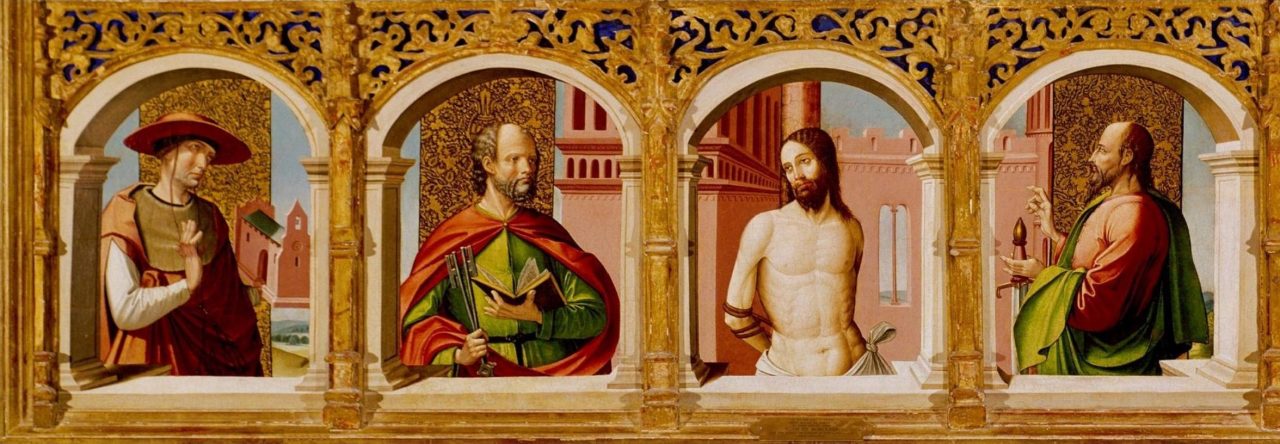
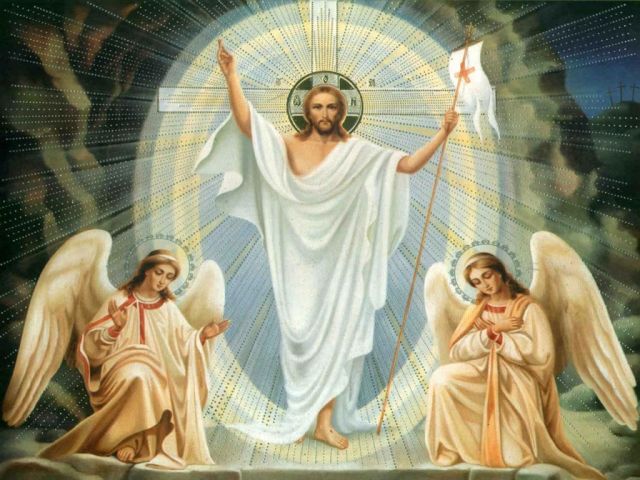
Triduum Sacrum
I.
At Passover the wind blew cold
And Peter crouched, in dread, beside a fire;
The feast of bitter herbs, observed of old,
The Master longed to eat, with strong desire:
An Upper Room
For Supper set
With lamps alight
And comrades met
For highest Priesthood’s rite.
He took a towel and a bowl –
(Water can wash the dusty feet,
But not a traitor’s soul!) –
Love’s mandate sealed by act replete
With sacramental chivalry.
“Take, eat” this food, this living Bread
And share the Cup of life Divine;
“Arise, let us go hence”, He said,
To sheltered Olivet’s incline,
Where cold winds shook the fertile boughs.
II.
When rain like tear-drops trickled down the vase
And all earth convulsed in agony,
The ruler of the secret stars
Died felon-like, stretched taut upon the beam.
The mourners’ nard His unction made,
Sad love anointing the enshrouded Christ,
Who in his infancy refused not myrrh.
Magnolias white as altar linen, bright
As day, in Joseph’s garden bloom,
With all the April flowers that love the light,
Flanking the sealed and guarded tomb.
Now vigil lights in faithful hearts will burn
Until, in deathless quiet of an Easter morn,
He will return.
Canon George F. Tull
Canon Tull, who wrote this poem in April 1966 (it was published in his anthology “The Quiet Ways” by Mitre Press in 1969, was Vice-Chancellor for Europe of the San Luigi Orders, Titular Abbot of San Encino in the Abbey-Principality of San Luigi, and a priest of the Old Roman Catholic Church in Great Britain.
Holy Week
Ever more bitter grows Thy Passion’s cup,
Filled up anew, a drink of deadly wine;
And are we able, Lord, with Thee to sup
The utmost measure of life’s sour vine?
Ever more pressing is the heavy load,
The weight of wrongs committed every day;
The mocking taunts of Thy revilers goad
Us on along the agonizing Way.
Humiliated Christ, here more and more
Within us Thy kenotic life complete.
Fill up what lacks in our devotion poor;
Reveal to all Thy nail-pierced hands and feet.
Canon George F. Tull
Canon Tull, who wrote this poem in 1955 (it was published in his anthology “The Quiet Ways” by Mitre Press in 1969, was Vice-Chancellor for Europe of the San Luigi Orders, Titular Abbot of San Encino in the Abbey-Principality of San Luigi, and a priest of the Old Roman Catholic Church in Great Britain.
New book on Prince-Abbot Joseph III

Fr. Raphaël Steck of the Mission Gallicane d’Alsace, who is a member of the Order of the Crown of Thorns, has published a life of Prince-Abbot Joseph III (Mgr. Joseph René Vilatte) in pictures. The images he has selected include many extremely rare and previously unseen early documents and photographs, accompanied by text which traces his life from humble origins in Paris to his consecration in Ceylon, reception of the Order of the Crown of Thorns and Abbey-Principality of San Luigi, missions in the Americas, France and England, and eventual reconciliation with the Roman Catholic Church in his homeland. The book will be an essential purchase for all who are interested in this crucial figure in the development of the independent sacramental movement.
To purchase a copy of the book, visit the publisher’s page at http://is.gd/8gV0uP
‘King of Kings’ – a meditation for Lent
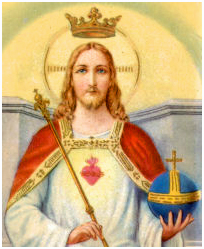 A naked man, covered with sweat and dirt and blood, exhausted and beaten, hanging on a gallows in front of a mocking crowd, dying in agony – a wreath of sharp thorns piercing his brows. That is the Crucified Christ – that is Christ the King. That was the end, so they thought, of a trouble-maker; that was, in fact, the most glorious victory the world has ever known.
We know now that the Cross, the shameful gibbet, was in fact a royal throne; we know that the dirt and sweat and blood were the purple robe of empire; we know that that apparent defeat was victory. We know that the mocking crown of thorns was the glorious diadem of the King of Kings and Lord of Lords. And, abashed and confounded, we kneel in worship and veneration.
For this confounds all the values of the world – as indeed we might expect, for is not the wisdom of this world foolishness in the eyes of God? Earthly monarchs live in honour and are robed in state, crowned with gold and jewels: but what need has true royalty for such trappings? Our Lord needed none of these things, and the greatest of earthly rulers have not needed them; no wonder that Saint Louis preferred a crown of thorns to a crown of gold.
It is not the habit that makes the monk; and it is not the crown and sceptre and purple robe that make the king. True royalty is that exemplified by Christ : authority, yes, but also humility, service, obedience, and – this above all – perfect love. These virtues shine more brightly than any material jewel, appear more splendid than any velvet robe : and if they lead through suffering, even death – can earthly pomp and honour avoid that?
The Crucifixion is the lesson and model for all kings: and by virtue of our Baptism we – yes, even you and I – are kings; kings and priests; a kingly priesthood. May we, united in the Order of the Crown of Thorns, keep those Thorns always before our mind’s eye : let us never be led astray by the false standards of the world, but in humility, obedience and love do the will of our Blessed Master, until we are worthy to receive a crown of thorns, with all its suffering, and in so doing bear in our lives the marks of the Lord Jesus, sharing in His redemptive work, until at last our crown of thorns on earth is exchanged for the halo of sanctity and the crown of glory as we reign with Him in heaven.
Archbishop Geoffrey Peter Thomas Paget King (1917-91)
Prelat-Commandeur, Order of the Crown of Thorns
taken from : ‘A Symposium in honour of the Crown of Thorns’ edited by Canon George F. Tull, 1962
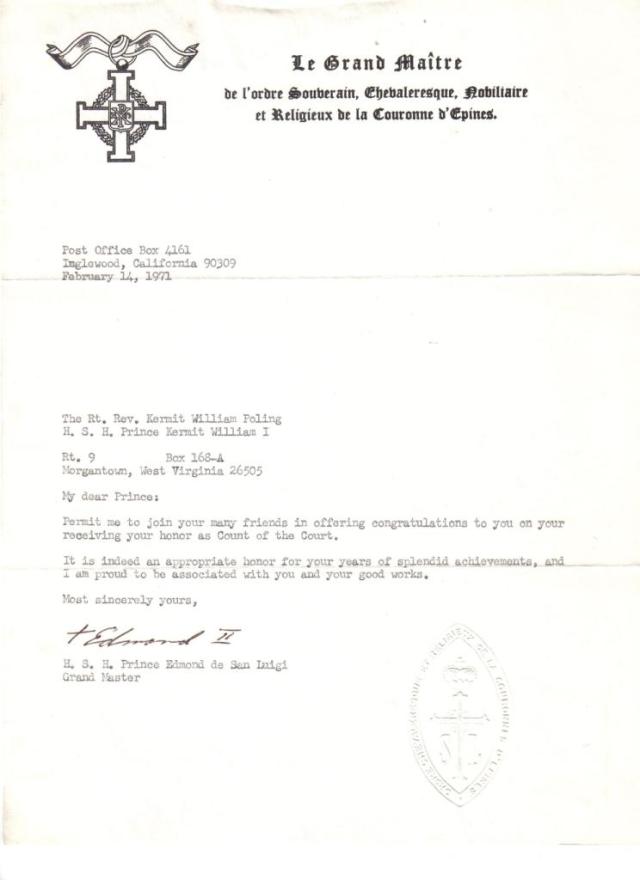
Letter from Prince-Abbot Edmond II
In this letter from February 1971, Prince-Abbot Edmond II writes to congratulate his friend the Most Revd. Prince Kermit William Poling upon his appointment as a Count. He would subsequently be advanced to a Marquisate and Dukedom in San Luigi, and is today our senior living member of Supreme Council.
Members of the San Luigi Orders: Canon Jan Gruszka
![1 R UMAX PowerLook 2100XL V1.4 [3]](https://san-luigi.org/wp-content/uploads/2013/02/st-peters-glasgow.jpg?w=640) Canon Jan Gruszka (1909-74) was a Chevalier of the Order of the Crown of Thorns, being admitted to the Scottish Priory in 1962.
Canon Jan Gruszka (1909-74) was a Chevalier of the Order of the Crown of Thorns, being admitted to the Scottish Priory in 1962.
One of several Roman Catholic clergymen to be members of the Order, Canon Gruszka was parish priest of St Simon’s Church, Partick, Glasgow (pictured left), until his death on 11 November 1974. The parish was a home for Polish expatriates, and the Scottish Priory of the Order of the Crown of Thorns was notably Polish in its membership under the leadership of the Baron de Prus. The Catholic Herald of 16 February 2007 reports former Speaker of the House of Commons Michael Martin (now Lord Martin of Springburn) as saying, “I have fond memories of the Polish Masses I attended in St Patrick’s Church in Anderston in Glasgow and also of Canon Jan Gruszka.”
Canon Gruszka was born in Hadjukach Wielkich, where he graduated from elementary school. In 1930 he graduated from the gymnasium at Królewskiej Hucie. After the cadet school at Szrem, he undertook military service as a non-commissioned officer in the 75th Infantry Regiment of Królewskiej Hucie. In 1931 he commenced seminary studies at the Śląskiego Seminarium Duchowego in Krakow, and studied theology at the Jagiellonian University. He was ordained priest in 1936. After two months at the pastorate of St John the Baptist at Pawłowice, he took up the position of curate in Różańcowej at Halembie in September of that year. Following the outbreak of World War II, he was briefly substitute priest at the parish of St Urban at Woli, and then became vicar at St Anthony and St Dąbrówce and at St Mary Magdalene in Bielszowicach. In 1942, the Nazis removed him from his parish for hearing confessions in Polish. He was forcibly conscripted into the Wehrmacht and served as a medical orderly on the Western Front. He managed to escape from the Nazis and joined the Polish Army for the remainder of the war. The Polish Army was based at Yorkhill Barracks in Glasgow, and it was then that St Simon’s Church became their place of worship.
In peacetime, he settled in Glasgow, where his ministry was directed particularly to the Polish-speaking community there. He is buried in St Peter’s Roman Catholic Cemetery, Dalbeth, Glasgow.
Investiture of the San Luigi Orders, 3 July 1976
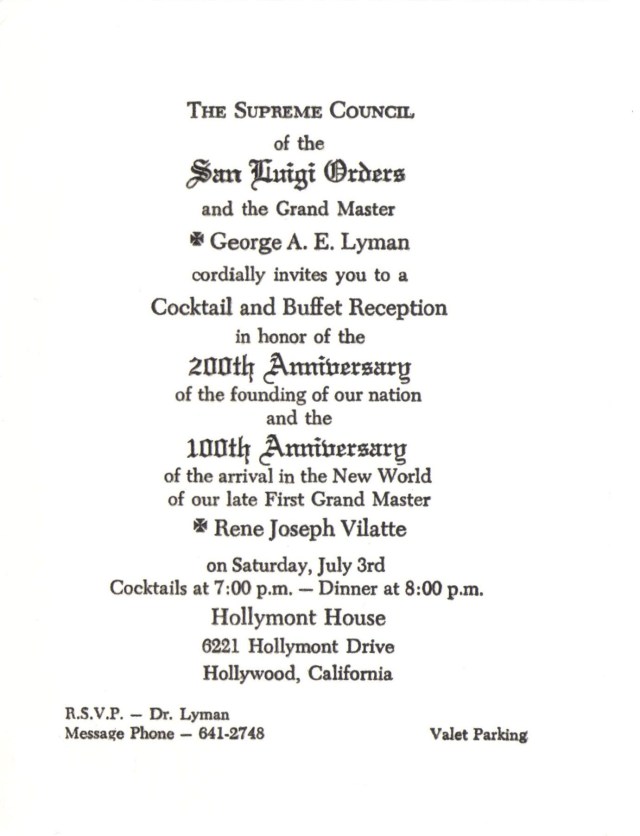
Eleven new knights were admitted to the San Luigi Orders on this occasion. Hollymont House had previously been the home of Robert Taylor and Barbara Stanwyck; by the time of the investiture it was the home of the Most Revd. Dr. Donald Jolly, a bishop in the Free Protestant Episcopal Church and a banker. He was admitted to the San Luigi Orders at the investiture. Two months before this event, the house was the subject of a KTTV news investigation into reports that it was haunted.
 The Abbey-Principality of San Luigi
You must be logged in to post a comment.