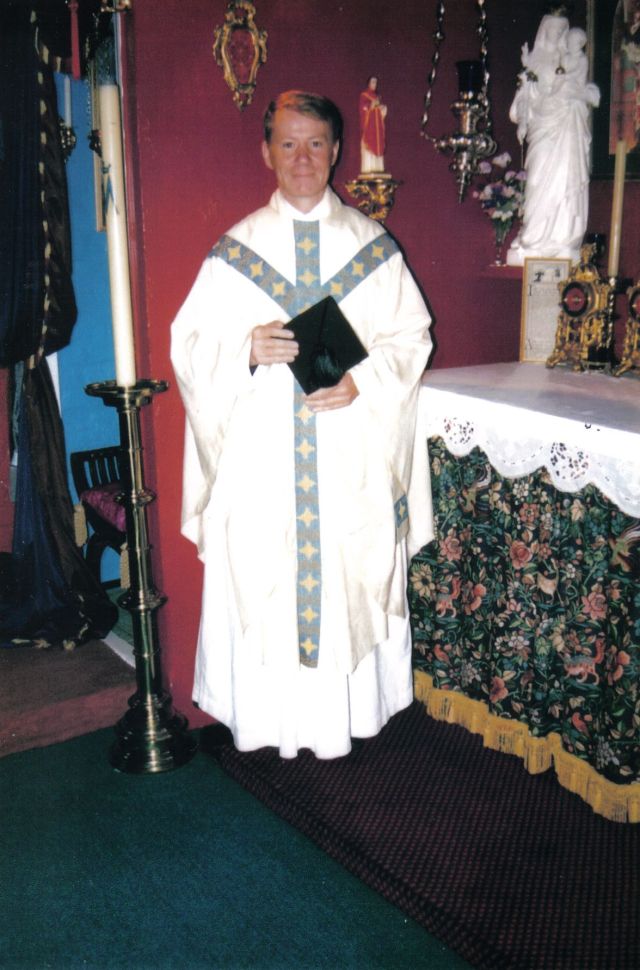
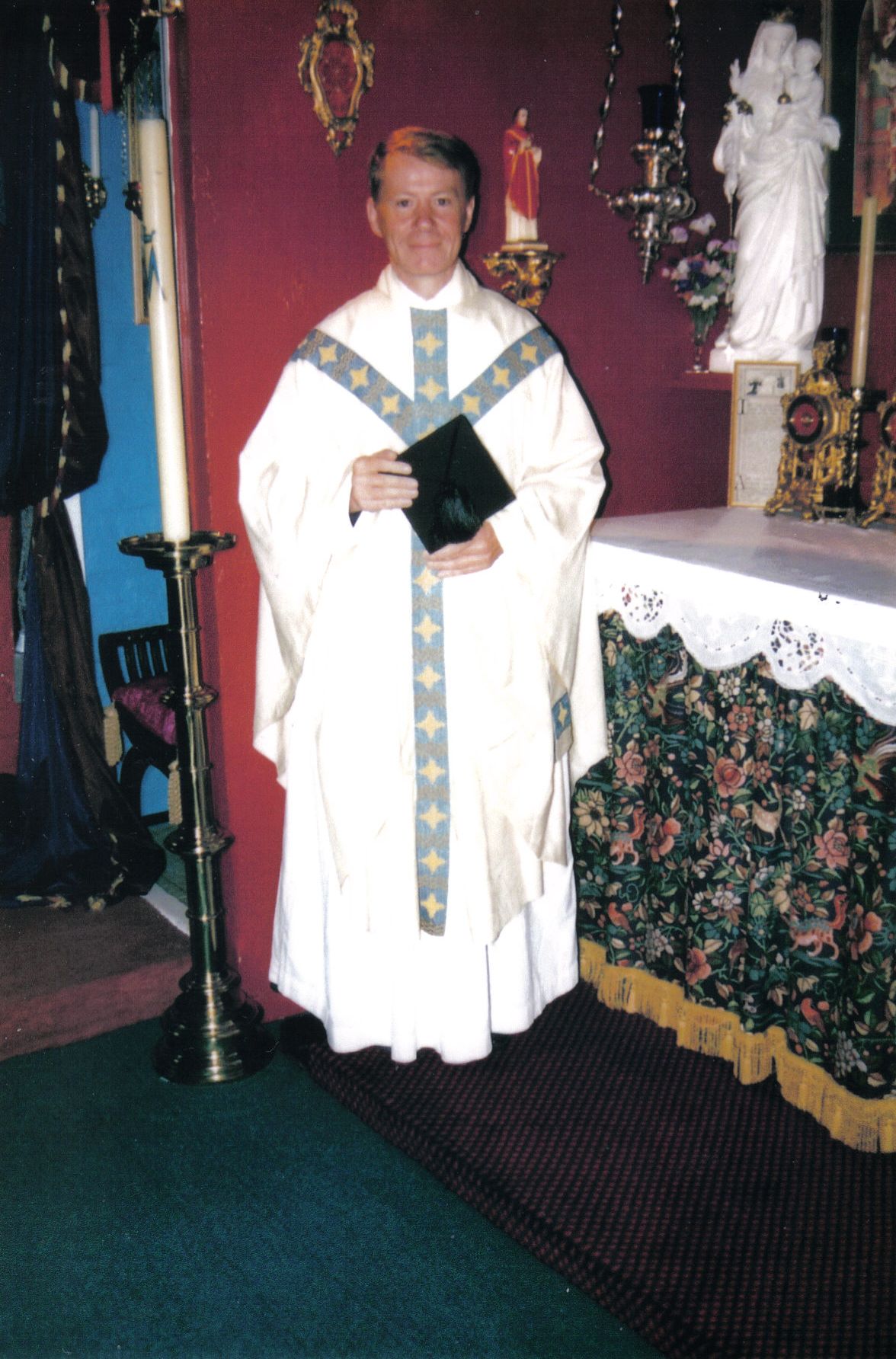
 The Abbey-Principality has been informed of the recent death of Fr. James Phillips, quondam Member of Supreme Council of San Luigi and Vicar-General of the Order of Antioch, at the age of seventy-six.
The Prince-Abbot writes:
James Vincent Alfred Phillips was raised in the hamlet of High Garrett, close to Braintree, Essex. He studied music privately, gave concerts as a musician, and took up a series of teaching appointments as a peripatetic instrumental teacher, classroom teacher of music, and organist and choirmaster. His range as a musician was wide; principally an organist and harpsichordist, he also taught a variety of other instruments. For a short period, he was also an occupational therapist at Severalls psychiatric hospital in Colchester.
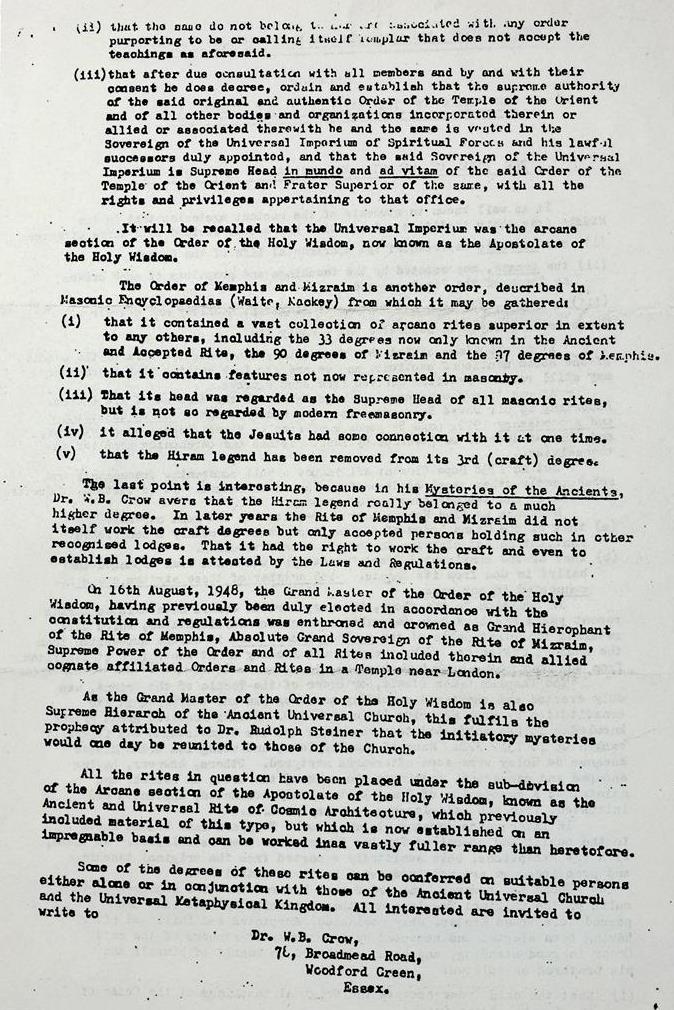
While teaching at a preparatory school at Westbury, Northants., in 1969, he came into contact with the late Archbishop Charles Brearley of the Old Holy Catholic Church, who he remembered as a kind and generous man. Brearley ordained him to the subdiaconate and diaconate in the school chapel, and through his Ministerial Training College conferred upon him the degree of Doctor of Music on the basis of the submission of a Mass setting and an anthem composed by Phillips. Brearley also arranged for Phillips to receive the same degree conferred ad eundem by the National University in Canada under Archbishop Earl Anglin James. Although both educational institutions were heavily criticized by opponents of Old Catholicism, I was able in later years to reassure Phillips that his degrees had been legally granted according to the laws in force at that time, and that, since they had been based on solid work, he need have no qualms about using them. Brearley was also Grand Master of the Order of the Holy Cross of Jerusalem, and admitted Phillips as a Knight Commander of that Order.
In the 1970s, Phillips came to know Bishop Francis Glenn of the Old Catholic Church of England, later the Catholic Episcopal Church. Bishop Glenn was a clergyman of a rather different order from Brearley, and did not accept that Phillips had been validly ordained. He tonsured him in 1973 and it would not be until 1975 that he was advanced to the minor orders and the diaconate de novo. Thereafter, Phillips remained with Bishop Glenn’s church until its closure in 1994. He had fond memories of services at the former chapel at Crystal Palace railway station as well as at other Old Catholic chapels in and around London.
In 1976, Phillips (who was then using the name James Thompson-Phillips) established the Hughendon School of Music which was run from rented premises in Dulwich, south London. According to the advertisement in The Musical Times, this offered “courses and studies in all musical subjects; preparation for musical examinations; O and A level music courses; diplomas, degrees; recitals: consultation lessons; General Studies department and English for foreign students”. Despite this wide scope, the School failed to recruit students.
During these years, Phillips also developed a friendship with Fr. George Tull of the Old Roman Catholic Church of Great Britain, who was then living in retirement. Fr. Tull was the representative for the San Luigi Orders in Great Britain and a member of Supreme Council of San Luigi. After the death of Prince-Abbot Edmond II in 1998, he was left as the only surviving member of Supreme Council, and appointed Phillips to that body in 1999. Phillips inherited from Tull the latter’s extensive file of documentation and correspondence with Prince-Abbots Edmond I and Edmond II, which would prove invaluable in the work of revival that was to come.
With the closure of Bishop Glenn’s church, Phillips was received into the Old Roman Catholic Church of Great Britain. He was ordained de novo for the third time to the diaconate on 31 March 1994 by Archbishop Douglas Titus Lewins and then ordained priest by him on 23 July 1994. In the late 1990s, Phillips formed the Benedictine-influenced Sitio Community, based on the south coast of England, and with a special mission to care for those suffering from HIV/AIDS. This was registered as a charity in 1999 but removed as having ceased to exist in 2005.
In 1998, Archbishop Lewins reconciled with the Holy See and Phillips was appointed Administrator of the ORCCGB. Unfortunately, the ensuing years were largely concerned with the end of viable worship in the remaining churches of the ORCCGB and the consequent closure and sale of buildings. Foremost among these was the sale of the Pro-Cathedral at Wittering, Cambridgeshire. This had suffered a serious decline in worshipping numbers, since the end of the Cold War had resulted in the departure of most of the American servicemen who had been stationed at the nearby RAF base. On 12 May 2000, Phillips also issued a Notice of Redundancy and Disposal in respect of the Church of the Good Shepherd, Penge, but this became moot in the light of subsequent events.
In 2001, Phillips went to Burkina Faso for several months to undertake missionary work. By this time, the ORCCGB had effectively ceased activity and its remaining clergy were working in other churches. The registered charity that had represented the church since 1965 was removed in 2005, having ceased to exist.
In 2006, Archbishop Lewins expressed a wish to resume his office in the ORCCGB and Phillips, as Administrator, reappointed him to the Primacy. However, Phillips resigned from the jurisdiction immediately following this, and made an approach to the Church of England seeking incardination. This course of action was not pursued when the Church of England made it clear that it would require Phillips to undergo the usual course of theological study expected of ordinands.
 Phillips eventually rejoined the ORCCGB, which was enjoying a period of purposeful ministry with new links forged both at home and abroad. In the ensuing years, Phillips visited the United States, where he met with Archbishop John Joseph Humphries and other clergy of the ORCCGB and helped bring about closer relations between the different branches of the Old Roman Catholic Church.
When the revival of the Abbey-Principality of San Luigi was proposed, Phillips became one of the key figures because of his position as the only surviving member of Supreme Council. He appointed further members and in due course presided over the election of the present Prince-Abbot to office. He was among the first Trustees of the San Luigi Orders Charitable Trust, and took administrative responsibility for the running of the Trust. He also served as Vice-Chancellor of the Abbey-Principality.
Phillips was a man of great personal charm and intelligence, and had a deep and genuine religious vocation, but his restless and somewhat impulsive nature meant that he was never greatly amenable to order and discipline. During the 1970s, he moved constantly from one job to another and also moved up and down the country, sometimes pursued by creditors. This brought about some regrettable press publicity at a time when Old Catholic clergy were seen as easy targets in some quarters of the tabloids. He was also a great raconteur and teller of tall tales. On reflection, I found that what he said to me about the Church and his vocation was generally truthful and unembellished (and was confirmed by documentation and other corroborative evidence), whereas what he said and claimed about his musical career sometimes included some obvious and embarrassing untruths.
Eventually, he achieved a greater degree of stability, and met the man who would be his close companion throughout his later years. He remained busy professionally, and was still providing peripatetic music tuition in schools through the local authority music service well into his seventies. He undertook a range of voluntary work over the years and had good relations with several well-regarded charities.
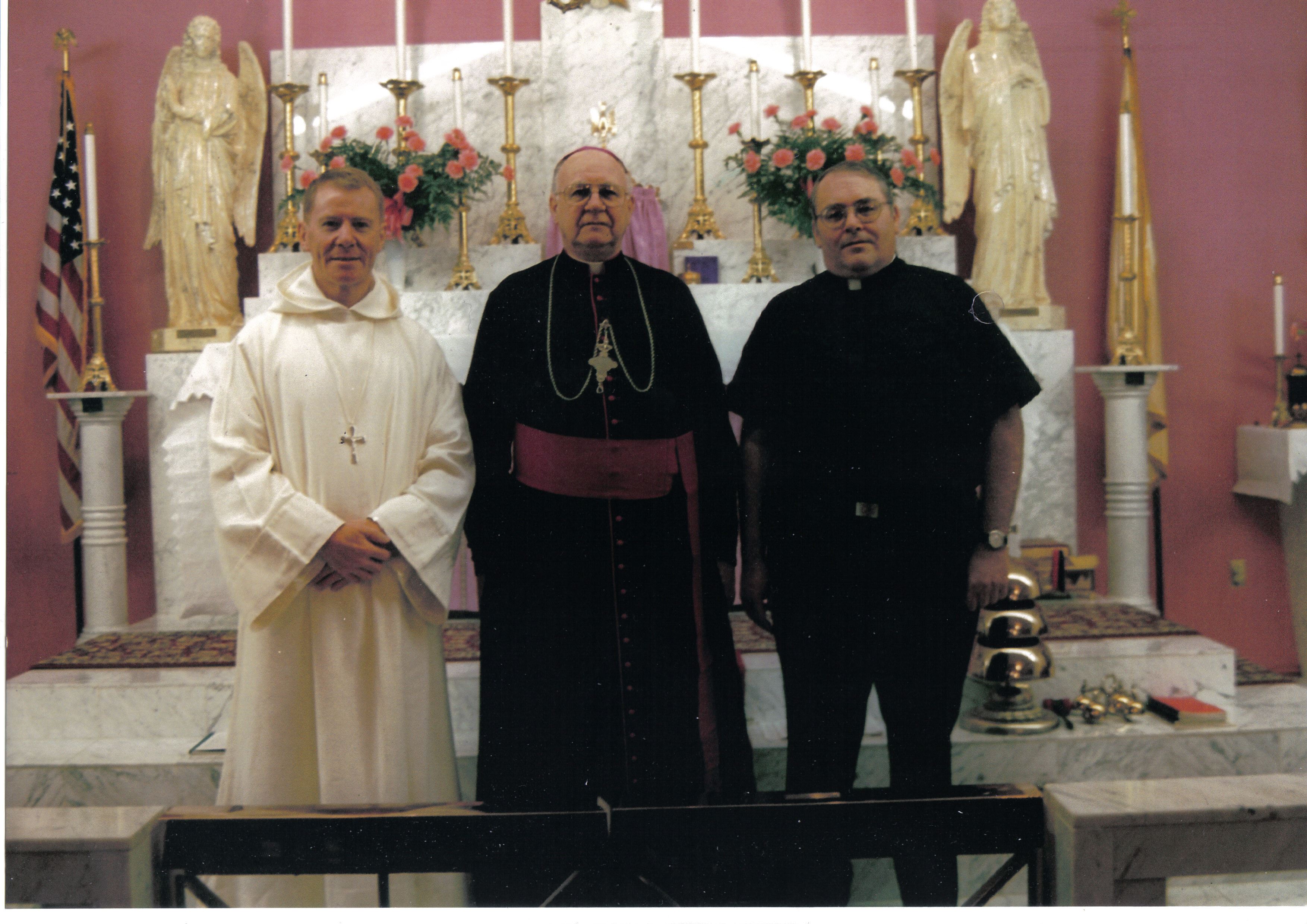
In 2013, differences between Phillips and the ORCCGB concerning aspects of practice and mission reached a point of crisis. It was agreed in a spirit of friendship between the ORCCGB and San Luigi that he should transfer from the ORCCGB to the Order of Antioch, in which he was appointed to Membership in the First Class and further as Vicar-General in July 2013. There were plans to establish a mission in Bethnal Green, east London, which were enthusiastically supported by me, but these were abandoned after the chapel in question was closed indefinitely on safety grounds due to roof damage. After this, there was for some time a joint mission on the south coast with a fellow Benedictine who was also briefly a member of the Order of Antioch. On a number of occasions, Phillips showed himself to be a most able master of ceremonies, and his close interest in liturgy and ceremonial had clearly been the product of considerable study and training.
Unfortunately, it was not long before Phillips was as dissatisfied with life in the Order of Antioch as he had been within the ORCCGB, and after his proposals for a complete re-organization of the jurisdiction had fallen on stony ground in March 2014, my reply to him would include the following observations,
It is difficult to avoid the overall impression from what you say that you are unhappy in your vocation with us, and I think this is probably the key issue that we need to address rather than concentrating our attention upon particular details. Many clergy in the Old Catholic movement wish for something that is not realistically available to them. When they come to the realization that it is not available, their response is too often to blame their denomination for not being something that it had, in fact, never claimed to be. Both ++Andrew and I have enjoyed working with you during the past eight months. We have valued your work, your commitment and your contribution to our jurisdiction. I believe we have developed a good personal understanding between us and, all things being equal, we would have certainly wished to see this continue into the future. However, if it has come to the point where you believe your vocation is better expressed within another denomination, or indeed outside of any affiliation, then it is better that we are honest about that and that we should make arrangements for your canonical release from the jurisdiction and from your administrative responsibilities rather than risk the sort of rancour that can easily develop in those situations if they are suppressed.”
Following this, Phillips made no contact with us for a period of three months. However, Phillips returned after this period, and faced with his renewed pledges of support I decided to overlook the previous difficulties. When I was additionally elected to the primacy of the Apostolic Episcopal Church, a Continuing Anglican jurisdiction, Phillips was enthusiastic about the prospects that this offered and was incardinated as an Archpriest in a ceremony on 16 February 2015.
Less than a month later, I received a communication from Phillips that contained much in the way of wilful misunderstanding and essentially returned to the themes he had pursued almost exactly a year previously. This time, I was not inclined to prolong what was clearly an unsuitable affiliation for him, and granted him a full canonical release from my jurisdiction without penalty. In my letter to him and the Benedictine who had made common cause with him, I would write,
“With the benefit of hindsight, all we have managed to achieve is to delay the outcome I foresaw above for a year. The misunderstandings expressed by Fr. James concerning the Order of Antioch then have merely been extended to include equal misunderstandings concerning the Apostolic Episcopal Church now. This may explain to you why it was not difficult to arrive at a swift judgement as to what should be done in the current circumstances regarding his release from my jurisdiction.”
Shortly afterwards, and entirely unbidden by me, Phillips chose to return his insignia in the San Luigi Orders, which act was interpreted as definitively ending the long connexion he had had with those bodies and in which he had played such a key role.
This, however, was not to be the end of the story. In January 2016, Phillips wrote to me thanking me for my Christmas card, and going on to seek reinstatement and offer a fulsome and detailed apology for his earlier conduct. On this occasion, caution was urged upon me, and the offer that was made to Phillips at our ensuing meeting was that of reinstatement to the First Class of the Order of Antioch only, with any other office to be considered after a period of three months. This was not acceptable to Phillips, who took the view that he wanted all or nothing, and it was not long before the warm sentiments he had expressed in his letter of January were replaced by others familiar to me from his previous complaints. Nonetheless, he expressed the wish that we would continue to maintain friendly contact and collaboration on issues of mutual interest. Shortly afterwards, I was informed that he had moved from the south coast to Lincolnshire, but this was at a point when I was myself about to move away from the Fens, and in the event, we did not meet again.
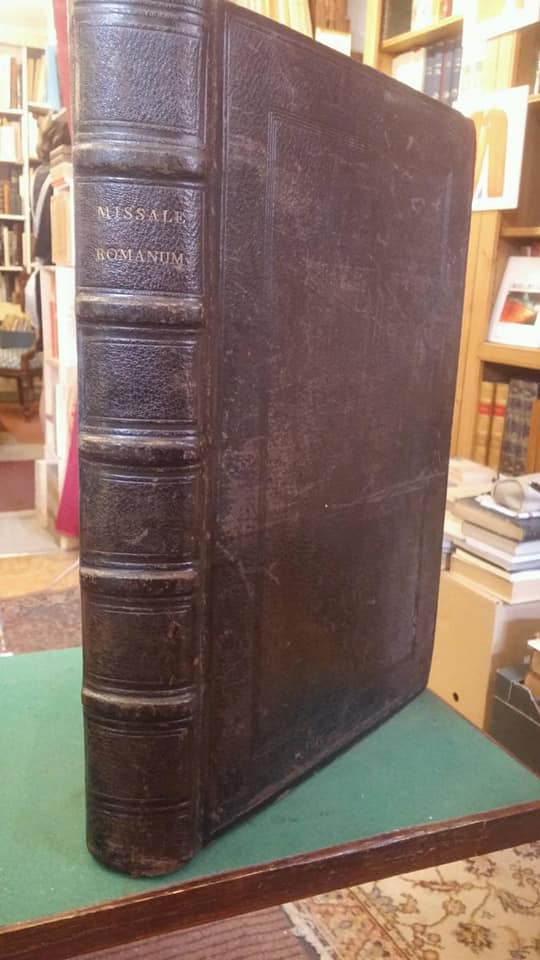
Phillips was the sort of person who was difficult to dislike and it would be impossible to deny that he could be excellent company. He was personally generous and I well recall a meeting at Enfield that concluded with the gift of around twenty antique liturgical books, some of which were very rare. There was also a strong element of risk-taking to his character, and to be a passenger in a car driven by him was to take one’s life in one’s hands. In the history of the smaller churches, he was one of the last links to English Old Catholicism as it had been constituted some fifty years ago, and in some ways was rather typical of the sort of person who was drawn into the movement in those days.
The life of Fr. James Phillips reminds us that God does not always choose as clergy the most obvious candidates. Doubtless certain aspects of his character would have disqualified him for service in some other churches, but within the denominations he served he found his niche and at times served with distinction. May he rest in peace and rise in glory!

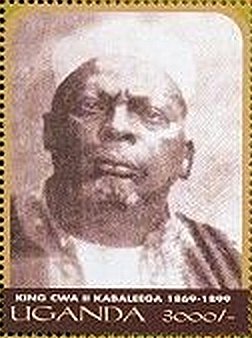 The Abbey-Principality of San Luigi commends its members and visitors to support the Kabalega Foundation, a charitable and commemorative institution which has been established in the Kingdom of Bunyoro-Kitara in memory of His late Majesty Omukama Chwa II Kabalega. H.M. Omukama Chwa II Kabalega, then the absolute ruler of the Bunyoro-Kitara Kingdom, was responsible for the re-establishment of the Abbey of San Luigi in 1885 and bestowed upon Prince-Abbot Joseph II the title of Mukungu of the Ancient Abbey-Principality of San Luigi (Fizzan), which is held by his successor today.
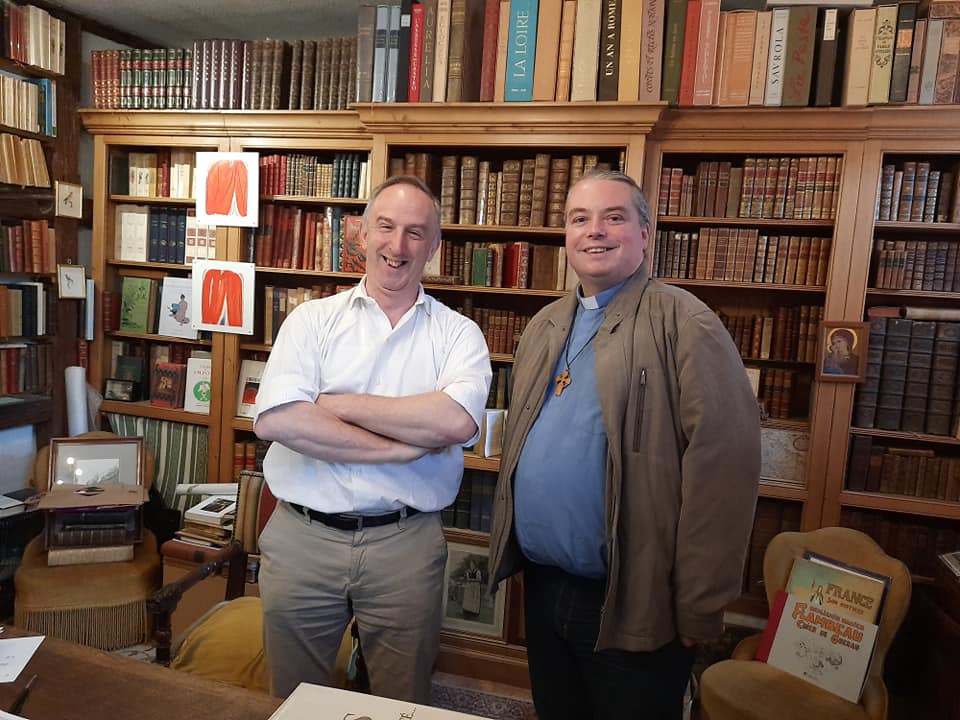







 The Abbey-Principality of San Luigi
You must be logged in to post a comment.