Obituary – The Very Revd. Michael Reed OCR

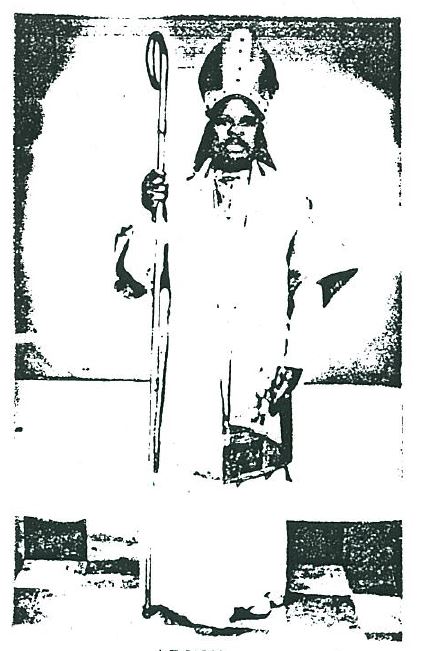
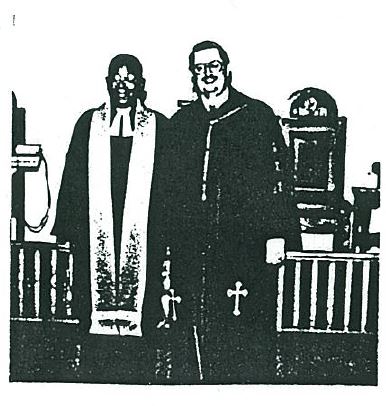
The Abbey-Principality of San Luigi has been informed of the death of the Very Revd. Michael Reed, OCR, at the age of 76. He was Vicar for Ohio in the Apostolic Episcopal Church and Order of Corporate Reunion and had charge of the St Peter the Aleut Apostolic Episcopal Mission in North Olmsted.

Michael Bauer Reed was born in 1946 in Wooster, Ohio. He earned bachelor and master’s degrees in sacred music and music education and in secular life taught music at a school in North Olmsted. He continued to teach music throughout his retirement and sent a number of video recordings of his performances at the Hammond organ as gifts to the Prince-Abbot.

He was ordained priest in 1983 in the Orthodox-Catholic Church of America under Bishops George Hyde and Alfred Lankenau, and subsequently entered the Apostolic Episcopal Church under former Primate Archbishop Francis Spataro. He wrote in 2014 of his church affiliation, “I will probably be right here till the veil opens, and I take the next step!” He served the Apostolic Episcopal Church and the Order of Corporate Reunion faithfully and was a valued member of our clergy.

He is survived by his widow, children and grandchildren. Memory Eternal!

False statements and harassment of members of the Order of Corporate Reunion by Richard Cumming

One Richard Cumming, who falsely alleges that he is a member of the Order of Corporate Reunion, has recently emailed a number of members of the Order with malicious propaganda in an attempt to sow discord and promote his own false claims regarding the Order.

Richard Cumming is not and has never been a member of the Order of Corporate Reunion. He is not a member of its corporations in England or California, USA. He is not even a member of the Missouri corporation under which Michael Kline falsely claimed authority in the Order. The falsehood of Kline’s claims regarding the Missouri corporation were exposed here, in factual terms which he has been unable to rebut in any manner whatsoever. In short, Cumming is an impostor who holds neither membership nor authority within the Order of Corporate Reunion.

This public notice stands as witness to Cumming’s base and unchristian actions in seeking to harass the genuine members of the OCR. In doing so he continues the malice of Kline who for years posted false, defamatory and vicious propaganda against the Order on Facebook. These men are clearly envious of the genuine Order, from whose membership they were rightly excluded, and in continuing to promote an entirely fictitious version of events in order to vaunt their own positions they expose their motivation as being that of personal gain and ego as well as the deception of the faithful.

Our members are, we trust, sufficiently aware of the true position to treat Cummings’ cant with the contempt that it deserves. Since these communications constitute unsolicited harassment, we will also be encouraging our members to report them as spam to his ISP and to take such further actions as they may deem necessary.


Copyright of the seal of the Order of Corporate Reunion

Various seals have been used by the Order of Corporate Reunion over the years. The seal illustrated here is not a historical seal, but instead was designed by Dr John Kersey in his capacity as Bishop and Pro-Provincial of Canterbury of the Order. He retains the copyright of the seal and permits its use only by the authentic Order of Corporate Reunion which is registered in England and Wales (no. 12692440) and in California, USA (no. C4684442), as a non-profit religious corporation.

The use of this seal by Michael James Kline or his associates, who falsely and fraudulently claim to represent the Order of Corporate Reunion, is in violation of copyright and notice is hereby given that all action at law is reserved against any such violation.

Death of Queen Elizabeth II

The Abbey-Principality of San Luigi extends its sincere condolences on the death of Queen Elizabeth II to the Royal Family and the peoples of the United Kingdom and the Commonwealth of Nations.

Two of the Prince-Abbots of San Luigi, Edmond I and the present Prince-Abbot, Edmond III, have been British by birth, and the San Luigi Orders have been continuously established in the United Kingdom since the 1930s.

We pray for those who join us in mourning the Queen at this time and wish her successor King Charles III God’s grace and strength as he prepares to shoulder the responsibilities of the throne.

False claims regarding the late Archbishop Caudill on the website of Rutherford Johnson

Our attention has been drawn to the website of one Rutherford Johnson and specifically to the reproduction therein of a photograph from this website without permission. The photograph appears on the section of this website devoted to the Apostolic Episcopal Church and may be viewed here.

False information added to our photograph

Johnson reproduces our photograph with the addition of wholly false information about the bishops pictured, all of whom are now deceased. This may be seen in the screenshot below taken from https://www.statopontificio.org/irc/

Johnson falsely identifies the consecration with these words, “Consecration of former Bishop of the See of St. Stephen, Coadjutorship of Rome and Apostolic See of the Gallo-Russo-Byzantine Catholicate and Anglican Patriarchate of Rome; H. Edwin Caudill by Macario V. Ga; Supreme Bishop of the Philippine Independent Church, and Bishops Frank Benning and John Hamers. 21 October 1993, Holy Cross Polish National Catholic Church, Brooklyn, New York.”

The actual facts about Archbishop Caudill and the photograph

The late Howard Edwin Caudill (1932-98) was a Continuing Anglican bishop. He was born on 9 January 1932 in South Charleston, West Virginia, USA, and was ordained to the priesthood in the Protestant Episcopal Church by Bishop Hubbard on 22 April 1956. In 1976, he left the PECUSA. He was received into the Anglican Catholic Church, a Continuing Anglican denomination, on 11 October 1980, and served that church as rector of Good Shepherd Church in Oklahoma City between 1980 and 1983. On March 26 1983, he was consecrated bishop by Robert Condit Harvey of the American Episcopal Church, assisted by Anthony F.M. Clavier and John M. Hamers. After this he served as bishop of the Diocese of the Southwest, which had originally been part of the Anglican Catholic Church, but had subsequently become independent. In 1984, Caudill took the Diocese into the American Episcopal Church, but withdrew from that jurisdiction in October 1988 to become independent once again, incorporating The Anglican Church, Inc. In 1993, Caudill and The Anglican Church, Inc. Diocese of the Southwest, became part of the Apostolic Episcopal Church, a church with Anglican patrimony and strong connexions with Continuing Anglicanism, and he became the AEC’s Archbishop of the Central Province of the USA on 21 August 1993. He was additionally appointed as Archbishop of the AEC Western Province of the USA on 1 March 1998, and died later that year.

The Apostolic Episcopal Church is in full communion with the Iglesia Filipina Independiente (Philippine Independent (Catholic) Church), which is a member church of the Anglican Communion  and the Union of Utrecht of the Old Catholic Churches, and has been associated specifically with the faction (approximately half) of that church that remained loyal to Obispo Maximo Macario Ga y Vilches (1913-2002) (today renamed the Archbishopric of Metro Manila and the entire Philippines of the P.I.C.C.). It was in the context of this relationship that the consecration of 21 October 1993 occurred. The photograph was taken by Bishop Francis C. Spataro, who between 1998 and 2015 was Primate of the Apostolic Episcopal Church. The original of the photograph is preserved in the Archive of the Apostolic Episcopal Church maintained at the Office of the Primate in England together with other photographs taken on the same occasion.

The consecration of 21 October 1993 was undertaken in and for the communion of the Apostolic Episcopal Church and for no other body. At no time was Archbishop Caudill “Bishop of the See of St. Stephen, Coadjutorship of Rome and Apostolic See of the Gallo-Russo-Byzantine Catholicate and Anglican Patriarchate of Rome”. These are fictitious titles invented by Rutherford Johnson, who has never had anything to do with our communion or with the late Archbishop Caudill.

Let us leave the final words in this matter to Archbishop Caudill himself:

Further falsehoods in a claimed “Apostolic Succession”

Johnson goes on to list a claimed Apostolic Succession at https://www.anglicanritecatholicchurch.org/apostolic.html

We have had cause to comment previously on aspects of this succession and reproduce the contents of our memorandum on this subject below.

HOLY ORDERS DERIVING FROM RONALD D. NOWLAN

Preliminary observations

1.     It has been asserted that Ronald D. Nowlan (also Nowland), quondam archbishop of Christ’s Apostolic Church of North America in Long Beach, California, was consecrated on 3 February 1997 by Robert R. Johnson, who was in turn consecrated by Jean Balland, the Roman Catholic Archbishop of Lyons, on 19 March 1969.

2.     In a 1999 press article, Nowlan is quoted as saying, “I got my orders through Utrecht, through Brazil, and through the Church of Antioch”, but does not mention his claim of succession from a Roman Catholic archbishop. The article goes on to say, “Nowland, a former Roman Catholic, said his church does not “differ all that much from the Roman Church,” except, of course, in the areas of papal infallibility, the indissolubility of marriage, the teaching on artificial contraception, and the ordination of women.”

3.     The circumstances of this lineage are of relevance principally because of the consecration of Paul Victor Verhaeren (Patriarch Stephanos I) (1939-2011) and Wayne Moore Hay by Nowlan on 21 November 1998. These two men founded the Anglican Catholic Byzantine Orthodox Church in Poughkeepsie, New York, which has subsequently been renamed Saints Cyril and Methodius Church. There are many bishops today who claim successions deriving from this consecration. The Apostolic Succession information on the website of Verhaeren and Hay can be viewed here.

Cardinal Balland

1.     Jean Marie Balland (1934-98) was ordained priest in 1961 and was on faculty of the Pontifical Gregorian Seminary 1962-68. In November 1982 he was appointed Bishop of Dijon by Pope John Paul II and consecrated bishop on 12 December 1982. He was Archbishop of Rheims 1988-95, Archbishop of Lyon 1995-98 and appointed Cardinal Priest 1998, dying in the same year.

2.     Balland was not consecrated bishop in 1969, so the claimed succession above is easily established as blatantly false. In fact, he was not consecrated until 1982. The Roman Catholic Church does not record that he ever consecrated a Robert R. Johnson. Indeed, investigation has been unable to establish that the said Robert R. Johnson ever existed. The only bishops to be consecrated by Balland served in the Roman Catholic Church, which Balland never left.

3.     Notwithstanding its patent falsehood, this succession (whose fabricated line also includes several bishops claimed to be ancestors of Cardinal Balland, but who are listed over a century after their death, with fabricated details of their episcopal appointments) continues to appear and be claimed by a number of groups descending from Nowlan.

Readjustment

Since the exposure of these facts, the following adjustments have taken place.

1.     It is now claimed that Nowlan’s consecration on 3 February 1997 was not by Johnson but by one Gerald Gates, who it is asserted in turn was consecrated on 2 November 1972 by Agusto Montez-Silvieri, who stands in the Duarte Costa lineage deriving from the Roman Catholic Church. Investigation has been unable to establish that the said Gerald Gates ever existed.

2.     Verhaeren and Hay have asserted that Irwin R. Young, Jr. assisted as co-consecrator at their consecration by Nowlan on 21 November 1998, and their lineage has since also been traced through him. However, another source has said that Young consecrated them after their consecration by Nowlan. Young claims a lineage through documented Independent Catholic bishops. If this lineage can be verified, it would be the only valid lineage held by bishops in this succession.

Opinion of the late Archbishop Peter Paul Brennan

In January 2010, Archbishop Peter Paul Brennan, Universal Primate of the Order of Corporate Reunion, was consulted for advice on those claiming episcopal orders in successions deriving from Nowlan. Archbishop Brennan responded to us as follows;

“This succession is all bogus…. not at all real. Nowlan  was either never consecrated or made up a very bad and poorly constructed lineage…. Beckertz, D’Autel and Balland are actually names from a previous century — bishops long dead before the quoted consecrations.  I had a [Roman Catholic] expert in successions look at this and he clearly said it was a fake…Any Nowlan succession is unfortunately bogus.”

Commentary

Where a succession is found to be false and another set of facts is put in its place by parties who have a considerable interest in the outcome, that alternative history will require more than usual verification for acceptance. In this case, the successions in question rely on claims of consecration by bishops whose very existence is unknown to standard references and concerning whose existence, activities and claims no evidence has been put forward by those who claim to stand in their succession.

Any independent bishop whose concern is with the truth should recognize that the Nowlan “successions” are unsupported by evidence and are based on falsehoods that are easily exposed. By associating themselves with these successions, they place their validity and credibility in doubt.

Conclusion

Despite the wish of our communion, which is that we should enjoy peaceful ecumenical relations with our fellow Christians, whatever differences there may be in our churchmanship, from time to time individuals believe that they can steal our intellectual property and lie about our communion without there being appropriate consequences. This notice may serve as proof that this is not the case.

A Response to Matthew T. Scarince

The Abbey-Principality of San Luigi notes the comments made by one Matthew T. Scarince on his Twitter account recently that refer to our organization in insulting terms and that reproduce photographs from this website of the late Prince Kermit de Polanie-Patrikios and Prince Hugo-José Tomassini Paternò without our permission.

Matthew T. Scarince (pictured left), who has a second Twitter account under the alias “Matteo Scaringi” describes himself as Catholic Restorationist, Legitimist, Habsburgtreuer Ciarsèano. Maria Laach Liturgical Movement. Author at thewarforchristendom.com”. 

It would appear that he is a young man in his early twenties and a resident of the United States of America.

It is clear from Scarince’s postings that he supports the modernist direction of the present Papacy, the Maria Laach liturgical movement having prefigured the Mass of Paul VI. If we wish to understand this movement better, perhaps we should recall the words of the Abbot of the Maria Laach monastery, Dom Ildefons Herwegen,

“What the liturgical movement is in the religious field is fascism in the political field. – The German person stands and acts under authority, under leadership … Those who do not follow are a pest for the community. … Let us say an unreserved yes to the new structure of the total state, which is thought to be entirely analogous to the structure of the church. The Church is in politics in the world like Germany today.”
Ildefons Herwegen at the third special sociological conference of the Catholic Association of Academics in Germany, Maria Laach July 1933 (Thomas Ruster: The lost usefulness of religion, Catholicism and modernity in the Weimar Republic (2nd edition 1997) Ferdinand Schöningh, Paderborn 1994, ISBN 3-506-77381-X, p. 105).

Our organization, by contrast, while respecting the person and office of the Pope, stands without apology for Catholic Tradition unimpaired and uncompromised, even though this prevents us at the present time from being in full communion with the Holy See. It is not uncommon to find those with a limited understanding of the theology behind Catholic traditionalism falling back on the argument that anything in union with the Pope is legitimate and anything else is not. This is not an argument that bears scrutiny, and it has been answered eloquently and comprehensively by the theologians of the Society of St Pius X and other traditionalist Catholic groups over the past decades.

Elsewhere Scarince has copious words of praise for Count Richard von Coudenhove-Kalergi, who was largely responsible for creating the European Union from which Britain has thankfully now extricated herself. Coudenhove-Kalergi also wished to destroy the European peoples, writing that “The man of the future will be of mixed race. Today’s races and classes will gradually disappear owing to the vanishing of space, time, and prejudice…the Eurasian-Negroid race of the future, similar in its appearance to the Ancient Egyptians, will replace the diversity of peoples with a diversity of individuals.” We reject such ideas entirely, holding that the God-given diversity of mankind has given rise to distinctive races, cultures and nations that should at all costs be preserved, and holding that the promotion of mutual respect for the traditions and established ways of life of the different peoples of the world is the path towards lasting peace and understanding between them.

Elsewhere Scarince appears to be involved with the world of fantasy and fictional monarchy. We could add further observations concerning his published writings, but much of the material reviewed was frankly too dull and poorly written to hold our attention.

Scarince’s curious attention to the restoration of the Habsburg dynasty is again marred by his lack of knowledge. He is clearly unaware that the British representative of the Empress Zita of Austria for many decades (and who received both the Golden Fleece and numerous titles of nobility from the de jure Emperor Otto under her Regency during the 1920s) was a prominent and senior member of our organization. The late Mar Georgius of Glastonbury worked tirelessly to restore the rightful Austrian and Hungarian monarchy. His efforts, it would seem, are now worthy only of being traduced by pompous and opinionated young Americans.

Scarince, like many of his ilk, is all too ready to criticize actual experts in one-line Twitter posts without having any serious factual arguments to put forward. This is the mark of the internet troll rather than the scholar. Of the lawyer and expert on nobility Bob Juchter van Bergen Quast, who is not associated with our organization but has written about it and many others in the past, Scarince opines that he has “some of the worst takes on nobility and house-law I’ve ever seen”. Unlike Scarince, Quast provides sources for his statements and supports his arguments and conclusions in a thorough and scholarly manner. We do not always agree with every point that Quast makes, but we certainly consider that he is among the most significant writers on nobility today. For Scarince, however, Quast is beyond the pale because he criticises the almighty Wikipedia, “Dude [sic] cites himself in an article on his own blog about how Wikipedia is totally wrong. Amazing:” It has clearly not occurred to Scarince that Wikipedia, which is not written by experts and is party to all manner of bullying and influencing tactics by powerful partisan forces, is susceptible to considerable bias and inaccuracy on subjects that are controversial.

It is obvious from Scarince’s comments that he is woefully ignorant concerning the question of Byzantine nobility, as is further proven by his ignoble and base attack on the late Prince Hugo-José Tomassini Paternò. This seems more to be based on the late Prince’s political support for Mussolini (for whom he fought heroically during the Second World War) than on any objective judgement. How curious that this political alignment should be criticised, given Scarince’s endorsement of the Maria Laach liturgical movement as discussed above.

As an indicator of his lack of scholarship, Scarince states entirely incorrectly that the Prince claimed “to be the head of the Sovereign Military Order of Malta”. The correct position is that the Prince in 1975 became Grand Protector of one of the numerous branches of the Order of St John that descend from a common foundation in the original medieval Johannine Order. He certainly did not claim authority over the Order of Malta with which he had no official relationship. It would doubtless harm Scarince’s case to mention that the Prince received the Lateran Cross from the Pope and acted in an official capacity as heraldic advisor to the Venezuelan government. The Prince was certainly no phoney; he was a remarkable and principled individual whose life honoured both his dynastic forebears and the traditions and causes for which he stood. His successor today is also a distinguished member of our organization.

Sadly there are many in our society today who claim to stand for monarchy and legitimism but are in reality little more than modern liberals in disguise, keen to throw mud at those who stand for genuine principle and have sacrificed much to do so.  They will remain safely within the boundaries of the mainstream, even when that mainstream betrays everything that it had inherited. Real monarchy, which is to say monarchy not tethered by a constitution but exercised in absolute form in accordance with sacred tradition, terrifies them. It is no surprise, then, that in order to convince themselves of the rectitude of their position they turn to attacking others. In doing so they can gain the attention that they so crave and the support of those who enjoy the resulting spectacle, while ignoring the shaky foundations of their own beliefs.

We by contrast adhere to Tradition, in religious, cultural and political matters, and will not hesitate to defend our principles and organization against modernist keyboard warriors.

Members of the San Luigi Orders – Archbishop Joanny Bricaud (Tau Jean II), his work and his succession

Jean-Baptiste (Joanny) Bricaud (1881-1934) was Patriarch of the Universal Gnostic Church in France. He was a Prelate-Commander of the Order of the Crown of Thorns and, together with his wife Eugénie, was of vital importance in the preservation of its archives and spiritual tradition in the last years of Prince-Abbot Joseph III.

Bricaud had entered the minor seminary in preparation for the Roman Catholic priesthood, but instead took up secular employment in a bank and continued an extensive exploration of Gnostic and kabbalistic traditions that had begun while he was a seminarian. He had contact with French esotericists Elia Alta and Charles Henri Détré (Teder) (1855-1918) and became involved with the Eliate Church of Carmel and the “Work of Mercy” which had been founded in 1839 by Eugéne Vintras (1807–1875), as well as the Johannite Church of Primitive Christians, founded in 1803 by the Templar revivalist Bernard-Raymond Fabré-Palaprat (1777–1838). He became a member of the Martinist Order and in that capacity met Gerard Encausse (Papus) (1865-1916) who was head of that order, in 1899.

The Gnostic Church in France had been established by Jules-Benoît Stanislas Doinel du Val-Michel (1842–1903), a librarian, Grand Orient Freemason and spiritualist. In 1888, while archivist at the Library of Orléans, Doinel discovered a charter dated 1022 by Canon Stephan of Orléans, who was a Gnostic forerunner of the Cathars and was burned at the stake in that same year as a heretic. This inspired Doinel to make a detailed study of Cathar and Gnostic teachings, and convinced him that it was Gnosticism that was the essential religious basis for Freemasonry.

Following a mystic consecration by the avatar of Jesus Christ in a vision, Doinel announced that the year 1890 was to begin the “Era of the Gnosis Restored” and became Patriarch of the Gnostic Church. The new church was to have both male and female bishops, the latter to be known as sophias, and they would take a mystic name prefaced by the Greek letter Tau (which represents the Tau Cross) or the Egyptian Ankh. Among the first bishops consecrated by Doinel, who became known as Tau Valentin, was Papus. Membership of the church was restricted to those who, in the view of its hierarchy, were “of high intelligence, refinement and open mind”.

The Gnostic liturgy was strongly Roman Catholic in influence (perhaps prefiguring a similar influence in the later Liberal Catholic Church), with a Gnostic Mass as the central ceremony, and two other main rites from the Cathar tradition, the Consolamentum and the Appareillamentum.

In 1895, Doinel resigned as Patriarch and converted to Roman Catholicism. He now launched a series of bitter attacks on his former church, which naturally endeared him to the Roman hierarchy. However, he repented of this behaviour, and was readmitted to the Gnostic Church as a bishop in 1899 by his successor as Patriarch, Léonce-Eugène Fabre des Essarts (Tau Synesius) (1848-1917).

It was Tau Synesius who consecrated the twenty-one year old Joanny Bricaud as a bishop of the Gnostic Church in 1901. Papus, who wanted to see a more directly Martinist and Roman Catholic-modelled body than the more general esotericism of Tau Synesius, encouraged Bricaud to found his own church as a schism of the Gnostic Church, which he did in 1907, adopting the name Gnostic Catholic Church and the title of Tau Jean II. In February 1908, the Episcopal Synod of the Gnostic Catholic Church elected Bricaud as its Patriarch, which event marked the point at which Bricaud’s jurisdiction, subsequently known as the Eglise Gnostique Universelle, became acknowledged as the successor jurisdiction to the Gnostic Church of Doinel, the Carmelite Church of Vintras and the Johannite Church. Papus conditionally consecrated Bricaud in 1911, from which date the Eglise Gnostique Universelle was considered to be the official church of Martinism. Eventually, in 1926, the remnant of Tau Synesius’ church also chose to unite with Bricaud’s Eglise Gnostique Universelle.

In 1908, an exchange of orders between Papus and Theodor Reuss (Merlin Peregrinus) (1855–1923), founder and head of the Ordo Templi Orientis, led to a commission to Papus in respect of authority within the Rites of Memphis and Mizraïm, and to Reuss in respect of establishing the Eglise Gnostique Universelle in Germany (which he did through subsuming it within the OTO).

Bishop Paulo Miraglia Gulotti had been consecrated by Prince-Abbot Joseph III in 1900 for work in Italy. On 4 December 1904, Gulotti consecrated another French esotericist, Jules Houssaye (Abbé Julio) (1844-1912). Houssaye consecrated Louis-Marie-François Giraud (1876-1951) as Mar Louis on 21 June 1911. After Bricaud had become Patriarch of the Eglise Gnostique Universelle, he had contact with Giraud, a bishop of the Eglise Catholique Gallicane, who ordained him deacon and priest on 25 July 1912 and consecrated him on 21 July 1913, thus bringing the Eglise Gnostique Universelle within the Vilatte succession and the historic Apostolic Succession proper, via the lineage of the Syrian Orthodox Church.

On 20 May 1914, Bricaud received a further conditional priestly ordination and episcopal consecration from Albert Laurain de Lignieres, who was the French co-adjutor to British Old Catholic bishop Arnold Harris Mathew and also a bishop of the Eglise Catholique Gallicane. Laurain de Lignières had been consecrated in 1909 by Henry Marsh-Edwards (1866-1931), one of the British bishops consecrated by Prince-Abbot Joseph III. Pursuant to this, Bricaud was appointed Bishop of Lyons in the Eglise Catholique Gallicane.

On 10 September 1919, Bricaud received a warrant via Theodor Reuss to establish the French Sovereign Sanctuary of the Orders of Memphis and Misraïm. On 30 September, he established a Supreme Grand Council of the Confederated Rites, which consolidated the Masonic and associated esoteric bodies that were under his aegis.

Bricaud and the Ancient British Church

According to Richard, Duc de Palatine’s work “The Right of Succession”, in which he discussed the Apostolic Successions he had received from his consecrator Mar Georgius of Glastonbury, Catholicos of the West, Bricaud appointed John Yarker the English representative of L’Eglise Gnostique Universelle, L’Ordre Martiniste, the Rite Ancien et Primitif Memphis-Mizraim, and L’Ordre de la Rose Croix. Palatine continues, “The Grand Orient of France, being based upon the Gnostic doctrines, extended John Yarker Jr. the Hand of Friendship with the proviso that all the Gnostic and Chrestian Orders were to remain separate from the common Masonic Lodges…Dr. [Herbert James] Monzani Heard [Mar Jacobus II (1866-1947), fifth British Patriarch and a bishop of the Catholicate of the West] was consecrated a Bishop of L’Eglise Gnostique Universelle, and thus through him the Chrestian/Gnostic lines of the Right of Succession passed into England.  John Yarker Jr. died in 1913, but before he died he passed to Dr. Heard the whole of his authorities both secular and religious. Dr. Heard did consecrate and initiate Dr. Hugh G. de Willmott Newman [Mar Georgius of Glastonbury] into L’Eglise Gnostique Universelle and also into all the Masonic Orders Dr. Heard gained from John Yarker Jr.” These statements indicate that Yarker was towards the end of his life consecrated a bishop of the Eglise Gnostique Universelle, presumably by Bricaud, and then that Yarker in turn consecrated Heard, who consecrated Mar Georgius. Mar Georgius never publicly referred to holding any Gnostic succession (although documentation exists attesting to his Masonic and Rosicrucian authorities), but in doing so he was surely simply following the common practice in the membership of esoteric bodies in those days (and sometimes still) of maintaining silence lest his motives and involvement should be misunderstood by others. Mar Georgius was also a bishop of the Apostolic Episcopal Church, which since 1977 has been united with the Catholicate of the West and is today part of the Abbey-Principality of San Luigi, and thus this succession has passed to the present Prince-Abbot of San Luigi.

Bricaud and Prince-Abbot Joseph III (Vilatte)

In February 1922, Prince-Abbot Joseph III was in France once more, and there he began to correspond with Bricaud. They continued contact after his reconciliation with Rome in 1925, and from 1927 onwards, Bricaud and his wife-to-be Eugénie (Mother Angelique Sophia) (they would marry in December 1929) were key to Prince-Abbot Joseph III’s plans for the continuation of his work.

By 1927, Prince-Abbot Joseph III had determined that he would not remain within the Roman Catholic Church. He had gained much-needed rest and respite from his time there since 1925, as well as welcome financial support through his Papal pension and from donors in the United States. However, he was frustrated by the Roman authorities’ unwillingness to allow him to celebrate Mass in public and felt that his mission demanded a more active witness. He intended to travel to the United States where he would conduct his mission through the Order of the Crown of Thorns and through the nascent Order of Antioch, which he planned in detail. In addition, it was planned that he would resume the headship of the American Catholic Church on the intended resignation of its Primate, Archbishop Frederick E.J. Lloyd.

For many years it was thought that many of the documents and artefacts associated with Prince-Abbot Joseph III – all of which had been seen by the future Prince-Abbot Edmond I during his visits – had been either destroyed in a fire at his home, or seized and subsequently destroyed at his death by the Roman authorities. In fact, neither was the case. A great deal of thought went into the best place for the safekeeping of this substantial archive. As correspondence of the time shows, Prince-Abbot Joseph III viewed Prince-Abbot Edmond I as his closest friend (see letter from Prince-Abbot Joseph III to Prince-Abbot Edmond I of 19 July 1925: “you are my Chancellor-General and my most sincere and faithful friend for ever”.) However, Prince-Abbot Edmond I was at the time and for some years to come still a priest in the Protestant Episcopal Church. Prince-Abbot Joseph III remembered the ill-treatment he had received at the hands of that church, and understandably feared that his most prized possessions would not be safe in an Anglican vicarage. A decision was taken as a result that they should be entrusted to Archbishop Lloyd in Chicago, who was both independent ecclesiastically and possessed of considerable financial means. Correspondence between Prince-Abbot Joseph III and Lloyd was smuggled in and out by the Bricauds, without the knowledge of the Roman authorities, and this was then followed by the archives themselves. One letter refers to the skirts of Mme. Bricaud concealing more than her virtue!

The Bricauds were key to the spiritual developments of Prince-Abbot Joseph III’s last years. A complete Missal, Service Book, Ritual and Pontifical was prepared by Bricaud under the nihil obstat of (and with an extended forward by) Prince-Abbot Joseph III. This is dedicated to Mother Angelique Sophia. It was subsequently translated from French into English by a professor of the University of Chicago under the commission of Mrs Lloyd. The nature of the work is esoteric, with a concluding section explaining its meaning with reference to Pythagoreanism, the symbolism of the triangle, and the use of Hebrew characters. There are three forms of the Divine Liturgy (the Rite of Perfection): one for bishops, one for priests, and one exclusively for the use of sophias. Although it might at first appear that Prince-Abbot Joseph III through his nihil obstat had given his support to the ordination of women in this Gnostic context, his subsequent response to Bricaud on the matter showed that this was not the case. In subsequent publications, the main form of this liturgy (the “Wadle Mass”, or “Divine Liturgy of the Antiochene Malabar Rite of the Holy Catholic Church”) has been referred to as originating under the authorship of Lloyd, but comparison has shown it to have originated with the Bricaud Missal.

++Bricaud Cross

Bricaud and the American Chapter of the Order of the Crown of Thorns

In addition, a complete plan was formulated for an American Chapter of the Order of the Crown of Thorns, under the patronage of St Louis. Central to this work was a jewelled pectoral cross given by Bricaud to Prince-Abbot Joseph III (photographed at right). At the beginning and end of each meeting of the Chapter, three gold-framed photographs were venerated: in the centre, of Prince-Abbot Joseph III wearing the Bricaud Cross, and to the sides, of Prince-Abbot Joseph III and Bricaud, and of Bricaud and Mother Angelique Sophia. The Chapter members each wore the Bricaud Cross in rotation during meetings, regardless of ecclesiastical or chivalric rank.

Unfortunately, relations between Bricaud and Prince-Abbot Edmond I did not proceed as planned. The intention had been for Prince-Abbot Edmond I to be fully involved (as befitted his office) in the American Chapter and the work taking place in Chicago. However, Prince-Abbot Edmond I regarded Bricaud as having turned Prince-Abbot Joseph III against him and having supplanted him as his closest friend and confidant for his own gain. Indeed, Prince-Abbot Edmond I went to his grave believing that Prince-Abbot Joseph III had betrayed him through reposing his trust in Bricaud.

Prince-Abbot Edmond I rejected Bricaud’s approaches during the early 1930s and as a result the American Chapter was separated from the canonical jurisdiction of the Order as a whole, eventually becoming closed to non-members of the American Catholic Church. After the deaths of Lloyd in 1933 and Bricaud in 1934, the archives moved from Chicago to Laguna Beach in California where Archbishop Lowell Paul Wadle (1900-65) succeeded Bricaud. For several years, relations between Prince-Abbot Edmond I and Wadle were publically at odds – Prince-Abbot Edmond I condemning Wadle for his esotericism and heresy, and Wadle condemning Prince-Abbot Edmond I for his social respectability and “selling out” to the Episcopalians for a paycheck. However, in private, they formed a highly productive relationship, and in 1960 formal union was entered into by the two prelates. In 1971, the American Chapter was reabsorbed into the general administration of the Abbey-Principality under Prince-Abbot Edmond II.

The succession to Bricaud

Bricaud had consecrated Victor Blanchard (1878-1953) (Paul Yésir) on 5 July 1920. However, this act did not negate the fact that much of the relationship between Bricaud and Blanchard was antagonistic. Blanchard had not accepted Bricaud as head of Martinism in France and in 1921 had established his own Martinist body, the Martinist Order and Synarchy. Unlike Bricaud’s body, this did not restrict membership to men who were Master Masons, admitting women and non-Masonic members. Blanchard also received many other esoteric authorities during his career and on 14th July 1938 proclaimed that he was the Universal Grand Master of the Rose-Croix and of all the initiatic orders of the entire world. On 28 January 1945, Blanchard consecrated Robert Amadou (Tau Jacques) (1924-2006), who on 17 September 1988 (pictured at right) conditionally consecrated Archbishop Bertil Persson of the Apostolic Episcopal Church, consecrator of the present Prince-Abbot of San Luigi.

Bricaud in 1907, and then again in 1918 or 1919, consecrated the Haïtian Lucien François Jean-Maine (Tau Ogdoade-Orfeo I) (1869-1960), who had previously received consecration from Tau Synesius and other Gnostic bishops, and who was at that time living in France and later Spain. Tau Ogdoade-Orfeo I was also a Voudon high priest, initiated in his father’s temple. About 1910, he was given a charter by Papus for the Ordo Templi Orientis in Haiti and the French West Indies. Aspects of the O.T.O. had much in common with the Voudon heritage into which he had previously been initiated. The Spanish-Haitian development of this body would be designated Ordo Templi Orientis Antiqua after 1921.

Tau Ogdoade-Orfeo I had also received the Rites of Memphis and Misraïm from his first consecrator Tau Orfeo VI (Paul-Pierre de Marraga) of the Spanish Albigensian Gnostic Church (From Tau Orfeo VI he had also inherited a line of episcopal succession through the French Eglise Constitutionelle that originated with Pope Benedict XIII). In consequence, Tau Ogdoade-Orfeo I was able to impart to Papus a number of the higher grades in Memphis and Misraïm and in return, Papus gave him charters for those Orders he had received from John Yarker and Theodor Reuss. Significantly, Tau Ogdoade-Orfeo I did not maintain his esoteric authorities separately from his Gnostic church authorities. Frater Joseph has written of this, “For under the combined influences of the O.T.O., Martinism, Gnosticism, and Voudoo-not to mention the Fraternitas Lucis Hermetica-the Spanish and Haitian branches of the Rite of Memphis-Misraim gave up entirely their quasi-masonic character and became completely esoteric and Gnostic orders of magic, i.e., The Gnostic and Esoteric Order of Misraim. or of Egypt and the Gnostic and Esoteric Order of Memphis, within the larger, totally occult and much more ecclesiastical “Ancient and Primitive Rite of Memphis-Misraim”. This point must be emphasized because there are other branches of the Rite of Memphis-Misraim which claim to continue a masonic character, while it is only interested in continuing the Gnostic and apostolic succession and the magical currents of initiation.” (Frater Joseph, History of La Couleuvre Noire, in Skoob Occult Review, no. 3, London: Skoob Books Publishing, Ltd., 1990).

In 1921, having returned to Haiti and married, Tau Ogdoade-Orfeo I developed his own occult initiatic system called La Couleuvre Noire (The Black Snake), since as a Black man he was excluded from much Western European esoteric activity. This work has survived to the present day, as has the succession of Memphis-Misraïm bishops from Tau Ogdoade-Orfeo I. Returning to and slightly amplifying Frater Joseph’s account, we learn that “On January 18, 1966, an American Martinist, Tau Ogoade-Orfeo IV [Michael Paul Bertiaux], born January 18, 1935, was consecrated to the episcopate for the Rite of Memphis-Misraim. The consecration took place in Chicago, with Tau Ogoade-Orfeo II [José Marraga y Adhémar (1893-1969) as principal consecrator] and Tau Ogoade-Orfeo III [Hector François Jean-Maine (1924-84)] acting as the co-consecrator. Later, Tau Ogoade-Orfeo IV received the complete magical consecrations and currents of the Ecclesia Gnostica Hermetica on August 10, 1967. The Ecclesia Gnostica Hermetica carried the magical currents of the secret work of the O.T.O. and the Choronzon Club, and thus united the Crowleyan (Germerian) and Neo-Crowleyan (Choronzon Club and G.B.G.) successions with the Gnostic and Hermetic traditions inherited from the Vilatte succession of bishops.” Bertiaux then on 16 June 1979 consecrated Archbishop Forest Barber of the Apostolic Episcopal Church, through whom this heritage has passed to the present Prince-Abbot of San Luigi.

Bricaud died on 21 February 1934 and was succeeded as Patriarch of the Eglise Gnostique Universelle by Constant Chevillon (Tau Harmonius (1880-1944)). According to the account of Mme. Bricaud, Chevillon worked closely with Bricaud in his last years, and indeed the two men are buried in the same tomb. Bricaud certainly consecrated Chevillon, probably in the mid-1920s, but no record of the exact date of this event has survived. Chevillon was consecrated again by Giraud on 5 January 1936. At the time of his assassination by agents of the Vichy government during World War II, Chevillon had consecrated no bishops. His successor was René Chambellant (Tau Renatus (1907-93)) who was consecrated in 1945 by Edouard Gesta (Dr X), who had been consecrated by Blanchard on 28 January 1945. After World War II, the church was placed in a state of dormancy and Chambellant relocated for many years to Africa.

While there would be a continuation of elements of the work of the Eglise Gnostique Universelle through the churches led by Robert Ambelain and his successors, this would essentially be a work of revival and rebirth that continues in many Gnostic churches of today, perhaps illustrating that its inner traditions and their spiritual teachings are capable of creating their own organizational frameworks through the transmission of initiatic and episcopal successions.

Holy Water and incense blessed by Bricaud is today part of the San Luigi archive, as are some of his vestments and items from the Vilatte archive that he helped save. He remains one of our most important forefathers and a continuing presence and inspiration.