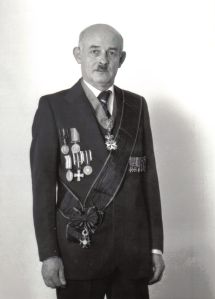
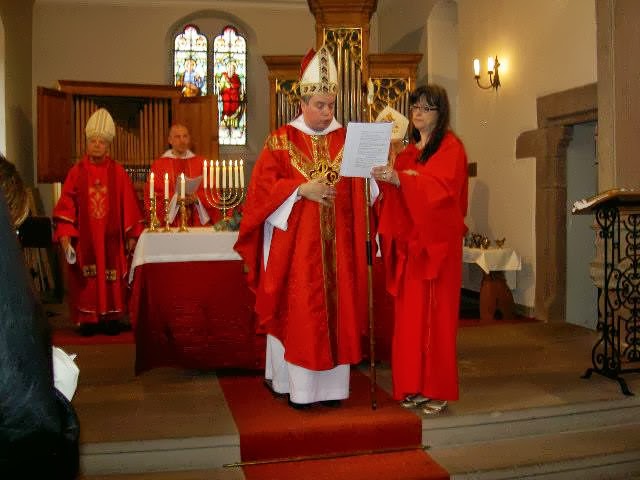
 The Most Revd. Juliusz Nowina-Sokolnicki (1920-2009) served as Assistant Bishop of the Apostolic Episcopal Church in Great Britain both as deputy to the late Archbishop-Count George Boyer and as bishop with special responsibilities for the Polish-speaking peoples. He was consecrated by the Most Reverend Bertil Persson, OCR, then-Primate of the Apostolic Episcopal Church, on 27 May 1983. Archbishop Persson was also the consecrator of the present Prince-Abbot of San Luigi (now also Primate of the Apostolic Episcopal Church), who from November 2008 served as Archbishop of the Apostolic Episcopal Church in Great Britain in succession to Archbishop-Count Boyer, and was thus for a few months Sokolnicki’s ecclesiastical superior.
Juliusz Nowina-Sokolnicki is best-known in his capacity as the head of one of the two entities that maintained rival claims to be the Polish government-in-exile during the 1970s and 1980s. Born in Pinsk, he completed secondary education and then took part in the September Campaign in 1939, following which he apparently made his way to Warsaw and distributed underground publications. In 1940, he was arrested by the Gestapo and imprisoned in Pawiak and then in Metz, where he was placed in a forced labour camp. Under these conditions his health deteriorated, and in 1942 he was released and returned to Warsaw, having been diagnosed with an incurable lung disease. He resumed insurgency against the Nazis and Communists as part of the shadowy organisation “Group of the Free”. In 1944, by means that are not clear, he escaped Poland and travelled through France to Italy, where he joined the Polish II Corps, an unofficial branch of the British Eighth Army.
He was demobilized in 1947 and in July 1948 settled in London. Throughout the following decade he was active in expatriate Polish associations. He was secretary of the Society for General Education, co-editor of “Bulletin of the Western Lands” from June 1950 and in 1958 founder of the Polish Association for the Defence of the Western Lands. In 1958 he became a member of the Supreme Council of the Union of Polish Eastern Territories and editor of the “Information Bulletin of the Eastern Regions of Poland.”
He was also politically active in the Polish cause. From 1951 he was involved with the Polish Independence League and with resistance to the Soviets; from this came the Struggle for Independence Convention which he founded. He was appointed to successive offices in the Polish Government-in-Exile and by 1970 had worked his way up to the position of Minister of Internal Affairs. In these years, strong alliances and animosities formed among members of the Polish diaspora, and these would become a major influence on the events of 1972. Most importantly, in 1954, President-in-Exile August Zaleski had refused to step down after the end of his seven-year term, citing the 1935 constitution and rejecting the post-war National Unity Act. The opposition to him then formed the Council of Three, which was recognized by some opposition members as a rival collective head of state for the ensuing eighteen years.
President-in-Exile Zaleski appointed Stanislaw Ostrowski as his successor in an announcement on 24 February 1971. However, in September of that year, Zaleski expressed serious misgivings on this matter to Sokolnicki. He feared that at age 80, Ostrowski was too old, and furthermore that he was too easily manipulated by opposition groups – of which the most obvious would have been the Council of Three and its followers. Zaleski asked Sokolnicki to succeed him instead, issuing him with documentation which has been the subject of fierce controversy ever since. As Zaleski had predicted, after his death on 7 April 1972, the Council of Three decided to dissolve itself and to confirm Ostrowski in office, thereby unifying the two largest Polish emigré groups.
Not unexpectedly, Sokolnicki was immediately to be denounced in the most vehement of terms by Ostrowski and his followers, but nevertheless he took up the Presidency-in-Exile undaunted, and gathered a number of supporters from among those who remained loyal to Zaleski and opposed to the Council of Three. These then formed the government of Free Poland in Exile, with Sergiusz Ursyn-Szantyr as Sokolnicki’s first Prime Minister.
Sokolnicki’s government-in-exile secured a number of successes. It was at his behest that the state governors of New Hampshire and New York initiated official memorials to the victims of the Katyn massacre. In 1986, he was initiator and co-founder of the Central European Community Council, which brought together governments-in-exile of the Communist states of Eastern Europe. Through Konstanty Zygfryd Hanff’s actions in the United States Sokolnicki maintained contact with anti-communist emigré groups there, notably “Fighting Solidarity” in the 1980s.
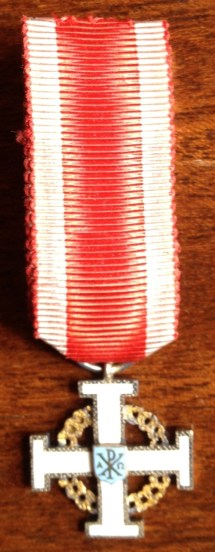
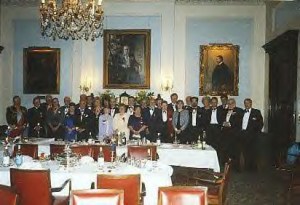 Sokolnicki also ensured that his cause became widely known through the conferral of the Orders and decorations of the Polish state, including the Order of Polonia Restituta (in which Archbishop Persson received the Grand Cordon) and the Order of St Stanislas, which he revived in 1979. The Most Revd. Prince Kermit Poling, OA, Royal Patron of the San Luigi Orders, to whom Sokolnicki was distantly related, received the Gold Cross of Merit from him in 1979. This aspect of Sokolnicki’s work was again not without its critics, not least in respect of its connexions to both corporate and personal fundraising. During the 1980s, Sokolnicki also served as a Vice-President of the London Appreciation Society, whose secretary, the late H.L. Bryant Peers, had been consecrated as a bishop of the Ancient Catholic Church in 1961.
At the fall of Communism in 1990, the Order of St. Stanislas was re-established as an international body and officially registered as a charity. Sokolnicki, whose family records stretched to over twenty generations, subsequently received the title of Prince from the head of the Hohenstaufen-Lanza family.
On 11 November 1990, in light of the upcoming Polish presidential elections, Sokolnicki issued an instrument dissolving his government-in-exile in favour of whoever would be the victorious candidate. From that point forward, he pursued a policy of absolute retirement from political activity and devoted himself to the Order of St. Stanislas. In 2009, at his last major public appearance, he attended that order’s thirtieth anniversary investiture.
>>Website containing relevant documentation (in Polish)
>>Biography by Dr. Norbert Wojtowicz at the site of the Polish Monarchist Association (in Polish)



 The Abbey-Principality of San Luigi
You must be logged in to post a comment.