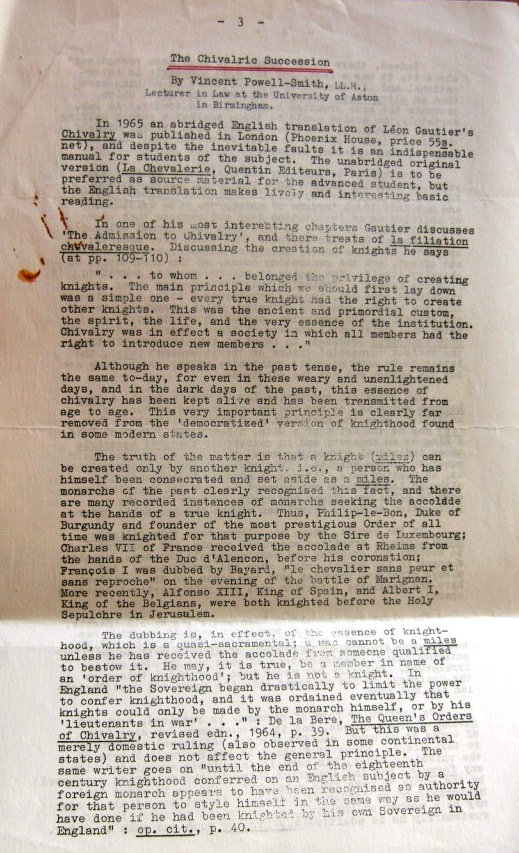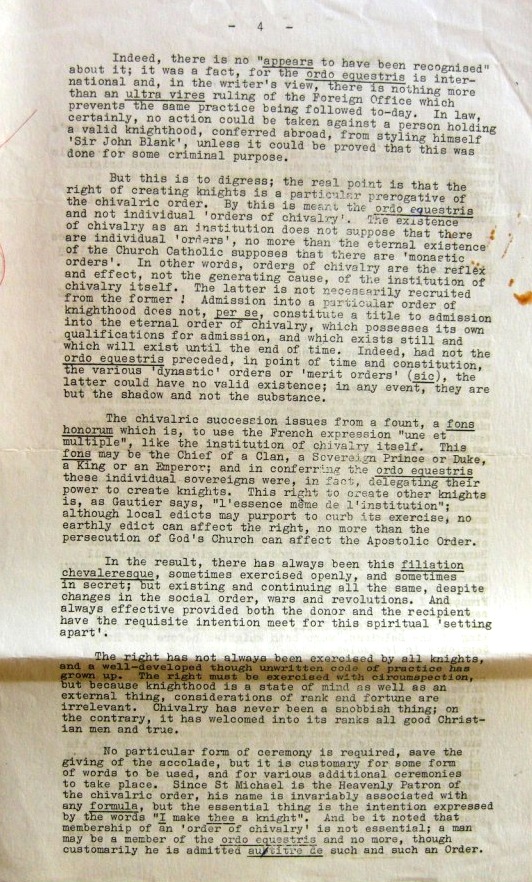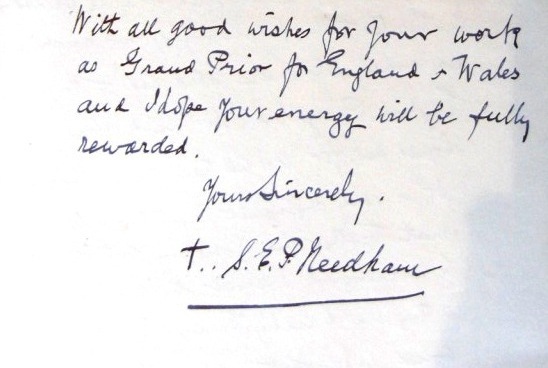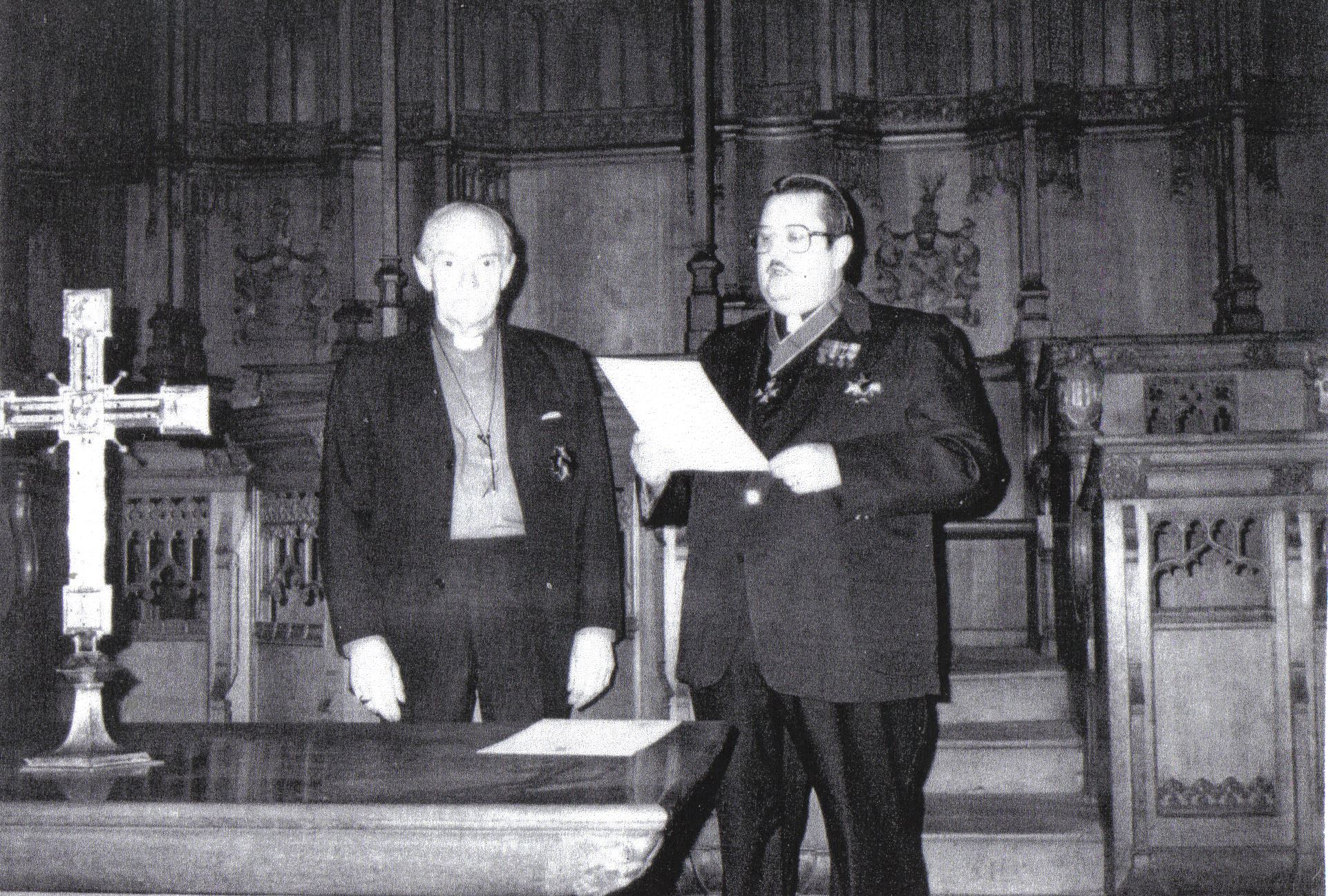
Members of the San Luigi Orders: Archbishop John van Ryswyck

Archbishop James John van Ryswyck (also Ryswyk) (1898-1963) of the Apostolic Church of St Peter served as Grande Prieur of the San Luigi Orders for England under Prince-Abbot Edmond I, until his retirement in 1960.

John van Ryswyck was born in Holland, and as a boy travelled with his family to the Dutch East Indies, which led to a lifelong interest in Eastern culture. He served in the Dutch navy and undertook intelligence duties. He subsequently became a naturalized British citizen. He was a noted spiritual teacher and lecturer, and in 1935 founded the Apostolic Church of St Peter. His home, and that of his church and related organizations, was Eldon Lodge in Victoria Road, Kensington, London W8.

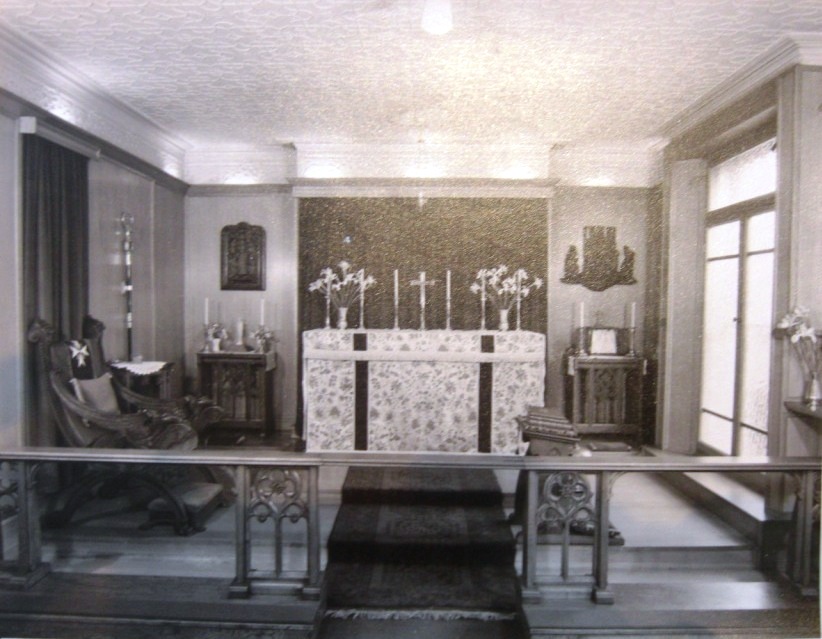
Eldon Lodge had been built for the painter Alfred Corbauld, and is an extremely substantial house with Tudor, baronial and Gothic elements. van Ryswyck converted Corbauld’s first floor studio into a chapel, the Sanctuary of the Vigil, and since his church and other organizations were open solely to initiates, this served as their place of worship. The basement, meanwhile, contained a large hall which served as the home for a number of chivalric orders. During the 1970s, Eldon Lodge would become the London centre of the Liberal Catholic Church before the purchase of the current pro-cathedral at Putney.

The work of the Apostolic Church of St Peter was a combination of elaborate Catholic worship with a process of inner teaching that was derived from Freemasonry. van Ryswyck was a staunch opponent of Communism in all its forms, and there were even (unsubstantiated) rumours at one point that he had received consecration from a Roman Catholic bishop in order to assist the Vatican in its fight against that ideology. He saw his mission and that of his followers in terms of the spiritual defence of global civilization.

In 1947, van Ryswyck was heavily involved in the F.U.D.O.S.I. (Federatio Universalis Dirigens Ordines Societatesque Initiationis) Congress at Paris that brought together many esoteric groups of the day. This was no small affair; there were 2,200 US groups represented and 300 French delegates in addition to representatives of other countries. Raymond Duncan was among the attendees. One objective was to establish a Supreme Martinist Council to bring together the various groups in that tradition; another was to establish a World Spiritual Parliament.

Aside from the Apostolic Church of St Peter, there were two main initiatic organizations that van Ryswyck headed, in addition to the many in which he held office and membership. These were the Temple of Service and the Avatar Defenders of Civilization (also known as the Order of Avatar and Avatar Imperium Internum), of which latter group he was Founder-President. Avatar was “an organization of people of all races, believing in the fundamental spiritual basis of life, as opposed to present-day materialism – in this sense a ‘Spiritual Kingdom’…the primary object of the Avatar Plans are decentralization of political power and the independence of all peoples and nations in Autonomous States, which may be federated into cultural and ethical groups, provided this is done with the consent of the peoples concerned,” and “a Universal Order working for a new way of life based on the sacredness of The Individual and the Spiritual Foundations of human existence.” Belief in past lives and in reincarnation appears to have been common. Avatar was finally dissolved in 1997 following a court case.

van Ryswyck held a large number of nobiliary and chivalric titles from various sources, including the Paterno Castello house and various of the Italo-Byzantine pretenders.

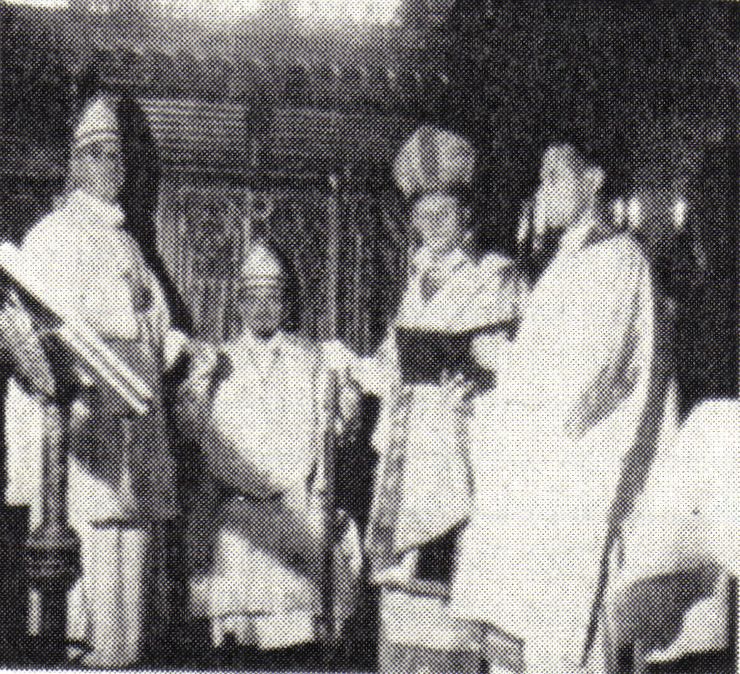
On 6 November 1949, at the mansion chapel of the Lord Patriarch Banks in East Molesey, van Ryswyck received conditional ordination up to the priesthood from Mar Georgius of Glastonbury (q.v.), who was a senior member of the San Luigi Orders. On 20 November, at Eldon Lodge, van Ryswyck was conditionally consecrated by Mar Georgius in an elaborate ceremony. This was described in Christocracy, the journal of the Apostolic Church of St Peter, as follows, “After the opening voluntary, Ave Verum, the procession entered to the music of the Creed, rendered by the choir of the Russian Orthodox Church of Paris. The Lord Patriarch [Mar Georgius] was attired in robes of cloth of gold. Bishop Langhelt and Fr. Sandys-Pemberton in white dalmatic and tunicle respectively, and Mgr. van Ryswyck in white and gold, in sharp contrast to which stood out the black and white bands of the Solicitor (Mr E.F. Power-Green). It is interesting to note that the epigonation worn by Mgr. van Ryswyck was presented to him by Bey Sulik Acarli, President of the Turkish Social Democratic Party, and Sacretary of the Red Crescent…After the long function Mgr. van Ryswyck was solemnly enthroned by the Patriarch by the name, style and jurisdiction of Mar Joannes, Lord Bishop of Ryswyck, and Imperator of the Ordo Equestris Militaris Avatar…Before the recessional, His Beatitude conferred upon Brigadier L.M. Poole, D.S.O., the Knighthood of the Order of St Gregory and Sarkis, and upon the Bishop of Ryswyck, the grade of Knight Grand Cross with the title of Duke de Richelieu-Ryswyck in the Order of the Spiritual Christian Nation [a body founded by the late Patriarch Frederic C.A. Harrington of the Ecclesiae Rosicrucianae Catholicae], these honours having been awarded for the services which the gentlemen concerned had rendered to religion.” The photograph taken after the ceremony above shows van Ryswyck seated, with, from left, Mar Francis (Langhelt), Mar Georgius  and Fr. Sandys-Pemberton.

At van Ryswyck’s funeral in 1963, the San Luigi Orders were represented by Fr. Brougham Yates Claxton, who acted as Mgr. Tull’s deputy during his time as Grande Prieur.

van Ryswyck consecrated a successor, (Rupert) John Luker (1906-84), who was a Grande Officier in the Order of the Crown of Thorns. During the 1950s, it was Luker who undertook most of the administration of the San Luigi Orders in England. Under his direction, fundraising took place among the members in aid of two London hospitals. He continued in membership under Mgr. Tull, being advanced to Grande Croix, until his resignation from the San Luigi Orders on 5 May 1970.

>>John van Ryswyck lectures

Members of the San Luigi Orders: Vida Hambro

Vida Agnes Hambro (1914-2002) was a Dame Grand Officier d’Honneur et Devotion of the Order of the Crown of Thorns, being appointed on 25 July 1955. She was the daughter of Captain William Lancefield and her first marriage was to Lieutenant-Commander Thomas Henry Morrough Chillingworth, RN. On 25 March 1957 she married, as his second wife, Richard Everard Hambro (d. 1967), son of Sir Eric Hambro, KBE. By her first husband, she had three children, and also became stepmother to her second husband’s children.

Her husband, Richard Everard Hambro, was a Officier and Compagnon of the Order of the Crown of Thorns. They had been introduced to the Order when they were both members of the esoteric Avatar spiritual organisation under the direction of Archbishop John van Ryswyck, which was based in the capacious Eldon Lodge in Kensington. Vida Hambro was also a member of van Ryswyk’s Apostolic Church of St Peter.  However, differences of opinion emerged between the Hambros, van Ryswyck and his Chancellor Bishop R. John Luker (who was a Grand Officier of the Order of the Crown of Thorns) concerning the financial administration of the organisations (to which the Hambros had for many years been generous donors), and they resigned from Avatar in consequence.

Although van Ryswyck had at that time exercised a representative role for England in respect of the San Luigi Orders, he had in practice left their administration to Mgr. Luker and taken little active part in their development. Vida Hambro was happy to see the growth of activity that occurred under Mgr. Tull as Grande Prieur from 1961 onwards. In a letter of 1963, she wrote, “We both feel that it is a great honour to belong to such an ancient Order and that it is a really worthwhile thing that can be an instrument for good, and we support the Order wholeheartedly.”

Members of the San Luigi Orders: The Most Revd. J.E. Bazille-Corbin

John Edward Bazille-Corbin (1887-1964) was a member of the Order of the Crown of Thorns. He was the founder and first Warden of the Monarchist League and combined his office as a bishop in the Catholic Apostolic Church (Catholicate of the West) with that of an Anglican priest.

Bazille-Corbin was educated at Oxford (M.A.) and qualified as a barrister at Lincoln’s Inn. He did not practice, however, and served in the Royal Artillery during the First World War. After this, he pursued a teaching career, being a member of the Royal Society of Teachers, and taught classics at a Guernsey college. He entered Cuddesdon Theological College to train for the Anglican ministry, and was ordained priest in 1921. In 1923 he became Rector of Runwell St Mary, near Wickford in Essex, and was to hold this benefice until his retirement on 30 September 1961.

Some idea of the nature of Bazille-Corbin’s interests can be gained from the knowledge that he was a fervent Jacobite, High Tory and devotee of the Sarum Rite, belonging to the High Church party and espousing Ritualism to the full. He was no pastoral priest, and the introduction of the Sarum Rite to his parish (with the knowledge but not the approval of his Ordinary) resulted in a much-diminished flock. It is clear that this approach also made him significant enemies within the Church of England hierarchy, which contained many who were Protestant in their views. In 1951, he would publish Toward a Uniate Rite, being the text of the Sarum Ordinary and Canon, closely rendered into English, which was favourably reviewed in the Catholic Herald. He was also a dedicated local antiquary, and around the same time appeared his Runwell S. Mary: A farrago of History, Archaeology, Legend and Folk-lore, collected and pieced together during an incumbency of many years.

Bazille-Corbin developed contacts within the Free Catholic movement in England during the 1940s, and as many Anglicans had done before him under Archbishop Arnold Harris Mathew, sought conditional revalidation of his Holy Orders so that they would be acceptable to Rome. During August 1946, he received conditional re-ordination to all orders up to the priesthood from James Bartholomew Banks, Lord Patriarch of the Old Catholic Orthodox Church. Subsequently, he became concerned with the Catholic Apostolic Church (Catholicate of the West) under Mar Georgius (Hugh George de Willmott Newman), who was also a member of the San Luigi Orders. The Catholicate of the West had formed in 1944 as the merger of several small British sacramental churches with succession from the major denominations, and aspired to create a Western Orthodox bridge between Rome and Canterbury in continuation from the mission of the Catholic Apostolic Church (“Irvingites”) into which body Mar Georgius had been born and raised. During the 1940s it established an international hierarchy and attracted a diverse following as a result of energetic public outreach, but was marred by a failure to gain lay support and by recurrent internal dissent which weakened its ranks.

Bazille-Corbin was consecrated to the Episcopate by Mar Georgius on 3 April 1948 with the title of Mar Marcus Valerius, Titular Bishop of Selsey. He was appointed Chancellor of the Glastonbury Patriarchate and Catholicate of the West and also appointed to office in the Order of Corporate Reunion. In 1950 the degree of Doctor of Divinity was conferred on him by the Western Orthodox University, which Mar Georgius headed and which was incorporated at the time in India. In 1958 Mar Georgius advanced him to Archbishop ad personam in the United Orthodox Catholicate. Bazille-Corbin’s choice of episcopal title was modelled after Marcus Valerius Corvinus, the friend of Horace, whose cognomen suggested a connexion with his own surname. Every attempt was made to preserve his secular identity as secret after his consecration, and this strategy was successful for some six years. From 1943 to 1953, Bazille-Corbin served as Chairman of the Chelmsford Branch of the National Clergy Association.

In 1954, the Anglican polemicist the Revd. F.H. Amphlett Micklewright, who was well-known for his malicious and frequently unfounded attacks on Free Catholics in the religious press, publicly named Bazille-Corbin in an article in The Pilot. This was intended to cause difficulties for Bazille-Corbin with his Ordinary, the Bishop of Chelmsford (Falkner Allison) who had already on several occasions shown extreme antipathy to the Free Catholic movement. Bazille-Corbin willingly gave to Allison an undertaking that he would not perform episcopal functions outside the Church of England, conditional upon the proviso that he would also not be required to perform such actions within that body. At this time, the Church of England was particularly fearful that there would be a repeat of the situation of the 1910s whereby its clergy, mindful of the invalidity of their Holy Orders in the sight of Rome, would seek conditional validation from Free Catholic prelates such as Bazille-Corbin, or that those holding the benefice of their parishes would find in Bazille-Corbin and Mar Georgius an alternative means of episcopal oversight that would lead to their removal from the Church of England’s effective control.

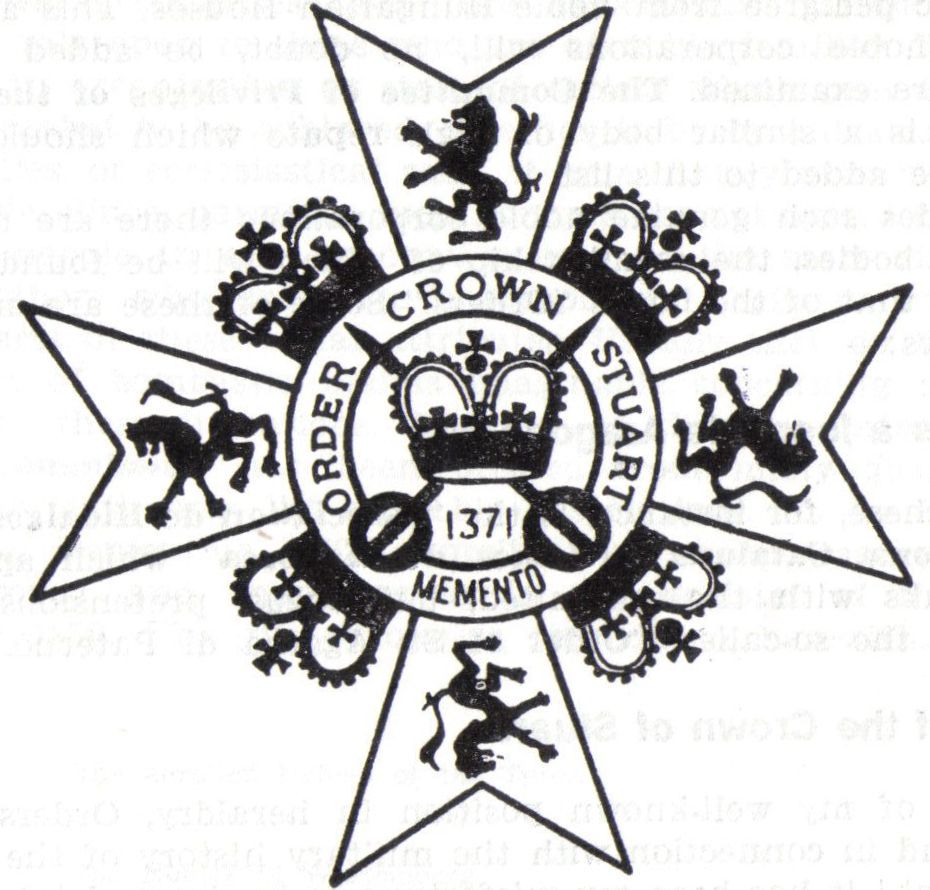
Certainly, Runwell St Mary was removed from such control under Bazille-Corbin. He regarded his vocation as being within the Catholicate of the West, and discharged the Anglican ministry as a mere “day job”. His letters were signed in purple ink, with the episcopal cross before his name. During the 1950s, Bazille-Corbin became a mentor to Vincent Powell-Smith, who would join him in a number of chivalric associations (including, for a time, the Order of the Crown of Thorns) and would eventually be ordained deacon by Mar Georgius. Both Bazille-Corbin and Powell-Smith served as officers in the Order of the Crown of Stuart, which has been separately described, with Bazille-Corbin as the Order’s Chancellor from 1955 onwards.

Bazille-Corbin came from an armigerous family in Guernsey and he asserted that his ancestor, a physician, had received the title of Marquis de Beuvel from the King of the Two Sicilies. In the post-war years, a number of claimants to long extinct thrones of the Byzantine and other empires obtained legal confirmation of their dynastic rights from Italian tribunals and Bazille-Corbin was further honoured by several of these pretenders, some of whom were also at the time members of the San Luigi Orders, with titles of nobility and membership of chivalric bodies under their headship. It is evident that Bazille-Corbin was possessed both of a sharp legal mind and of the adherence to strict principle familiar to Legitimists, and his acceptance of such honours would presumably thus have been subject to his having been fully satisfied of their basis in law.

In 1943, Bazille-Corbin founded the organization that would provide his most tangible legacy, the Monarchist League, which survives today as the International Monarchist League. This body had a quiet existence in its early years, and it was not until 1959 that, along with the Order of the Crown of Stuart and with several officers in common with that body, serious efforts were made to bring it to a wider public. A newsletter, The Monarchist Guardian, was published from 1960 onwards. After Bazille-Corbin’s death, those who were antipathetic to his outlook wasted little time in committing to print their harshly critical assessment of him, which would certainly have been actionable if published within his lifetime. This in turn seems to have given rise to the curious situation whereby Bazille-Corbin is recalled today chiefly through the words of his enemies, whereas it is clear that among his circle of close associates he was regarded with both respect and affection.

Members of the San Luigi Orders: Emperor Haile Selassie I of Ethiopia

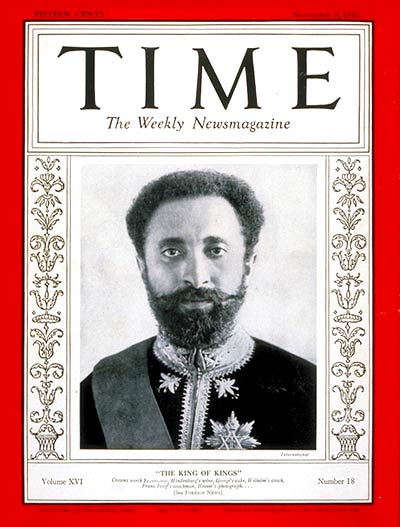
During the 1930s, our archives indicate that H.I.M. Emperor Haile Selassie I of Ethiopia (1892-1975) exercised a role of Royal Patronage towards the San Luigi Orders. He was regent of Ethiopia from 1916 to 1930, and Emperor from 1930 to 1974. By tradition, he was the descendant of King Solomon and the Queen of Sheba, and has been acclaimed by the Rastafari movement as the Biblical Messiah.

>>Biography (Wikipedia)

>>Biography (Ethiopian Treasures)

Documentary: The Lion of Judah

Members of the San Luigi Orders: Henry Stuart Wheatly-Crowe

Captain Henry Stuart Wheatly-Crowe (1882-1967) (often rendered Wheatley-Crowe) was a Commandeur of the Order of the Crown of Thorns.

Wheatly-Crowe devoted the greater part of his energies and much of his inheritance to the two causes of Jacobitism and the restoration of the commemoration of the martyrdom of King Charles I to the calendar of the Church of England. His addition of “Stuart” to his forenames reflected his claimed descent from the Lennox Stuarts. He was using the title Baron Montrencie from early adulthood onwards, though the provenance of this title is unclear. Later he would assert his right to the title of Duc de Saint-Quentin in the Peerage of France.

His career was with the Army, and he was gazetted Second Lieutenant in the 1st Cheshire Royal Engineers (Volunteers) in July 1900, becoming Second Lieutenant in the 6th Battalion, The Lancashire Fusiliers, in September 1902. In October 1914 he was gazetted as temporary Captain and thereafter served during the First World War with the Manchester Regiment. In 1919 he resigned his commission on account of ill-health and was permitted to retain the rank of Captain.

A High Church Anglican, he inaugurated his campaign for King Charles the Martyr by founding the Royal Martyr Church Union in 1906. This attracted around 500 members at its peak, including a number of peers of the realm. In 1911, the Memorial of Merit of King Charles the Martyr was established, and a revival of this body continues today. This was conceived as a system of honours within the Anglican Communion, and its Statutes received the approval both of the Archbishop of Canterbury and King Edward VII.

Unfortunately for the Royal Martyr Union, little headway was made with the Anglican hierarchy, and as members died, others did not come forward to replace them. There was also dissent within its ranks, and during the 1930s this seems to have resulted in Wheatly-Crowe being sidelined for a time. By the 1960s, and back in charge, Wheatly-Crowe had no regrets, although the whole endeavour was estimated to have cost him some £25,000. He said, “I’ve done what I said I would do. I’ve tried. And I would do it again.”

Jacobitism began to gain some ground in the aftermath of the First World War, and in 1926, Wheatly-Crowe founded the Royal Stuart Society, and subsequently in 1932 the Order of the Crown of Stuart, which were to prove key organizations for the British Jacobite movement.

During the 1930s, Wheatly-Crowe was mostly a supporter of the claim of Prince Rupert of Bavaria (Robert I and IV) to the British throne, although at other times, because of the descent of Prince Rupert from an uncle-niece marriage, he gave support to the Infanta Alicia de Borbon or other Jacobite claimants in his stead. The Abdication Crisis of 1936 presented an opportunity for Jacobites to capitalize on public dissatisfaction with the House of Windsor, and Wheatly-Crowe accordingly issued a proclamation that declared himself to be “His Highness the Lord Regent of England, Scotland and Ireland” based on a letter of authority from Prince Rupert of 22 February 1937. As Regent, Wheatly-Crowe’s first act was to issue a strongly worded protest against the coronation of George VI.

Prince Rupert had generally been extremely circumspect about advancing any Jacobite claims, and the publicity that attended Wheatly-Crowe’s actions was not welcomed. He ordered his Chancellor, Erwin Freiherr von Redwitz, to write to Wheatly-Crowe making it clear that he refuted any claims made in his name, and that if Wheatly-Crowe persisted in them, legal action would follow. This setback meant that the Jacobite cause lost what temporary momentum it had gained.

A newspaper report of 1951 details Wheatly-Crowe’s custody of the mummified heart of the Marquess of Montrose, which had been gifted to him in 1931 and had successively reposed in a glass case in his Hampstead home and under the bed in his New Forest residence. The Marquess had been executed in 1650 as a result of his failed attempt at a rebellion in favour of the restoration of Charles II. The reporter recalls that Wheatly-Crowe brought the relic down while he was having tea with him, and placed the “brownish-black, leathery lump” on the table. Wheatly-Crowe eventually sent the heart by registered air mail to a descendant of Lord Napier, a prior recipient, in Canada.

The Order of the Crown of Stuart rose to greater prominence amid the chivalric revival of the post-war years, although Wheatly-Crowe’s tenure at its helm was not consistent and at one point he found himself ousted by modernisers. Its structure under his leadership was that of a chivalric confraternity – doubtless in remembrance of those Jacobite orders and chivalric societies revived under the Earl of Ashburnham and the Marquis de Ruvigny in the latter half of the nineteenth-century, to which it saw itself as the successor. Knighthood was conferred in three ranks, including provision for hereditary Chevaliers, and with other nobiliary distinctions introduced.

A thorough revision of the membership was undertaken in 1960. At this time, Wheatly-Crowe was Grand Master and among the officers were the Most Revd. J.E. Bazille-Corbin (Grand Chancellor; also a member of the Order of the Crown of Thorns) and Professor Vincent Powell-Smith (Registrar; also an Officier of the Order of the Crown of Thorns until his withdrawal from the Order in June 1962). As of 1959, the Chaplains of the Order included not only representatives of the Roman Catholic and Anglican Churches but also the Revd. Geoffrey Paget King, as representative of the Old Roman Catholic Church. Mgr. Paget King was also a Prelat-Commandeur of the Order of the Crown of Thorns. During the 1960s, the Order of the Crown of Stuart and the Memorial of Merit published a joint newsletter entitled Legitimist Notes.

The pattern of the Order established by Wheatly-Crowe was not to the approval of all those involved, and harsh criticism from both present and former members brought about fundamental changes that sought to remove the chivalric and nobiliary elements that he saw as essential to its character. By this time, he was no longer able to maintain the staunch resistance he had always offered to such developments, and it would perhaps be true to say that the Order as he had created it died with him.

Members of the San Luigi Orders: Maurice Beddow Bayly

Maurice Beddow Bayly (1887-1961) was a Chevalier of the Order of the Lion and the Black Cross.

He was a medical doctor by profession, graduating MRCS and LRCP. His principal work was in campaigning against vivisection for medical purposes, being a member of the Animal Defence and Anti-Vivisection Society, and against vaccination, in which connexion he was a member of the National Anti-Vaccination League.

He published many papers and pamphlets on these subjects, and in 1944 wrote on vaccination, “Perhaps the greatest evil of immunization lies in its diversion of public attention from true methods of disease prevention. It encourages public authorities to permit all kinds of sanitary defects and social problems to remain unaddressed, particularly in schools. It ignores the part played by food and sunlight and many other factors in the maintenance of health. It exaggerates the risk of diphtheria and works upon the fear of parents. The more it is supported by public authorities, the more will its dangers and disadvantages be concealed or denied.”

Concerning vivisection, he commented, “In a universe which embraces all types of life and consciousness and all material forms through which these manifest, nothing which is ethically wrong can ever be scientifically right; …in an integrated cosmos of spirit and matter one law must pervade all levels and all planes. This is the basic principle upon which the whole case against vivisection rests. Cicero summed it up in the four words: “No cruelty is useful”.

Bayly was admitted a Chevalier of the Order of the Lion and the Black Cross in February 1961, four months before his death. His letters expound his philosophy of religion. He was a member of the Liberal Catholic Church and Secretary of its church at Tekels Park, Camberley. Earlier in life, he had received the minor orders in that body, but did not proceed further “since I considered it too serious a step to take, unless I was likely to be in a position to carry out regular duties as a priest.” He was an active member of the Theosophical Society.

He wrote “All the ancient legends concerning King Arthur and his knights have an immense appeal for me, for whatever the historical facts may be the central theme of the Quest for the Holy Grail is a living reality today as it ever was and ever will be.”

>>Biography (Wikipedia)

>>Various writings, quotations etc. (whale.to)

Members of the San Luigi Orders: Henry Cabot Lodge, Jr.

Henry Cabot Lodge, Jr. (1902-85) was a member of the Order of the Crown of Thorns. He served as a senator for Massachusetts as well as as United States Ambassador to the United Nations, South Vietnam, West Germany and the Holy See (as Plenipotentiary). In the 1960 Presidential Election he was the Republican nominee for Vice-President.

>>Biography (Biographical Directory of the United States Congress)

>>Biography (Wikipedia)

Interview given as campaign manager for General Eisenhower, 1952

Members of the San Luigi Orders: Frederick Bowman

Frederick Bowman (1893-1969) was an Officier of the Order of the Crown of Thorns and also an Officier of the Order of the Lion and the Black Cross. Described in an obituary as “the last of Liverpool’s notable eccentrics” his life was of such unusual variety that the late Grand Prieur, Mgr. George Tull, at one point planned to write his biography. It was said of him that “everything he did was in inverse proportion to his diminutive size.”

The exact date of Bowman’s birth was not even vouchsafed to the authorities at the hospital where he passed away. His early career was as an actor (he claimed Sir Donald Wolfit among his friends, and compared notes with him on their respective portrayals of Richard III) and he appeared often in the Liverpool music halls in melodrama and as an orator. He would customarily appear in public in the same uniform of tailcoat and buttonhole that he had worn upon the stage. In June 1934 he was formally presented to King George V at a levée.

As time wore on, he gained a reputation for litigiousness. On one occasion, a printer whose bill he had failed to pay was unwise enough to make some derogatory remarks about him in a letter. Bowman successfully sued him for libel, winning £400 damages, a considerable sum in those days.

At some point in early adulthood, he became a Muslim and adopted the name Hameedullah, being particularly impressed by the reverence of that faith for the suffering of animals. However, he later decided that he “did not know enough to be religious at all”. By the time of his admission to the OCT, however, he was able to complete the required subscription to the Nicene Creed without overmuch difficulty.

A fierce pacifist and member of his friend the Marquess of Tavistock’s anti-war (and at various times anti-Semitic and pro-fascist) British People’s Party, he was interned during the Second World War, and clearly felt his duty lay in maximum resistance to the authorities. He founded the Frederick Bowman Freedom League in Brixton Prison in 1942, and in June of that year attempted to escape while disguised as a clergyman. Recaptured and put on bread and water, he went on hunger strike on several occasions and was forcibly fed by tube. The authorities offered him conditional release, but he refused their terms; they then opted for unconditional release, having previously considered forcibly expelling him from the prison. Bowman then sued the prison governor and the Home Secretary for having ordered that he be force-fed: although this act was clearly illegal, Bowman’s appearance pro se before the judge antagonized him, and he lost the case.

Shortly after his release, in March 1943, he received a knighthood from Count Potocki de Montalk, who was a rather tenuous pretender to the throne of Poland as King Wladyslaw V. Potocki was a determined controversialist, fierce anti-Semite and practising pagan as well as a poet and private printer of some note. The service of investiture included a reading from the Egyptian Book of the Dead, prayers for those working for peace and an invocation to the sun god. The following year, Potocki deprived Bowman, whom he had (with characteristic contempt for the British Establishment) encouraged to use the title “Sir Frederick”, of his knighthood for alleged lèse majesté and breach of his oath of fealty. All this was reported in the less salubrious quarters of the press of the day.

Bowman continued to be interested in phaleristic matters, and particularly their insignia and minutiae of dress, and in due course was introduced to the Order of St Stanislas as well as to the San Luigi Orders. In 1928, he had co-founded the weekly periodical The Liverpool Examiner and Talking Picture News and also at some point published The Theatrical Observer and The Liverpolitan. Most editions of the first of these titles carried a photograph of him, usually taken some twenty years previously. Curiously, they also carried on occasion reproductions of British coins and stamps on which Bowman’s head replaced that of the monarch.

By now, he was dedicated to the great cause of his life, which was animal welfare. As founder-president of the Animal Service Association, his home, “Humanimal House”, became a refuge for innumerable itinerant cats which he fed at his own expense, leading to his acquiring a rather fishy effluvium that made it sensible to keep downwind of him on occasion. One letter details in heroic terms his rescue of a spider from his sink. Other associations included Alma Chetwynd Aid for Strays (Mrs Chetwynd ventured out late at night to feed them, accompanied by Bowman as her protector), M.D.-W. Pigeon Relief, anti-vivisection, and the campaign to end the ill-treatment of transported horses from Ireland. One of his letterheads indicates in no uncertain terms, “No connection with those now running what they call the league against cruel sports. No sympathy about people killed while hunting.”

Alongside this, he worked for the peace movement and for relief for the deaf-blind community. He joined the Guild of St Francis under Mgr. Tull, which had an especial care for animal welfare.

In 1960, he was persuaded to revive his compact version of East Lynne at Liverpool’s Pavilion Theatre; he played the villain, Sir Francis Levison. He authored a number of plays, some of which were professionally performed, and wrote many songs, including a March Song for the Order of the Crown of Thorns which has subsequently been adopted as the Anthem of San Luigi.

His correspondence with Mgr. Tull concerning the San Luigi Orders was voluminous and conducted with great energy and enthusiasm, with typescript at all angles of the page and copious handwritten additions. It is clear that the appointment to the Orders caused him to rediscover the Catholic Faith and to become more attentive in his devotions after many years of indifference. In 1961 he wrote to Mgr. Tull “Your friendship is an inspiration and encouragement in troubled times, and it seems as if you had been spiritually impelled to get in touch with me when you did. I feel it is something for which my gratitude is due to God himself.”

Late in his life, Bowman was in ailing physical and financial health and approaching a Christmas that would have been spent on his own and with few comforts, when he was telephoned by the then Mr (later Bishop) Mervyn Thompson-Butler-Lloyd, a local hotelier, who arranged for him to enjoy a free Christmas dinner at the hotel with taxi service to and from his house. In recognition of this kind gesture, Bowman arranged for Mr Thompson-Butler-Lloyd to be admitted to the Order of the Crown of Thorns, although Bowman had passed away before this honour was conferred.

The obituary published in “Les Chroniques de Chevaliers” read, “Following a short illness, he died in a Liverpool hospital, after a life of kind and useful service to humanity and animals. Devoted to the Orders and the ideals of true chivalry; staunchly celibate, he left no next of kin, but many friends in Liverpool and far beyond. The Grand Prieur will remember him with especial affection as a loyal comrade.”

Frederick Bowman