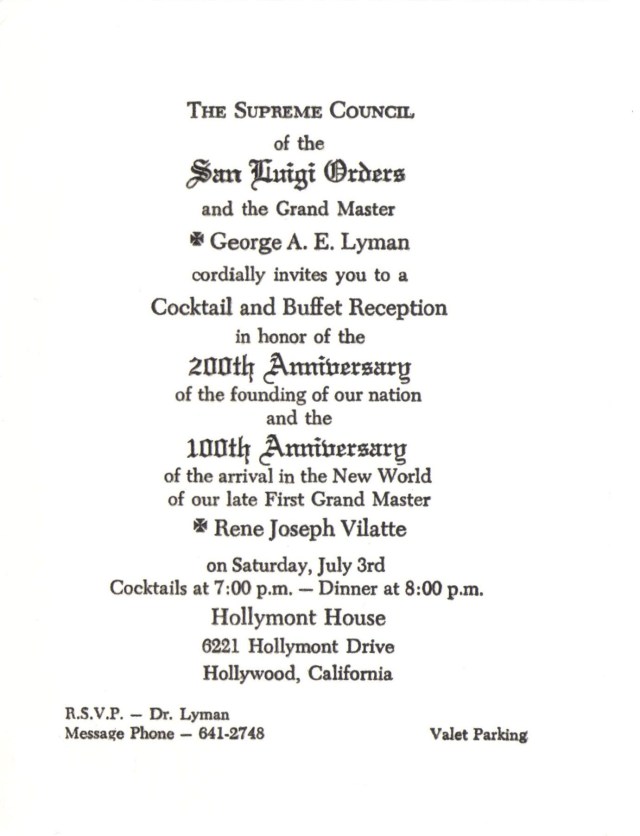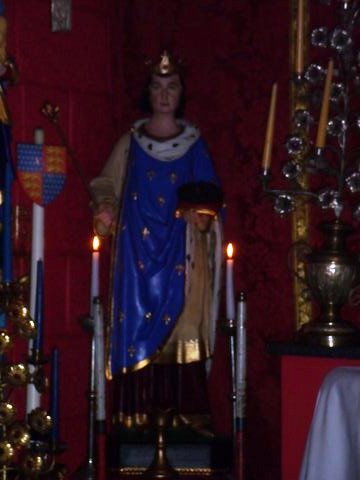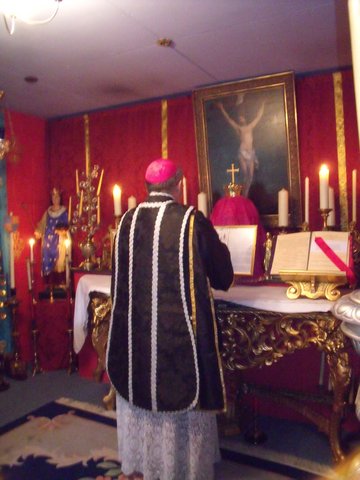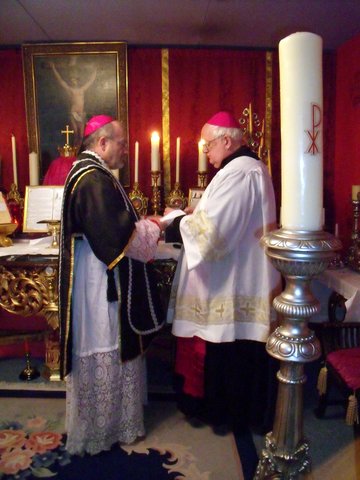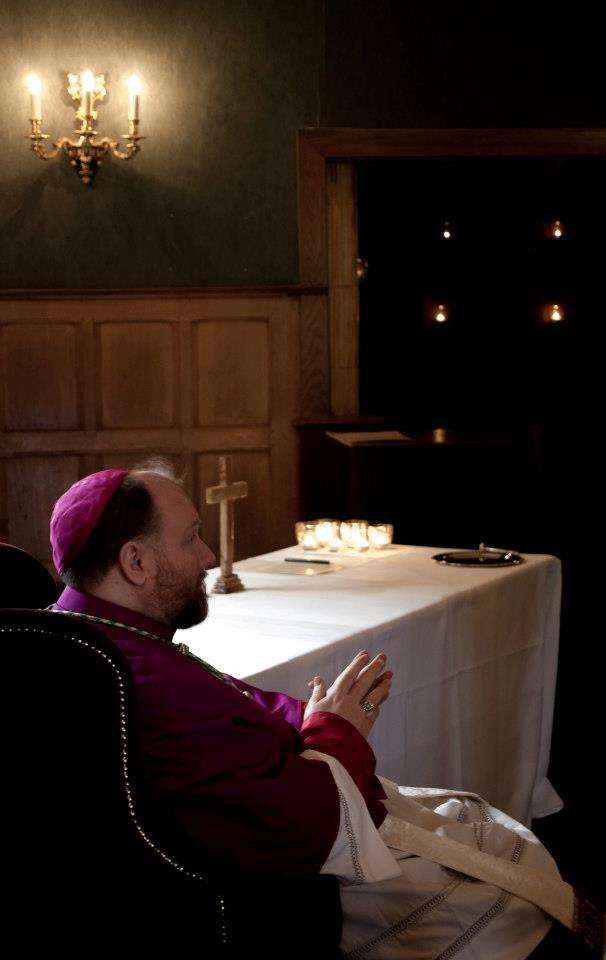
Investiture of the San Luigi Orders, 3 July 1976

1976 investiture

Eleven new knights were admitted to the San Luigi Orders on this occasion. Hollymont House had previously been the home of Robert Taylor and Barbara Stanwyck; by the time of the investiture it was the home of the Most Revd. Dr. Donald Jolly, a bishop in the Free Protestant Episcopal Church and a banker. He was admitted to the San Luigi Orders at the investiture. Two months before this event, the house was the subject of a KTTV news investigation into reports that it was haunted.

Two Prince-Abbots and their Grand Chancellor

In this photograph, taken around 1961, we see (from left to right): Bishop Hugh Michael Strange (Comte Michel L’Estrange), Grand Chancellor of the San Luigi Orders, Prince-Abbot Edmond I and the future Prince-Abbot Edmond II, in whose favour Prince-Abbot Edmond I would resign his office in 1962.
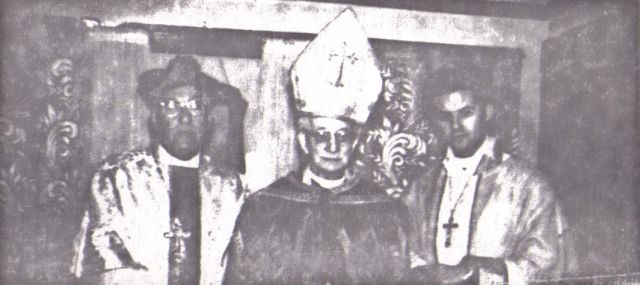
Strange, Edmond I, Edmond II

Requiem for Dom Klaus Schlapps OPR OA

A Solemn Pontifical Requiem for Dom Klaus Schlapps, OPR, OA, Duke of Saih Nasra, took place at the Episcopal Chapel of the Old Roman Catholic Church at Gosberton. The eulogy was delivered by the Prince-Abbot and the celebrant was Archbishop Douglas Titus Lewins, Marquis of Tejerri, assisted by Bishop Howard Weston-Smart, Duke of Gatrun. Prayers were offered for the Abbey of St Severin and for all who mourn Dom Klaus’s sudden and untimely passing.

DSCF0780

DSCF0768

DSCF0769

DSCF0770

DSCF0771

DSCF0773

DSCF0775

DSCF0776

DSCF0777

DSCF0779

DSCF0781

Members of the San Luigi Orders: Archbishop Forest Ernest Barber

Forest BarberArchbishop Sir Forest Ernest Barber was a member of the Order of the Crown of Thorns, being admitted by Prince-Abbot Edmond I. He was a founder and President of The Augustan Society and a bishop of the Apostolic Episcopal Church.

Archbishop Barber was born in Rensselaer, Indiana, on 31 December 1922, into a Presbyterian family. After war service in US military intelligence, he trained as a teacher, earning Bachelor of Science (Butler University, Indiana, 1945) and Master of Arts (Loyola University, Chicago, 1954) degrees, and pursued that vocation in the public school systems of Germany, Canada and the United States, latterly in his adopted home of Long Beach, California. A lifelong scholar, with his academic specialisms being history and English literature, his research in Germany led to one of the first studies of the development of the Hitler Youth, which formed his MA thesis at Loyola University.

Entering the Free Catholic movement, he was ordained priest aged 22 by Archbishop Denver Scott Swain (1905-48) of the American Episcopal Church in 1944. Swain was a controversial attorney who had been a priest under Archbishop Carmel Henry Carfora of the North American Old Roman Catholic Church. His early death prevented his American Episcopal Church gaining ground as more than a paper organization. Barber was also ordained priest conditionally in 1946 by James Christian Crummey (1887-1949), a former bishop under Carfora whose Universal Christian Communion was an early attempt to unite the various Old Catholic denominations; today this entity is one of the inner churches of the Order of Corporate Reunion.

Barber was active in the chivalric, heraldic and genealogical arenas. In 1953, Barber married Princess Eleonore von Auersperg (1924-2009), daughter of Prince Eduard von Auersperg and of his wife, née Sophie Gräfin von Clam und Gallas, who he had met in Canada. They had three sons. In 1957, with the late Sir Rodney Hartwell (d. 2006) and several others, Barber founded The Augustan Society with headquarters in Torrance. This had two aims: (1) to preserve material related to heraldry, genealogy, and orders of chivalry, and (2) to further chivalric ideals in society. The Society grew rapidly and acquired some influential supporters, counting among its patrons Ernst August Prinz zur Lippe, Dr. Otto von Habsburg and Prince Victor Emmanuel of Savoy. Barber’s views on the legitimacy of chivalric orders differed sharply from some of his colleagues, notably Robert Gayre of Gayre and Nigg, and it was perhaps unfortunate that the opinions of the latter – also closely connected with the propagandistic agenda of the Sovereign Military Order of Malta, in which Gayre held the Grand Cross of Merit – tended over time to prevail within the Society. Nevertheless, Barber continued to be an energetic contributor of scholarly and informative articles to The Augustan.

Barber came to know the future Prince-Abbot Edmond II through the membership of both men in the National Society of Arts and Letters Santa Monica Chapter. It was thus that he received membership in the Order of the Crown of Thorns. In his search for an ecclesiastical home after some years without a church affiliation, Barber turned to Lowell Paul Wadle (1900-65), Archbishop of the American Catholic Church of Laguna Beach, California, and was re-ordained to the priesthood by him on 7 January 1961 in the Pro-Cathedral of St Francis-by-the-Sea. Within a short time, Barber had left Wadle and prevailed upon Edmond II to introduce him personally to Edmond I, in the hope that he would agree to consecrate him to the episcopate. However, Edmond I declined to meet with Barber on the grounds of his failing health. On 1 January 1962 the future Edmond II wrote, “Fr. Barber at one point considered joining Bp. Fairfield but decided not to later because of national differences. It is now apparent that he is considering inactive work with the Orders and possibly the Free Catholic Church [a corporation maintained by Edmond II and used for church work prior to his succession]. He is a schoolteacher in Long Beach.”

Wadle’s theology was prevailingly esoteric, and for a long period this would also be an important strand for Barber, who was in due course consecrated by other prelates. Wadle led for some years the American Chapter of the Order of the Crown of Thorns that espoused esoteric beliefs, and Barber’s adherence to this group was one cause of his increasingly strained relations with Prince-Abbots Edmond I and II, who both condemned Wadle as heretical and his O.C.T. group as unauthorized. Edmond II had experienced life in an esoteric church (that of Archbishop Herman Adrian Spruit (1911-94)) early in his career, and his perception of Spruit’s moral failings and inconsistent theology led him to turn against such bodies with considerable vigour. Subsequently, Edmond II expelled Spruit from the San Luigi Orders when Spruit formed an alliance with the mystic Justin Boyle (aka Robert Raleigh) (1887-1969). Boyle had thrown Edmond II and Archbishop Emile Rodriguez y Fairfield out of his “shrine” when they paid a visit in September 1961 on the grounds that he “did not like strangers”. When, after leaving Wadle, Barber began to associate himself with Spruit and the noted esoteric teacher Richard, Duc de Palatine, his relations with San Luigi reached a nadir.

kingpeteriistjohnThere was, however, to be a further close link between Barber and Edmond II in the person of King Peter II of Yugoslavia (1923-70) (pictured left wearing his St John insignia), who was resident in California during his final decade. King Peter, who had not abdicated his throne and who preserved his sovereign rights intact, showed a willingness to encourage chivalric and nobiliary activity. King Peter was, like Barber, a member (Grand Cross of Justice) of the Sovereign Order of St John of Jerusalem which was based in Shickshinny, Pennsylvania, and later extended his protection to a breakaway group of members of the Order which, at Gayre’s instigation, finally received the status of a Royal Yugoslav Order shortly before the King’s death. Edmond II first met King Peter at a reception hosted by Dr Rufus B. KleinSmid in 1959, and developed a friendship that led to the King accepting the High Protectorship of the Order of the Crown of Thorns in the following year and issuing a patent of recognition of the title of Prince de San Luigi as well as bestowing a marquisate upon Edmond II in 1962.

However, unlike the Royal Yugoslav Order of St John, the San Luigi Orders did not have the support of Gayre or his recently-established “International Commission on Orders of Chivalry”, and after the King’s death Gayre attacked them in his customary intemperate manner in his book The Knightly Twilight. Likewise, an edition of The Augustan (vol. XIII no. 4) commemorating the 700th anniversary of St Louis included an article on the San Luigi Orders by Mgr. Tull, but Rodney Hartwell felt it necessary to add a disclaimer at the end citing their non-recognition by the ICOC. To this, Edmond II commented in a letter of 5 January 1971, “I am not at all happy with Hartwell’s silly footnotes…We have never made any effort to receive recognition from Hartwell or his organization. Nor have we gone “out of our way” to get listings. What we have done, as you well know, is attempt to serve Christ and to award those outstanding citizens of the world who serve the cause of Knighthood in one way or another…We do not have many members BUT we do have some very well-known and well-beloved Knights and Dames.” The letter goes on to express some decidedly unfavourable views concerning both Barber and Hartwell. On 31 October 1971, Edmond II adds, “I avoid meeting such people [as Hartwell] but when I do – I avoid giving any details about my work or orders. He does not know me as the Grand Master nor do I want him to. He is much, too much, of a busy body…”

Barber had long wished to obtain a title of nobility, and Hartwell’s article New Nobles in the International Chivalric Institute Members’ Newsletter no. 30 (October 2001) – published some seven years after Barber’s death – tells the story of his peregrinations, firstly paying the elderly Prince of Cos to adopt him as his heir, only to discover that the prince was not all he had seemed to be, and secondly obtaining a “revived” title of Count Leslie von Neustadt in Germany (this was apparently accepted as valid by Gayre). There then followed his marriage; he did not gain any title by virtue of marrying a princess, but in the course of his research into her ancestry discovered a title belonging to her family, that of Prince Proskowski, which he believed could be rehabilitated. The lands referenced by the title were in present-day Yugoslavia, and so Barber asked King Peter to recognize it in his favour. King Peter did so, as did the Spanish heraldic authorities. But Barber was ever the contrarian. Having at last obtained an indisputably valid noble title, he did not use it.

What were certainly used were Barber’s chivalric awards, which numbered at least a dozen. In addition to those referenced above, he was a knight of the Sacred Military Constantinian Order of St George (under the Duke of Castro), of the Byzantine Constantinian Order (under the rather more controversial Prince Henri de Vigo Aleramico Lascaris Paleologo), and of the Order of St Lazarus. He held membership in The Augustan Society’s “house order”, the Noble Company of the Rose, and of the Hereditary Order of Armigerous Augustans. From the Shickshinny Order he joined the Order of St John under the protection of King Peter, and remained a member of one of its successor groups after it divided into factions. From King Peter personally he received the title of Hereditary Knight Bachelor of the Kingdom of Yugoslavia. It was this title that carried the predicate “Sir” at the specific request of King Peter. Also among those receiving this honour were Hartwell, who would later follow medieval precedent in dubbing other knights bachelor ad vitam after King Peter’s death, and Prince Kermit Poling, who was until his death in 2015 the senior living member of the San Luigi Orders.

In 1964, Barber purchased the rights to a United States Grand Priory of the Sovereign Military Order of the Temple of Jerusalem from Fernando de Sousa Fontes, the Order’s Grand Master. Barber’s Templar Grand Priory was officially granted Royal Protection by King Peter in 1965; the King had accepted the Grand Cross of the Order in the previous year.

In 1982, Barber visited London, England, to receive the accolade of knighthood in the Mystical Order of St Peter, founded the previous year under H.S.H. Prince George King de Santorini, the leader of the Aetherius Society and another California-based bishop. Barber commented, “It is, of course, the first time that I have ever had the honour of being introduced into an Order which is not only Chivalric, but which, as its title proclaims, is mystical…That is, it is not simply just Military or Hospitaller or or an Order of Chivalric merit, but it is an Order which hopes that, through further study, effort, reading and service to humanity, its members will, with Divine grace, grow to a higher consciousness, and in this respect, I do believe ‘The Mystical Order of Saint Peter’ must be unique in the world.”

Forest BarberDuring the later 1960s and 1970s, Barber became extensively involved with the revival of Gnosticism and with the heritage of the Templars both within and beyond Freemasonry. He claimed to have discovered evidence of a Templar origin for Rosicrucianism in a set of ancient manuscripts, though this has since been disputed. He received consecration from Richard, Duc de Palatine, Spruit and Tau Stephanus Hoeller, among the leading esoteric and Gnostic bishops of their generations, and was in turn one of the consecrators of Tau Rosamonde Miller. He was a member of the Ordo Templi Orientis and several esoteric fraternities. During the 1970s he also came to know the esoteric bishops Roger Caro (with whom he worked on Rosicrucian matters) and Michael Bertiaux. In 1979, he received the Templar episcopal succession that descends via Bernard-Raymond Fabré-Palaprat from Bertiaux.

The 1980s saw Barber’s church activities return to a position of greater orthodoxy, and in 1985 he was consecrated by the Patriarch of the Igreja Católica Apostólica Brasileira (Brazilian Catholic Apostolic Church) and appointed Bishop-Primate of the Holy Apostolic Church of the Philippines (a part of ICAB). ICAB had been established in 1945 by Roman Catholic bishop Carlos Duarte Costa. On 26 February 1986 he was additionally consecrated and appointed Bishop of Hugao in the Iglesia Filipina Independiente (Philippine Independent Catholic Church, a member church of the Anglican Communion). In addition, Barber had duties concerning an ICAB parish in Santo Domingo in the Dominican Republic. He made an annual visit to the Dominican Republic and spent several months of each year at his missions in the Philippines until his death; on one of his visits he contracted elephantiasis which was subsequently treated on his return to California.  On 3 April 1988 he was appointed Archbishop of the Philippines for the Apostolic Episcopal Church (a church in communion with both ICAB and IFI). He consecrated conditionally Archbishop Bertil Persson (consecrator of the present Prince-Abbot of San Luigi) on 14 July 1987,  and the late Archbishop Peter Paul Brennan, subsequently Grand Prior of the United States for the San Luigi Orders on 14 March 1987. Archbishop Brennan remembers Barber as “a gem of a man…very kind and friendly.”

Barber was awarded the title of Professor by the Greek Parliament and was a member of the Royal Stuart Society, the Monarchist League and the Instituto International de Genealogia y Heraldica. He died on 7 April 1992.

American Council of Ecumenical Churches

The American Council of Ecumenical Churches was established by Bishop Frank Dyer (Bishop Sylvester), OA, of Santa Monica, California, during the 1940s as a project to foster the movement for Church Reunion. By 1947 it numbered ten bishops representing various communions. In 1963, Bishop Dyer consecrated Prince-Abbot Edmond II and passed to him the Council’s corporation.

For some years after this, both Prince-Abbot Edmond II and his close colleague Archbishop Frederick C. King engaged in the work of collecting religious corporations in order to augment the work of the Council. Their aim was to unify those Free Catholic bodies incorporated in California – and in Archbishop King’s case, also several in Louisiana – into a single structure under their control.

On 31 October 1971, Prince-Abbot Edmond II wrote,

“A number of the Old Catholic groups have placed their tiny numbers under a San Luigi related organization of which I am president. Most of these churches were (and are) nothing more than paper organizations and there is nothing to do but go “up”. A listing will be published in a very short time and I will send you a copy of the same.”

As well as serving to establish legal title to the churches concerned, it also provided something of a platform for Edmond II to express his sometimes trenchant views on the shortcomings of several of his ecclesiastical peers. It should be stated that his perspectives are those of personal opinion, and should not be taken to represent the position of the Abbey-Principality on the persons and entities concerned.

The Council may have begun with some degree of aspiration to growth, and in time absorbed further corporate entities in addition to those listed, but in practice there was little lay involvement other than a study group that met at Edmond II’s home. Any further plans were hampered by Edmond II’s descent into illness and the death of Archbishop King in 1985. With Edmond II’s death in 1998 the Council came to an effective end.

Here is the February 1972 listing with commentary as referenced above:

American Council of Ecumenical Churches 1

American Council of Ecumenical Churches 2

Requiem for Dom Klaus Schlapps OPR OA

+Schlapps coaThe Requiem for Dom Klaus will take place at the chapel of St. Severin’s Abbey, Eichwald 5-7, 87600 Kaufbeuren, at 2pm on the 2nd of February.

The Abbey-Principality has sent formal condolences to the St. Severin’s Abbey. The Prince-Abbot has offered a private Requiem Mass for Dom Klaus and there will be further commemoration within our community at a later date.

The Prince-Abbot has also sent a donation to assist with funeral expenses. Our members are asked to remember the financial situation at the Abbey, which is entirely self-supporting, and to consider whether they may be able to offer practical assistance to the monks at this most difficult of times. Donations can be made at http://www.abtei-st-severin.de/support.htm

Abbot Dom Klaus Schlapps OPR OA

domklaus

Abbot Dom Klaus Schlapps
OPR, OA, GCCT, GCLBC, GCStJH(J), EGCLJ-J, COSSH
Duke of Saih Nasra
Grand Prior of the San Luigi Orders for Continental Europe
Minister of Humanitarian Affairs for San Luigi
Member of Supreme Council of the Abbey-Principality
30 September 1959 – 20 January 2013

Requiescat in pace

klausThe sudden and untimely passing of Dom Klaus deprives us of a staunch advocate of the Abbey-Principality as well as a distinguished monk, bishop and humanitarian. He was born in Passau, Germany, on 30 September 1959 and received Baptism on 2 October of that year and Confirmation on 15 June 1969. After his schooling, he pursued four years of training as an ornamental gardener and then from 1979-82 attended Bible School in Germany and New Zealand, with internships in Australia, Indonesia and Singapore.

In 1982, he was ordained pastor of a Methodist Free Church in California, which post he followed with youth work in Landsberg am Lech within a Free Church context. The Free Church position did not satisfy him, however, and in 1985 he took the major decision to embrace Old Catholicism. He was ordained deacon the following year and priest in 1987, and served between 1987-90 as a parish priest in Munich. In that latter year he joined the Order of Port Royal.

The Order of Port Royal is an ecumenical Cistercian congregation that dates its foundation to 1705, and in the modern era was revived in 1930 by the Mariavite regionary bishop for Hungary, Thomas de Csernohorsky Fehervary (1917-84). For some years the Order was in decline, and by 1990 a decision point had arrived whereby the last surviving priest, Dom Peter Falk, had to determine whether to close the Order or attempt to revive it. The latter course was chosen, and Dom Peter was elected to the vacant position of Abbot.

217343_157288811001609_2344872_nDom Klaus spent the year 1991-92 undertaking pastoral work in Miami, Florida. Returning to Germany, he began, together with Dom Michael Maier, to gather a worshipping group of people who would in time form the nucleus of a religious community. By 1998, several members of the group had committed to religious vows, being recognized as an Abbey of the order in 1999, and the search then began for a building that could serve as a home for them. The following year, a suitable building was located in Kaufbeuren. The community moved from there in 2002 to Pforzen-Leinau and in 2010 to its present home which is again in Kaufbeuren.

45256_102111093181473_7751831_nThe work of the Abbey of St Severin is an example to us all of what can be achieved with a small but dedicated religious community. Alongside their full schedule of worship, the monks began an art school and gallery, taking advantage of the talent of several of their number, and also established a woodworking shop where furniture and toys are made. This enabled the abbey to become self-supporting, and to undertake an apostolate of care and healing towards the sick and suffering. There was a direct and deep-rooted engagement with the local community and a charitable outreach that also extended overseas. At present, there are three monks in the monastery, one monk outside the walls who is a professed Solitary, and two secular professed nuns in addition to a number of oblates.

10458_413015388754821_383251558_nAt the synod in 2002, Dom Peter Falk retired as Prior on grounds of health and Dom Klaus was elected to succeed him, also in time receiving episcopal consecration. The following years were marked by a number of ecumenical links. In 2004, the Order became a part of the Union of Utrecht of the Old Catholic Churches. However, the modernist direction of the Union did not sit well with the theology of the Order, and in 2010 it became independent once more, establishing its own synod, the Christ Catholic Church in Germany. This was in 2012 accepted as the German administration of the Nordic Catholic Church under the Union of Scranton. Sister communities were established in the USA, Haiti and Cameroon, the latter two of which are under the protection of Anglican bishops. Dom Klaus was appointed an Honorary Canon of St Michael’s Anglican Cathedral, Cameroon, in 2008. He was German Superintendent of the International Council of Community Churches.

Dom Klaus served as a trustee of the Art Aid Foundation, Leinau, and as President of PARMED, which provides medical assistance to the Third World. He served as Second Chairman of the St Andrew Volunteer Corps, Stockau, an organisation that developed out of the charitable and chivalric work of the late Helmut von Bräundle-Falkensee.

191943_209616009064769_5846190_oHis interest and involvement with chivalric and nobiliary matters was deep and embraced a willingness to undertake extensive study and research rather than simply accepting received opinion. He was particularly knowledgeable on the subject of the chivalric and nobiliary traditions in Africa and those existing within the Church, and was an advocate for the fair treatment of these traditions alongside the more familiar manifestations of Western secular nobility. He was appointed to the noble office of Shufai Ngaibunri by the Fon (King) of Nso, Cameroon, and undertook the elaborate ritual and ceremony there that attends the appointment. Closer to home, he served as Almoner and Grand Chaplain of the Order of St Lazarus (Carpathian Grand Priory) and Superintendent and International Director of the International Green Cross Organisation, its humanitarian arm. He was also a Prelate Grand Cross of Justice in the Order of St John Knights Hospitaller (Commandery of Carpathia of the Russian Grand Priory) and Grand Prior of the Ökumenische Bruderschaft des Heiligen Grabs zu Jerusalem (COSSH), Bavaria. He received the Grand Cross in Silver of the Freundeskreis Hoch- und Deutschmeister Mannheim.

313163_215283645194664_3079210_nWhen the Abbey-Principality of San Luigi was revived in 2011 through the election of a new Prince-Abbot after some years of interregnum, Dom Klaus was energetic in his support and proved a most worthy representative in his discharge of the various offices and appointments with which he was entrusted. He was among the small number of those associated with the Abbey-Principality to receive nobiliary recognition, being appointed Duke of Saih Nasra. This title also recognized his work with the Regency of Lomar, of which he became President in 2003. Lomar had been an attempt to create an internationally sovereign non-governmental organisation to aid refugees and other displaced persons, but had early on fallen victim to Nigerian confidence tricksters who used its name without authority. Dom Klaus restored Lomar’s reputation and formed alliances with a dozen other NGOs. He was planning to resume its activities in the future. His ducal title in San Luigi was designated to pass to his successor as Regent of Lomar in the event of his death.

Two aspects of Dom Klaus’s character stand out. One was his unflinching honesty. He did not hesitate to say what he believed, even when it involved exposing the bogus and the insincere, and had the courage to challenge openly those whom he opposed in debate. The other was his great kindness. He loved nature and animals, particularly cats, but was also selfless and unfailingly helpful in his dealings with his fellow men. He was a much valued friend of the Prince-Abbot of San Luigi, who was virtually in daily communication with him up to the night before he died.

Memory Eternal! Memory Eternal! Memory Eternal!

The Abbey San Encino

Abbey of San EncinoPhotograph of the Abbey San Encino, Los Angeles, California, from the Abbey-Principality archives. The Abbey was under the spiritual protection of Prince-Abbot Edmond II and several San Luigi ceremonies were held there under him.

The Abbey was built by printer and typographer Clyde Browne in the 1920s and continues to be owned by his family. The building contains a chapel in which services have been held, as well as family accommodation and dungeons. It is located very close to Hollywood.

>>Website of the Abbey (includes video tour)