Consecration of Mgr. Raphaël Steck

steckconsecration

On 28 May 2013 the Prince-Abbot issued a Charter and Apostolic Mandate (no. 58/2013) to the Mission Gallicane d’Alsace. This Charter, issued by the Abbey-Principality in its capacity as one of the senior extant Vilatte-succession jurisdictions, served to regularize the position of the Mission as a canonical jurisdiction that is recognized among the descendants of the Eglise Gallicane of which Prince-Abbot Joseph III served as Primate. Several subsequent Primates of the Eglise Gallicane served as Prelats-Commandeurs of the Order of the Crown of Thorns and the Prince-Abbot stands in their episcopal lineage.

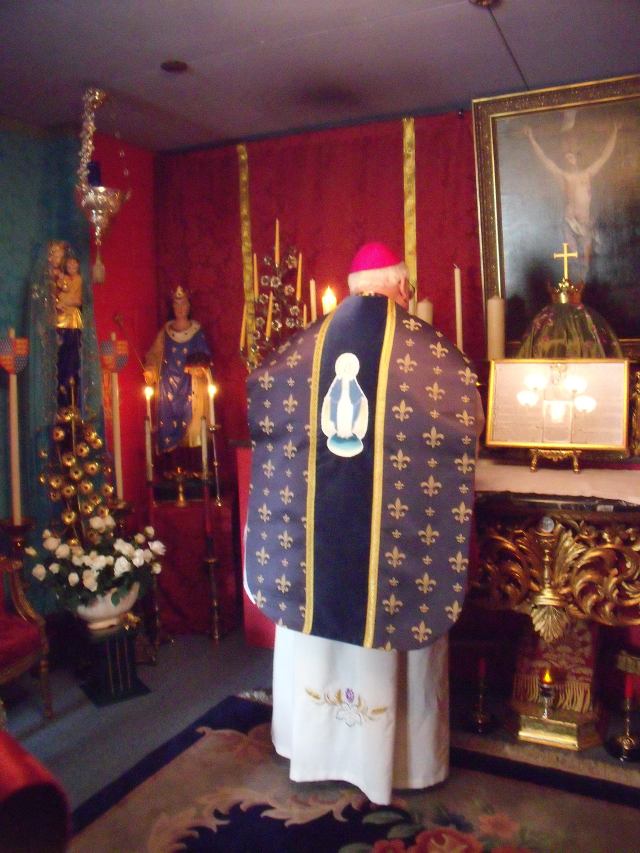
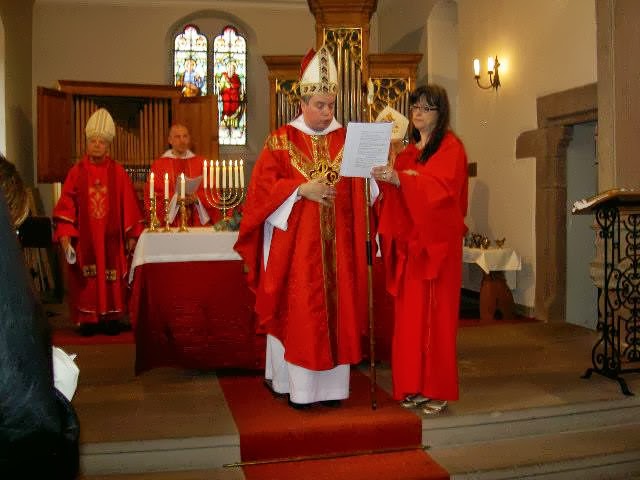
The Apostolic Mandate provided for the consecration of a bishop for the jurisdiction in the person of Canon Mgr. Raphaël Steck, who was duly consecrated on Saturday 29 June 2013 at the Eglise Luthérienne de Wolfisheim by the Most Reverend François Marie Fournier de Brescia OA assisted by other bishops (see photograph above). Mgr. Steck additionally becomes Prior of the Order of St. Columban. He has been appointed to the titular See of Hohenbourg and Honau and has taken the episcopal name of Raphaël-Magnoald.

In consequence of this, an Instrument of Intercommunion has been executed between the Order of Antioch and the Mission Gallicane d’Alsace and Bishop Raphaël-Magnoald has been admitted to membership in the Order of Antioch in the Second Class.

The connexion with the Order of St. Columban is noteworthy. The Order declined in the ninth-century after Christ and was revived by St. Tugdual I (Jean-Pierre Danyel, 1917-68), Primate of the Sainte Eglise Celtique, from whom both Bishop Raphaël-Magnoald and the Prince-Abbot are in succession, the Prince-Abbot having been ordained in an English branch of this Celtic jurisdiction.

>>Mission Gallicane d’Alsace website

Dedication Day for H.M. Omukama Chwa II Kabalega

Omukama KabalegaIt has been announced that 9 June will be the occasion for the dedication of H.M. Omukama Chwa II Kabalega of Bunyoro-Kitara as “Bunyoro Hero” by his grandson H.M. Omukama Rukirabasaija Agutamba Solomon Gafabusa Iguru I.

This is also the day on which, in 2009, H.M. Omukama Chwa II Kabalega was declared a “National Hero” of Uganda by President Musuveni of Uganda.

The anniversary of the birth of H.M. Omukama Chwa II Kabalega falls on 18 June.

H.M. Omukama Chwa II Kabalega was a key figure in the history of the Abbey-Principality of San Luigi and was responsible for bestowing the title of Mukungu upon the then-Prince-Abbot in 1885. H.M. Omukama Rukirabasaija Agutamba Solomon Gafabusa Iguru I today serves as Royal Patron of the Order of the Crown of Thorns and the Order of the Lion and the Black Cross.

The 19th Empango – the coronation celebrations of H.M. Omukama Rukirabasaija Agutamba Solomon Gafabusa Iguru I – will fall on 11 June.

The Most Revd. Juliusz Nowina-Sokolnicki

SokolnickiThe Most Revd. Juliusz Nowina-Sokolnicki (1920-2009) served as Assistant Bishop of the Apostolic Episcopal Church in Great Britain both as deputy to the late Archbishop-Count George Boyer and as bishop with special responsibilities for the Polish-speaking peoples. He was consecrated by the Most Reverend Bertil Persson, OCR, then-Primate of the Apostolic Episcopal Church, on 27 May 1983. Archbishop Persson was also the consecrator of the present Prince-Abbot of San Luigi (now also Primate of the Apostolic Episcopal Church), who from November 2008 served as Archbishop of the Apostolic Episcopal Church in Great Britain in succession to Archbishop-Count Boyer, and was thus for a few months Sokolnicki’s ecclesiastical superior.

Juliusz Nowina-Sokolnicki is best-known in his capacity as the head of one of the two entities that maintained rival claims to be the Polish government-in-exile during the 1970s and 1980s. Born in Pinsk, he completed secondary education and then took part in the September Campaign in 1939, following which he apparently made his way to Warsaw and distributed underground publications. In 1940, he was arrested by the Gestapo and imprisoned in Pawiak and then in Metz, where he was placed in a forced labour camp. Under these conditions his health deteriorated, and in 1942 he was released and returned to Warsaw, having been diagnosed with an incurable lung disease. He resumed insurgency against the Nazis and Communists as part of the shadowy organisation “Group of the Free”. In 1944, by means that are not clear, he escaped Poland and travelled through France to Italy, where he joined the Polish II Corps, an unofficial branch of the British Eighth Army.

He was demobilized in 1947 and in July 1948 settled in London. Throughout the following decade he was active in expatriate Polish associations. He was secretary of the Society for General Education, co-editor of “Bulletin of the Western Lands” from June 1950 and in 1958 founder of the Polish Association for the Defence of the Western Lands. In 1958 he became a member of the Supreme Council of the Union of Polish Eastern Territories and editor of the “Information Bulletin of the Eastern Regions of Poland.”

He was also politically active in the Polish cause. From 1951 he was involved with the Polish Independence League and with resistance to the Soviets; from this came the Struggle for Independence Convention which he founded. He was appointed to successive offices in the Polish Government-in-Exile and by 1970 had worked his way up to the position of Minister of Internal Affairs. In these years, strong alliances and animosities formed among members of the Polish diaspora, and these would become a major influence on the events of 1972. Most importantly, in 1954, President-in-Exile August Zaleski had refused to step down after the end of his seven-year term, citing the 1935 constitution and rejecting the post-war National Unity Act. The opposition to him then formed the Council of Three, which was recognized by some opposition members as a rival collective head of state for the ensuing eighteen years.

President-in-Exile Zaleski appointed Stanislaw Ostrowski as his successor in an announcement on 24 February 1971. However, in September of that year, Zaleski expressed serious misgivings on this matter to Sokolnicki. He feared that at age 80, Ostrowski was too old, and furthermore that he was too easily manipulated by opposition groups – of which the most obvious would have been the Council of Three and its followers. Zaleski asked Sokolnicki to succeed him instead, issuing him with documentation which has been the subject of fierce controversy ever since. As Zaleski had predicted, after his death on 7 April 1972, the Council of Three decided to dissolve itself and to confirm Ostrowski in office, thereby unifying the two largest Polish emigré groups.

Not unexpectedly, Sokolnicki was immediately to be denounced in the most vehement of terms by Ostrowski and his followers, but nevertheless he took up the Presidency-in-Exile undaunted, and gathered a number of supporters from among those who remained loyal to Zaleski and opposed to the Council of Three. These then formed the government of Free Poland in Exile, with Sergiusz Ursyn-Szantyr as Sokolnicki’s first Prime Minister.

Sokolnicki’s government-in-exile secured a number of successes. It was at his behest that the state governors of New Hampshire and New York initiated official memorials to the victims of the Katyn massacre. In 1986, he was initiator and co-founder of the Central European Community Council, which brought together governments-in-exile of the Communist states of Eastern Europe. Through Konstanty Zygfryd Hanff’s actions in the United States Sokolnicki maintained contact with anti-communist emigré groups there, notably “Fighting Solidarity” in the 1980s.

order of st stanislas carlton club 1998Sokolnicki also ensured that his cause became widely known through the conferral of the Orders and decorations of the Polish state, including the Order of Polonia Restituta (in which Archbishop Persson received the Grand Cordon) and the Order of St Stanislas, which he revived in 1979. The Most Revd. Prince Kermit Poling, OA, Royal Patron of the San Luigi Orders, to whom Sokolnicki was distantly related, received the Gold Cross of Merit from him in 1979. This aspect of Sokolnicki’s work was again not without its critics, not least in respect of its connexions to both corporate and personal fundraising. During the 1980s, Sokolnicki also served as a Vice-President of the London Appreciation Society, whose secretary, the late H.L. Bryant Peers, had been consecrated as a bishop of the Ancient Catholic Church in 1961.

At the fall of Communism in 1990, the Order of St. Stanislas was re-established as an international body and officially registered as a charity. Sokolnicki, whose family records stretched to over twenty generations, subsequently received the title of Prince from the head of the Hohenstaufen-Lanza family.

On 11 November 1990, in light of the upcoming Polish presidential elections, Sokolnicki issued an instrument dissolving his government-in-exile in favour of whoever would be the victorious candidate. From that point forward, he pursued a policy of absolute retirement from political activity and devoted himself to the Order of St. Stanislas. In 2009, at his last major public appearance, he attended that order’s thirtieth anniversary investiture.

>>Website containing relevant documentation (in Polish)
>>Biography by Dr. Norbert Wojtowicz at the site of the Polish Monarchist Association (in Polish)

State funeral of King Peter II

The State funeral of Their Majesties King Peter II, Queen Alexandra, Queen Maria and His Royal Highness Prince Andrej of Yugoslavia takes place at Royal Mausoleum of St. George’s Church in Oplenac near Topola, today. This event reunites members of the Royal Family who were originally buried outside their homeland during the years when Yugoslavia was under Communist rule.

H.M. King Peter II was High Protector of the Order of the Crown of Thorns from 1960 until his death in 1970; the position has been held vacant in his memory ever since. In 1962 he issued Letters Patent recognizing the title of Prince de San Luigi and bestowing the title of Marquis de Valjevo upon its then-holder, Prince-Abbot Edmond II. Prince-Abbot Edmond II was present at the funeral of King Peter in the United States in 1970. The photograph below, which is a copy made using the technology of the era, shows King Peter with Prince-Abbot Edmond II (who is wearing the insignia of the Order of the Crown of Thorns) in 1959.

King Peter II and Edmond II

>>Information from the Royal House of Serbia

The Abbey-Principality in Old Catholic and Old Roman Catholic history

catholic traditionThe Abbey-Principality of San Luigi is today, together with its sister jurisdiction the Eglise Gallicane, one of the senior bodies in the Old Catholic and Old Roman Catholic traditions that remains independent from the Union of Utrecht of the Old Catholic Churches. Founded on 25 August 1883 (some thirteen years after the formation of the Old Catholic Churches following the First Vatican Council) and with a continuous history to the present day, its first bishop (Prince-Abbot Joseph III) was consecrated by the Syrian Orthodox Church as Metropolitan of the Old Catholics in the United States on 29 May 1892.

The Abbey-Principality was in communion with the Holy See between its foundation on 25 August 1883 and 13 June 1900, and again between 1 June 1925 and 1 July 1929. It was in communion with the Syrian Orthodox Church between 7 May 1899 and circa 1929, although this was not definitively terminated until 1938. It has also been in communion with a number of other jurisdictions.

The terms Old Catholic and Old Roman Catholic have been used interchangeably to describe Old Catholicism in the United States of America and in Great Britain, referring to the position on faith defined by the 1889 Declaration of Utrecht. Prince-Abbot Joseph III described his church using both terms. Here is a letterhead from 1915 in which he refers to his office as Metropolitan and Primate of all the Americas in the Old Roman Catholic Church:

1915 ORCC letterheadNote also the postnominal “D.C.” which stands here for “Doctor Christianissimus”, one of the dignities attached to the Order of the Crown of Thorns, whose insignia can be seen pendant from the shield on the coat of arms. The original Old Catholic (or Old Roman Catholic) Church of America, which was established in 1885 under Prince-Abbot Joseph III, subsequently merged with the Apostolic Episcopal Church, in which the present Prince-Abbot serves as a bishop today.

ocrAfter he had raised Fr. Ignatius of Llanthony (Joseph Leycester Lyne, OSB, 1837-1908) to the priesthood and consecrated him as Mitred Abbot of Llanthony on 27 July 1898, Prince-Abbot Joseph III became responsible for establishing the first Old Roman Catholic episcopal hierarchy in the British Isles, when he on 14-15 March 1903 consecrated two bishops, Henry Marsh-Edwards (1866-1931) (Bishop of Caerleon; he was a former Anglican priest who for some years maintained a chapel in Bournemouth) and Henry Bernard Ventham (Dom Columba Mary OSB, 1873-1944), and assigned the latter as Bishop of Dorchester in succession to the see which had previously been held by Archbishop Frederick George Lee (1832-1902) within the Order of Corporate Reunion. Prince-Abbot Joseph III had known Lee personally, meeting with him for discussions in July 1898.

The Vilatte hierarchy were concerned with mission among Anglo-Catholics and the aim of Corporate Reunion. In addition, Ventham, who had since 1898 been a member of the OCR and previously of the Order of St Augustine under Bishop George Nugée (1819-92), had prior to his consecration made an unsuccessful attempt to form an Old Catholic Benedictine community in Liverpool, with a novice, Ambrose Thomas (1880-1959), who would later be well-known in Thaxted circles as the Marquis d’Oisy, a gifted artist. This foundered due to financial difficulties.

On 19 February 1905, Ventham together with Archbishops William Patterson Whitebrook (1871-1915) (Archbishop of Whitby; he had been consecrated by Frederick Lee and George Nugée of the OCR around 1891-92, and further in the Ferrette succession) and his brother John Cudworth Whitebrook (1873-1961) (Archbishop of Lindisfarne; he had been consecrated by Lee) formed the Society for the Restoration of Apostolic Unity, which was an attempt to revive the mission of the OCR. From 27 December 1908 (when W.P. Whitebrook exchanged consecrations with Bishop Paolo Miraglia Gulotti, who had been consecrated by Prince-Abbot Joseph III and will be discussed below), they constituted themselves as the Independent Catholic Church under J.C. Whitebrook as primate. This latter church was based at no. 5, New Court, Lincoln’s Inn, London, W.P. Whitebrook being a barrister and the church containing a high proportion of legal men. It did not survive the First World War as an active organization, though its succession was perpetuated, and W.P. Whitebrook eventually reconciled with Rome. Bishop Ventham eventually accepted the living of South Creake, Norfolk, in the Church of England in 1927, and consolidated that parish’s steadfast Anglo-Catholicism, but treated his episcopal office as paramount throughout his ministry (consecrating the Holy Oils each Maundy Thursday and publicly doubting Anglican orders). At the end, he refused the Anglican Last Sacraments.

A brief digression concerning John Cudworth Whitebrook is here in order. J.C. Whitebrook was, aside from his career as a teacher, also actively interested in genealogy, paleography and antiquarianism. He served in the First World War and taught in Paris before returning to England, where his career culminated in the headmastership of a private school. Having retired, he read for the Bar as had his brother, and was admitted to Lincoln’s Inn. He practised law until in his eighties, when failing health finally compelled a second retirement. He reconciled with Rome in 1960, a year before his death.

Abp Mathew's consecrationThe Vilatte-succession British Old Catholic mission thus predates the consecration of Arnold Harris Mathew (1852-1919) as Old Catholic Regionary Bishop of Great Britain by the bishops of the Union of Utrecht on 28 April 1908, who by that action established a second and competing Old Catholic jurisdiction in the British Isles. Archbishop Mathew withdrew from the Union of Utrecht on 29 December 1910 and became Primate of the revived Order of Corporate Reunion on 3 January 1911, which still exists today and of which the present Prince-Abbot of San Luigi is a bishop. It was at around this time that he adopted for his movement the title of “Old Roman Catholic Church of Great Britain”. At this point, too, Bishop Ventham had allied himself with his movement.

In 1915, Mathew submitted to Rome and placed the Old Roman Catholic Church of Great Britain (which was the remnant of the body founded at his consecration in 1908) under the jurisdiction of the Holy See in a document of 16 December of that year. This had followed the separation of most of his clergy to form the Liberal Catholic Church (Old Catholic) earlier in 1915.

Because Mathew could not accept the punitive terms for his reconciliation that Rome offered him, and because he had surrendered the jurisdiction he had formerly headed to Rome, he was now compelled to look to the OCR for jurisdiction as he sought to resume his ministry. On 5 March 1916 he founded a mission under the banner of the  Uniate Western Catholic Church, which had been an inner communion of the OCR and today continues as such. In March 1917, at the instigation of his co-adjutor Bernard Mary Williams (1889-1952) he established the (second) Old Roman Catholic Church of Great Britain that also continues to exist today and that has been associated with the San Luigi Orders since 1961. This latter church in 1925 adopted a Constitution that created a separation in faith between its position and that of other Old Catholic and Old Roman Catholic churches, since it involved the repudiation of the Declaration of Utrecht in order to adopt a proto-Uniate stance. Counted among the Primates of this church (between 1982-8Emilio_Federico_Rodriguez_y_Fairfield3) is the late Archbishop Emile Rodriguez y Fairfield (1912-2005) (pictured right), last archbishop of the Mexican Old Roman Catholic Church (established by Archbishop Carfora in 1926), who was a consecrator both of Prince-Abbot Edmond II and of the consecrator of Prince-Abbot Edmond III, Archbishop Bertil Persson. The Mexican Old Roman Catholic Church is among the jurisdictions to have entered into intercommunion with the Apostolic Episcopal Church as well as being recognized by the North American Old Roman Catholic Church (see later). This lineage therefore provides a full, regular and canonical descent from Archbishop Mathew to the present Prince-Abbot that is untainted by schism.

mathew and met messanaOn 25 August 1911 Archbishop Mathew had signed an Act of Union with the Syrian Orthodox Patriarchate. This act brought his church into intercommunion with the Abbey-Principality, which was at that point also in union with the Syrian Orthodox Church. Despite Anglican pressure, the Act of Union was not formally repudiated, but neither was it maintained actively by Mathew or his successors.

+paolo miraglia gulottiIn the United States, Old Catholicism had developed more extensively than in Britain, and several churches descended from the missionary work of Prince-Abbot Joseph III. One of these mostly ethnically-based bodies was the Chiesa Cattolica Nazionale Italiana, founded in 1895 by Louis Prota Giurleo Miraglia Gulotti (1852-1916). Gulotti would be consecrated by Prince-Abbot Joseph III in 1900, and he in turn exchanged consecrations with W.P. Whitebrook in 1908. He was Prelate-Commander of the Order of the Crown of Thorns for Italy. Between 1900 and 1904 he was a refugee on Corsica, and there joined an independent Old Catholic mission.

AbpCarforaCarmel Henry Carfora (1878-1958), a Roman Catholic priest (O.F.M.Cap.) had been ministering to Italian-Americans at St Anthony of Padua Church in Youngstown, Ohio. A dispute arose with the Roman hierarchy, and on 17 May 1907 he and his congregation established St Rocchus Independent National Church. Gulotti moved to New York in May 1908 to serve as suffragan to Prince-Abbot Joseph III and build up the work of the Italian missions there. By 1912 there were several such missions in New York, Ohio and West Virginia, and Gulotti and Carfora organized these as the Italian National Diocese of America, Gulotti consecrating Carfora for this new ministry on 14 June 1912. However, serious differences between Gulotti and Carfora emerged afterwards concerning financial matters. In 1915, Gulotti’s ministries came under the aegis of the newly incorporated Old Roman Catholic Church of America, known as the American Catholic Church, of which Prince-Abbot Joseph III was Primate. The ACC was a consolidation of the missions of Prince-Abbot Joseph III, whose incorporated name The Old Roman Catholic Church of America recalled its 1885 antecedent. Gulotti died on 25 June 1916.

de landas berghesAfter his breach with Gulotti, Carfora was isolated and antipathetic to the Vilatte-succession prelates. He consequently sought to make links with other sympathetic Old Catholics. He came into contact with Prince Rudolph de Landas Berghes et de Rache (1873-1920), who had been consecrated by Mathew and was licensed to function as a bishop in the Protestant Episcopal Church of America, and with Francis (William Henry) Brothers (1887-1979), who had been priested by Prince-Abbot Joseph III but subsequently deposed by him. Brothers was Abbot-Bishop of St Dunstan’s Priory, Fond-du-Lac, Wisconsin and of the Old Catholic Church in America (not connected with the 1885 foundation of the same name), a body founded in 1908 from the remnant of the Polish Old Catholic Church in America. These three prelates resolved to join together to form what was originally termed the Old Roman Catholic Western Orthodox Church in America and soon afterwards renamed the North American Old Roman Catholic Church.

It seems that the Prince de Landas Berghes had, through his special connexion with the Episcopalians, absorbed some of the false propaganda that they, and particularly Bishop Charles Grafton of Fond-du-Lac, had spread in order to attempt to discredit Prince-Abbot Joseph III, and Carfora in turn came to believe some of these falsehoods. This accounted for de Landas Berghes’ need to subject Carfora to reconsecration (his third) on 4 October 1916 at his hands and those of Brothers, whom he had consecrated the previous day. In this act, Carfora thus repudiated the episcopal orders of the Vilatte succession that he had previously received, and for that reason, clergy of the Carfora succession are not generally considered to be in the Vilatte succession. Soon, however, the triumvirate had broken up. de Landas Berghes and Carfora both denounced Brothers, who resumed his previous ministry in the Old Catholic Church in America independently on 8 January 1917 and eventually united his movement with the Russian Orthodox Church between 1962-67. At the end of his long life, he sent his support to the nascent Vilatte Guild under the present Primate of the Apostolic Episcopal Church, Archbishop Francis C. Spataro.

Carfora had been assigned as Archbishop of Canada of the NAORCC, but on 22 December 1919 he was given charge of the whole of the church when de Landas Berghes rejoined the Roman Catholic Church and retired to an Augustinian monastery. Under his pontificate, the church remained Old Catholic in its faith but was very close to the position of Rome before 1870. Carfora regarded himself as infallible and condemned the Union of Utrecht for its agreement with the Anglicans in 1931, arguing that at this point it had left the mainstream of non-Papal Catholicism. His negative remarks about other Old Catholic churches were primarily directed towards Brothers, but also increasingly came to include a number of clergy whom he had been compelled to depose from his church for disciplinary cause, most of whom proceeded to establish their own schismatic jurisdictions. Carfora built up the church through a series of ethnically-based missions, and this strategy proved successful, so that his jurisdiction was eventually both geographically widespread and with a significant lay following.

lloyd2On 19 August 1925, following a conference at Our Lady of Grace Church, Chicago, Carfora’s church entered into formal union with the American Catholic Church under Archbishop Frederic E.J. Lloyd (who would go on to establish the Order of Antioch in 1928). This was as open acknowledgement by Carfora that he now considered the Holy Orders of the Vilatte line to be valid, as well as a recognition of his own episcopal origins. The agreement created the Holy Catholic Church of America as the unification of the two jurisdictions.

>>Public announcement of the Holy Catholic Church of America

While this agreement was never repudiated, within a year of its inception it had effectively become a dead letter. However, Carfora’s NAORCC also eventually entered into intercommunion with the African Orthodox Church, another Vilatte-succession body, and during the 1960s maintained ecclesiastical relations with several jurisdictions closely related to the Abbey-Principality.

consecration of zeigerNotable among these jurisdictions was the Orthodox Catholic Patriarchate of America under Patriarch Peter Zhurawetsky (1901-94). On 1 July 1961, Patriarch Zhurawetsky assisted by Carfora’s successor as NAORCC primate, Archbishop Hubert Augustus Rogers (1887-1976) and NAORCC bishop James Hubert Rogers (1920-91; he would succeed his father as Primate in 1972), consecrated Archbishop Robert Schuyler Zeiger (1929-99). A photograph from the service is reproduced above. In the following year, Archbishop Zeiger, while still remaining in communion with Patriarch Zhurawetsky, founded a new jurisdiction, the American Orthodox Catholic Church. The Holy Orders of Archbishop Zeiger were affirmed as valid by a Roman Catholic diocesan newspaper, the Denver Catholic Register, of 26 April 1962. Archbishop Zeiger went on to consecrate both Prince-Abbot Edmond II and the consecrator of Prince-Abbot Edmond III. Through this lineage, Prince-Abbot Edmond III is today of the fourth generation of bishops in succession from Archbishop Carfora. Again, that succession is traced through a regular and canonical descent, and not through schism.

A further descent is through the North American Old Roman Catholic Church (Utrecht Succession) headquartered in California under the late Edgar Ramon Verostek (1909-94), who was recognized by Carfora as part of the NAORCC hierarchy and continued in affiliate status to that jurisdiction after Carfora’s death. Verostek consecrated Prince-Abbot Edmond II and entered into intercommunion with the Apostolic Episcopal Church.

Over the years, the Abbey-Principality has included within its administration at various points several of the Old Roman Catholic and Old Catholic jurisdictions, particularly under the former American Council of Ecumenical Churches, and has been in intercommunion and friendly relations with other churches from within this tradition. It has entered into such alliances with caution, and only after being satisfied that the jurisdiction in question is doctrinally, canonically and historically bona fide. Although generally reluctant to indulge in public controversy on such matters, believing such to be a call to the exercise of charity, the seniority of the Abbey-Principality causes it to regard with the most sceptical of eyes the tendentious claims of certain jurisdictions to a historical patrimony and primacy that is not supported by examination of the relevant facts. As Prince-Abbot Edmond II wrote on 31 October 1971, “‘quality’…is lacking in the Free Catholic movement, all too often.”

The faith of the Abbey-Principality is based upon the Declaration of Utrecht and remains that of the mainstream of Old Catholic and Old Roman Catholic belief from the outset of the movement as a reaction to the First Vatican Council. It therefore stands apart from that of the member churches of the Union of Utrecht, which have generally developed in a modernist direction and no longer conform in faith and practice to the foundational and traditional basis of Old Catholicism, and also from that of other groups that have moved away from the position of the Declaration of Utrecht. However, it nonetheless maintains some interesting historical links. For example, the consecrator of the present Prince-Abbot, Archbishop Bertil Persson, was a bishop of a member church of the Union of Utrecht (and the AnLogo_ifi_whiteglican Communion) when for several years he served as Archbishop of Europe of the Philippine Independent Catholic Church, a member jurisdiction of the Union since 1965. This means that the Holy Orders of the present Prince-Abbot also include the Philippine lineage from the Anglican Communion that is accepted by the Union of Utrecht as valid, whereas it has publicly repudiated both the Mathew and Vilatte successions.