In this paper we will address several of the works concerning the movement which we term Free Catholic, by which is meant the autocephalous sacramental churches deriving variously from opposition movements to the First Vatican Council, Orthodox missions to the West, independent Protestantism and attempts to introduce varying degrees of esotericism to Christianity. The term overlaps somewhat, but does not mean exactly the same as, the commonly-used term “independent sacramental movement” which tends to be used to describe the more progressive or liberal churches of the Free Catholic movement. There are some within Free Catholicism who do not conceive of themselves as in any respect Catholic, and thus it is – as are all generalizations – imperfect. However, it has distinguished antecedence in that it was the favoured term of Mar Georgius of Glastonbury, and we believe it has life in it yet.
The works that we will discuss cause the greatest difficulty to the scholar in this field because of the particular viewpoint, not to say bias, of the authors concerned. This should not imply that other works are not necessarily free from biases, and the author of this paper acknowledges that he is no more immune to that charge than anyone else. However, the particular nature of these works, and their prominence in discussions of these issues many decades after their publication, marks them out as of special significance and in need of particular explanation, since their bias is ultimately hostile to the existence of the Free Catholic movement and its acceptance by those who that movement seeks to serve.
Below, we shall discuss the two major works by Henry R.T. Brandreth and Peter Anson on the Free Catholic movement, the first author being a priest of the Church of England and the second a Roman Catholic layman.
These works have multiple common factors. They have been written with the explicit intention of attacking Free Catholic churches and clergy, and diminishing their credibility in the eyes of their readers. The manner of attack is more direct in Brandreth’s work than in Anson’s, largely because Brandreth’s work is the outcome of a report written for the hierarchy of the Church of England, while Anson’s work is largely satirical and written as the outcome of his extensive interest in the area, nevertheless with a distinct ultramontane Roman Catholic viewpoint in evidence.
Brandreth and Anson have not gone unanswered – and indeed have met with eloquent ripostes from within our movement, such as Mar Georgius’s “Episcopi in Ecclesia Dei and Father Brandreth” – but those ripostes, because they have lacked the necessary backing of publishers and institutions with the requisite financial means and establishment connexions, have generally been little-noticed and have soon fallen out of print. This means that the access that present-day enquirers have to our history is sorely compromised by the over-prominence of these two hostile works from many decades past. At times, it is as if one were trying to learn about the American Civil Rights movement with access only to the opinions of the Ku Klux Klan.
In recent years, both of these works have been returned to print (following long unavailability) in the United States by Apocryphile Press, Brandreth also initially in 1987 in a reprint by the St Willibrord Press. While this renewed availability has certainly provided a service to scholars, it has also brought with it certain problems with regard to the external and internal perception of the Free Catholic movement.
We will therefore discuss these works in turn, adding meanwhile an interpolated commentary on another commentator who was much influenced by Brandreth and whose work at the time was seen as continuing that particular line of attack.
“Episcopi Vagantes and the Anglican Church” (1947, 1961) by Henry R.T. Brandreth
Henry Reynaud Turner Brandreth (1914-84) was an Anglican priest and the last in the line of a wealthy landowning family. His grandfather was Lord of the Manor of Houghton Regis, and had his seat at Houghton Hall, which was built by his ancestors in 1700. However, at his death, Houghton Hall was sold off, and Brandreth, who was the only child of a younger son of the family, was placed in the position of many aristocrats in the wake of the First World War – aware of their considerable past glories, but without the means of recapturing the style to which they had once believed themselves entitled.
In line with the practice of many members of cadet branches of noble families in those days, Brandreth was prepared for the ministry of the Church of England. Before seeking ordination, he was secretary of the Seven Year Association, which was aimed at preparations for a 1940 sequel to the 1933 Centenary Congress.
He graduated from Lincoln Theological College in 1940 and was ordained deacon in 1942 and priest in 1943. In 1945, he left St Ives, where he had been curate, to take on his second curacy at St Barnabas, Wood End, Northolt, London, which he held until 1949. In that year he moved to Paris where he was Chaplain of St George’s Anglican Church until his return to London in 1965, when he became Vicar of St Saviour, Aberdeen Park, Highbury, until his retirement in 1982. He was Guild Vicar of St Dunstan-in-the-West between 1970 and 1976 and was Priest-in-charge there between 1976 and 1978. Between 1970 and 1974 he served by invitation as Associate Secretary of the Church of England’s Council on Foreign Relations. He was a member of the Oratory of the Good Shepherd, an Anglo-Catholic dispersed religious society of unmarried priests and laymen living according to a common rule.
Brandreth was a relatively inexperienced curate when he was charged with the mission to investigate and prepare a report on the various Free Catholic churches by senior members of the Anglican hierarchy. Brandreth had certainly had an active interest in these matters since the mid-1930s, but as one who doubtless wished to gain favour, he was most likely proof of the adage that those who commission reports usually have a good idea of their preferred conclusions in advance, and seek authors who will provide them accordingly. Brandreth was likely to be only too willing to prove his worth to his masters, and as a staunch Anglo-Catholic he was not one to need any great persuasion that those he described must be discredited as a threat to Anglican good order.
Fr. Gregory Tillett of the Coptic Orthodox Patriarchate has suggested the Anglican motivation for such a work,
“Brandreth’s book is further flawed by an enthusiastic and bitter hostility towards any Orthodox “invasion” of the West, and needs to be understood in the historical context of desperate, but ultimately unsuccessful, attempts by the Anglican authorities (in which Brandreth was involved) to gain approval from the Orthodox Churches as some sort of British equivalent to the Orthodox national churches. This necessitated the preservation of the ethnic mission model of Orthodoxy in the West, and opposition to any alternatives.”[i]
This political context meant that Brandreth was particularly vehemently opposed to those churches that claimed to represent a Western Orthodoxy. This of course included principally the Catholicate of the West, but also such sincere and genuine figures as Ulric Vernon Herford of whom Brandreth falsely claimed that there was no evidence he was ever consecrated.[ii]
The first edition of Brandreth’s book contained a preface by Canon John A. Douglas, Secretary of the Church of England Council on Foreign Relations, who had been active in a mendacious campaign against the clergy of the Vilatte succession during the 1930s[iii]. Douglas’s tactics were not dissimilar to those which Brandreth adopted in his approach to the subject. Although Brandreth was from time to time sufficiently humane to admit some of his subjects to be sincere men, he was inevitably motivated towards a conclusion that would find the Holy Orders of all those he described to be invalid, and, in a bizarre twist of logic, even if they were valid, that those prelates in question would be wrong to exercise them, save for the conferral of Holy Orders!
Bishop Timothy Cravens[iv] describes the result as,
“This scurrilous work by a vicious gossipmonger and Anglican priest (I pity the parishes under his pastoral care) contains vicious attacks on our early forebears in the independent sacramental movement (which is not to say that many were not at least a couple of sandwiches short of a picnic[v]), and the attacks reveal a lot about the author’s character. Many of his theological opinions for doubting the validity of independent orders could be used equally well to invalidate his own Anglican orders.”[vi]
This, of course, is the nineteenth-century debate on Anglican validity all over again – “Apostolicae Curae” versus “Saepius Officio”[vii] – and Brandreth’s work suggests that since he has to protest so loudly and so frequently, he is suffering from more than a little insecurity on that point.
Brandreth did manage to collect together a great deal of useful information, being permitted full run of the archives of Lambeth Palace, and it is in the comparative difficulty of obtaining the information that he includes from less partisan sources that Brandreth’s work has continued to have significant value. We should note, however, that some of the information he offers as fact is inaccurate, and much that is presented is intended to discredit its subjects, such that it is often difficult to distinguish facts from opinions that are disguised as facts. The various negative psychological speculations that characterise the work often amount to no more than character assassination, and are of no value given the open hostility of the author to the subjects in question.
Fr. Chris Tessone[viii] describes the work as “biased, often uncharitable, and openly racist in several places. Fr. Brandreth did very little to discern what spiritual good may have come to the church catholic as a result of independent bishops.”[ix]
Had Brandreth not written as he did, and had he not echoed the prevailing tone of Anglican hostility in both thought and deed, it is very possible that the Free Catholic movement would have developed in England more along the lines that it eventually did in the United States, where the absence of an Established Church allowed some communities to put down lasting roots. It was Anglican opposition that was the leading factor in pushing Free Catholic ministry to the margins in England, and it has only been a combination of the Church of England’s decline in Establishment influence and the more enlightened attitude of some of its members that has meant that the Free Catholic movement has been able to gain more of a firm foothold in recent times.
Brandreth’s first edition, published in 1947, brought forth a storm of protest from its subjects. The publishers, doubtless wary of lawsuits, recalled the books and reissued them with some of the names therein covered with small pasted-in pieces of paper bearing the typescript “The author and publishers are assured that the statements in the paragraph beneath this slip are inaccurate in detail.” For this reason it is particularly unfortunate that when reprinting Brandreth’s work in recent years, Apocryphile Press chose this factually flawed 1947 first edition over the 1961 second edition, which was extensively corrected.
The response to Brandreth’s first edition revealed the qualities of character of many of those he had traduced, who wrote to him at great length and with great patience, pointing out exactly in what places he had erred and hoping that he would recognise these mistakes and correct them properly, and indeed apologise where he had maligned the innocent. For even Brandreth had advised,
“if an individual bishop or priest of one of these succession were a man of upright life, genuinely convinced of the rightness of his position, anomalous though it must be by Anglican standards, it would clearly be wrong for the Anglican Church to place herself in the position of a persecutor.”[x]
Doubtless those clergy who corresponded with Brandreth regarded it as natural that they should assume good faith in a fellow man of the cloth, and that he would approach the issue as a fair-minded discussion between scholars of that field concerned for Truth above all. Although in a number of cases this correspondence seems to have thrown up some additional information which Brandreth proceeded to use in due course, the second edition of his book in 1961 is motivated by exactly the same ill-natured intent as the first, and shows that his heart was hardened against any argument that would deflect him from his overtly political purpose.
We see Herman Philippus Abbinga (1894-1968), sometime a bishop of the Apostolic Episcopal Church and the Catholicate of the West, writing to Brandreth on 19 November 1962,
“But dead men can’t protest, neither those bishops who are living in far-off countries, which makes it difficult or even impossible to sue you. In many letters, Bp. Brooks[xi] wrote that he could not obtain a copy [of your book] through a bookseller, for in the USA this person is responsible – together with the publisher and the author – for selling and/or publishing lies and slander, etc. about persons. So I understood he was going to sue you through a bookseller. He died too soon for doing so in 1948, and not in 1950 as you published. Over more than 25 years you could have inspected his papers, as I wrote to you in my last letter, but you didn’t.”
Later in the same letter, Abbinga hits the nail securely on the head,
“Would you deny that you are not ambitious yourself? By writing your book “E.V.” you became a clergyman of “world fame”. Without it you would have been just an unknown pastor somewhere, without any chance for an Anglican bishopry. Would you deny that you have not been “daydreaming” along such lines of becoming a bishop?”
By one of those little ironies that we will see recur shortly, there is a persistent rumour – and not merely among Free Catholic clergy – that Brandreth was actually secretly consecrated for the Order of Corporate Reunion[xii]. If true, this would have satisfied any doubts he may have entertained as to the validity of his Anglican orders. It would also have proved that many who chronicle this movement from an external perspective are torn between a complex mixture of derision, envy and admiration for its subjects. This manifests as a wish at once to stand outside the Free Catholic movement so as not to share in its external opprobrium, and to be within it so as to share its considerable spiritual richness.
In private, rather than in his books, some found Brandreth to be a more sympathetic figure than outward appearances might have suggested. Bertil Persson, formerly Primate of the Apostolic Episcopal Church, enjoyed a productive scholarly correspondence with him during the 1970s, such that Brandreth suggested in 1975 that Persson should continue his work on the independent bishops through the authorship of a number of studies of particular figures and churches, which he proceeded to do.
Writings of F. H. Amphlett Micklewright
Before we come to discuss the other major book hostile to the Free Catholic movement, we should mention another author who, although he never produced a book on the subject, was an active writer of articles.
Frederick Henry Amphlett Micklewright (1908-92)[xiii] studied theology and history at St Peter’s Hall, Oxford (MA), whence he proceeded to Ripon Hall and ordination for the Anglican ministry in Manchester Cathedral.
Having served in northern parishes[xiv], Micklewright then left the Church of England and joined the Unitarians. During the 1930s he came into contact with the independent bishop Ulric Vernon Herford (1866-1938), who had also been a Unitarian before his consecration by a bishop of the Syro-Chaldean Church, and for whom Micklewright expressed some degree of support. From 1941-49 Micklewright served as a Unitarian minister, firstly in Southampton, and from 1943 in charge of Manchester’s Cross Street chapel. At the same time he was a Labour Party councillor for the Cheetham ward and attracted controversy for his political views. He also lectured for the Workers’ Educational Association during the Second World War. At some point he became a Fellow of the Royal Historical Society and of the Society of Antiquaries of Scotland.
Micklewright was a convinced supporter of the Soviet Union, and a November 1937 article found him describing that regime in extraordinary terms as “the most Christian of countries” and later defending the treatment of Trotsky as an internal Soviet problem.[xv] Micklewright also supported the Fenian cause in Ireland; 1949 found him sharing a platform with Eamonn de Valera at a public meeting in Manchester, and he wrote for the “Irish Democrat”, the journal of the Connolly Association, which was then edited by Irish Marxist C. Desmond Greaves.[xvi]
These were not mainstream perspectives even within the academic Left of those times. Micklewright was indeed a fully-fledged Marxist, and as such was a convinced republican. He did, however, have a common bond with more mainstream Left-wingers in that he was a constitutionalist anarchist, a perspective that made him appear (and not merely at first sight) to be distinctly conservative on a number of issues.
In 1949 Micklewright rejoined the Anglican priesthood, being appointed priest in charge of St Mary’s, Dewsbury, in Yorkshire. He also became a priest-companion of the Community of the Resurrection, Mirfield.[xvii] He continued his political activity, and a report of a meeting of the Church Unity Octave Council at the Caxton Hall in 1951 records that “there was uproar when the Rev. F.H. Amphlett Micklewright, of Dewsbury, began to speak. A woman standing at the back of the hall began chanting “Papists, Papists, Papists” and was then ejected. Earlier in the meeting, a man in the audience had stood up and declared, before himself being ejected, “I protest against this meeting because it is an attempt to destroy the soul of England and the English church…This is the sort of thing that brings the judgment of God upon a nation.”[xviii] October 6 of the same year found him speaking at the World Day for Animals at the Milton Hall, Manchester as he had done in previous years; he was a devoted cat lover and anti-vivisectionist. He also continued his work for Irish republicanism[xix].
In November 1951, Micklewright became rector of All Saints’ Ennismore Gardens, in Kensington, which is now the cathedral of the Russian Orthodox Church. By 1961, he had left the Church of England, apparently under something of a cloud. The following years found him living with his wife in Norwood, south London, in a house called – for reasons upon which one can only speculate – “Bishop’s Folly”[xx]. Here he turned to atheism and was active in the National Secular Society and as a writer for the Rationalist Press Association. His writings at this time displayed a very strong anti-Catholic viewpoint, having turned full circle from his earlier persuasions.
Micklewright’s major works included “Catholicism, and the need for Revolution” (1937), “The New Orthodoxy” (1943), and “Rationalism and Culture” (1944), but it was as a writer for journals that he became best-known, with innumerable articles to his credit. He contributed to “Notes and Queries”, “Law & Justice”, “Transactions of the Unitarian Historical Society” and similar publications. Although some nicknamed him “Pamphlet Micklewright”, he in fact wrote no pamphlets, merely articles.
In the years following his departure from the ministry, Micklewright turned to writing in earnest, while earning his living as a history teacher for the Inner London Education Authority. He also read for the Bar, and gained the degree of Doctor of Philosophy of the University of London with a thesis on Doctors’ Commons. In 1974, in what was again a complete volte face from his previous position, he was accepted into the Roman Catholic Church as a layman. His relations with the Church of England, previously strained to breaking point, apparently mellowed somewhat in his last years.
Micklewright always seems to have been something of an outsider, and perhaps not unlike Peter Anson, who we shall discuss next in turn, was constantly in search of spiritual stability and direction. Equally, as will be seen, his enthusiasms most likely made him difficult company within the organisations he chose to work within. His articles tended to be written from a standpoint of polemical attack, and the objects of his ire included Anglican orders, the Conservative government, and indeed the Free Catholics. It is hard to tell what he really believed, and those whom he today counted as his fellows were as likely as any others to be counted among his foes tomorrow.
It should come as no surprise, then, that Micklewright’s reaction to the dedicated anti-Communist Mar Georgius of Glastonbury and his essentially traditionalist, conservative movement in the Catholicate of the West would be one of violent antipathy, and indeed the only perspective the two men would have seemed to have shared was that of resolute pacifism in the face of the Second World War.
There was another reason for this antipathy, too. In 1946, Micklewright had contributed an article to “The Occult Review”[xxi] in which he praised the occultist Aleister Crowley. Crowley, then living in obscurity and nearing the end of his days, responded with delight, “What we want above all is to be taken seriously by serious people.” Mar Georgius had corresponded with Crowley during the preceding period, seeking to receive authority from him, but had been unsuccessful. We shall probably never know whether that outcome was in any way due to Micklewright’s intervention.
Micklewright attacked the Free Catholic movement in a series of articles in “The Pilot”[xxii], the journal of the Society for Promoting Catholic Unity. This body was an Anglo-Papalist (and not merely Anglo-Catholic) organisation that was also the promoter of the Church Unity Octave Council whose 1951 meeting caused such uproar. Understandably, it was deeply hostile to the Free Catholics, seeing them as a threat to their aim of union with Rome. The titles of Micklewright’s articles tell their own Brandreth-led story: “Ecclesia in Partibus” (Summer 1951), “A Chapter of Vagrant Episcopacy” (Autumn 1951), “The Vilatte Succession” (Winter 1951), “Episcopacy and Reunion” (Summer 1952), “Vagrants Still” (Spring 1955), “Some Orders of Corporate Reunion” (Summer 1955) and so onwards. The Revd. Kenneth Leech says kindly of Micklewright’s work on these matters that it was “more journalistic than academic”[xxiii]. Others might simply call Micklewright a purveyor of scurrilous gossip without regard for its truth. Equally, we must not judge him too harshly, for as Leech says, he was after all “a contradictory and confused figure”. Mar Georgius responded in detail to Micklewright’s attacks, showing them to be factually incorrect as well as polemical, in several lengthy articles in Hieratica, the journal for the clergy of the Catholicate of the West. That of January 1952 (Vol. 2 no. 1, p.3) is memorably titled “Micklewright – The Man with the Muck-Rake”.
Perhaps an appropriate assessment is offered by the anarchist and atheist Nicolas Walter (sometime vice-president of the National Secular Society) in his letter to “The Guardian”, in which he says of Micklewright, “He was known as “Pamphlet Micklewright” because of his propensity for producing a pamphlet on the slightest pretext. He was also known as such an extreme anti-Catholic that he embarrassed even the hard-bitten militants of the National Secular Society with his virulence [William McIlroy, editor of The Freethinker, writes separately, quoting one of Micklewright’s articles: “Individual Catholics…are usually to be distinguished by their tight-lipped bigotry and their ignorant arrogance…John Bull made a bad mistake when, in 1829, he passed the Catholic Emancipation Act.] Micklewright was known as a great collector of books, including other people’s. He had sneered at people who took refuge in Holy Mother Church as they approached old age; when he did so himself, his departure was greeted by most freethinkers with a sigh of relief as well as a burst of laughter.”[xxiv]
“Bishops at Large” (1964) by Peter Anson
Anson’s book is dedicated to Brandreth, and is largely a continuation and expansion of its approach, with a great deal of ancillary detail concerning its subject-matter.
Peter Anson’s biography is recorded in “Peter Anson: Monk, Writer and Artist, An Introduction to his Life and Work” by Michael Yelton (Anglo-Catholic History Society, London, 2005), a work which does a great deal to illuminate the hitherto-obscure life of its subject and which is the principal source for the outline which follows. He was born in 1889 as Frederick Charles Anson, later adopting the name Peter in religion, and had a significant number of Anglican clergy among his near relations. His father was eventually a Rear-Admiral in the Royal Navy who became Superintendent of the Chatham Dockyard. His health prevented entry to school, and he was educated by a succession of private tutors. He tried on two occasions to enter Christ Church, Oxford, but failed to satisfy the examiners.
Yelton writes, “The whole of Anson’s life was marked by a restless spirit which left him unable to settle for too long in one place, and, particularly in his later years, led to him moving from place to place without any great warning or forethought. It was that characteristic, together with a variety of undefined ailments, some of mental rather than physical origin, which led to the failure of his many attempts to adopt a monastic way of life.”[xxv]
Anson as a young man spent two years studying to become an architect at the Architectural Association School in London’s Tufton Street. His attention was more drawn to the life of the Church, however, and for about a year in 1908-09 he was an enthusiastic member of the congregation of Percy Dearmer at St Mary, Primrose Hill. This church, however, did not merit his exclusive allegiance, and he also “sampled” most of the other High Church Anglican places of worship in London.
Anson discovered a life of Father Ignatius of Llanthony (who had been priested by Mar Timotheos (Vilatte)) in a library and was fired with enthusiasm to enter a monastic community. In his second year at the AA he had frequent contact with the Cowley Fathers, and later looked back on that time as “perhaps the happiest period of my youth”.
In 1910, he abandoned thoughts of an architectural career and tested his vocation with the Benedictines on Caldey Island under Abbot Aelred Carlyle. He was given the name in religion of Richard, after Whyting, the last martyred abbot of Glastonbury. He made his simple profession on 18 December 1911.
At this time, both Anson and a number of his fellow monks were convinced supporters of Corporate Reunion, and on 5 March 1913 twenty monks of Caldey, including Anson, joined the Roman Catholic Church.
This began a period of instability for Anson. Three weeks later, he left Caldey for Parkminster, convinced that he must try his vocation as a Carthusian. Four weeks on, he was back with the Benedictines. His mental state was a concern, and Yelton suggests that he may have been suffering from “a form of depression, but it is perhaps unwise to probe further.”
By January 1914, Anson was six months into his second novitiate, and was causing grave concern to his superiors on account of his instability. They ordered that he have a complete change of circumstances, and accordingly he set off on a tour of Llanthony, Belmont Abbey, Stanbrook, and Milford Haven before returning to Caldey after seven months away. He had expected to make his profession that October, but the Abbot was so concerned by his health that he ordered that this be postponed.
In the following nine months, Anson was subjected to psychoanalysis, the result of which was again the recommendation of a complete change of circumstances. He decided to apply to other monastic houses, and went on trial to Farnborough Abbey, but after three months was told by the Abbot that he lacked the necessary interior stability for any form of monastic life. He applied to return to Caldey, and surprisingly was accepted on condition that he begin his novitiate ab initio. Ten weeks on, it was clear that this was a complete failure; the view of the monastery was that Anson’s vocation definitely did not lie with them, and he went to live with his grandmother in Portsmouth for the following four months.
It is testament to the character of Dom Aelred Carlyle – a character which Anson would most unfairly malign in his uncharitable biography “Abbot Extraordinary” (1958) – that he was prepared to listen to Anson when at the end of this period, and having meantime taken much inspiration from St Ignatius Loyola, Anson once more applied to him in order to return to Caldey. Carlyle accepted him as an oblate brother only, which meant he was not under vows and could come and go as he pleased, and appointed him librarian. Anson would hold this post and some other duties for the next eight years, though with certain long absences; Yelton says that these “may perhaps have been something of a relief to the other residents, because it is apparent that Anson was never an easy man with whom to live in close proximity.[xxvi]” Thus he had been given a gift of great generosity, and a means to anchor his life in work of genuine usefulness. Doubtless had he shown greater stability, he might have been able to progress to the novitiate again, or find fulfilment in the status of a valued lay brother. But this was not to be.
A further bout of ill-health in 1919 resulted in Anson forming “a violent desire” to go to Scotland, and for about two years, though still ostensibly connected with Caldey, he based himself at the Benedictine monastery at Fort Augustus. While there, in 1920, he promoted an “Apostleship of the Sea” as a united mission to seafarers. This project foundered when he was once again overcome by ill-health, and he sought refuge in painting and in drifting around the ports talking with the seafarers.
Anson next went to the Scots College at Rome for two months, and Pope Pius XI personally commended him for the work of the Apostleship. The Rector of the College, Donald Mackintosh (1877-1943) had just been appointed as Archbishop of Glasgow, and promised Anson that he would organise his ordination as a secular priest with responsibility for seafarers. However, when subsequent investigation revealed Anson’s mental instability, as well as his lack of any substantial tertiary education, this plan was quietly dropped. He returned to Rome in 1923 and seems to have led a vagrant life; according to Yelton, “the autobiographies detail all the hospitality given to Anson in various places and by various people without any indication of whether he paid for his keep, or indeed, how he paid for all the travel involved. It may be that he was on occasion less welcome as a guest than he thought.”[xxvii]
Anson returned to Caldey, from which he had long been absent, at Easter 1923, but could not stay for long and wandered off again to the Belgian Benedictines at Saint-André. They were not enthusiastic about his prospects as a secular priest, and so in September he went to stay with at Quarr Abbey on the Isle of Wight. The following June, Carlyle’s successor as Abbot, Dom Wilfred Upson, determined that Anson’s by-now nominal connection with Caldey should come to an end.
In 1924, Anson suffered a further mental breakdown and resigned as Secretary to the Apostleship of the Sea. He now went to Tuscany and embarked on a career as an artist, a field in which he was a highly talented, skilled and prolific practitioner. His draughtsmanship in particular was distinctive in style and bears the mark of the Englishness of its time. His illustrations often appeared in the Catholic journal “The Universe”.
By the autumn of that year, fortified by a visit to Assisi and convinced that his error had merely been to have sought to conform to the Benedictine rule, when his vocation truly lay with the Franciscans, Anson had decided that he wanted to be a Franciscan tertiary, and on 2 October 1924 was admitted as such with the religious name of Peter. He spent the years 1924-27 among the friaries of Italy and on that basis wrote his first book, “The Pilgrim’s Guide to Franciscan Italy” (1927). On 10 October he was admitted as a Regular Tertiary, residing permanently at the friary of San Damiano in Assisi. Ten days later, the Father Provincial, who seems to have known little of Anson’s previous history, suggested to him that he enter the novitiate in the Province of Santa Chiara and prepare for the priesthood. Anson accepted, though expressing some reservations about his suitability on account of his health, and joined other aspirants at a friary in Umbria.
Unfortunately, Anson found that he could not abide the cold nights in Umbria, which is high above sea level, and had abandoned his plans by Christmas of that year. He resumed his wanderings from monastic house to monastic house, and even stayed with Dom Aelred Carlyle, who was by then a secular priest working in Vancouver.
Anson was now thirty-eight years old, and without job, prospects or clear vocation. He had run short of money and his father agreed to pay him an allowance to keep him from dire poverty; it would be some time before he was able to support himself in any fashion.
He worked at his painting, and enjoyed some success in that regard, but was always travelling abroad, both in Europe and in Palestine. He wrote several books on the fishing communities, and based himself at Gravesend, then at Northfleet. In 1933 he decided to buy a gipsy caravan and tour Britain in something of a vagabond manner, perhaps inspired by H.V. Morton’s “In Search of England” (1927) and contemporaneously with J.B. Priestley’s “English Journey” which was also undertaken in 1933 with the consequent book published the following year. The result was Anson’s book “The Caravan Pilgrim” (1938) which followed an account of the earlier part of the voyage published by his travelling companion Anthony Rowe.
In 1934, Anson moved to Walsingham, where he established himself as a convinced opponent of Anglo-Catholicism and attacked the Anglican community under Fr. Hope Patten. In later years, his feelings towards the Anglicans would mellow considerably. He moved in 1936 to Scotland, to Portsoy and then to Banff, finally arriving in Macduff. Again, he wished to be near the fishermen for whom he felt a close affinity.
Yelton writes, “There is no doubt that Peter Anson enjoyed the company of young men, especially fishermen and sailors. Equally there is no trace in his writings of any heterosexual feelings: that does not mean that it is appropriate to draw the conclusion that he was homosexual in his leanings and certainly not overtly so.”[xxviii]
During the war years, Anson continued painting and writing, publishing two volumes of memoirs and, in the United States, “Churches, Their Plan and Furnishing” (1948) which would later be developed as “Fashions in Church Furnishings 1840-1940” (1960) which many rightly regard as his best work.
In 1952, Anson resumed his life of wandering restlessness, leaving Macduff in 1958 and living for a short, unsuccessful, period in the grounds of Ramsgate Abbey. In 1960 he returned to Portsoy, then moving to Montrose and then the village of Ferryden in 1963. He was at this time enjoying a productive period as a writer, and in 1964 published no fewer than four books. One of these was “Bishops at Large”. In 1966, in recognition of his literary output, he was appointed a Knight of the Order of St Gregory by Pope Paul VI.
In a move that arguably brought his life full circle, Anson returned to Caldey in 1970, where the monastery was now occupied by the Cistercians. They accorded him the status of choir-oblate and he continued his writing there. However, he became infirm and moved to Sancta Maria Abbey at Nunraw, and in his final illness to hospital in Edinburgh.
Yelton records that in preparing “Bishops at Large”, Anson was much assisted by Brandreth, whom he visited in Paris and to whose extensive archives he was given access. Mar Georgius also supplied Anson with a great deal of material concerning his own church and its predecessors, hoping that this would lead to an account that was at a minimum factually correct. Perhaps this explains Yelton’s finding that “as with a number of his books, there is an element of reproduction of material obtained from other sources without independent investigation.”[xxix]
Anson’s difficulties in addressing his subject-matter are considerable. One of the main problems stems from his own instability; an inability to provide a fair and reasoned judgement of the character of those whom he describes. Anson magnifies minor faults and eccentricities to an extent that sensationalises his subjects; it also contributes to an overall lack of perspective.
That lack of perspective is a severe failing; Anson becomes mired in a style that is shallow, brittle and gossipy, and that rarely takes its subjects (or itself) seriously. While satire has its place, and some of Anson’s passages certainly manage to be both striking and funny, the over-extension of such a tone to some 593 pages far outstays any welcome it might have initially enjoyed. In this aspect, one has some idea of why Anson may have been such a difficult person to deal with, and why for much of his life he was unable to form close friendships. He shows an inability to treat serious matters with seriousness, whatever his conclusions on them, and cannot tie his descriptions into any form of coherent commentary or overall argument. The book is, for all its volume and detail, little more than a series of unconnected vignettes with no sense of their wider context. One recalls Brandreth’s admonition regarding the “light-hearted trafficking in holy things” and cannot help but apply this description squarely to Anson.
What Anson singularly fails to grasp is the pivotal role men like Arnold Harris Mathew played in the ecclesiology of their time. One might ask exactly what motivation Anson ascribed to the many Anglican clergy who sought Mathew and the other Order of Corporate Reunion bishops out in order to validate their Holy Orders. These were not ignorant men embarked upon some trivial errand, but experienced and educated priests engaged upon an enterprise that went to the very heart of their vocation and their service to God. If they saw in Mathew someone who could give them the Apostolic validity they lacked, then they saw him as the channel of something of immense value and seriousness. Anson as a Roman Catholic should have understood this from instinct, but his comprehension of the issues at hand is too lax and too centred upon mere sensationalism and the discussion of personalities to appreciate their wider significance.
It is perhaps right that we should recall Anson’s circumstances as he wrote. He was short of money; his income was never certain, and writing and artwork were its only progenitors. A publisher would have regarded a gossipy and journalistic account as having considerably greater commercial potential than a sober or scholarly treatment of its subject. If Anson succumbed to such temptations, he would hardly have been the first to do so. Yet it is difficult to escape the conclusion, on knowing the course of his life and its preoccupations, that Anson sought to identify with many of those he described by reducing them to his own level.
We have already noted the odd stance of Brandreth, with seemingly one foot in and one foot out of the movement he describes with such disdain. Now we must unfortunately record that Anson, in the wake of the publication of his book, began to style himself “the Abbot of Ferryden” in his correspondence. If he was joking, then it is a good sign of his inability to know when such humour was appropriate. If this was a form of ultimate wish-fulfilment, then its absurdity speaks for itself.
It is difficult to read the life of Anson without being moved by sympathy for its sad rootlessness; its quest for a fulfilment that was ultimately an issue of what was inside him and his relationship both to God and to his God-given nature, rather than that of any conformity to the external rule of a particular community. Thus it was that he sought faith, but found only religion. Undoubtedly his talent was expressed in his writings and his artistic work, and it is perhaps the latter which forms his most enduring epitaph. Yet even here, the prevailing style is strictly representational, rather than aiming at transcendance.
The term episcopi vagantes
The phrase “episcopi vagantes” means “wandering bishops” – referring to those in ancient times who had not been tied to a particular diocese, and in itself was formerly merely a descriptive, not a pejorative term.
It was most likely Brandreth who was the first to apply this term to the Free Catholics. Yet, with the possible exception of Vilatte, few of those he described wandered much in their ecclesiastical careers. Ferrette’s period of travelling was after his retirement as a bishop. Arnold Harris Mathew and the British Patriarchs moved around no more than any clergyman would have normally done at that period. Mar Georgius lived his entire life in suburban domesticity in London and Doncaster. If the reference is taken on the other hand to mean wandering, that is to say moving, from one church to another, then it could as easily have been directed at the many members of the Anglican churches who have crossed the Tiber, and not a few who have gone the other way.
No, to understand why this particular term was used by the Anglicans, we should recognise that it was close in its intended effect – but not close enough to provoke a lawsuit – to the word vagabundi (vagabonds) which had been used in recent correspondence on the matter between the Old Catholics of the Utrecht Union and the Archbishop of Canterbury[xxx].
Thus when a member of another church uses this phrase of a bishop of the Free Catholic movement today, he does so as a calculated insult, and with as offensive an effect as if he were to use one of the many coarse terms common to anti-Semitism against a person of the Jewish faith. Having begun as a term of description, episcopi vagantes has become a term of hatred and oppression, and for supposedly neutral institutions such as libraries and institutes to continue to use it in describing the Free Catholics is reprehensible.
Notwithstanding this, rather as various racial epithets have been “reclaimed” by the Black community, there are some bishops who have sought to reclaim the term “episcopus vagans” in the modern era. Terms are only of value, however, when they are genuinely descriptive and thus serve a real purpose. Most Free Catholic bishops are people of modest means (though a few over the years have been wealthy); some have lived in poverty through choice or necessity. None, at least to the knowledge of this author, has lived, as Peter Anson once did, as a travelling vagabond in a gipsy caravan, but even were we to see a generation of beggar-bishops (and that would be no bad thing), they would still deserve the dignity of their God-given office and calling as Episcopi in Ecclesia Dei, something which the insult that is applied to them seeks merely to denigrate.
The search for an appropriate collective term is discussed at length in the preface to Bain, Persson, Ward (pp xiii-xiv)[xxxi]. We have outlined our preference for the term “Free Catholic” as the most inclusive available. It is also possible in time that the term “Independent Sacramental Movement” will become less centred on the progressive churches and more acceptable to the conservative churches. Neither term is pejorative, and both deserve wider adoption.
Brandreth and Anson in retrospect and conclusion
It would be an exaggeration to attribute to these two works the entirety of the inhibiting effects that have affected the acceptance and reception of the Free Catholic movement in their wake; much of this is due to wider issues of relations with the mainstream churches which those writers simply echo, record and describe, together with the relative lack of money and numerical support for the Free Catholic cause. However, those who would do down the Free Catholic movement have not hesitated to use Brandreth and Anson as their weapons of choice. Indeed, at one point it appeared that those two books were unofficially included on the prescribed reading lists of certain theological colleges and seminaries, and they account for all that many of that generation of clergy either know or wish to know about the movement in question. Again, the re-publication of these works in the modern era, without the parallel provision of a proper critical context for their understanding, distorts the understanding of the history of the Free Catholic movement as much for those inside it as for those outside it. This paper is a minor attempt to bridge that gap.
It is undeniably difficult for those whose ministry and ecclesiology is based on connexion with a church whose standing is based at least in part upon its role within the establishment, its extensive portfolio of property and monetary wealth, and indeed its inculcation into the very warp and weft of what it is to be English, to understand those whose calling is to a ministry that, while it may share common roots, and certainly is in no way any less the product of the culture, people and places of its times, in practice has little in common with a conventional parish-based ministry, and calls upon a wider range of individuals whose social and educational backgrounds do not invariably conform to the expectations of a church establishment.
We must recall that one of the chief issues raised by Brandreth in his objections to the Free Catholics was that the men they chose for ordination were not invariably of significant education, nor had been prepared adequately for ordination. This was written at a time when bishops of the Church of England would invariably be chosen from the ranks of those who had received a public school education. Yet no denomination, and no hierarchy, can claim a monopoly on the discernment of God’s call to humankind. When remembering some of the criticisms of the Free Catholics by the Anglican hierarchy, one imagines them protesting at Our Lord that He had extended His call to mere fishermen, rather than drawing his disciples from among the well-educated and well-heeled Pharisees who had gone through the “approved ministerial channels”.
In the history of Free Catholicism, we will find occasional examples of men ill-prepared for their calling, but we will also find that they constitute a minority, not a majority, of Free Catholic clergy, and furthermore that with certain isolated exceptions of individuals who lapsed into immorality and criminal conduct, most clergy were sincere and godly within boundaries to their ministries that were rarely those of their own choosing. We will see that the selection and preparation of Free Catholic clergy has much in common with those of the important precursor of their movement, the Catholic Apostolic Church (“Irvingites”), and that these traditions also spread to other churches in the charismatic revival. Lastly, we may reflect that much of the Free Catholic movement was, at least for a short time, unified in a single organization – the Catholicate of the West – with aims of the highest and most worthwhile sort, and that this organization has produced successors in the present day who seek to continue its work.
It is high time that a serious attempt was made by those outside the Free Catholic movement to understand the men and women who today work within the independent sacramental movement in a more sympathetic context than hitherto, and to appreciate that the majority of them fulfil a worthwhile vocation in a way that is both different from the traditional parish model of ministry and that does not necessarily seek to conform to that model – but indeed generally resembles the worker-priest movement initiated in France in 1944 and subsequently suppressed by the Vatican for political reasons[xxxii]. The aim then remains to seek properly and proportionately to restore the reputations of those men and women of significant achievement who have found themselves most unfairly and unreasonably traduced by successive generations of individuals who have seen in their movement only a threat and a spur to their own insecurities. Perhaps it is time for all concerned to take a fresh look at the past, and consider how the future might offer an opportunity to move forward.
Free Catholics are, as has been said, predominantly part of the worker-priest movement, and are thus less obviously visible than the local vicar who has access both to a permanent church and to heavily subsidised, often free, housing. That does not mean that Free Catholics are “hiding” from fear or shame about their ministries, nor that their vocations are not necessarily any less effective – indeed, the worker-priest may well meet and engage rather more souls in the course of everyday ministry than will pass through the doors of his neighbouring parish church. They are, however, less immediately visible, often by choice, and certainly less obviously part of a recognisable hierarchy. Understanding the Free Catholic movement, even from within its ranks, is a time-consuming and often obstacle-strewn course, as much because of those aspects that are for various reasons deliberately concealed as the sheer diversity and complexity of the complimentary and competing strands of influence and practice.
There are interesting parallels with the growth of the modern-day Evangelical and Pentecostal churches, themselves also the outcome of the nineteenth-century charismatic revival, which again are often found to be meeting in buildings they do not own, with ministers and pastors who give their vocations voluntarily and work among their flock during the week. Of course, in their Protestant theological positions, these churches are different in certain aspects from the Free Catholics, but perhaps the differences are less substantial than might otherwise be thought.
What we often see in surveying the history of the Free Catholics is the making of a virtue out of necessity; being driven to the margins, their ministry is reconceived as a ministry at those margins. Being persecuted, the Free Catholics are one with the outcasts of society; where we see Jesus identifying himself with beggars, prostitutes and criminals as “the least of these[xxxiii]”, we see a similar identification occurring time and again within Free Catholic ministry.
Along with this, and again following the example of the worker-priests, we see frequent and principled involvement with the causes of Christian Socialism, support for pacifism and much work for social justice, minority rights (particularly in the cause of gay and lesbian equality), and for feminism. We also see the evolution of new theologies, particularly in the esoteric sphere, new means of worship and an increasing view of the church as a separated alternative to the traditional denominations, sharing their roots, but otherwise consciously asserting its own identity without fear of accusations of schism or heresy, nor seeking the approval of those who would judge it in such a way.
Although this image of Free Catholicism is powerful and important, since it represents many of the most outwardly visible manifestations of that tradition today, it is not by itself the whole story. Even where a Free Catholic approach ultimately achieves a number of similar aims in common with those outlined above, it may have differed significantly in its ideological basis. There are Free Catholics who are dedicated to a traditionalist (though often radically so) and conservative vision of society; whose theology has been predominantly Orthodox and anti-modernist, and rooted in a love for the Church as she has been constituted from her earliest days, and whose liberalism has been expressed in terms of the compassionate extension of conventionally- and commonly-held principles rather than any desire to innovate in church matters, or to become iconoclasts. Above all, and following the nineteenth-century model of the Catholic Apostolic Church, sometimes called Irvingites, much worthwhile work has been dedicated to ecumenical reunion and towards uniting in fellowship those parts of the Body of Christ that would otherwise remain separated brethren.
Whether of the political Left or Right, these men (and they are almost invariably men in this particular sector of the movement, notwithstanding the contribution of several distinguished women) have sought to serve missions that have not been so much concerned with establishing what are often now called “new religious movements” as to operate in co-operation with the existing denominations, and to serve particular ministries not otherwise provided with pastoral care. They have not sought to replace or supplant the mainstream church, nor (in general) to apply Marxist principles to its development by openly confronting its perceived shortcomings in an attempt at Gramscian culture war or ecclesial revolution[xxxiv]. Where there is an element of a counter-establishment, that is not so much intentional as the outcome of the political stance of the mainstream churches towards that which has been seen as alien or threatening in some degree. If they have been less immediately visible to the observer, and regarded by other historians of the independent sacramental movement as less important since their approach has been conservative rather than radical, we should nevertheless reflect that they have probably constituted the numerical majority of the Free Catholic movement through its history.
In any case, we should not over-emphasise these distinctions; the Free Catholic movement has enjoyed such a high degree of cross-fertilisation and mobility of people and denominations that any hard and fast principles of separation and classification can scarcely be maintained for long; nor do they serve a higher purpose if the final aim is unity and the transcending of differences. And in the recounting of this history, one approaching the facts from a perspective different from that of the present writer may indeed perceive either more or less connectivity between the matters outlined, and may conceive political and ecclesial contexts entirely differently. So be it.
What we should never forget is that the conservative and “mainstream” strand within Free Catholicism is one that is fundamental to its history, and that those who promulgated it, even if they have often been misunderstood by others, are not in fact particularly difficult to understand and come to terms with. They represent ministries of sincerity, conviction and positive significance, and are forefathers of great importance to those serving in the movement descending from their work today. It is to their memory, then, that this paper is humbly dedicated.
Notes:
[i] Tillett, Fr. Gregory, book review of Mar Seraphim Flesh of Our Brethren in The Glastonbury Review no. 113, January 2006.
[ii] This was manifestly untrue. Herford’s consecration is well attested and the Instrument of Consecration has been preserved. The work for which he was responsible in India survived into the 1940s.
[iii] See the separate discussion of this in the context of the events leading to the Council of London.
[iv] Bishop Cravens serves as Presiding Bishop of the Independent Catholic Christian Church: http://www.forministry.com/USPAINDPTICCCI/ accessed November 2009.
[v] The author would suggest that this comment – though an entirely understandable one for someone reading Brandreth – is not justified by examination of the facts concerning the vast majority of the prelates described in his book. Most were sincere men, and their chief difficulties were provided by the machinations of external politics and the want of resources to support their intentions for their missions. Where some may have been poorly educated and have fallen prey to the temptations of vanity, the Anglican and Roman communions can hardly hold that such cases are not to be found (in greater numbers and certainly with greater prominence) amongst their own ranks.
[vi] Cravens, Bishop Timothy, review of Brandreth at http://www.amazon.com/Episcopi-Vagantes-Anglican-Church-Brandreth/product-reviews/0977146170/ref=cm_cr_dp_all_helpful?ie=UTF8&coliid=&showViewpoints=1&colid=&sortBy=bySubmissionDateDescending, accessed November 2009.
[vii] This controversy gave rise to the Order of Corporate Reunion, originated by the Roman Catholic Archbishop of Milan as a means of introducing valid Holy Orders into the Church of England.
[viii] Fr. Chris Tessone serves in the Independent Catholic Christian Church under Bishop Cravens (see previous note).
[ix] Tessone, Fr. Chris, review of Brandreth at http://www.amazon.com/Episcopi-Vagantes-Anglican-Church-Brandreth/dp/0977146170, accessed November 2009.
[x] Brandreth, p 5
[xi] Arthur Wolfort Brooks (Mar John Emmanuel) of the Apostolic Episcopal Church (q.v.)
[xii] The author has heard this stated by three clergy independently, indicating either that it is a highly persistent myth, or perhaps that it has some foundation. It is impossible to imagine that any documentary evidence would have survived to prove the position either way, although the curious position with regard to Brandreth’s archives has already been noted.
[xiii] A short biography (which the author has not been able to consult in the preparation of this work) was published in 1999: F.H. Amphlett Micklewright; A Memoir by Gillian Hawtin (Minerva Press, 62pp). However, the author has consulted Hawtin’s obituary of Micklewright Shepherd on the rocks in The Guardian, 29 January 1992, p 35, and subsequent letter, idem, 8 February 1992, p 21.
[xiv] St Anne’s, Manchester, and Blackburn.
[xv] Quoted in Wollenberg, Bruce, Christian Social Thought Between the Wars, University Press of America, 1997, pp 98, 104
[xvi] This position had led him into controversy much earlier; in a letter Ulster Catholics, in The Manchester Guardian, 27 November 1944, p 4, John M. Andrews, President of the Ulster Unionist Council and MP for Mid Down writes that “[Micklewright] might have added truthfully that he knew nothing of the Irish position, either North or South. His ignorance is lamentable, and if left unanswered his letter would create in the minds of readers a complete travesty of the facts…May I respectfully suggest to the reverend gentleman that he confines his efforts in the future to looking after his own people in his own parish in Manchester instead of, through ignorance, joining in the attack on the loyal people of Northern Ireland.” This advice, as subsequent events would show, was not heeded.
[xvii] Second Ordination in The Manchester Guardian, 6 December 1949, p 8
[xviii] Uproar at Church Meeting, The Manchester Guardian, 26 January 1951, p 7
[xix] This again attracted serious criticism and controversy; a letter in The Manchester Guardian, 19 August 1958, p 4, from Douglas L. Savory, concludes, “Your correspondent [Micklewright] can hardly be surprised if, as he says, the Northern Ireland Government complains about its critics in this country when those critics make grave and sweeping accusations on the basis of a hasty, ill-informed, and indeed incorrect assessment of facts which could so easily have been verified.” A similar verdict might also have been applied to Micklewright’s views on the Free Catholics.
[xx] 228, South Norwood Hill.
[xxi] Micklewright, F.H. Amphlett, Aleister Crowley, Poet and Occultist in The Occult Review Vol.LXXII No 2, April 1945, pp 41-46
[xxii] By a curious coincidence, this organ published one of the first articles by the Revd. Kenneth Leech (see later in this section).
[xxiii] Leech, Revd. Kenneth, Letter in Letters: Amphlett Micklewright and Sid Vincent: a butt and a buttie?, The Guardian, 5 February 1992, p 37
[xxiv] Walter, Nicolas, Letter in Letters: Amphlett Micklewright and Sid Vincent: a butt and a buttie?, The Guardian, 5 February 1992, p 37
[xxv] Yelton, p 2
[xxvi] Yelton, p 13
[xxvii] Yelton, pp 14-15
[xxviii] Yelton, p 22
[xxix] Yelton, p 35
[xxx] Cited by Persson, Biographical Sketch of Arnold Harris Mathew, St Ephrem’s Institute, Solna, Sweden, n.d., p 28, note 16. “Mgr Andreas Rinkel (1889-1970), 1937-1970 Archbishop of The Ütrecht Union sent the following memorandum to Cosmo Gordon Lang, 1928-1942 Archbishop of Canterbury, that it is of the utmost importance for both churches that they have the same outlook: “a denial of the validity of all ordinations and consecrations of episcopi and presbyteri vagabundi, who trace their orders from A. H. Mathew, Vilatte and all these sorts of adventurers.”
[xxxi] Ward, Gary; Persson, Bertil; Bain, Alan Independent Bishops: An International Directory Apogee Books, Detroit, 1990
[xxxii] The worker-priests were an initiative by the French Catholic Church under Fr. Jacques Loeuw, whereby priests went to live and work among the working-classes (who were increasingly alienated from the Church at that time). The worker-priests wore secular dress and earned a living by full-time labour in the factories. During the 1950s, the Vatican became concerned that the worker-priests were becoming involved in left-wing politics. The Vatican ordered the priests to leave work, but some 50 chose to remain in their posts. See Collins, Peter, SJ, The Demise of the Worker Priests in Uniya Newsletter: Autumn 1995, p 12, accessed at http://home.vicnet.net.au/cardoner/uniya/un5au12.txt in November 2009. From 1963 onwards the Vatican supported the initiative again and in the 1990s there were around 2,000 worker-priests in France.
[xxxiii] Matthew 25:45
[xxxiv] Marxist theory holds that the destruction of a conservative cultural establishment is accomplished by confronting it with its antithesis. Thus if the church, for example, does not ordain women and teaches that homosexual activity is contrary to Biblical teaching, the counter-church will promote female ordination and celebrate marriage between partners of the same sex, with the aim being to damage and ultimately replace the church itself, whether institutionally in toto, or simply through the eventual adoption of its ideology by the mainstream. It should be pointed out, however, that there are many non-Marxist advocates of female ordination and same-sex marriage, who find arguments to support these practices within conventional theology and not in any kind of political interpretation. There are also complex ideological hybrids; Archbishop Emmanuel Milingo’s work for married priests, for example, has been explicitly placed within a context of a desired unity with the Roman Catholic Church and no other body, although its agenda of bringing change to that church through diametric cultural opposition would strike a chord with many Marxist observers. Again, such a ministry is based on theological precedent, and not on modernist innovation per se.

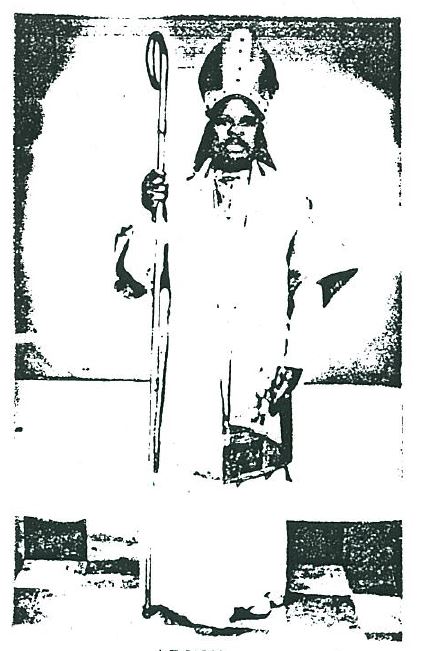
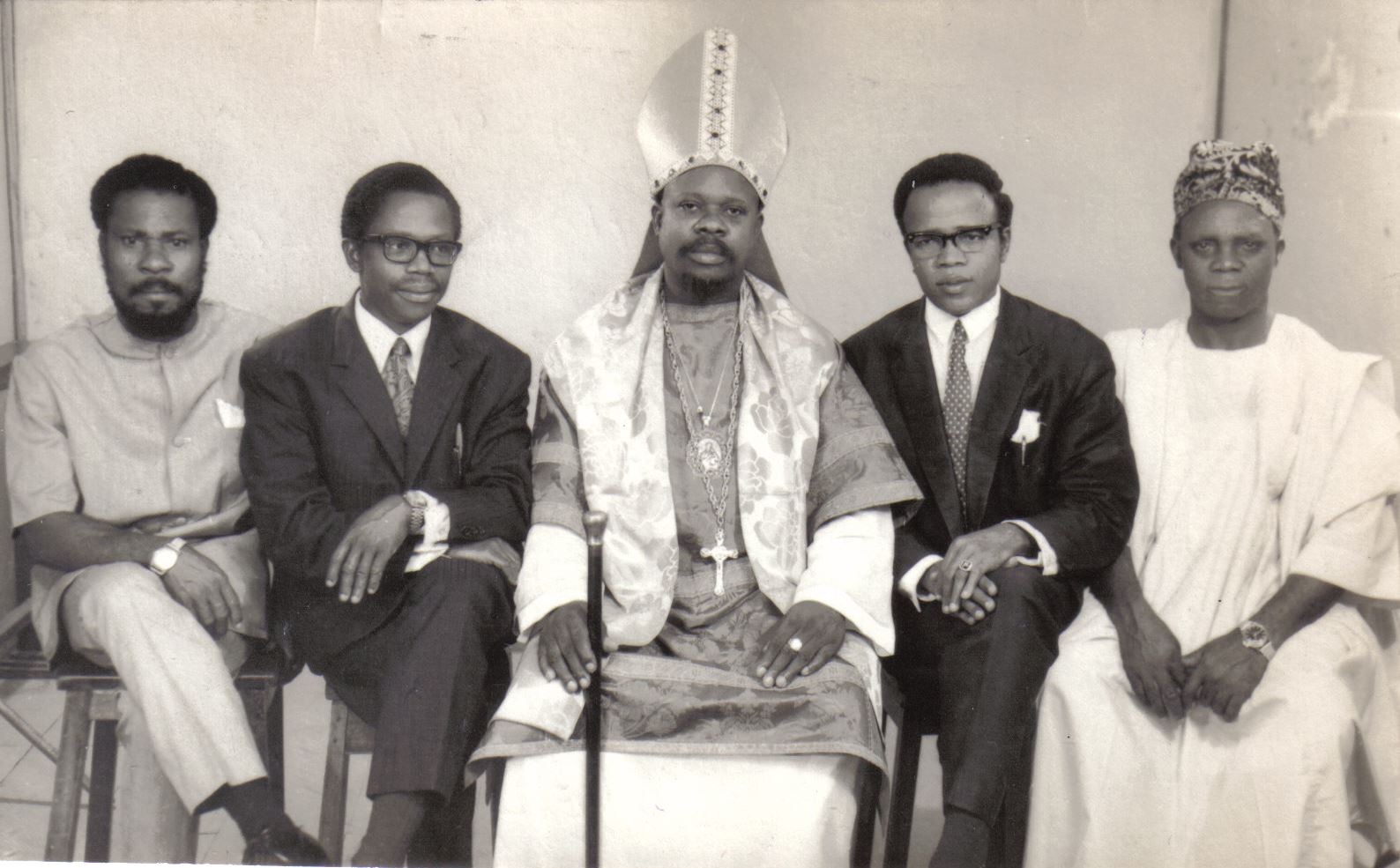
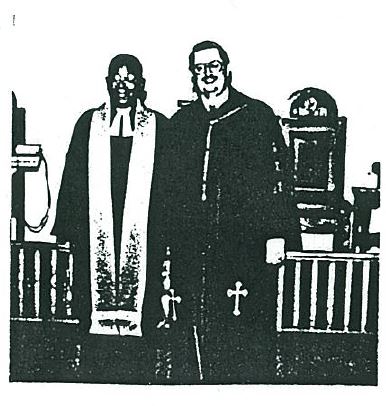
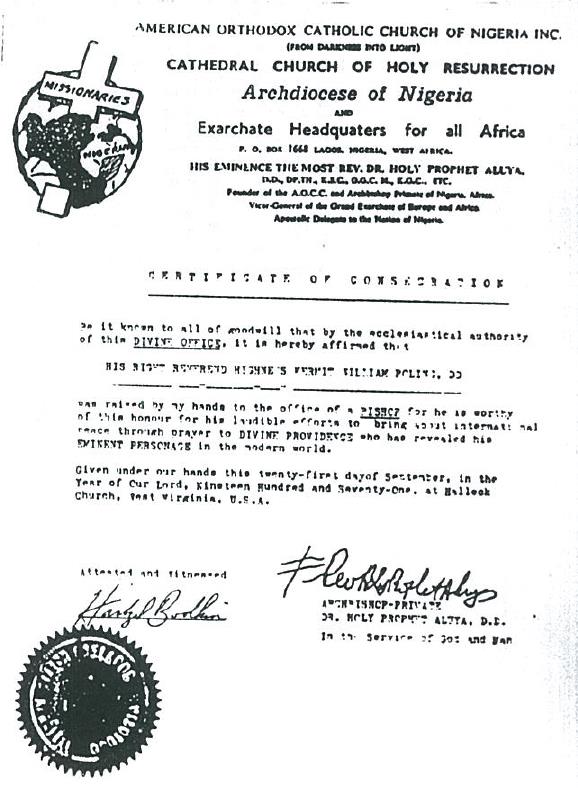
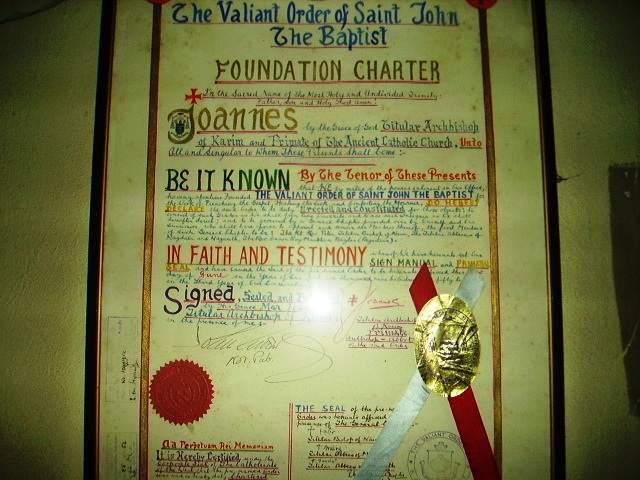
 Mar Lukos (Davison Quartey Arthur) was a bishop of the Ancient Catholic Church, appointed in 1951.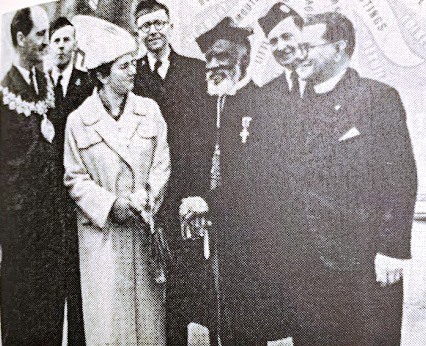







 The Abbey-Principality of San Luigi
You must be logged in to post a comment.