

Author: johnkersey
Educationalist, musician and clergyman.
St George’s Day in Brazil
The Apostolic Episcopal Church will celebrate St George’s Day in Brazil, at the cathedral dedicated to that saint that is its principal place of worship there.


Easter 2023
The Abbey-Principality of San Luigi wishes all members, friends and visitors to its website a very happy Easter.

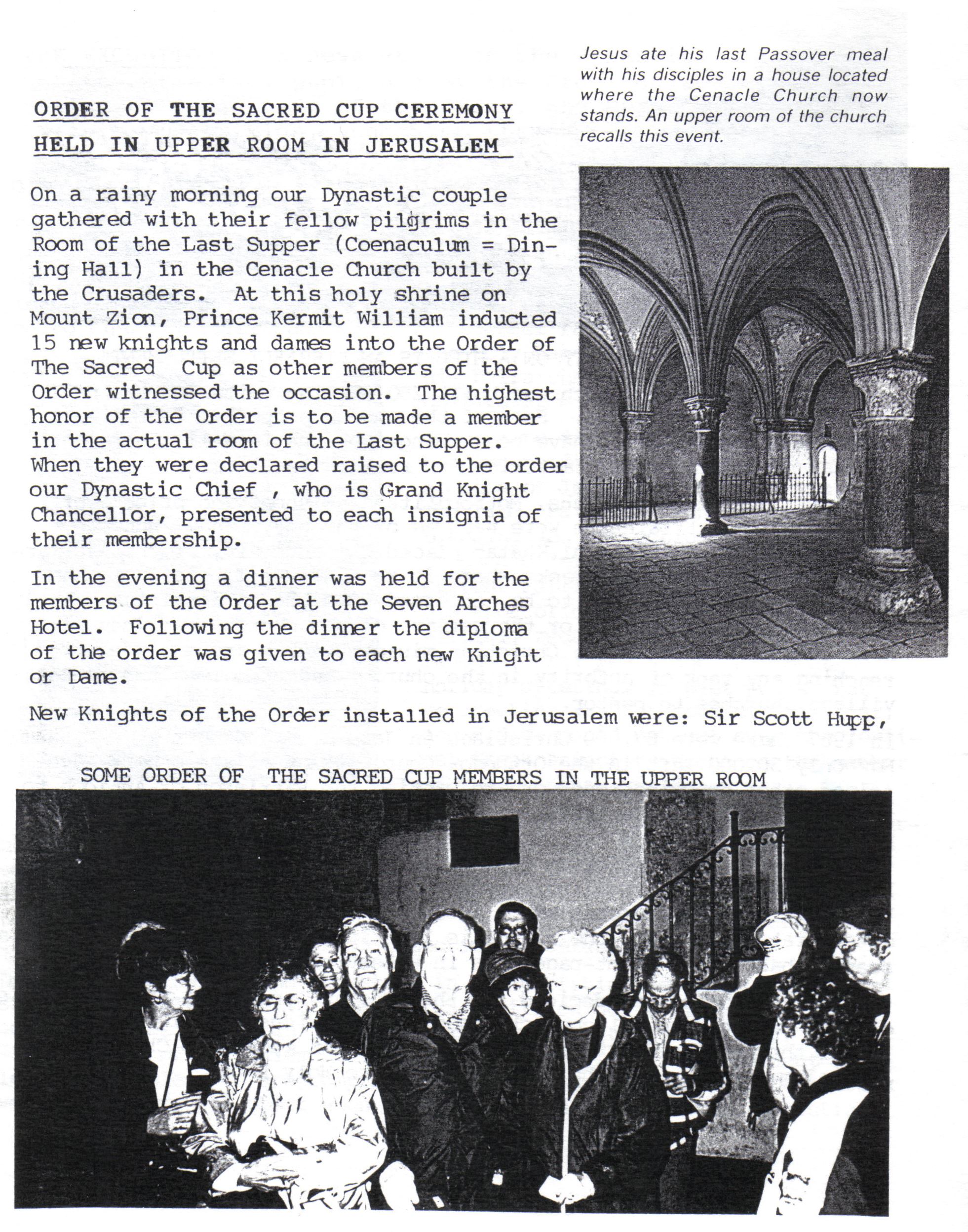
From the archives: Ceremony of the Order of the Sacred Cup in Jerusalem
From a past edition of The Excubitor comes this account of one of a number of investitures of the Order of the Sacred Cup held in Jerusalem in the Cenacle Church, the location of the Last Supper.
Developments in the Byelorussian Patriarchate of St Andrew the First-Called Apostle
The Byelorussian Patriarchate of St Andrew the First-Called Apostle was established in 1970 under the late Patriarch Peter II Zhurawetsky, in whose memory the Patriarchal seat has been held vacant since his death in 1994. From the outset the executive duties of the Patriarchal office were devolved to the Ecclesiast of All Byelorussia, the first holder of this office having been the late Prince Kermit of Miensk. Under Prince Kermit, the Patriarchate was latterly maintained as a private ekklesia of the Royal House Polanie-Patrikios.
Since the succession of Prince Edmond of Miensk to the position of Ecclesiast of All Byelorussia on the death of his adoptive father Prince Kermit in 2015, there has been an increase in the ecclesiastical activities in exile of the Patriarchate, these having been centred on missions in Brazil which have latterly expanded to other countries.
Recent developments have caused a revision of those missions that have hitherto been associated with the Patriarchate and which have operated under the working name Igreja Católica Ortodoxa Bielorussa no Brasil.
With immediate effect, the position of the Patriarchate has reverted to the former status of a private ekklesia of the Royal House Polanie-Patrikios solely. As such, its only member of clergy is now the Prince of Miensk as its Ecclesiast. All former members of the clergy, all lay ministers and all attached missions have now been released from the Patriarchate, and those clergy and missions who have wished to remain with our communion have been transferred to the Apostolic Episcopal Church and the Order of Antioch, where their ministry will continue.
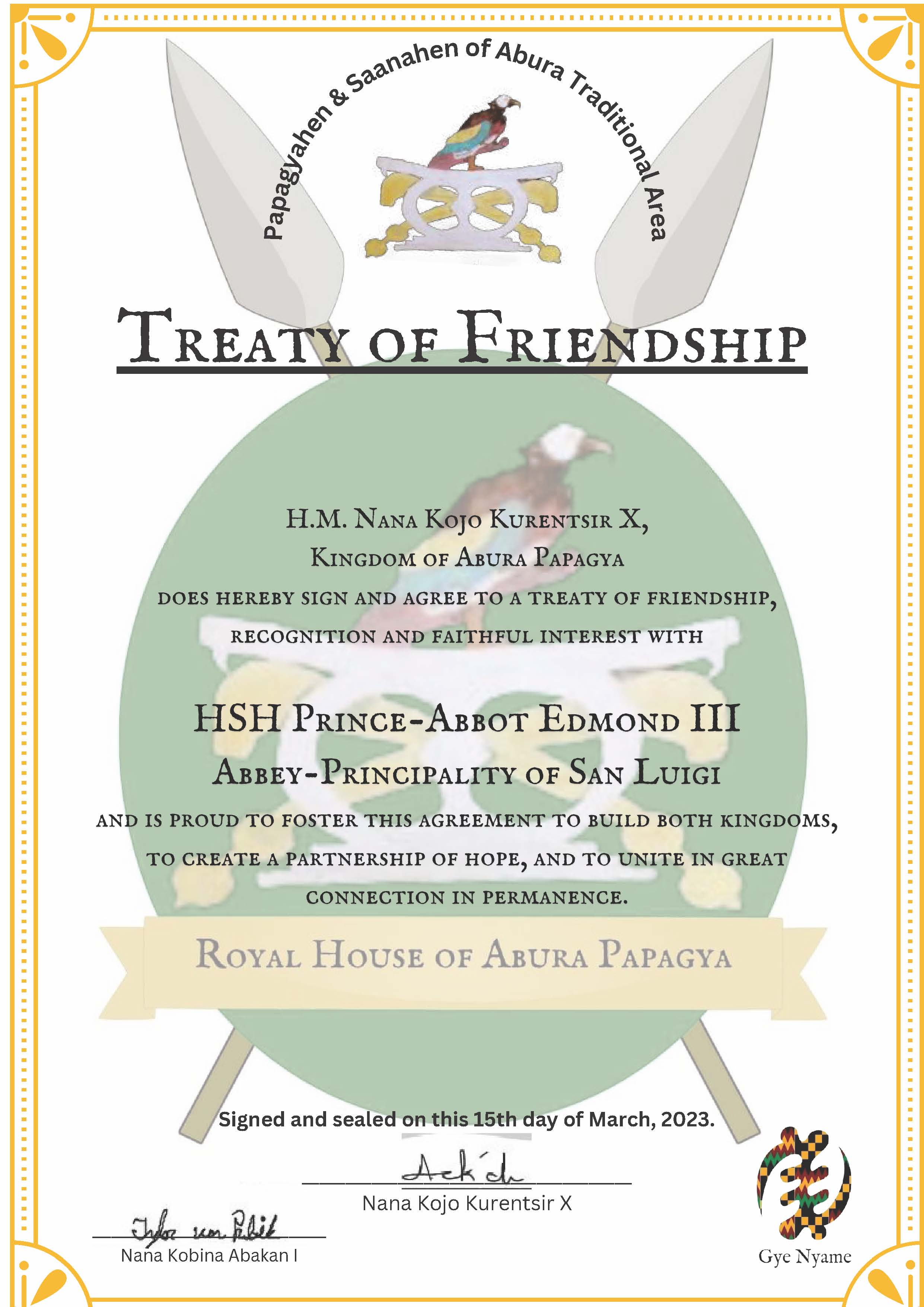
Treaty of Amity, Friendship and Goodwill with the Stooldom of Abura Papagya
The Abbey-Principality of San Luigi has entered into a Treaty of Amity, Friendship and Goodwill with the Stooldom of Abura Papagya, Abura Traditional Area, Republic of Ghana. The Stooldom is a recognized traditional kingdom in Ghana, ruled by HRH Nana Kojo Kurentsir X, the current Papagyahen (King), who was enstooled in 2015.
The website of Papagya linked above gives further information concerning the Kingdom, its history and its current projects.
As is customary on these occasions, an exchange of honours has taken place whereby HRH Nana Kojo Kurentsir X has been awarded the Grand Collar of the Order of the Crown of Thorns, and the Prince-Abbot has been awarded the Grand Collar of the Royal Order of Kwakyen Ababio.
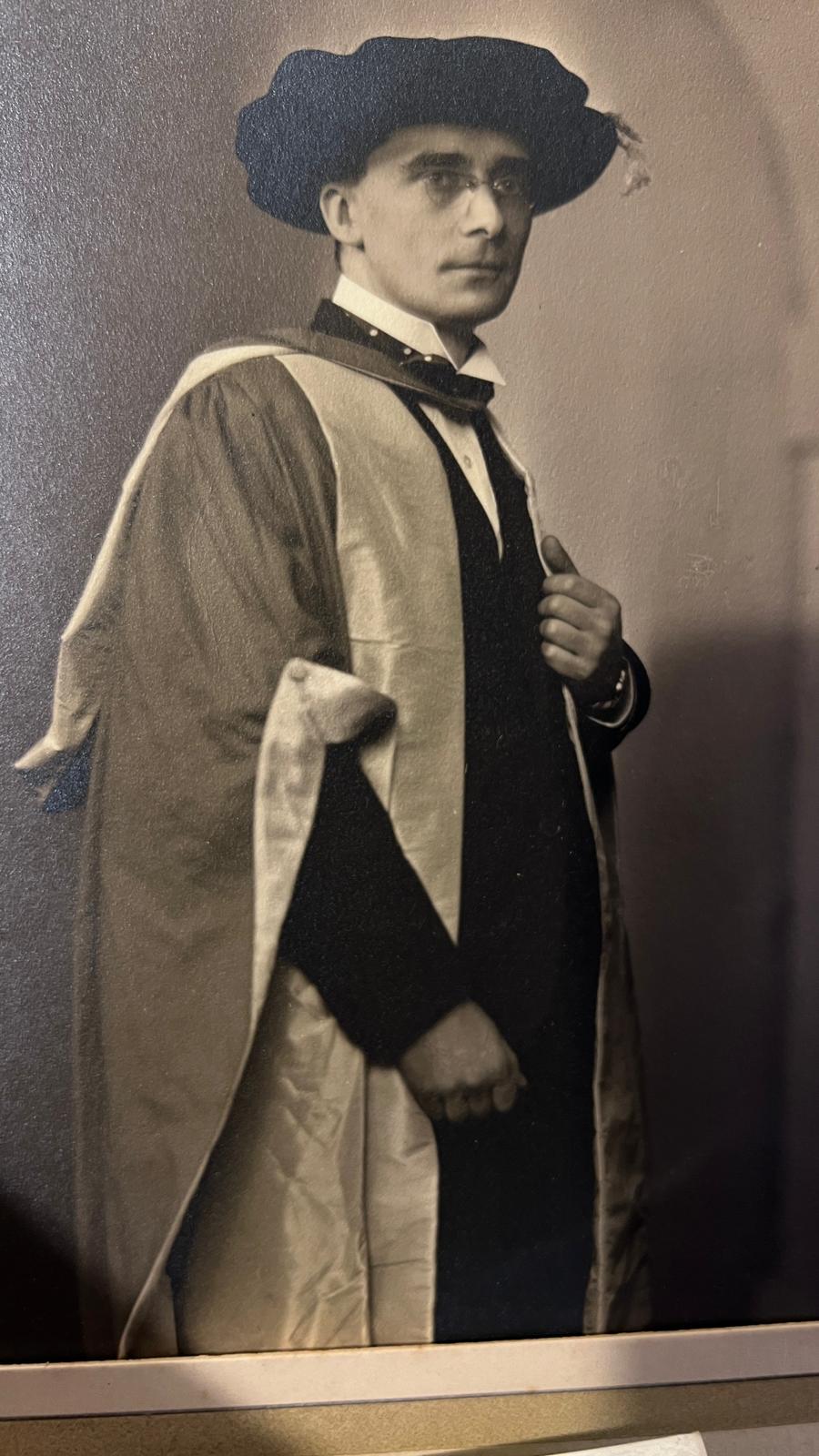
From the archives: A photograph of Archbishop William Bernard Crow
This photograph of the future Archbishop William Bernard Crow (Mar Bernard, subsequently Mar Basilius Abdullah III) (1895-1976) has recently been shared with us by his family. Dr Crow is shown here in the full dress robes of a Doctor of Science of the University of London.
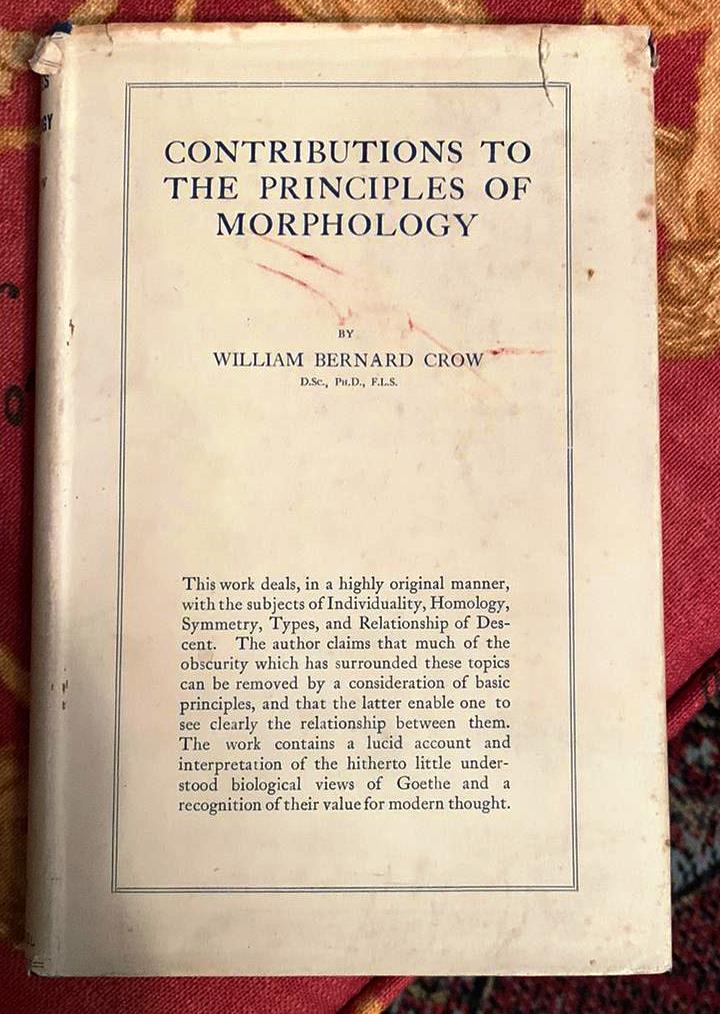
Dr Crow held the degrees of Associate of Arts (University of Oxford), Master of Science (University of Wales), Bachelor of Science, Master of Science, Doctor of Philosophy and Doctor of Science (University of London). This last degree was a rare academic distinction awarded in 1928 for a thesis entitled “Contributions to the Principles of Morphology” At that time, the higher doctorate of Doctor of Science from a British university was so prized that a university professor who had been awarded the degree would be called Doctor rather than Professor. Dr Crow was aged 33 in 1928 and so would have been one of the youngest persons ever to be awarded this degree.
At the University of London, the Doctor of Science degree by examination was withdrawn on 30 September 2001 and is no longer awarded.
The academic robes for the Doctor of Science degree worn by Dr Crow in the photograph were of scarlet cloth, faced and the sleeves and hood lined with faculty silk, which for Science was gold.
Dr Crow was Grand Master of the Apostolate of the Holy Wisdom (which includes the Ancient Catholic Orthodox Church). This has since 2015 been united with the Abbey-Principality of San Luigi, which continues its work.
 The Abbey-Principality of San Luigi
You must be logged in to post a comment.