Our attention has been drawn to the book “Wicca and the Christian Heritage: Ritual, Sex and Magic” by Joanne Pearson (Routledge, 2007, ISBN 978-0415254144). In responding to this work we are not concerned with those aspects of it that treat wicca and paganism, still less sex and magic, but rather with addressing specific falsehoods that are directed against certain of our past clergy and against the Western Orthodox University.
It appears from the references cited in this book that whatever expertise the author may possess in the area of paganism and wicca, she is sadly deficient in the study of the smaller sacramental churches, and has chosen to consult only the harshly critical studies of Henry R.T. Brandreth (a clergyman of the Church of England) (“Episcopi Vagantes and the Anglican Church”, 1st ed. 1947, 2nd ed. 1961) and Peter Anson (a Roman Catholic sometime lay monastic) (“Bishops at Large” (1964)). These works are polemics directed against our movement, and even though they contain much useful factual information (in the case of Anson, some of which was provided by the late Mar Georgius of Glastonbury in response to his enquiries), they are written from a standpoint of religious opposition, and perhaps what we might even classify today as religious hatred. Their purpose is to discredit and at times to ridicule our movement and persuade others not to join it or to grant it the respect that would normally be due to those of other religious affiliations, whatever the merits or otherwise of those bodies. This is not to imply that our movement is not without fault or that it should be immune from robust criticism, but when an author chooses to write on us citing only our enemies then it is clear where they stand.
It is in some respects unsurprising that scholars find this area problematic, and Pearson refers explicitly to the difficulty of obtaining Anson’s work prior to its 2006 republication. The reason for this is that almost all universities have close ties with the Church of England and the Roman Catholic Church, and those churches have made clear over the years their opposition to and desire to suppress the smaller sacramental churches lest they should exploit their weaknesses of doctrine and policy so as to constitute a viable alternative and threat to their dominant position. As a result, the scholar will look in vain for an archive of the publications and documents concerning the smaller sacramental churches in the universities and many reference libraries. Many records of our history are only held privately and it may consequently be exceptionally difficult even to know of their existence, let alone obtain and access copies. There are documents and publications in our own archives that are almost certainly the only copies of those works that survive.
That being said, the British Library does hold a good many of the publications of the Catholicate of the West and of Mar Georgius, due to his far-sighted policy of depositing copies there, and it is difficult to understand why anyone who was not approaching the subject as a polemicist opposed to everything we stand for would not trouble at least to consult them. Among these are Mar Georgius’s comprehensive response to Brandreth’s work, “Episcopi in Ecclesia Dei and Father Brandreth” (Patriarchal Press, 1962).
It is time that Pearson and other authors ceased to regard the term “episcopi vagantes” as an acceptable way to refer to clergy of the smaller sacramental churches. Whatever its historical antecedents, the term came into use among twentieth-century Anglicans and Roman Catholics as a term of abuse, implying a disrespect and a class hatred from the close correlation with the word “vagabond” (the phrase “episcopi et presbyteri vagabundi” occurs in a memorandum from the Union of Utrecht of the Old Catholic Churches to the Archbishop of Canterbury in 1940). It is important to recollect that in the years in question, there was very little of the meek and mild about the Church of England and the Roman Catholic Church in England, which identified themselves predominantly with the wealthy and socially influential, and deemed it not unchristian to sneer at the poor and the working-class, their hierarchies being derived predominantly from those who had attended the major public schools. That the smaller sacramental churches were chiefly a working-class development made them an easy target.
No scholar should now be using the phrase “episcopi vagantes” any more than they would use many other insulting sectarian religious epithets now fortunately consigned to history. Most of our movement’s clergy belong to legally established churches or religious orders, even when these are small in numbers. A few clergy may specifically designate themselves as wandering bishops or vagabonds from choice and because this is how they conceive their mission to do Our Lord’s work in humility, but it is one thing for them to designate themselves willingly thus, and entirely another to have these terms thrust upon them by hostile outsiders.
It is also quite possible to see class hatred behind Anson’s and Pearson’s sneering at the religious titles used in smaller sacramental churches. Such churches are traditionalist and hierarchical, and even if they are small in numbers that does not mean that the titles and roles of their clergy are not legitimate and justified, even if outsiders may find them hard to understand or not in accordance with the egalitarian and modernist philosophy that now dominates the Church of England and the Roman Catholic Church. It is also important to note that very few of the expressions of our movement have been Protestant in their emphasis; the majority have derived their impetus from Orthodoxy or Traditional Catholicism, with some also adopting traditionalist Anglicanism in more recent times.
Pearson states with certainty that the titles given to clergy of our movement “are not connected to any form of ministry”. This is a lie, and one which could hardly have been the result of any careful scholarship. A study of the life of our forefather Joseph René Vilatte, for example (as has been undertaken by the author of this post) would reveal an energetic church-planter at work on two continents, some of whose ministries continue to this day, and which include the African Orthodox Church, the first specifically African-American such body. Pearson also seems to think it problematic that churches and pro-cathedrals “were often rooms in private houses”. Clearly, for her, worship is only valid when performed by rich people in great cathedrals – although let us reflect for a moment that the pagans and wiccans of whom she also writes often find spiritual inspiration in the simplest and most modest of surroundings.
Pearson also seems unaware that the churches that make up our movement often derive from sources within Eastern Orthodoxy and not from the Anglicans or Roman Catholics. The titles of Mar and Catholicos are of Eastern Orthodox origin and those prelates who have used them are reflecting their continuity from that heritage, chiefly that of Syrian Orthodox missions to the West in the latter part of the nineteenth-century. Clearly, Pearson would prefer it if they were all to use “a simple “my Lord Bishop”” and some in fact do so. But where a mission has a specific character and charism, why should it suppress the expression of its heritage because of Pearson’s intolerant opinion?
If there is a correlation between ecclesiastical and aristocratic titles, as Pearson observes, then that reflects the fact that a number of our prelates have indeed legitimately held both, and moreover some have also been princes-religious within an Orthodox or Catholic understanding of that term.
Where Pearson speaks of the universities established by members of our movement and the degrees they have held, she displays a manifest ignorance. Until 1988, the law of England and Wales permitted any person or establishment to confer degrees, and furthermore there was no mechanism in existence whereby any private establishment could gain the recognition of the state for its awards. Because the mainstream academic establishment, having a close connection to the Church of England and Roman Catholic Church, was hostile to the smaller sacramental churches, they were compelled to establish their own institutions for the training of their clergy. Doubtless some were also made painfully aware that they were looked down on as inferiors by their counterparts in the larger churches because they were working-class men who could not afford a university education at the establishments of the state. This was also at a time when the Archbishop of Canterbury conferred Lambeth degrees upon the clergy, particularly the bishops, of the Church of England without examination, with a doctoral degree being regarded as the right of a bishop upon consecration jure dignitatis.
Then as now, the establishment on the one hand says, “if you do not like what we offer, you are at liberty to establish your own” but in practice then does everything it can to suppress that option – and indeed explicitly so in law since 1988.
Mar Georgius spoke eloquently on these matters in offering a justification of the educational involvement of the smaller sacramental churches,
It is a principle held dear by all who profess the true Catholic Faith that the Church has a necessary function to perform with regard to education, and indeed universities as we now know them were originally instituted by the Church. Owing to the secularization of the ancient universities, and the subsequent formation of modern universities of a secularist type, the curricula of the so-called “recognized” universities, and the general tone of their examinations are such that they are not based upon a sufficiently high standard of orthodoxy, for which reason many Christian Churches have found it necessary to establish their own academic institutions…Doubtlessly it is natural for the wealthy secular universities to dislike competition, and they and many of their graduates have constituted themselves open enemies of institutions of the type alluded to above. Unfortunately in so doing they have departed from all canons of decent behaviour and impute unworthy motives to those in charge of the same, besides sneering at the degrees which they grant. Every autocephalous Church has a right to impart instruction to those who seek it, and to test the knowledge of its students by examinations, and to recognize proficiency by the award of degrees. Only by this means can the clergy and laity be properly trained in the Faith, for as indicated above, the “recognized” universities are not based upon true doctrine. For any attempt to sneer at or contest this right is an act of religious persecution. After all, why should any Church be forced to accept other people’s standards? Down with academic totalitarianism!! Down with secularist intolerance!! Down with religious persecution!!!
[Orthodox Catholic Review vol. 2 no. 3, December 1946, p.10]
This article implies that it was not expected that the Western Orthodox Academy, which was led by Mar Georgius, would be without its detractors, although it was prepared to defend itself robustly. When the anonymous author of the preface to the 1948 edition of “Crockford’s Clerical Directory” made a number of ill-judged remarks, Mar Georgius brought an action in libel in the High Court (Mar Georgius v. The Vice-Chancellor and Delegates of the Press of the University of Oxford, and Geoffrey Cumberlege, 1948.G.No.1907 – the Vice-Chancellor and Delegates being sued as printers, and Mr Cumberlege as publisher of the libel). Mar Georgius was successful in this action, and the defendants were required to publish an apology including an unreserved withdrawal of the passage that had been complained of and to pay damages. The case was believed to have been the first time that the University of Oxford had been sued in its long history.
Mar Georgius, in speaking of the Western Orthodox University (which had formed from the Western Orthodox Academy), made reference to the basis of its operation,
The Patriarchs and other Supreme Hierarchs of the Church of Christ possess a prescriptive right to confer academic degrees in all faculties, either personally, or through such academic institutions as they may Charter for this purpose. In the case of the Pope, he has the Pontifical Gregorian University, the Archbishop of Canterbury confers what are called “Lambeth Degrees” personally, whilst the Patriarch of Glastonbury confers them both personally (when they are called “Glastonbury Degrees”) and also through the Western Orthodox University…The Universities of Oxford and Cambridge, and the authorities of the Church of England, apparently object to Mar Georgius exercising his ecclesiastical and legal rights in this matter. But they are, of course, powerless to prevent him.
[Hieratica, vol. 1 no. 7, April 1949, p.40]
While these establishments were indeed powerless to prevent Mar Georgius from exercising his rights, this did not mean that their supporters would not continue to sling mud and engage in malicious falsehoods. Pearson’s uncritical acceptance of their propaganda shows that this campaign has left a long shadow. She libels the Western Orthodox University by stating that its degrees were “sold” for various prices – something she cannot prove and that she should have suspected to have been untrue. All universities charge fees, including the Western Orthodox University, but that institution maintained its academic standards, publishing its lists of graduates and requiring of them proper attainment, whether through examination or through the accumulation of pre-existing credits. In practice, the list of graduates was not a long one, and consisted mainly of clergy and laity associated with the Catholicate of the West in some capacity.
Regarding the personal position of Mar Georgius, he having been recognized by the award of a number of degrees from universities and cognate institutions from within his movement and the churches related to it, Pearson cannot show that these were not legally granted or merited by the considerable scholarship and attainments of their holder.
She says of these degree-granting bodies that “none of these foundations obtained recognition as degree-giving universities in Britain”, but this is a misleading statement. If she means legal recognition, such that the degrees granted were valid under the law of England and Wales, then all of those establishments were indeed granting legally valid degrees prior to the restriction of the grant of degrees to state-recognised bodies by Act of Parliament in 1988. Any such degree from these establishments has exactly the same legal status as any other degree, state or private, granted prior to 1988 in England and Wales. The value of such a degree as an academic or professional credential is a separate matter from its legal status, and is by its nature wholly subjective.
If on the other hand she means that these institutions could have somehow obtained state recognition and Royal Chartered status as universities of the realm, then this is another disingenuous lie, firstly because there was absolutely no legal mechanism by which any private institution could apply for such recognition, and secondly because it would have been impossible for Her Majesty the Queen, who is the Head of the Church of England, to have granted a Royal Charter to any institution under alternative religious authority.
What on earth could be the basis for Pearson to publish such a grotesque lie as “neither were [these institutions] concerned with offering any pre-ordination training – priestly and episcopal orders were, by and large, given on a whim”? She offers no evidence for this statement, which certainly is not one that applies to the Catholicate of the West.
Again, this is ultimately a criticism based on class. Our movement has never had the means to offer candidates for ordination full-time training in residential seminaries, as has been the Anglican and Roman practice. Most clergy have trained through correspondence study and through direct, in-person study with a bishop. Almost all have had to support themselves through secular employment, giving of their limited spare time to support the churches of which they were part.
There has therefore never been a general or uniform policy as to preparation for ordination, particularly given that many candidates came from other churches and may have already had some instruction and ministerial experience prior to their acceptance as ordinands. Yet the introduction of uniform preparation for ordination through seminary study is a relatively recent phenomenon even in the larger churches, postdating the Council of Trent. We might also reflect that Our Lord chose as His disciples not the highly educated Pharisees of his day but simple fishermen of no formal education whatsoever.
Moreover, the open-minded scholar, unlike Pearson, might notice that there is more than a passing resemblance between the circumstances in our movement described above and those in which pagan and wiccan initiates are selected and trained.
Pearson alleges that the activity of our movement has not been successful in promoting Christian unity. There has, particularly within the Catholicate of the West, long been a determined effort to bring about a practical realisation of wide ecumenical aims just as was the case with our antecedent the Catholic Apostolic Church in the nineteenth-century. It would be fair to say that we have not made all the headway that might have been hoped for in this regard, but this is surely more due to the hard-hearted and hostile responses to our initiatives by the larger churches than to any lack of effort or positive intent on our own part.
From the outset, there was a determination on the part of the Church of England, the Roman Catholic Church and some of the Eastern Orthodox Churches to treat the smaller sacramental churches as a threat to be quashed. This at times has involved incidents of very real persecution of clergy, and our movement has survived not only due to the exercise of Divine grace and mercy but through the grit, guts and determination of several generations of men, and not a few women, who stood up without compromise for what they believed in. Our movement has survived against the odds, and it remains to be seen whether, amid the significant changes that are occurring in the larger churches, it may yet have a further chapter to be written in its history. Whatever its future may have in store, it deserves better than Pearson’s careless treatment.

 The International College of Arms of the Noblesse has entered into a reciprocal Treaty of Full Partnership, Recognition, Accreditation and Collaboration with the Saint Peter and Saint Paul Lutheran Institute. The Institute originated with The Biblical College of Religious Teaching of St Peter and St Paul, which initially derived from the internal resolution of the Statutes of the St Paul Committee, legally registered and published in the Journal Officiel de la Republique Française (July 1996), while the University and College of the church, Art.4 of the Statutes, concerning Higher Education, was registered in January 2000, in the city of Marseille, in accordance with the legal capacity to grant degrees and give credit transfer/equivalence (Art.L731b of the “Code de l’Education”, 09/22/2002, L.335.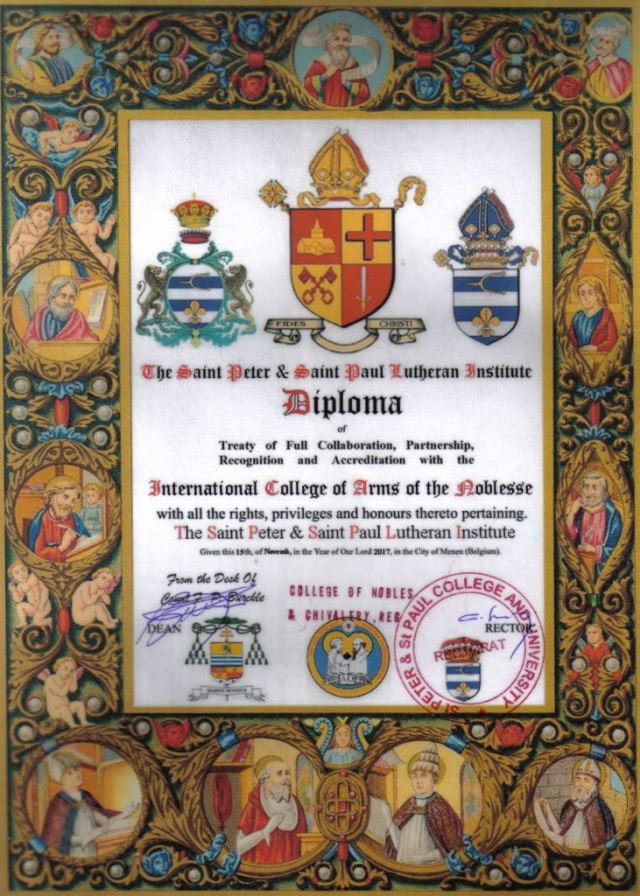
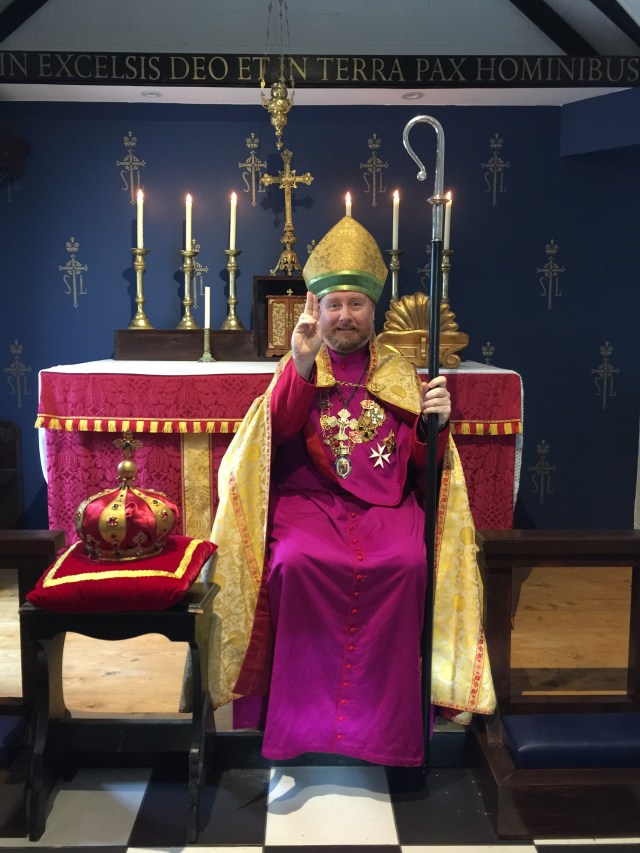
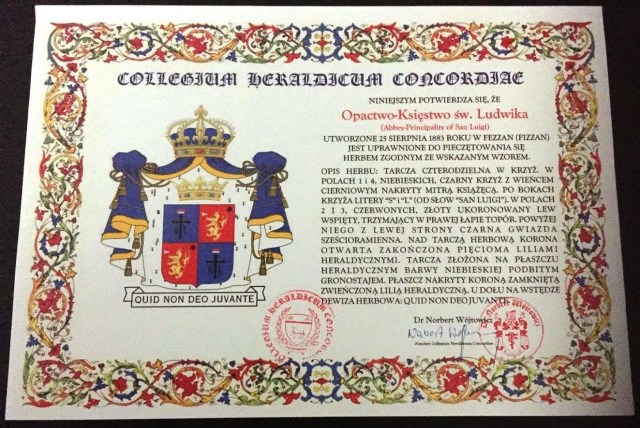
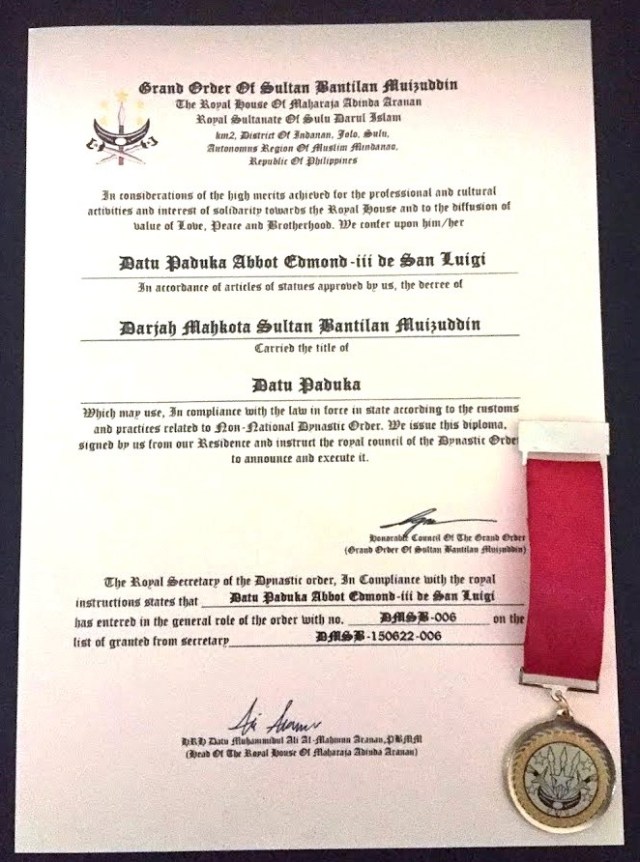
 The Prince-Abbot has received the decoration of the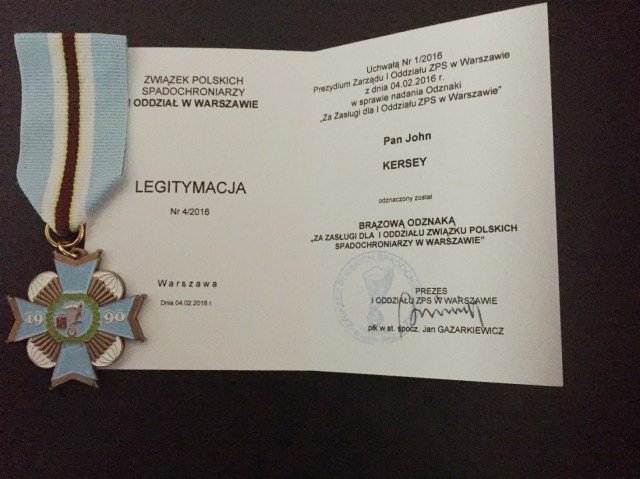


 Archbishop William additionally admitted the Prince-Abbot to membership in the Confraternity of the Holy Apostles, the ecumenical society of the Old Roman Catholic Church in America.
 The Abbey-Principality of San Luigi
You must be logged in to post a comment.