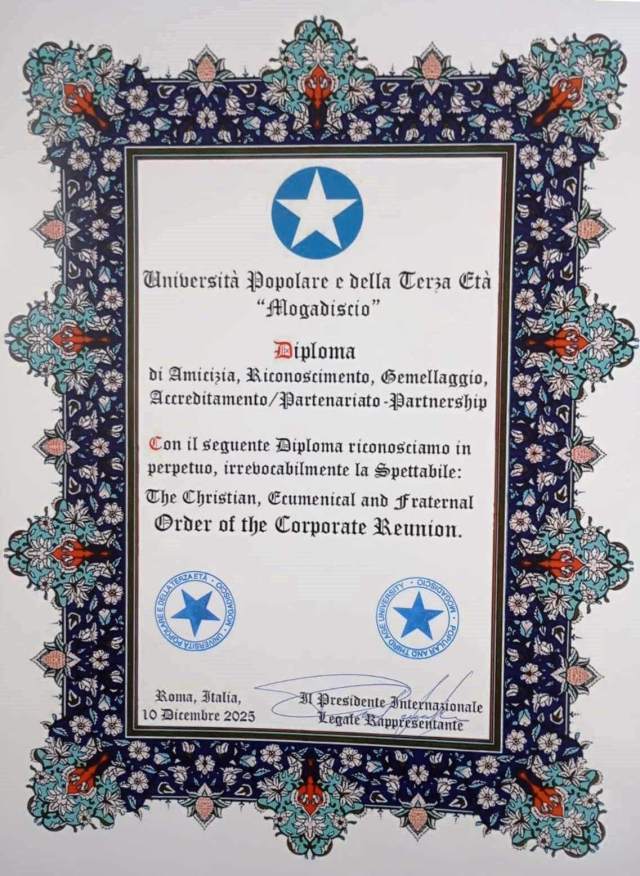
This Pastoral Letter was issued to members and friends of the Order of Corporate Reunion. It responded to a recent circular from a Roman Catholic archbishop in The Philippines that was directed against a number of traditionalist Old Roman Catholic churches based in the United Kingdom and the USA.
In recent times it has been the practice of certain senior clergy of the Roman Catholic Church to issue polemical statements to the faithful and to the media concerning Old Roman Catholic and related groups which they allege are proselytising within their dioceses.
The issue of the relationship between different religious bodies is in the modern world regarded as a question of law and specifically of human rights. In most democratic countries where freedom of religion is guaranteed by law, a person has the right to belong to, leave, or create a religious body. The right to discuss the differences between religious bodies on particular issues, and the right to criticise their doctrines and practices, is a matter of freedom of speech, but there is an exception for this in many jurisdictions where speech constituting religious hatred is forbidden by law.
The World Council of Churches in The Challenge of Proselytism and the Calling to Common Witness states the following:
“19. Proselytism as described in this document stands in opposition to all ecumenical effort. It includes certain activities which often aim at having people change their church affiliation and which we believe must be avoided, such as the following:
- making unjust or uncharitable references to other churches’ beliefs and practices and even ridiculing them;
- comparing two Christian communities by emphasizing the achievements and ideals of one, and the weaknesses and practical problems of the other;
- employing any kind of physical violence, moral compulsion and psychological pressure e.g. the use of certain advertising techniques in mass media that might bring undue pressure on readers/viewers;
- using political, social and economic power as a means of winning new members for one’s own church;
- extending explicit or implicit offers of education, health care or material inducements or using financial resources with the intent of making converts;
- manipulative attitudes and practices that exploit people’s needs, weaknesses or lack of education especially in situations of distress, and fail to respect their freedom and human dignity.”
The issue of proselytism has been a problematic one for the Roman Catholic Church, as witness the foundering of the 1993 Balamand Declaration that sought to reach an understanding on the matter between the Roman Catholic and Orthodox churches. It may be argued that it is the duty of all Christians to follow the Great Commission, but where dialogue goes beyond this to compare the merits of different religious bodies or seek to persuade a person to leave one and join another, this will inevitably cause controversy and conflict. Let us then examine the background to this issue and some solutions to it.
Whether or not anyone agrees with them, the fact remains that Old Roman Catholic and similar churches enjoy a legal existence in most countries and conform to the precepts that govern the definition of a religious body in law. That they may be small is of no consequence in this context, since the size and material wealth of a religious body is not a factor that leads to its recognition or non-recognition in law.
Most such bodies descend from the Catholic Church, and from their perspective any separation is as a result of the misdirection of that church’s leadership and the adoption of false teachings or doctrines that in their view do harm to the faithful. Those who objected to the First Vatican Council, which proclaimed the infallibility of the Pope, are generally referred to as Old Catholics, which term also refers to an earlier development of the Church in the Diocese of Utrecht in The Netherlands where a hierarchy developed independently after the Pope refused to approve the election of its archbishop. Old Roman Catholicism is a movement that subsequently developed within Old Catholicism that sought a closer relationship to the Holy See, and some Old Roman Catholic groups have come to accept both the First and Second Vatican Councils and to petition the Holy See for recognition and reconciliation. There are also groups that accept the First Vatican Council but not the Second, of which the most prominent is the Society of St Pius X. Others which developed a separate identity at around the same time embrace sedevacantism, which is the belief that the Papacy is vacant, or sedeprivationism, which is the belief that the Pope has been morally deprived of valid office for cause. All of these groups use as their liturgy the Traditional Latin Mass.
It can be seen therefore that to these separated groups a Catholic identity is of their very essence. In each case, it can also be seen that radical change or division within the Roman Catholic Church has brought about a separation between the official hierarchy and those who believe that they should in conscience hold fast to the traditional belief and practice of their forebears. All concerned hold themselves out to be Catholics and believe that their interpretation of doctrine and practice is in accordance with their express mission. From a scholarly perspective, much more unites all of them than divides, and it would certainly not be impossible to imagine a situation where, if traditional doctrine and practice were again to be accepted by the Holy See, the separated groups could once again become reconciled.
Even where the term “church” is used by separated groups, it does not generally mean that they are setting themselves up in deliberate opposition to the Roman hierarchy. Some groups have close relations with Rome, and some define themselves as apostolates, confraternities or religious orders so as to make it clear that they are not claiming any jurisdiction other than that which is necessary to regulate their immediate affairs. All the major groups under discussion teach that they are Catholic and that the Catholic Church is necessary for salvation.
What does the Roman Catholic Church teach regarding this situation? To see it addressed explicitly, we should refer to the Declaration “Dominus Iesus” of the Congregation for the Doctrine of the Faith issued under Pope St John Paul II. Here, we read,
“The Catholic faithful are required to profess that there is an historical continuity – rooted in the apostolic succession – between the Church founded by Christ and the Catholic Church: “This is the single Church of Christ… which our Saviour, after his resurrection, entrusted to Peter’s pastoral care (cf. Jn 21:17), commissioning him and the other Apostles to extend and rule her (cf. Mt 28:18ff.), erected for all ages as ‘the pillar and mainstay of the truth’ (1 Tim 3:15). This Church, constituted and organized as a society in the present world, subsists in [subsistit in] the Catholic Church, governed by the Successor of Peter and by the Bishops in communion with him”. With the expression subsistit in, the Second Vatican Council sought to harmonize two doctrinal statements: on the one hand, that the Church of Christ, despite the divisions which exist among Christians, continues to exist fully only in the Catholic Church, and on the other hand, that “outside of her structure, many elements can be found of sanctification and truth”, that is, in those Churches and ecclesial communities which are not yet in full communion with the Catholic Church. But with respect to these, it needs to be stated that “they derive their efficacy from the very fullness of grace and truth entrusted to the Catholic Church”.
Therefore, there exists a single Church of Christ, which subsists in the Catholic Church, governed by the Successor of Peter and by the Bishops in communion with him. The Churches which, while not existing in perfect communion with the Catholic Church, remain united to her by means of the closest bonds, that is, by apostolic succession and a valid Eucharist, are true particular Churches. Therefore, the Church of Christ is present and operative also in these Churches, even though they lack full communion with the Catholic Church, since they do not accept the Catholic doctrine of the Primacy, which, according to the will of God, the Bishop of Rome objectively has and exercises over the entire Church.”
Since all the groups under discussion here profess, and in some cases have been explicitly acknowledged by Rome as having “apostolic succession and a valid Eucharist” it can be safely concluded that they are true particular Churches and that the Church of Christ, which is to say the Catholic Church, “is present and operative also in these Churches”. It is for that reason that Canon 844(2) of the current Roman Catholic Code of Canon Law states, “Whenever necessity requires it or true spiritual advantage suggests it, and provided that danger of error or of indifferentism is avoided, the Christian faithful for whom it is physically or morally impossible to approach a Catholic minister are permitted to receive the sacraments of penance, Eucharist, and anointing of the sick from non-Catholic ministers in whose Churches these sacraments are valid.”
We may see then, that the Roman Catholic Church teaches that these communities are entirely justified in describing themselves as Catholic, although they are not in full communion with the Holy See. This is further elaborated in Dominus Iesus,
“The Christian faithful are therefore not permitted to imagine that the Church of Christ is nothing more than a collection – divided, yet in some way one – of Churches and ecclesial communities; nor are they free to hold that today the Church of Christ nowhere really exists, and must be considered only as a goal which all Churches and ecclesial communities must strive to reach”. In fact, “the elements of this already-given Church exist, joined together in their fullness in the Catholic Church and, without this fullness, in the other communities”. “Therefore, these separated Churches and communities as such, though we believe they suffer from defects, have by no means been deprived of significance and importance in the mystery of salvation. For the spirit of Christ has not refrained from using them as means of salvation which derive their efficacy from the very fullness of grace and truth entrusted to the Catholic Church”.
What then of the term “schismatic”, so often thrown as an insult by ultramontane Roman Catholics at these brethren? Or indeed the charge of heresy? Canon 751 of the current Code of Canon Law provides that “Heresy is the obstinate denial or obstinate doubt after the reception of baptism of some truth which is to be believed by divine and Catholic faith…schism is the refusal of submission to the Supreme Pontiff or of communion with the members of the Church subject to him.” It will be obvious that the communities concerned do not teach heresy but instead carefully maintain the essentials of the Faith. It will be equally obvious that they do not meet the definition of schism. They do not refuse communion with Roman Catholics, indeed many have good and close relations with them, and it might be argued that their activities termed by Roman Catholics “proselytisation” are in fact a demonstration of their desire to bring this communion into greater being. Nor have they been asked to submit by the Pope and refused. They are not at present under his jurisdiction, but that does not mean that if they were not asked by proper authority to submit as a body to a just ruling of his that they would necessarily refuse that command. Were they to do so, they could rightly be termed schismatic.
Even were they to be so termed justly, that would not cut them off from the Church, nor would it mean that they were to be counted among the damned. Ludwig Ott, in his “Fundamentals of Catholic Dogma” (1955) explains, “Schismatics in good faith (material) like heretics in good faith, can by a desire to belong to the Church, belong spiritually to the Church, and through this achieve justification and salvation.”
“Pope Alexander VIII, in 1690, condemned the Jansenistic propositions that Christ died for the faithful only and that Pagans, Jews and heretics receive no grace from him. Denz 1294 et seq. cf Denz 1376 et seq.”
In conclusion, we can therefore see that what is actually the case here is not that certain clergy of Roman Catholic Church are promulgating polemics against other churches, nor are those other churches necessarily trying to persuade people to abandon the Catholic Faith, but rather that this is a conflict borne of differences within the Catholic Church as a whole, where radical changes have caused genuine and deeply-felt divisions among the clergy and faithful. As is always the way in the sociology of groups, a group gains its identity not only from what it is, but from what it is not, and at worst, that identity is reinforced by comparison with out-groups.
How, then, can we seek unity? It is high time that rather than condemning traditional Catholic groups, the Holy See considered the possibility that dialogue with them might produce a common understanding and serve as a step towards greater unity. The prohibition of the Traditional Latin Mass in the Roman Catholic Church has also been handled in a deeply divisive and authoritarian manner, and it could easily have been seen that this would cause traditionalist Roman Catholics to be attracted to separated Catholic groups that maintain the TLM. The question then must be asked: does Rome wish to be the source of a genuine unity borne of Christian love, tolerance and respect, or will it impair that unity through the insistence on imposing a modernist agenda and vilifying or excluding any who resist it? Let us at this time pray for all who are affected by past and present changes in the Church, that they may learn to concentrate on the things that unite us, and work towards a common understanding and a toleration of difference in all things that are not of the essentials of the Faith.
You must be logged in to post a comment.