
 Frederick Bowman (1893-1969) was an Officier of the Order of the Crown of Thorns and also an Officier of the Order of the Lion and the Black Cross. Described in an obituary as “the last of Liverpool’s notable eccentrics” his life was of such unusual variety that the late Grand Prieur, Mgr. George Tull, at one point planned to write his biography. It was said of him that “everything he did was in inverse proportion to his diminutive size.”
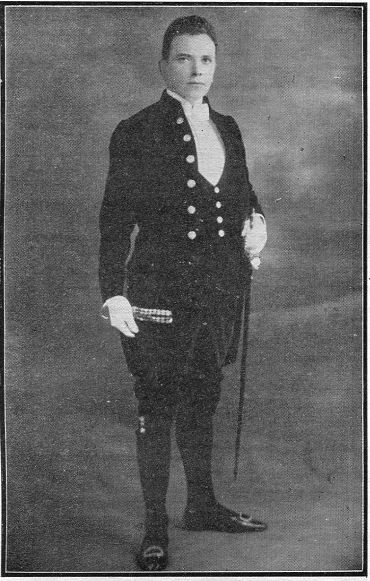
The exact date of Bowman’s birth was not even vouchsafed to the authorities at the hospital where he passed away. His early career was as an actor (he claimed Sir Donald Wolfit among his friends, and compared notes with him on their respective portrayals of Richard III) and he appeared often in the Liverpool music halls in melodrama and as an orator. He would customarily appear in public in the same uniform of tailcoat and buttonhole that he had worn upon the stage. In June 1934 he was formally presented to King George V at a levée.
As time wore on, he gained a reputation for litigiousness. On one occasion, a printer whose bill he had failed to pay was unwise enough to make some derogatory remarks about him in a letter. Bowman successfully sued him for libel, winning £400 damages, a considerable sum in those days.
At some point in early adulthood, he became a Muslim and adopted the name Hameedullah, being particularly impressed by the reverence of that faith for the suffering of animals. However, he later decided that he “did not know enough to be religious at all”. By the time of his admission to the OCT, however, he was able to complete the required subscription to the Nicene Creed without overmuch difficulty.
 A fierce pacifist and member of his friend the Marquess of Tavistock’s anti-war (and at various times anti-Semitic and pro-fascist) British People’s Party, he was interned during the Second World War, and clearly felt his duty lay in maximum resistance to the authorities. He founded the Frederick Bowman Freedom League in Brixton Prison in 1942, and in June of that year attempted to escape while disguised as a clergyman. Recaptured and put on bread and water, he went on hunger strike on several occasions and was forcibly fed by tube. The authorities offered him conditional release, but he refused their terms; they then opted for unconditional release, having previously considered forcibly expelling him from the prison. Bowman then sued the prison governor and the Home Secretary for having ordered that he be force-fed: although this act was clearly illegal, Bowman’s appearance pro se before the judge antagonized him, and he lost the case.
Shortly after his release, in March 1943, he received a knighthood from Count Potocki de Montalk, who was a rather tenuous pretender to the throne of Poland as King Wladyslaw V. Potocki was a determined controversialist, fierce anti-Semite and practising pagan as well as a poet and private printer of some note. The service of investiture included a reading from the Egyptian Book of the Dead, prayers for those working for peace and an invocation to the sun god. The following year, Potocki deprived Bowman, whom he had (with characteristic contempt for the British Establishment) encouraged to use the title “Sir Frederick”, of his knighthood for alleged lèse majesté and breach of his oath of fealty. All this was reported in the less salubrious quarters of the press of the day.
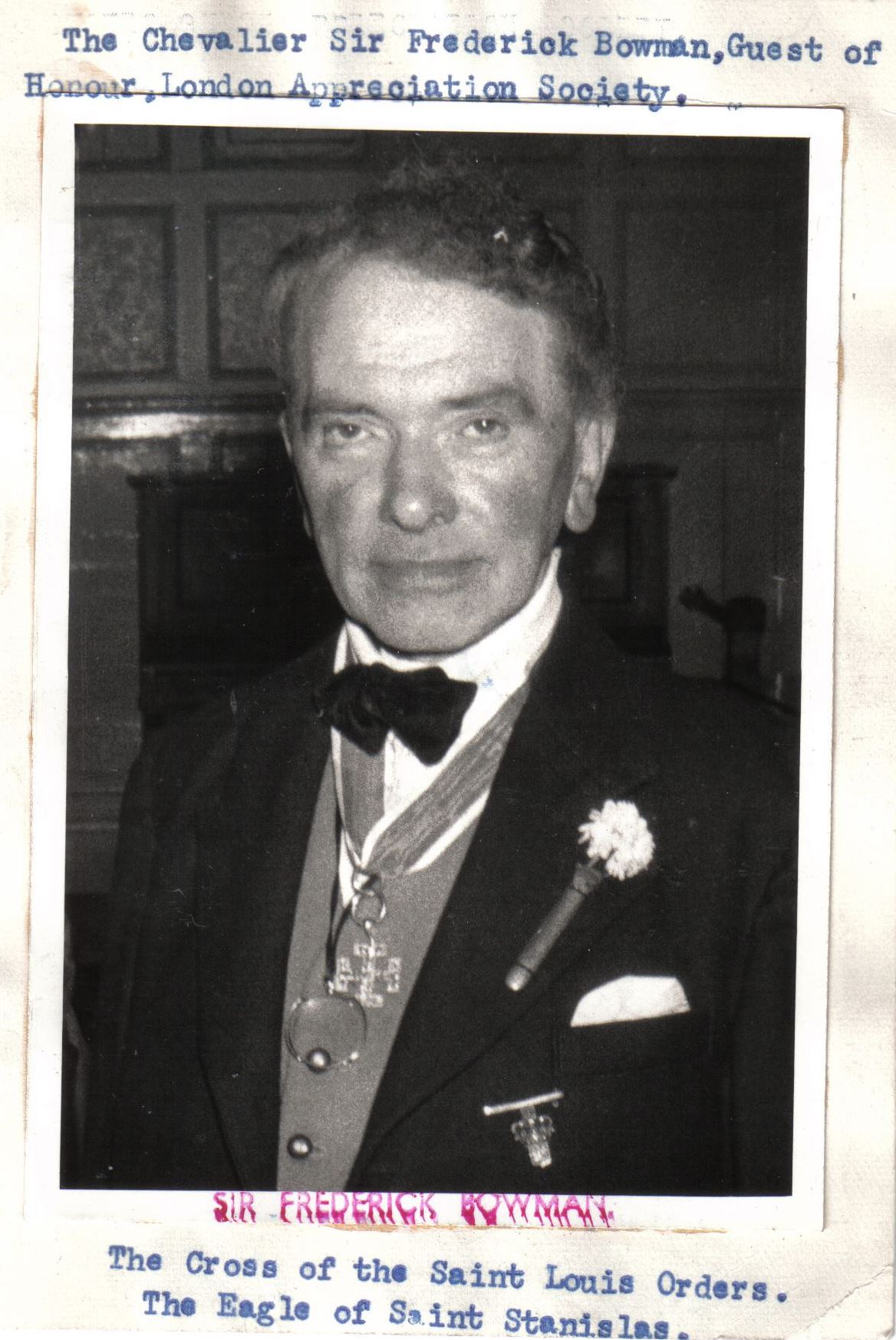
Bowman continued to be interested in phaleristic matters, and particularly their insignia and minutiae of dress, and in due course was introduced to the Order of St Stanislas as well as to the San Luigi Orders. In 1928, he had co-founded the weekly periodical The Liverpool Examiner and Talking Picture News and also at some point published The Theatrical Observer and The Liverpolitan. Most editions of the first of these titles carried a photograph of him, usually taken some twenty years previously. Curiously, they also carried on occasion reproductions of British coins and stamps on which Bowman’s head replaced that of the monarch.
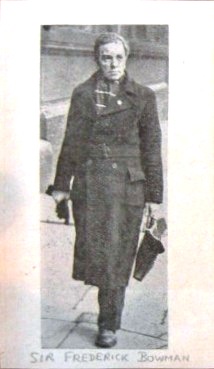 By now, he was dedicated to the great cause of his life, which was animal welfare. As founder-president of the Animal Service Association, his home, “Humanimal House”, became a refuge for innumerable itinerant cats which he fed at his own expense, leading to his acquiring a rather fishy effluvium that made it sensible to keep downwind of him on occasion. One letter details in heroic terms his rescue of a spider from his sink. Other associations included Alma Chetwynd Aid for Strays (Mrs Chetwynd ventured out late at night to feed them, accompanied by Bowman as her protector), M.D.-W. Pigeon Relief, anti-vivisection, and the campaign to end the ill-treatment of transported horses from Ireland. One of his letterheads indicates in no uncertain terms, “No connection with those now running what they call the league against cruel sports. No sympathy about people killed while hunting.”
Alongside this, he worked for the peace movement and for relief for the deaf-blind community. He joined the Guild of St Francis under Mgr. Tull, which had an especial care for animal welfare.
In 1960, he was persuaded to revive his compact version of East Lynne at Liverpool’s Pavilion Theatre; he played the villain, Sir Francis Levison. He authored a number of plays, some of which were professionally performed, and wrote many songs, including a March Song for the Order of the Crown of Thorns which has subsequently been adopted as the Anthem of San Luigi.
His correspondence with Mgr. Tull concerning the San Luigi Orders was voluminous and conducted with great energy and enthusiasm, with typescript at all angles of the page and copious handwritten additions. It is clear that the appointment to the Orders caused him to rediscover the Catholic Faith and to become more attentive in his devotions after many years of indifference. In 1961 he wrote to Mgr. Tull “Your friendship is an inspiration and encouragement in troubled times, and it seems as if you had been spiritually impelled to get in touch with me when you did. I feel it is something for which my gratitude is due to God himself.”
Late in his life, Bowman was in ailing physical and financial health and approaching a Christmas that would have been spent on his own and with few comforts, when he was telephoned by the then Mr (later Bishop) Mervyn Thompson-Butler-Lloyd, a local hotelier, who arranged for him to enjoy a free Christmas dinner at the hotel with taxi service to and from his house. In recognition of this kind gesture, Bowman arranged for Mr Thompson-Butler-Lloyd to be admitted to the Order of the Crown of Thorns, although Bowman had passed away before this honour was conferred.
The obituary published in “Les Chroniques de Chevaliers” read, “Following a short illness, he died in a Liverpool hospital, after a life of kind and useful service to humanity and animals. Devoted to the Orders and the ideals of true chivalry; staunchly celibate, he left no next of kin, but many friends in Liverpool and far beyond. The Grand Prieur will remember him with especial affection as a loyal comrade.”

 The Abbey-Principality of San Luigi
You must be logged in to post a comment.