Christmass 2013

“For unto us a child is born, unto us a son is given: and the government shall be upon his shoulder: and his name shall be called Wonderful, Counsellor, The mighty God, The everlasting Father, The Prince of Peace.” (Isaiah 9:6)

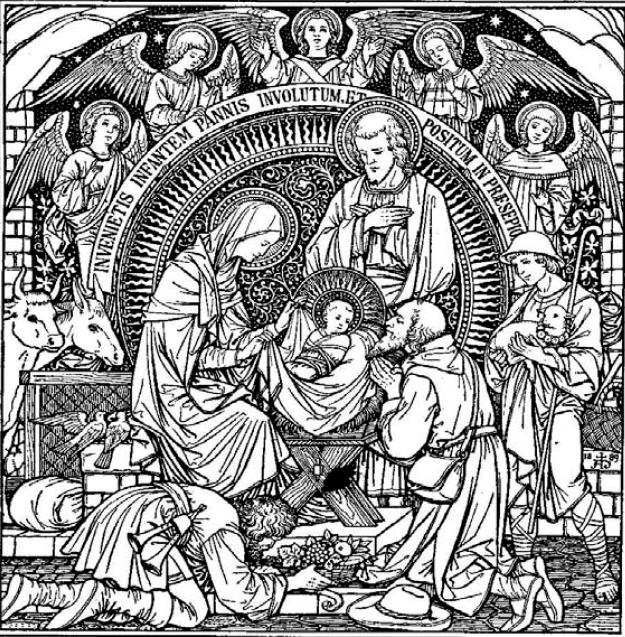
The Abbey-Principality of San Luigi and the San Luigi Orders wish all our members and friends a blessed Christmass and a peaceful New Year.

christmas

Prince-Abbot receives awards

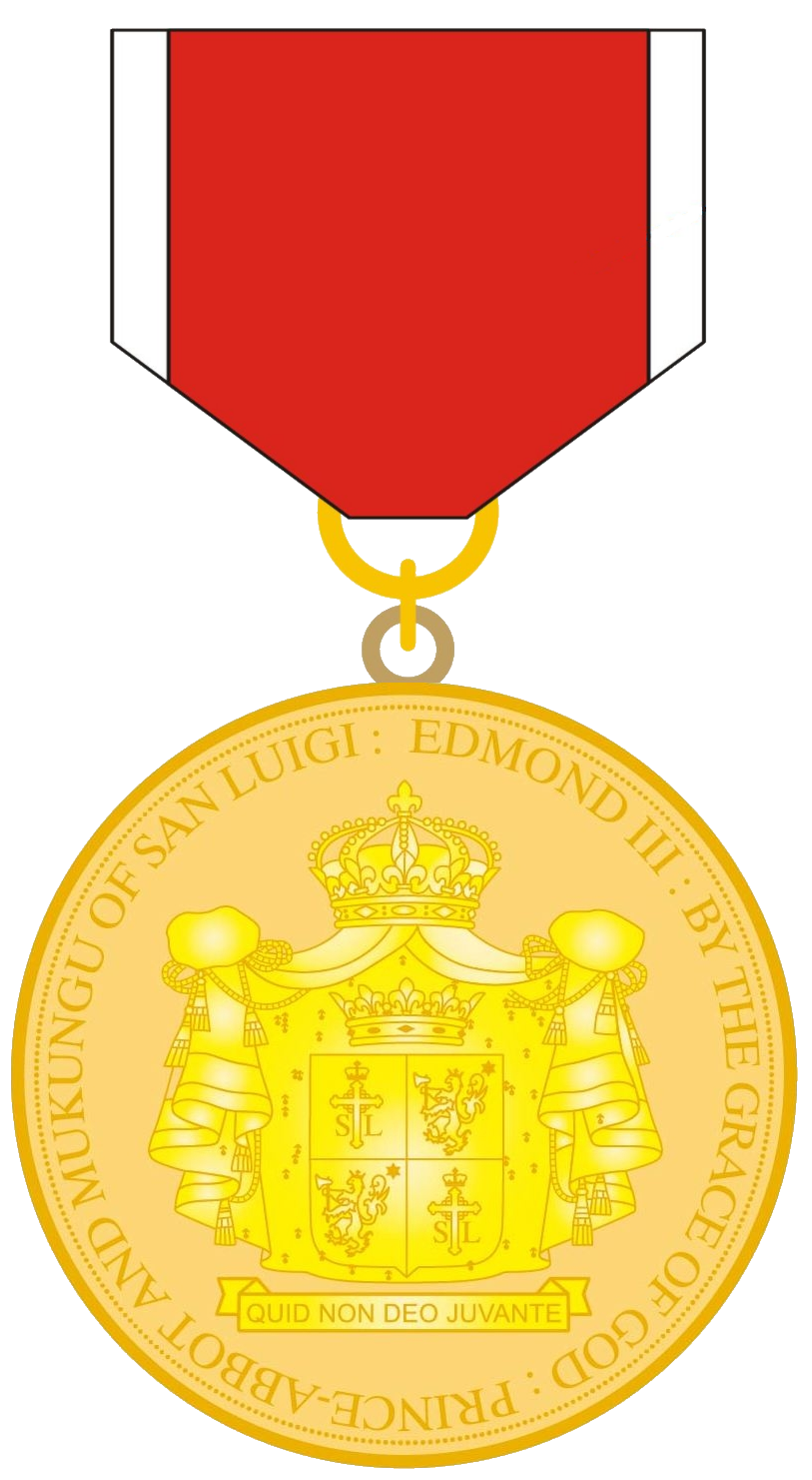
herb-chcThe Prince-Abbot has been honoured by the Polish Collegium Heraldicum Concordiae. The CHC was founded in 2009 to promote traditional and conservative values within society.

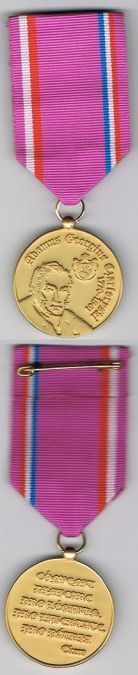
The Medal “Pro Probitas” was instituted in 2010 and is awarded in three classes: gold, silver and bronze. It is awarded to those who have promoted conservative values. The obverse design of the medal depicts Adam Jerzy Czartoryski (1770-1861), while the reverse bears a quotation “CONVENIT DIMICARE PRO LEGIBUS, PRO LIBERTATE, PRO PATRIA” (it is fitting to fight in defense of rights, freedoms and country) taken from “Tusculan Disputations” by Marcus Tullius Cicero. The ribbon depicts the national colours of Poland and of France.

The Prince-Abbot has received the Medal “Pro Probitas” in gold (Class I) which is the highest award of the CHC.

gold medalproprobitasAdditionally, the Prince-Abbot has received the CHC Medal commemorating the hundredth anniversary of the birth of the late Archduke Otto von Hapsburg. The reverse of the medal depicts a quotation from Vergil, “Semper honoris nomenque laudesque manebunt tuum” (Your honour, name and glory will remain forever)

habsburgmedalhabsburga

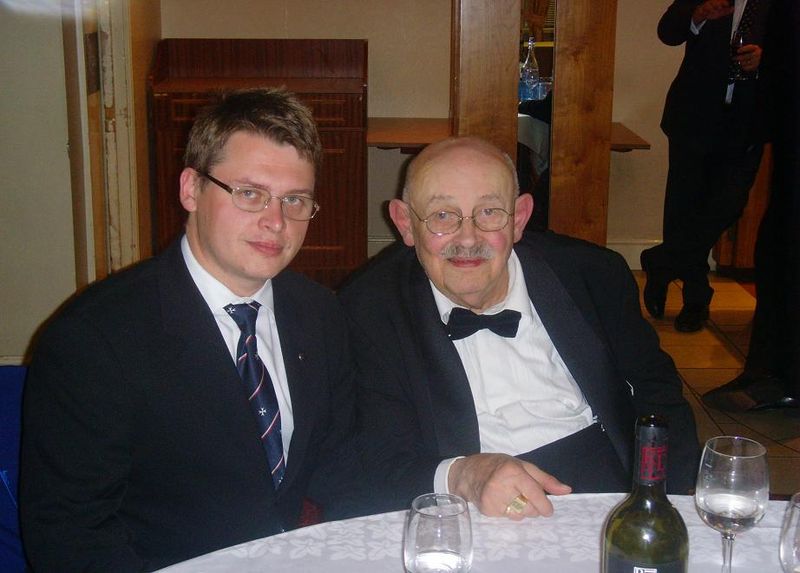
The chairman of the CHC is Dr Norbert Wojtewicz, who is a Knight Officer of the Order of the Crown of Thorns. Dr Wojtewicz, who earned his first two degrees from the Papal Theological Faculty in Wroclaw and his PhD from the University of Wroclaw, is the former Keeper of the Laws of the Association of Polish Monarchists. Among his many chivalric offices, he is Grand Herald and member of the Grand Chapter of the Order of Saint Stanislaus, and is author of the official history of the Order. He is photographed below with the late Prince-Bishop Juliusz Nowina-Sokolnicki, Grand Master of the Order of Saint Stanislaus, who was briefly Assistant Bishop to the Prince-Abbot in his capacity as Archbishop of Great Britain in the Apostolic Episcopal Church.

800px-London_Nov2007_3

Book review by Archbishop Spataro

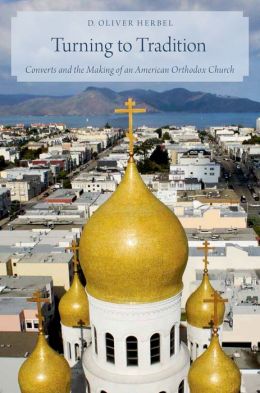
Turning to Tradition; Converts and the Making of an American Orthodoxy. By D. Oliver Herbel. Oxford University Press, 2013.

Reviewed by Francis C. Spataro

This is the story of recent movements in the United States which greatly expanded the Eastern Orthodox Church in America. Russian explorers to Alaska brought their Ancient Faith to North America. However, the men mentioned in this book ignited a light which still glows today.

The first of these is St. Alexis Toth who was a Catholic priest from Austria-Hungary, sent to the USA to work as a missionary among the many thousands of Uniates who had immigrated to this country to seek a better life. He ended up converting them en masse to the Russian Orthodox Church which had been the religion of their ancestors. It is an amazing study in the inability of the local Roman Catholic hierarchy to adjust to Catholics of a different Rite and History. The majority Irish bishops were trying to keep immigrants from the Irish Potato Famine from being lost to the Catholic Church. So they lost thousands of immigrants from Austria-Hungary instead.

Then we have the turning to Orthodoxy of Black Americans who eventually founded the African Orthodox Church here, in the West Indies and Africa. The first Black man ordained a priest was Fr. Raphael Morgan. Then we have Fr. Moses Berry and the Order of St. Moses the Black. Fr. Berry was first attracted to non-canonical Orthodoxy through the Holy Order of MANS and the Brotherhood of Christ the Saviour. Having personally known Metropolitan Pangratios and Bishop Joseph Langdon, I can comment knowingly about this phenomenon. Eventually,both the Order of MANS and the Brotherhood converted to canonical Orthodoxy, joining either the Orthodox Church of America (OCA) or the Antiochian Orthodox Church.

Finally we have the saga of the Evangelical Orthodox Church and Pastor Peter Gillquist. This large group from the Campus Crusades have already documented their journey in Becoming Orthodox: A Journey to the Ancient Christian Faith. Unfortunately the change from Fundamentalist, Evangelical Protestants was too radical an effort. Many “deconverted” after joining the Antiochian Orthodox Church. In some cases ethnic Orthodoxy was not severe enough for these Fundamentalists who wanted to live like the Thebaid Monks of Egypt. Some changed to the OCA while others just went back to being Evangelical Orthodox.

This is a very fascinating book, especially for me who since 1976 through the Vilatte Guild has watched and recorded so many persons in both Independent – Autocephalous and Canonical Orthodoxy. The Bibliography is well done and very complete. I highly recommend this study to all interested in American Orthodoxy.

Launch of the Companionates of the San Luigi Orders

The Abbey-Principality is pleased to announce the launch of the Companionates of the Order of the Crown of Thorns and the Order of the Lion and the Black Cross.

The idea that there should be a rank in the Order of the Crown of Thorns below that of Knight was first planned in 1938, when a draft scheme of membership was presented to Prince-Abbot Edmond I that made provision for Companions. However, the Companionate has had to wait until now to be formally inaugurated.

The Companionate is therefore the introductory rank of membership in the San Luigi Orders, and is available to men and women of good character located anywhere in the world. For Christians of any denomination, membership is as a Companion of the Order of the Crown of Thorns. For members of other faiths or those of no religious belief, membership is as a Companion of the Order of the Lion and the Black Cross. The Companionate offers an opportunity for members of the public who wish to become involved in the work of the San Luigi Orders, since its members are full members of the Orders, and those who show an active commitment to this work will be eligible for promotion to the higher ranks in due course.

Insignia for Companions

Companions are entitled to wear the Companionate Medal of the respective Order. The Companionate Medals are of 40mm diameter finished with gold and worn from the chest ribbon of the respective Order. They bear an image of the insignia of their Order on the obverse, while on the reverse of both medals is depicted the full achievement of arms of the Abbey-Principality of San Luigi.

Click the images below to enlarge them.

DOCT companionate obverse Companion of the Order of the Crown of Thorns (obverse) Medal of a Companion of the Order finished in gold depicting the insignia of the Order on the obverse and the arms of the Abbey-Principality on the reverse. The medal is worn on the chest ribbon of the Order.
CDOLBC companionate obverse Companion of the Order of the Lion and the Black Cross (obverse) Medal of a Companion of the Order finished in gold depicting the insignia of the Order on the obverse and the arms of the Abbey-Principality on the reverse. The medal is worn on the chest ribbon of the Order.
CDOCT companionate reverse Both Companionate Medals (reverse) The reverse of both Companionate Medals depicts the full achievement of arms of the Abbey-Principality of San Luigi.

In informal dress, companions may also wear the lapel badge of San Luigi (depicted at the top left of this page) which is available to purchase separately.

The Order of Piast and the San Luigi Orders

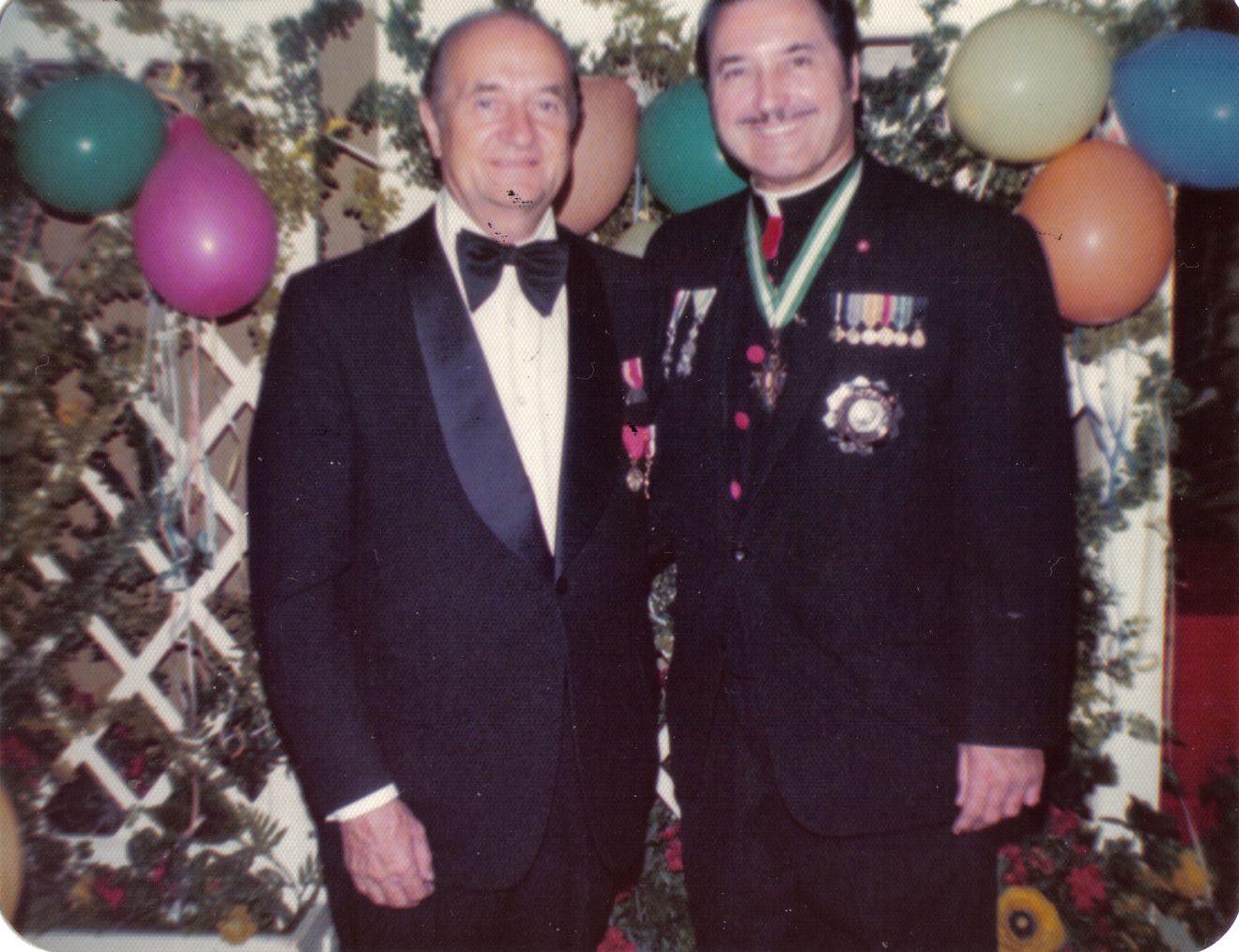
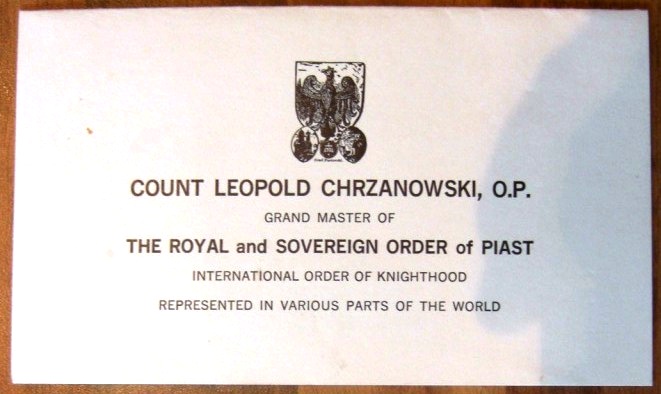
Count Leopold and Archbishop KingThe photograph above shows our former San Luigi Vice-Chancellor for the United States of America, Archbishop Frederick C. King (right) with the late Revd. Count Leopold F. Chrzanowski O.P., Grand Master of the Sovereign and Royal Order of Piast, who was a member of the Order of the Crown of Thorns. The occasion of the photograph was a Beaux Arts Ball in aid of blind children held in 1973 by Countess Patte Barham, publisher and editor of “Society West”. Countess Patte had been a member of both the Order of the Crown of Thorns and the Order of the Lion and the Black Cross since 1959. She had purchased the palatial residence of the former Roman Catholic Archbishops of Los Angeles in 1971, and this became the venue for several San Luigi investitures over the years.

The Order of Piast was founded on 27 January 1927 as “a progressive Order of Chivalry and Merit”. Its stated purpose is “to protect the absolute independence of the Polish Lithuanian States, and the ultimate recovery of the achievements of the Piast Dynasty; through the realization of a project/movement via ‘The Slavic Commonwealth of Nations.” Count Leopold and other Polish-Lithuanian nobles were responsible for the foundation, with Count Leopold serving as Grand Chancellor following the decease of the Revd. Joseph Paul Chodziewicz. At some point the Royal Stewardship of Poland of Boleslaus the Bold was formed along with the Royal Force of Piast; as of 1963 the Commander-in-Chief of this body was General Conrad Strzelczyk Sphinx, who would receive the accolade of a Duke from Prince-Abbot Edmond I of San Luigi.

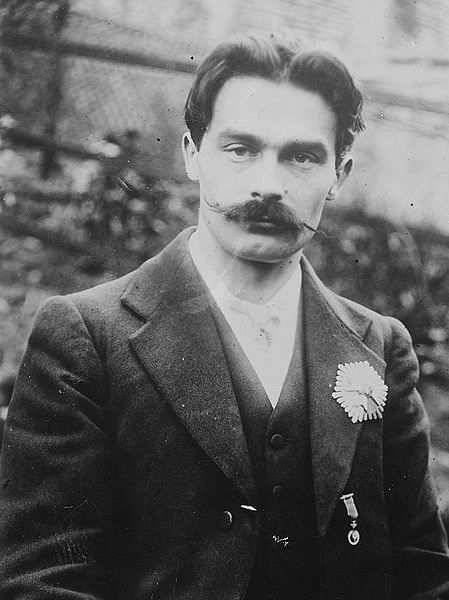
RSPPrince Pawel Piast-RiedelskiThe first Grand Master of the Order was Prince Pawel Salvator Piast-Riedelski (1884-post 1944), who was a claimant to the throne of Poland. Resident at various points in Great Britain and the United States of America, he had received some financial support in his claims from the British Foreign Office. He published several books setting out his cause, and detailing the history of the Piast dynasty and its Order. Under Prince-Abbot Edmond I, Prince Pawel accepted an invitation to become a Patron of the Order of the Crown of Thorns.

After the death of Prince Pawel, the Order of Piast under his successor Count Leopold came under the administration of the Polish Nobility Association. This organization traced its origins to the Polish uprisings of the 1830s, and from the 1960s was headquartered at Villa Anneslie in Maryland, USA. The PNA was charged with the “Stewardship” of the chivalric customs of the Commonwealth of the Kingdom of Poland and the Grand Duchy of Lithuania; and the perpetuation of genealogical and heraldic traditions of the Polish Commonwealth.” It continues to exist today.

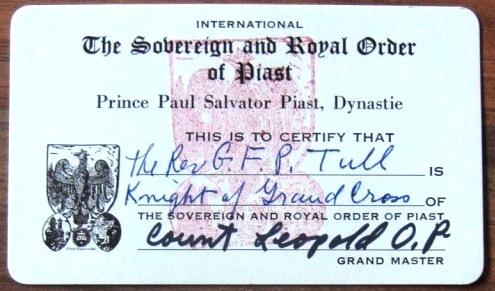
Piast cardCount Leopold also honoured San Luigi’s Vice-Chancellor Canon George Tull with the Grand Cross of the Order of Piast. Mgr. Tull’s membership card in the Order is reproduced below.

Canon Tull Piast

Kabalega Day proposed

Omukama KabalegaA newspaper article details plans to commemorate H.M. Omukama Chwa II Kabalega of Bunyoro with a special Kabalega Day in the Kingdom of Bunyoro-Kitara.

The Abbey-Principality fully endorses and supports this move. H.M. Chwa II Kabalega in 1885 recognized Prince-Abbot José II of San Luigi, honouring him with the additional chiefly title of Mukungu, translated as “Prince-Governor,” and granting territory to the monastic community for the re-establishment of the abbey in Bunyoro-Kitara. He is rightly regarded as a key figure in our history and has been declared a National Hero by the President of Uganda. Omukama Kabalega’s grandson, the present Omukama H.M. Solomon Gafabusa Iguru I, is a Royal Patron of the Order of the Crown of Thorns and the Order of the Lion and the Black Cross.

>>Bunyoro Kingdom moves to honour Kabalega

Anniversary of the Abbe Julio

Jules-Ernest Houssaye (1844-1912) was known as the Abbé Julio and was a French Gallican bishop known for his writings on esoteric matters.

He was admitted a member of the Order of the Crown of Thorns by Prince-Abbot Joseph III in 1893 and served as Prelate-Commander and its representative in France (later Switzerland) until his death, maintaining a Secretariat at 21 Croix-des-Petits-Champs, Paris. He was formally invested by Prince-Abbot Joseph III in 1898 at 5, Rue Vernier, Paris. His episcopal arms bear a suspension of the jewel of the Order and a photograph of his office shows his commander’s collar together with the sword of his commandery.

He was ordained priest in the Roman Catholic Church on 16 March 1867 by Casimir Wicart, Bishop of Laval, and in 1870 was vicar of Grand Oisseau. At the outbreak of the Franco-Prussian War he volunteered and became a military chaplain. He was acclaimed as a national hero after on a single day rescuing ten wounded soldiers under enemy fire; that same night he led twenty soldiers who had become lost through the forest. After the war he became vicar of Juvigné, but his health broke down as a result of his war service and he was admitted to a military hospital.

He returned as vicar of St Joseph in Paris, where his social and religious views, although popular with his laity, aroused the ire of Cardinal Richard, his ultramontane ordinary, who caused Houssaye to be deposed in 1885.
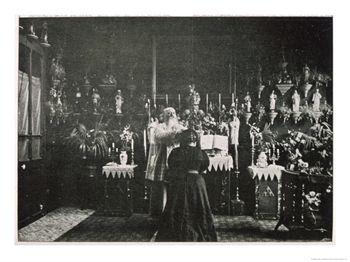
From this time, Houssaye turned to writing and teaching, issuing periodicals and promoting a Gallican and democratic viewpoint in church affairs. A chance meeting at that time with noted healer Jean Sempé led to an interest in Divine Healing, and Houssaye subsequently made a long study of this subject as well as gaining a reputation as a practitioner. His wide interests embraced much esoteric philosophy including studies in Gnosticism and Martinism, and he was a particular advocate of the use of pentacles. Nevertheless he maintained a strict orthodoxy of belief and worship. During 1901, he met Prince-Abbot Joseph III, and in 1904 founded the Liberal Catholic Church of France, for which he was consecrated by Paulo Miraglia Gulotti (a bishop consecrated by Prince-Abbot Joseph III) on 4 December 1904. Between 1908 and 1912 he served as Primate of the Eglise Catholique Gallicane. His successor was Mgr. Louis-Marie-François Giraud (1876-1951). His relics are preserved in a small chapel in Haute-Savoie.

His books (some published under the pseudonym Benoît Gogo) include: Gorin et Cie, Société d’exploiteurs, Bruxelles 1886; L’Archevêque de Paris et les dames Carreau, Paris 1887; Passibonqueça, histoire véridique et peu surprenante d’un curé de Paris, manuscrit de l’abbé Le Gallo, Paris 1888; Un forçat du bagne clérical, Paris 1888. He was editor of L’Étincelle religieuse libérale, organe de l’Union des Églises and La Tribune populaire, organe de la démocratie religieuse et de la défence du clergé.

>>Page from the Mission Gallicane d’Alsace